
Ultraviolet Disinfection Equipment Market Growth, Demand & Size by 2034
Coverage: By Component (UV Lamps, Reactor Chambers, Quartz Sleeves, Control Units, Others); Power Rating (Low, Medium, High); Application (Water and Wastewater Disinfection, Process Water Disinfection, Air Disinfection, Surface Disinfection); End User (Residential, Commercial, Industrial) , and Geography (North America, Europe, Asia Pacific, and South and Central America)
- Status : Data Released
- Report Code : TIPRE00029381
- Category : Electronics and Semiconductor
- No. of Pages : 150
- Available Report Formats :


- Last update date : September 21, 2026


2025 Market Size
US$ 3.97 Bn
Base year value
2034 Forecast
US$ 13.9 Bn
Projected by 2034
CAGR 2026-2034
14.95 %
Growth rate
Addressable Market
US$ 76.44 Bn
(2026-2034)
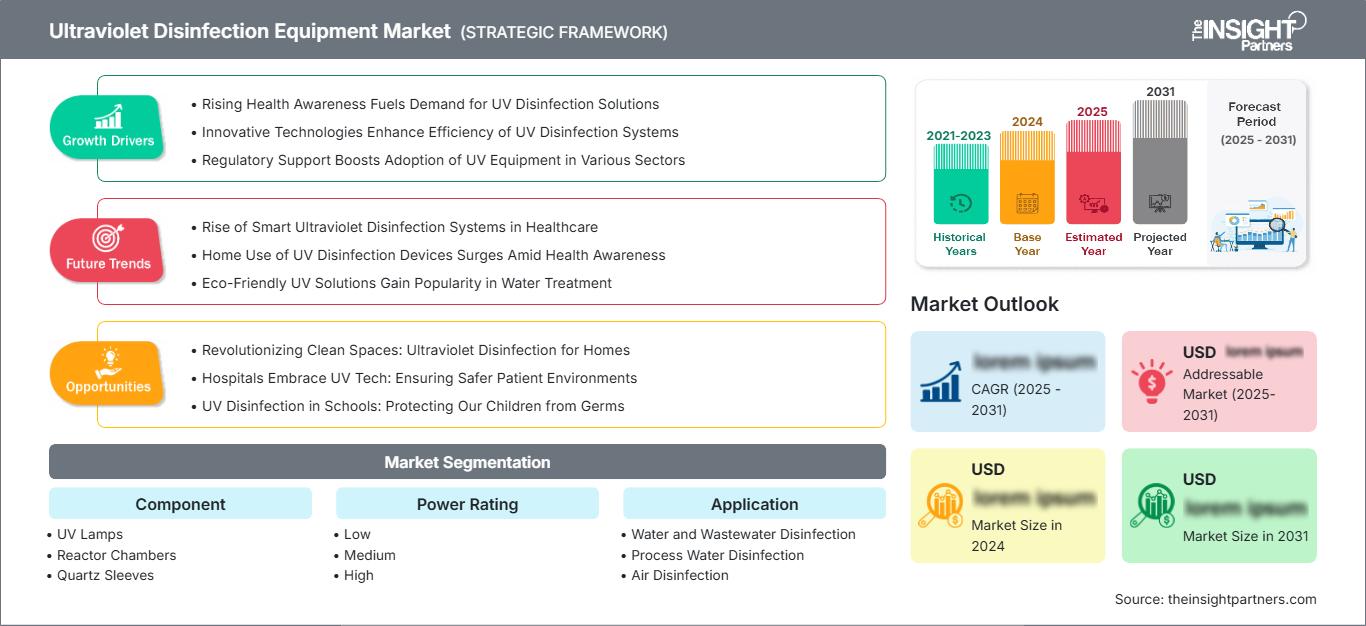
The ultraviolet disinfection equipment market is projected to grow from US$ 3.97 Billion in 2025 to US$ 13.9 Billion by 2034, registering a CAGR of 14.95% during 2026–2034. Demand is increasing as utilities, industrial users, healthcare facilities, commercial buildings, and residential water users adopt chemical-free disinfection systems that reduce microbial risk without introducing disinfection byproducts.
North America remains a major adoption center, supported by large municipal treatment upgrades, high awareness of waterborne pathogens, and automated compliance monitoring. The ultraviolet disinfection equipment market size in the region is supported by water infrastructure renewal, industrial process water reuse, healthcare air-quality initiatives, and continued replacement of chlorine-intensive treatment methods.
Ultraviolet Disinfection Equipment Market Assessment and Insights
- North America: The region accounted for an estimated 31–34% share in 2025 and is expected to grow at a CAGR of 13.8–14.6% during 2026–2034, driven by municipal water upgrades and stricter microbial control.
- U.S.: The U.S. represented 78–82% of North America in 2025 and is projected to grow at 14.0–14.8% CAGR as utilities modernize disinfection assets.
- Europe: Europe held an estimated 24–27% share in 2025 and is forecast to expand at 13.2–14.0% CAGR, led by Germany, the UK, France, Italy, and Spain.
- Asia Pacific: Asia Pacific captured 28–31% share in 2025 and is expected to grow at 15.8–16.8% CAGR, supported by China, India, Japan, South Korea, and Australia.
- Largest Segment: Water and wastewater disinfection held 68–72% market share in 2025, with a 14.3–15.1% CAGR, reflecting municipal and industrial wastewater demand.
- High Growth Segment: UV lamps held 32–35% share in 2025 and are expected to grow at 15.4–16.4% CAGR due to replacement cycles and UV-C LED migration.
- Key companies analyzed in detail: Advanced UV, Inc.; American Ultraviolet; Atlantic Ultraviolet Corporation; Atlantium Technologies Ltd.; Evoqua Water Technologies LLC; Halma plc; Dr. Hönle AG; Kuraray Co., Ltd.; Trojan Technologies; Xylem Inc.
Source: The Insight Partners' analysis based on proprietary research, government publications, company annual reports, investor presentations, industry databases, and expert interviews.
Technology evolution is reshaping the ultraviolet disinfection equipment market through a shift from conventional mercury lamps toward energy-efficient UV-C LEDs, intelligent controllers, remote monitoring, and modular reactor designs. The production process itself is undergoing transformation due to suppliers’ focus on lamp longevity, quartz jacket resistance, compact design of chamber technology, and dosage validation using sensors. This trend will allow the consumer to cut lifecycle costs while coping with increasing demands for inactivation of microorganisms.
The future demand for such products will become stronger in regions where there is pressure caused by water shortage, increased urbanization, industrialization, and recycling initiatives for water. Capital will be attracted to technologies based on decentralization of purification facilities, intelligent municipal solutions, and validation of UV treatment systems.
Ultraviolet Disinfection Equipment Market Report Scope
| Report Attribute | Details |
|---|---|
| Market size in 2025 | US$ 3.97 Billion |
| Market Size by 2034 | US$ 13.9 Billion |
| Global CAGR (2026 - 2034) | 14.95% |
| Historical Data | 2021-2024 |
| Forecast period | 2026-2034 |
Ultraviolet Disinfection Equipment Market Analysis
Ultraviolet disinfection equipment market growth is driven by utilities and industrial operators seeking reliable microbial control without chemical residuals. Water shortages are forcing the use of reclaimed water, whereas the food, beverage, pharmaceutical, and electronics industries require a consistent quality of process water. The drivers are the need to replace old chlorination systems, increasing worries regarding resistant pathogens to chlorine, and the need for automatic dosing monitoring.
The value chain comprises manufacturers of lamps, suppliers of reactors, quartz sleeves, control units, designers, engineering contractors, and service companies. The supply dynamics are affected by the availability of electronics, lamps, stainless steel manufacturing capabilities, and certification requirements. Increasingly, buyers look at the total cost of ownership instead of just capital cost, particularly for large municipal equipment.
Ultraviolet disinfection equipment market analysis shows a competitive landscape shaped by water technology leaders and specialist UV engineering firms. Xylem Inc., Trojan Technologies, Halma plc, Atlantium Technologies Ltd., Atlantic Ultraviolet Corporation, American Ultraviolet, and Advanced UV, Inc. compete on dose validation, energy efficiency, ease of maintenance, and applications across the municipal, industrial, commercial, and residential segments.
Strategic positioning trends are towards integrated treatment platforms, remote monitoring, and service based on results. Evoqua Water Technologies LLC adds to the water expertise of Xylem, while Dr. Hönle AG and Kuraray Co., Ltd. help with specialized industrial and materials expertise. Manufacturers who combine the performance of disinfection treatment with energy savings and after-sales service will probably be successful.
● REPORT CUSTOMIZATION
Tailor This Report To Align With Your Specific Business Requirements
This report can be customized to align precisely with your business objectives, scope, and target markets. Customization options include tailored segmentation, geography, competitive analysis, and strategic insights to support informed decision-making.
Customize This Report →WHAT YOU CAN ADJUST
- ● Segmentations
- ● Geography
- ● Competitive Analysis
- ● Language Preferences
Ultraviolet Disinfection Equipment Market: Strategic Insights
Regional Insights
North America Ultraviolet Disinfection Equipment Market
North America held 31–34% ultraviolet disinfection equipment market share in 2025 and is projected to grow at 13.8–14.6% CAGR during 2026–2034. Municipal wastewater treatment, drinking water safety, industrial reuse, and healthcare air disinfection remain principal drivers. The region benefits from a large installed treatment infrastructure and a high willingness to invest in automation.
Utilities are prioritizing validated UV dose delivery, remote monitoring, and energy-efficient lamps to reduce lifecycle cost. Industrial customers in food processing, pharmaceuticals, and electronics also favor UV systems for process water reliability. Demand is expected to remain resilient as aging treatment assets are upgraded.
U.S. Ultraviolet Disinfection Equipment Market
The U.S. represented 78–82% of North America in 2025 and is expected to expand at 14.0–14.8% CAGR. Adoption is facilitated by infrastructure financing in municipalities, reuse of water, and increased emphasis on disinfection efficiency. Presence of players is marked among Xylem Inc., Trojan Technologies, Atlantic Ultraviolet Corporation, American Ultraviolet, and Advanced UV, Inc.
Uses are expanding beyond water and wastewater applications into HVAC air disinfection, health care surfaces disinfection, and commercial applications. Market dynamics are positive due to well-established engineering, high equipment replacement needs, and automation preference.
Europe Ultraviolet Disinfection Equipment Market
Europe accounted for 24–27% share in 2025 and is projected to grow at 13.2–14.0% CAGR. Germany takes the lead owing to its sophisticated industrial water requirements, stringent discharge standards, and engineering expertise. The UK is experiencing consistent uptake in municipal wastewater treatment and commercial building air purification.
France, Italy, and Spain are adopting UV technologies through their increased usage in water recycling, food processing, and tourism purposes. European buyers place high emphasis on certified efficacy, energy savings, and reducing mercury. This creates room for LED technologies and digital reactor platforms.
APAC Ultraviolet Disinfection Equipment Market
APAC held 28–31% share in 2025 and is forecast to grow at 15.8–16.8% CAGR. China drives regional demand via its urban water treatment and industrial recycling efforts. Japan and South Korea drive regional demand through high-quality UV installation in electronics manufacturing, pharmaceuticals and commercial operations.
India and Australia drive regional demand via urban sanitation initiatives, decentralized treatment and industrial treatment. The faster APAC growth is attributable to increased budgets for infrastructure spending, water stress reduction and improved drinking water standards.
Middle East & Africa Ultraviolet Disinfection Equipment Market
The Middle East & Africa is expected to grow at 12.6–13.6% CAGR during 2026–2034. The top drivers in Saudi Arabia and the UAE include water systems due to desalination, smart city initiatives, and industrial reuse of water. UV systems have become a choice when it comes to polishing, safety of distribution, and commercial applications.
The Rest of MEA and South Africa represent selective opportunities related to municipal improvement, mining water management, and decentralized treatment. The use of such systems depends on finance, maintenance, and energy, which makes small-sized and supported UV systems appealing.
Segmentation Analysis
Component
Component demand is expected to grow at 14.6–15.6% CAGR during 2026–2034. The ultraviolet disinfection equipment market scope across components is shaped by recurring lamp replacement, reactor durability, sleeve maintenance, and smarter control units. Buyers increasingly specify components that improve dose reliability, reduce downtime, and support digital performance tracking.
- UV Lamps: UV lamps remain the highest-value component category due to replacement cycles, dose performance requirements, and migration toward efficient UV-C LED solutions in compact and specialized systems.
- Reactor Chambers: Reactor chambers are strategically important because system efficiency depends on flow design, stainless-steel durability, UV exposure uniformity, and compatibility with municipal and industrial water volumes.
- Quartz Sleeves: Quartz sleeves protect lamps while transmitting UV energy, making them critical for dose consistency, maintenance planning, and operations in facilities with variable water quality.
- Control Units: Control units are gaining importance as operators demand dose monitoring, alarms, remote diagnostics, energy optimization, and integration with plant-level automation systems.
Power Rating
Power Rating segmentation is projected to grow at 14.1–15.0% CAGR, according to the Ultraviolet Disinfection Equipment market report. Low-, medium-, and high-power systems serve different flow rates and risk profiles. Selection depends on pathogen targets, water transmittance, contact time, operating cost, and whether the installation serves residential, commercial, industrial, or municipal infrastructure.
- Low: Low-power systems are favored in residential and point-of-use applications where compact design, low energy consumption, and simplified maintenance influence purchase decisions.
- Medium: Medium-power systems serve commercial buildings, small utilities, and industrial process lines that require reliable microbial control with moderate flow capacity.
- High: High-power systems support municipal plants, large industrial facilities, and high-volume wastewater operations where validated dose delivery and system redundancy are essential.
Application
Application demand is expected to grow at 14.8–15.7% CAGR. Water and wastewater disinfection remains the anchor application, but process water, air, and surface disinfection are strengthening. The segment benefits from cross-industry pressure to reduce pathogens, minimize chemicals, and demonstrate measurable hygiene performance.
- Water and Wastewater Disinfection: This application dominates because utilities and industries need pathogen control, regulatory compliance, and safer effluent reuse without creating harmful chemical byproducts.
- Process Water Disinfection: Process water disinfection is important in food, beverage, pharmaceutical, electronics, and power applications where water quality affects product consistency and operating reliability.
- Air Disinfection: Air disinfection adoption is rising in healthcare, commercial buildings, and transit environments where HVAC-integrated UV helps reduce airborne microbial load.
- Surface Disinfection: Surface disinfection supports healthcare, laboratories, food processing, and cleanroom settings where non-contact microbial control improves routine hygiene practices.
End User
End-user demand is forecast to grow at 14.3–15.2% CAGR. Industrial users lead high-value adoption, while commercial and residential customers expand demand for compact systems. End-user selection is influenced by water-quality risk, operating budget, maintenance capability, and the need for chemical-free disinfection.
- Residential: Residential users adopt compact UV systems for point-of-entry and point-of-use water safety, especially where groundwater quality and microbial contamination risks remain concerns.
- Commercial: Commercial facilities use UV for water, air, and surface applications in offices, hotels, hospitals, schools, and foodservice environments requiring visible hygiene assurance.
- Industrial: Industrial users rely on UV disinfection for process water control, wastewater reuse, biosecurity, equipment protection, and compliance across food, pharma, electronics, and energy facilities.
Opportunity Snapshot
| Application | Revenue Contribution | Trend Tag | Adoption Stage |
| Water and Wastewater Disinfection | High | Reuse Compliance | Mature |
| Process Water Disinfection | Medium | Purity Control | Scaling |
| Air Disinfection | Medium | HVAC Hygiene | Scaling |
| Surface Disinfection | Low | Cleanroom Safety | Emerging |
Ultraviolet Disinfection Equipment Market Growth Drivers and Impact Analysis
Rising Need for Chemical-Free Water Treatment
UV systems are being considered more and more by utilities and industries because they do not involve any residuals, such as chlorine, ozone, and associated chemical taste and odor problems in their processes. This aspect becomes critical in applications like drinking water, wastewater recycling, food processing, pharmaceuticals, and electronics manufacturing, which need protection from such residual chemistry because it can pose safety problems or impact the quality of the products.
Infrastructure Upgrades in Municipal and Industrial Facilities
Water and wastewater infrastructure aging is driving the demand for disinfection systems proven to perform. While municipalities have disinfection needs, industry clients have their own, requiring high-quality process water and minimal downtime. The UV technology will be favored by its modularity, automation and the ability to integrate both with the new construction and the retrofit projects. This will also include capital spending on big reactors and lamps with high wattage and remote control options.
Expansion of Healthcare and Indoor Air Quality Applications
UV products are being used in hospitals, laboratories, offices, educational institutions, and transport centers in addition to regular cleaning and filtration methods. Air sterilization using HVAC systems, along with surface disinfection, provides an effective way for facilities to enhance microbial control in crowded spaces. Despite the fact that water still accounts for the biggest application area, indoor air quality is contributing to additional demand in the market for compact UV modules and related services.
Ultraviolet Disinfection Equipment Market Future Trends
Shift Toward UV-C LEDs and Smart Reactor Controls
Ultraviolet disinfection equipment market trends point to broader adoption of UV-C LEDs, intelligent controllers, and sensor-led performance validation. LED systems offer compact design, instant on-off operation, lower mercury dependence, and design flexibility for small-volume applications. Smart controls will improve dose accuracy, maintenance planning, and energy optimization. As LED efficiency improves, suppliers will target residential, commercial, air, and process water applications first, while high-flow municipal markets continue using optimized lamp-based reactors.
Integration with Water Reuse and Advanced Oxidation Platforms
Systems in the future will incorporate UV disinfection with filtration, membranes, and oxidation to handle issues like pathogens, contaminants, and water reuse demands. Customers from industries and municipalities will require a system that incorporates all these features instead of just one unit. This leaves an opportunity for suppliers to provide solutions that can be application-specific, monitored digitally, and serviced through contracts. This trend is going to be more pronounced in water-stressed environments where water reuse has to satisfy higher standards.
Ultraviolet Disinfection Equipment Market Opportunities
Decentralized Treatment for Water-Stressed Communities
Ultraviolet disinfection equipment market forecasts indicate strong potential in decentralized water and wastewater systems for small municipalities, remote communities, commercial campuses, and industrial sites. Compact units of UV technology can be installed much more quickly than large-scale infrastructure and can aid in local reuse, groundwater treatment, and ensuring water safety in emergencies. Manufacturers who provide modular units, easy maintenance, and low-cost monitoring technology can tap into this market opportunity. This particular opportunity holds more relevance in the Asia Pacific, the Middle East, Africa, and rural parts of North America.
Industrial Process Water Quality as a Premium Segment
Industrial clients offer a lucrative business potential since UV systems help to maintain the quality of manufacturing, operational efficiency, and compliance results. The food and beverages industries need a process that will allow microbial control without having any chemicals left, whereas the pharmaceutical and electronics sectors are in need of pure water. The energy, mining, and chemical sectors are using UV systems as well. Companies may differentiate themselves through industry-specific validation, membrane integration, predictive maintenance, and service agreements.
Frequently Asked Questions

- Comprehensive Market Sizing and Forecast Analysis
- Detailed Segmentation Analysis
- In-Depth Market Dynamics Assessment
- Regional and Country-Level Insights
- Competitive Landscape and Company Benchmarking
- Strategic Business Intelligence
Recent Reports
Testimonials

The Insight Partners' SCADA System Market report is comprehensive, with valuable insights on current trends and future forecasts. The team was highly professional, responsive, and supportive throughout. We are very satisfied and highly recommend their services.
RAN KEDEM Partner, Reali Technologies LTDs
I requested a report on a very specific software market and the team produced the report in a few days. The information was very relevant and well presented. I then requested some changes and additions to the report. The team was again very responsive and I got the final report in less than a week.
JEAN-HERVE JENN Chairman, Future Analytica
We worked with The Insight Partners for an important market study and forecast. They gave us clear insights into opportunities and risks, which helped shape our plans. Their research was easy to use and based on solid data. It helped us make smart, confident decisions. We highly recommend them.
PIYUSH NAGPAL Sr. Vice President, High Beam Global
The Insight Partners delivered insightful, well-structured market research with strong domain expertise. Their team was professional and responsive throughout. The user-friendly website made accessing industry reports seamless. We highly recommend them for reliable, high-quality research services
YUKIHIKO ADACHI CEO, Deep Blue, LLC.
This is the first time I have purchased a market report from The Insight Partners.While I was unsure at first, I visited their web site and felt more comfortable to take the risk and purchase a market report.I am completely satisfied with the quality of the report and customer service. I had several questions and comments with the initial report, but after a couple of dialogs over email with their analyst I believe I have a report that I can use as input to our strategic planning process.Thank you so much for taking the extra time and making this a positive experience.I will definitely recommend your service to others and you will be my first call when we need further market data.
JOHN SUZUKI President and Chief Executive Officer, Board Director, BK Technologies
I wish to appreciate your support and the professionalism you displayed in the course of attending to my request for information regarding to infectious disease IVD market in Nigeria. I appreciate your patience, your guidance, and the fact that you were willing to offer a discount, which eventually made it possible for us to close a deal. I look forward to engaging The Insight Partners in the future, all thanks to the impression you have created in me as a result of this first encounter.
DR CHIJIOKE ONYIA MANAGING DIRECTOR, PineCrest Healthcare Ltd.Reason to Buy
- Informed Decision-Making
- Understanding Market Dynamics
- Competitive Analysis
- Identifying Emerging Markets
- Customer Insights
- Market Forecasts
- Risk Mitigation
- Boosting Operational Efficiency
- Strategic Planning
- Investment Justification
- Tracking Industry Innovations
- Aligning with Regulatory Trends





 Get Free Sample for