
Underfloor Air Distribution Systems Market Share, Demand & Growth by 2034
Coverage: By Component (Underfloor Air Supply Plenums, Diffuser, Electronic control unit, Underfloor fan terminals); Application (Offices, Commercial Spaces, Data Centers, Community Halls and other public gatherings, Exhibitions and Temporary Constructions, Others) , and Geography (North America, Europe, Asia Pacific, and South and Central America)
- Status : Data Released
- Report Code : TIPRE00009151
- Category : Electronics and Semiconductor
- No. of Pages : 150
- Available Report Formats :


- Last update date : September 18, 2026


2025 Market Size
US$ 292.77 Mn
Base year value
2034 Forecast
US$ 465.87 Mn
Projected by 2034
CAGR 2026-2034
5.30 %
Growth rate
Addressable Market
US$ 3,441.64 Mn
(2026-2034)
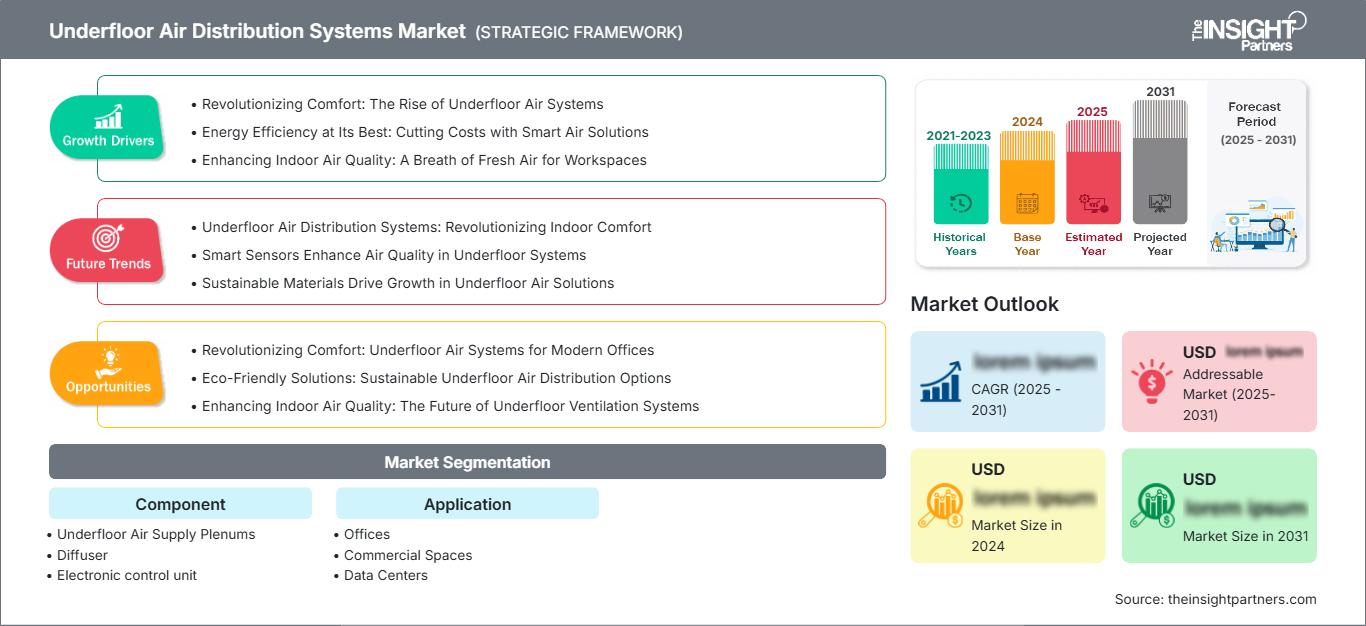
The underfloor air distribution systems market is projected to grow from US$ 292.77 million in 2025 to US$ 465.87 million by 2034, registering a CAGR of 5.30% during 2026–2034. Adoption is being shaped by the shift toward energy-efficient commercial HVAC architecture, raised-floor flexibility, occupant-level air delivery, and the increasing use of modular interiors across offices, data centers, community halls, exhibitions, and temporary construction environments.
North America remains a major demand center as commercial retrofits, premium office redesigns, and data center cooling upgrades support the underfloor air distribution systems market size expansion. Regional adoption is expected to advance at a mid-single-digit CAGR during 2026–2034, supported by green building specifications, indoor air quality priorities, and the growing use of flexible floor layouts in corporate and institutional facilities.
Underfloor Air Distribution Systems Market Assessment and Insights
- North America held an estimated 31–34% share in 2025 and is expected to grow at a CAGR of 5.1–5.6% during 2026–2034, supported by retrofit projects, flexible office design, and demand for low-pressure air delivery.
- US accounted for 72–76% of North America in 2025 and is projected to grow at a CAGR of 5.2–5.7% during 2026–2034, driven by offices and data centers.
- Europe represented 27–30% share in 2025 and is forecast to grow at a CAGR of 4.8–5.3% during 2026–2034, with Germany, the UK, and France leading demand.
- Asia Pacific held 24–27% share in 2025 and is expected to grow at a CAGR of 5.8–6.4% during 2026–2034, led by China, Japan, India, South Korea, and Australia.
- Largest Segment: Offices held 38–42% market share in 2025 and are projected to grow at a CAGR of 4.9–5.4% during 2026–2034 due to flexible workplace planning.
- High Growth Segment: Data Centers held 16–19% market share in 2025 and are expected to grow at a CAGR of 6.2–6.8% during 2026–2034 as thermal management requirements intensify.
- Key companies analyzed in detail: Advanced Ergonomic Technologies Ltd, Air System Components, Inc., AirFixture, LLC, Carrier Global Corporation, DuctSox Corporation, Johnson Controls International plc, Kingspan Group plc, Longden, Price Industries Limited, and TROX USA, Inc.
Source: The Insight Partners' analysis based on proprietary research, government publications, company annual reports, investor presentations, industry databases, and expert interviews.
Present-day market dynamics point towards a transition from standard overhead air distribution to conditioned air solutions, which help with thermal stratification, reduction of pressure on fans and ease of interior modification. The market growth curve is directly correlated with the development of raised access flooring, diffusers, plenums, commissioning process and automation of zone-level controls through building automation systems.
Future-oriented adoption should become more prominent in buildings where running expenses, occupant comfort and interior flexibility play an important role in HVAC decisions. Growth trends can be seen in the Asia Pacific and Middle Eastern regions, where growing demand for commercial real estate, implementation of smart building projects and investment in data centers increase the need for systems with low ductwork reliance and scalability controls.
Underfloor Air Distribution Systems Market Report Scope
| Report Attribute | Details |
|---|---|
| Market size in 2025 | US$ 292.77 Million |
| Market Size by 2034 | US$ 465.87 Million |
| Global CAGR (2026 - 2034) | 5.30% |
| Historical Data | 2021-2024 |
| Forecast period | 2026-2034 |
Underfloor Air Distribution Systems Market Analysis
The underfloor air distribution systems market growth is supported by demand for HVAC configurations that deliver conditioned air closer to occupants while allowing warmer air and contaminants to rise toward return pathways. It is consistent with modern office planning, where turnover ratios and workstations that need to be modified need flexible air terminals in place of ceiling ductwork that cannot be changed.
The supply dynamics are contingent upon synchronized manufacturing of plenums, diffusers, fan terminals, electronic control devices, and raised floor equipment. The installation accuracy, leakage prevention, positioning of the diffusers, and commissioning are key elements that affect system performance, which means that vendors with engineering capabilities and retrofit experience enjoy an advantage.
The market analysis indicates that the competitive landscape is relatively concentrated, with HVAC manufacturers competing against manufacturers of UFAD systems and components and raised floors. Some of the key players such as Johnson Controls International plc, Carrier Global Corporation, Price Industries Limited, TROX USA, Inc., and AirFixture, LLC are positioned in comfort and commercial HVAC markets.
Investments are being directed towards the adoption of smart diffusers, reduced profile plenums, fan terminals along the perimeter, and control systems that enhance balancing and occupant comfort. Companies such as Kingspan Group plc, DuctSox Corporation, Air System Components, Inc., Longden, and Advanced Ergonomic Technologies Ltd have come on board with solutions for offices, exhibitions, and construction sites.
● REPORT CUSTOMIZATION
Tailor This Report To Align With Your Specific Business Requirements
This report can be customized to align precisely with your business objectives, scope, and target markets. Customization options include tailored segmentation, geography, competitive analysis, and strategic insights to support informed decision-making.
Customize This Report →WHAT YOU CAN ADJUST
- ● Segmentations
- ● Geography
- ● Competitive Analysis
- ● Language Preferences
Underfloor Air Distribution Systems Market: Strategic Insights
Regional Insights
North America underfloor air distribution systems market
North America accounted for an estimated 31–34% underfloor air distribution systems market share in 2025. Demand is concentrated in the US and Canada, where premium office retrofits, institutional buildings, and high-density digital infrastructure require better thermal comfort and layout adaptability. Regional CAGR is estimated at 5.1–5.6% during 2026–2034.
Adoption is supported by sustainable building certifications, energy code compliance, and corporate real estate strategies that value low-pressure air movement and workstation-level flexibility. Data center operators are also evaluating underfloor air delivery, where raised floors, aisle management, and heat removal strategies can be integrated with facility cooling design.
U.S. underfloor air distribution systems Market
The US represented 72–76% of North America in 2025 and is expected to post a 5.2–5.7% CAGR during 2026–2034. Demand is strongest in offices, control rooms, technology campuses, and data centers, where diffuser relocation and individualized airflow control improve facility adaptability.
Company presence from Johnson Controls International plc, Carrier Global Corporation, AirFixture, LLC, Price Industries Limited, and TROX USA, Inc. reinforces market maturity. Facility owners increasingly compare UFAD against overhead ducting on lifecycle cost, indoor air quality, reconfiguration speed, and energy performance in large floorplate buildings.
Europe underfloor air distribution systems Market
Europe held an estimated 27–30% share in 2025 and is forecast to expand at a CAGR of 4.8–5.3% during 2026–2034. Germany leads demand through energy-efficient commercial buildings, while the UK benefits from office retrofit activity and France shows steady adoption in institutional and mixed-use projects.
Italy and Spain are developing opportunities where hospitality, public facilities, and exhibition spaces require adaptable air delivery. Europe’s focus on building decarbonization, indoor environmental quality, and flexible workspaces supports continued UFAD specification, though higher upfront coordination requirements can slow adoption in cost-sensitive projects.
APAC underfloor air distribution systems Market
Asia Pacific accounted for 24–27% share in 2025 and is expected to grow at a CAGR of 5.8–6.4% during 2026–2034. China remains the leading country, supported by commercial construction and data center expansion, while Japan and South Korea emphasize compact, efficient building systems.
India and Australia are gaining traction as corporate campuses, IT parks, and institutional buildings seek better comfort and flexible layouts. Policy support for energy-efficient buildings, rising cooling loads, and digital infrastructure investment are expected to keep APAC the fastest-growing regional opportunity.
Middle East & Africa underfloor air distribution systems Market
The Middle East & Africa is projected to grow at a CAGR of 4.6–5.1% during 2026–2034. Saudi Arabia and the UAE lead adoption through infrastructure, hospitality, and large commercial developments where cooling efficiency and interior flexibility are critical in high-temperature operating environments.
South Africa and the rest of MEA show selective adoption in premium offices, public venues, and temporary exhibition facilities. Regional growth is influenced by energy management priorities, large-scale real estate development, and the need for HVAC systems that perform reliably in high-load building conditions.
Segmentation Analysis
Component
The Component segment is expected to grow at a CAGR of 5.0–5.5% during 2026–2034. The underfloor air distribution systems market scope includes underfloor air supply plenums, diffusers, electronic control units, and underfloor fan terminals. Growth is led by integrated component packages that reduce field coordination risk and improve airflow consistency.
- Underfloor Air Supply Plenums form the distribution pathway beneath raised floors and are strategically important because leakage control, floor height, and pressure management directly influence comfort and system efficiency.
- Diffuser demand is supported by occupant comfort requirements, workstation flexibility, and low-velocity air delivery. Adjustable units help facilities align airflow with changing layouts and heat loads.
- Electronic control unit adoption is rising as building owners seek zone-level monitoring, automation integration, and more predictable commissioning outcomes across complex commercial interiors.
- Underfloor fan terminals are used where perimeter loads, high-density zones, or variable occupancy require supplementary air movement and tighter local comfort control.
Application
The Application segment is forecast to grow at a CAGR of 5.4–5.9% during 2026–2034. Offices remain the largest use case, while data centers are the fastest-growing application. Commercial spaces, community halls, public gatherings, exhibitions, and temporary constructions benefit from flexible underfloor supply where ceiling duct changes are costly.
- Offices represent the largest application because workstation churn, open-plan layouts, and occupant comfort expectations favor movable diffusers and adaptable floor-based air delivery.
- Commercial Spaces use UFAD to support premium retail, mixed-use, and institutional interiors where architectural openness and HVAC flexibility must coexist.
- Data Centers are gaining importance as raised floors, airflow optimization, and thermal zoning become critical to server reliability and cooling efficiency.
- Community Halls and other public gatherings require steady comfort across high-occupancy areas, making low-level air delivery useful where crowd heat loads vary by event.
- Exhibitions and Temporary Constructions benefit from modular air distribution because layouts change frequently and rapid deployment is more valuable than fixed overhead ducting.
Opportunity Snapshot
| Application | Revenue Contribution | Trend Tag | Adoption Stage |
|---|---|---|---|
| Offices | High | Flexible Workplaces | Mature |
| Commercial Spaces | Medium | Premium Interiors | Scaling |
| Data Centers | Medium | Thermal Zoning | Scaling |
| Community Halls & Public Gatherings | Low | Event Comfort | Emerging |
| Exhibitions & Temporary Constructions | Low | Modular Deployment | Emerging |
Underfloor Air Distribution Systems Market Growth Drivers and Impact Analysis
Rising Demand for Energy-Efficient Commercial HVAC
HVAC systems that are low energy, easy to install, and effective at delivering conditioned air are now being favored by building owners. UFAD technology utilizes floor-level supply and thermal stratification for conditioning only the occupied zone rather than the total room space. Such a system is well-suited for office, institutional and public buildings with the potential for reduced operational cost savings. The greatest benefits will be seen in applications where large floor areas, variable occupancy levels and sustainability goals exist.
Growth of Flexible Workspaces and Retrofit Projects
Commercial interiors in today’s world are constantly evolving as changes are made in terms of seating capacity, collaboration areas, and technological setups. In comparison with alterations done to overhead ducting, changes in diffusers and terminals using underfloor systems are easier to implement. Hence, the adoption of UFAD can be justified in terms of the flexibility requirements of property owners, tenants, and facility management companies. Additionally, there is an increased demand for retrofits in old office buildings which require improved indoor environmental quality.
Data Center Cooling and High-Density Load Management
The cooling system for data centers needs to ensure airflow management of servers, networking equipment, and power generation systems. Raised flooring, aisle containment, and localized airflow make it easy to develop an underfloor air distribution strategy when the process is well planned and commissioned. The components for UFAD can assist in directing cooled air to important areas, reducing mixing of hot and cold air, and improving reliability. While it is not all facilities use the same design, the growth in edge computing and enterprise data rooms is causing the need for scalability in the cooling systems.
Underfloor Air Distribution Systems Market Future Trends
Smart Diffusers and Sensor-Based Airflow Optimization
Underfloor air distribution systems market trends increasingly point toward intelligent diffusers, connected controls, and sensor-based balancing. Facility teams want systems that detect occupancy, temperature variation, and local airflow needs in real time rather than relying only on static commissioning. This shift can improve comfort consistency, reduce energy waste, and make UFAD more predictable for operators. Over the forecast period, integration with building management systems is expected to become a differentiator, especially in premium offices, institutional campuses, and mixed-use assets that require continuous performance reporting.
Low-Profile Modular Systems for Retrofit-Led Demand
Retrofit projects often face floor height constraints, tenant disruption concerns, and coordination challenges between mechanical, electrical, and interior teams. Future product development is likely to emphasize low-profile plenums, modular fan terminals, compact controls, and pre-engineered diffuser packages, according to the underfloor air distribution systems market forecast. These systems can expand UFAD adoption beyond new-build premium offices into older commercial buildings and temporary facilities. Suppliers able to simplify installation and reduce commissioning uncertainty will be well placed as building owners seek comfort upgrades without extensive ceiling or structural intervention.
Underfloor Air Distribution Systems Market Opportunities
Commercial Retrofit Programs in Mature Office Markets
Owners of office space in mature markets are facing the challenge of upgrading the level of comfort, efficiency, and appeal without undertaking a full replacement of the mechanical system. UFAD represents an option where raised flooring provides an opportunity for integration of air distribution, wiring, and configuration flexibility. Providers are able to extract benefits from audit services, design packages, and lifecycle service agreements that cover commissioning and maintenance. This is especially true for premium properties where the level of interior environmental quality is important for tenants and lower churn costs are possible through better repositioning.
Application Expansion in Data Centers and Temporary Facilities
Data centers, exhibitions, and temporary buildings present action-oriented possibilities due to the rapidly changing infrastructure and thermal control needed for each. Vendors can package their products into application-specific kits featuring plenums, diffusers, controls, and fan terminals for repeatable installs. For data centers, the benefit is accurate air movement and density management. For exhibitions, the benefit is quick installation and redeployment. Those vendors who tailor their offerings to these separate business models will expand their market opportunity while being less reliant on traditional office builds.
Frequently Asked Questions

- Comprehensive Market Sizing and Forecast Analysis
- Detailed Segmentation Analysis
- In-Depth Market Dynamics Assessment
- Regional and Country-Level Insights
- Competitive Landscape and Company Benchmarking
- Strategic Business Intelligence
Recent Reports
Testimonials

The Insight Partners' SCADA System Market report is comprehensive, with valuable insights on current trends and future forecasts. The team was highly professional, responsive, and supportive throughout. We are very satisfied and highly recommend their services.
RAN KEDEM Partner, Reali Technologies LTDs
I requested a report on a very specific software market and the team produced the report in a few days. The information was very relevant and well presented. I then requested some changes and additions to the report. The team was again very responsive and I got the final report in less than a week.
JEAN-HERVE JENN Chairman, Future Analytica
We worked with The Insight Partners for an important market study and forecast. They gave us clear insights into opportunities and risks, which helped shape our plans. Their research was easy to use and based on solid data. It helped us make smart, confident decisions. We highly recommend them.
PIYUSH NAGPAL Sr. Vice President, High Beam Global
The Insight Partners delivered insightful, well-structured market research with strong domain expertise. Their team was professional and responsive throughout. The user-friendly website made accessing industry reports seamless. We highly recommend them for reliable, high-quality research services
YUKIHIKO ADACHI CEO, Deep Blue, LLC.
This is the first time I have purchased a market report from The Insight Partners.While I was unsure at first, I visited their web site and felt more comfortable to take the risk and purchase a market report.I am completely satisfied with the quality of the report and customer service. I had several questions and comments with the initial report, but after a couple of dialogs over email with their analyst I believe I have a report that I can use as input to our strategic planning process.Thank you so much for taking the extra time and making this a positive experience.I will definitely recommend your service to others and you will be my first call when we need further market data.
JOHN SUZUKI President and Chief Executive Officer, Board Director, BK Technologies
I wish to appreciate your support and the professionalism you displayed in the course of attending to my request for information regarding to infectious disease IVD market in Nigeria. I appreciate your patience, your guidance, and the fact that you were willing to offer a discount, which eventually made it possible for us to close a deal. I look forward to engaging The Insight Partners in the future, all thanks to the impression you have created in me as a result of this first encounter.
DR CHIJIOKE ONYIA MANAGING DIRECTOR, PineCrest Healthcare Ltd.Reason to Buy
- Informed Decision-Making
- Understanding Market Dynamics
- Competitive Analysis
- Identifying Emerging Markets
- Customer Insights
- Market Forecasts
- Risk Mitigation
- Boosting Operational Efficiency
- Strategic Planning
- Investment Justification
- Tracking Industry Innovations
- Aligning with Regulatory Trends





 Get Free Sample for