
Variable Speed Generator Market Size, Trends & Demand by 2034
Coverage: by Type (Doubly-fed Induction Generator, Permanent Magnet Synchronous Generator, Wound Rotor Induction Generator, Variable Speed Self Excited Induction Generator); Prime Mover (Internal Combustion Engines, Wind Turbines, Hydro Turbines, Steam and Gas Turbines); End User (Marine and Shipbuilding, Power Generation, Oil and Gas, Commercial and Residential, Others) , and Geography (North America, Europe, Asia Pacific, and South and Central America)
- Status : Data Released
- Report Code : TIPRE00009327
- Category : Electronics and Semiconductor
- No. of Pages : 150
- Available Report Formats :


- Last update date : September 15, 2026


2025 Market Size
US$ 9.61 Bn
Base year value
2034 Forecast
US$ 15.05 Bn
Projected by 2034
CAGR 2026-2034
5.12 %
Growth rate
Addressable Market
US$ 111.94 Bn
(2026-2034)
The Variable speed generator market is valued at US$ 9.61 Billion in 2025 and is projected to reach US$ 15.05 Billion by 2034, expanding at a CAGR of 5.12% from 2026 to 2034. The market reflects increasing deployment of generators capable of adjusting rotational speed to operating conditions, improving efficiency, controllability, and compatibility with renewable and distributed power systems across diverse end-use environments.
North America is expected to register an estimated 4.8–5.5% CAGR during 2026–2034. Replacement of aging generation assets, increasing deployment of distributed power systems, and demand for flexible generation in data centers, commercial facilities, marine applications, and industrial operations are supporting adoption, while emissions requirements encourage more efficient generator configurations, contributing significantly to the Variable Speed Generator Market size.
Variable Speed Generator Market Assessment and Insights
- North America: The region is projected to account for 27–31% share in 2025 and grow at a 4.8–5.5% CAGR between 2026–2034, supported by resilient backup-power demand and modernization of distributed generation infrastructure.
- US: The US is estimated to represent 78–83% of North America's 2025 share, growing at a 4.7–5.4% CAGR between 2026–2034, driven by data-center power requirements and replacement demand.
- Europe: Europe is expected to hold 22–26% share in 2025 and expand at a 4.6–5.3% CAGR between 2026–2034, with Germany, the UK, France, Italy, and Spain supporting demand through renewable integration and grid-flexibility investments.
- Asia Pacific: Asia Pacific is estimated at 31–35% share in 2025 and is forecast to grow at a 5.8–6.5% CAGR between 2026–2034, led by China, India, Japan, South Korea, and Australia.
- Largest Segment: Doubly-fed Induction Generator is estimated at 38–42% market share in 2025, with a 5.2–5.8% CAGR from 2026–2034, benefiting from wind and pumped-storage applications.
- High Growth Segment: Permanent Magnet Synchronous Generator is estimated at 19–23% market share in 2025, with a 6.1–6.8% CAGR from 2026–2034, supported by compact designs and high-efficiency applications.
- Key companies analyzed in detail: ABB Ltd.; Atlas Copco UK Holdings Ltd.; Cummins Inc.; Fischer Panda GmbH; Generac Power Systems, Inc.; General Electric Company; Innovus Power, Inc.; Siemens AG; WhisperPower B.V.; Yanmar Co., Ltd.
Source: The Insight Partners' analysis based on proprietary research, government publications, company annual reports, investor presentations, industry databases, and expert interviews.
The variable speed generator market has evolved from mechanically optimized generation toward electronically controlled systems integrating generators, converters, sensors, and digital controllers. Improvements in power electronics have widened controllable operating ranges while reducing losses and enabling more precise synchronization. Production strategies increasingly emphasize modular architectures, application-specific engineering, permanent-magnet technologies, and integrated controls for wind, hydro, marine, and distributed-generation installations.
Looking ahead, investment is shifting toward flexible generation assets capable of complementing variable renewable electricity and responding rapidly to changing load conditions. Emerging markets in Asia and the Middle East are becoming important manufacturing and deployment centers, while grid codes, emissions standards, and energy-efficiency policies encourage higher-performance equipment. Pumped-storage modernization is another structural opportunity because adjustable-speed technology can improve operational flexibility.
Variable Speed Generator Market Report Scope
| Report Attribute | Details |
|---|---|
| Market size in 2025 | US$ 9.61 Billion |
| Market Size by 2034 | US$ 15.05 Billion |
| Global CAGR (2026 - 2034) | 5.12% |
| Historical Data | 2021-2024 |
| Forecast period | 2026-2034 |
Variable Speed Generator Market Analysis
Rising demand for flexible electricity generation is strengthening the ecosystem surrounding variable-speed equipment. Generator manufacturers increasingly collaborate with turbine suppliers, converter specialists, control-system providers, engineering contractors, and utilities to deliver integrated systems. The value chain therefore, extends beyond the rotating machine itself, with power electronics and controls becoming increasingly important to system economics and performance.
The variable speed generator market growth is also supported by expanding distributed-generation requirements. Wind turbines need speed adaptability to harvest energy more effectively in different wind speeds. Hydro generators can benefit from a wider operating range. Industrial and marine power plants can make use of adjustable speed generation to enhance fuel consumption efficiency in varying load levels. The supply dynamics continue to be affected by the availability of copper, electrical steel, permanent magnet, semiconductor parts and specific manufacturing abilities.
Competitions are increasingly focusing on efficiency, integration, reliability, servicing, and application engineering rather than just the generator. ABB Ltd, Siemens AG, General Electric Company and Cummins Inc have extensive technological ranges including generation, control, power conversion and other related equipment, while Fischer Panda GmbH, WhisperPower B.V., Yanmar Co., Ltd., and Innovus Power, Inc. serve specific applications, as per theVariable Speed Generator Market report.
Strategic positioning is also being shaped by regional manufacturing. Suppliers are increasing local production and engineering capabilities to reduce lead times and adapt equipment to regional grid and emissions requirements. Investment is particularly relevant in renewable generation, critical infrastructure, marine electrification, and backup power. Atlas Copco UK Holdings Ltd. and Generac Power Systems, Inc. strengthen the competitive landscape through distributed and industrial power solutions, while specialist suppliers compete through application-focused designs.
● REPORT CUSTOMIZATION
Tailor This Report To Align With Your Specific Business Requirements
This report can be customized to align precisely with your business objectives, scope, and target markets. Customization options include tailored segmentation, geography, competitive analysis, and strategic insights to support informed decision-making.
Customize This Report →WHAT YOU CAN ADJUST
- ● Segmentations
- ● Geography
- ● Competitive Analysis
- ● Language Preferences
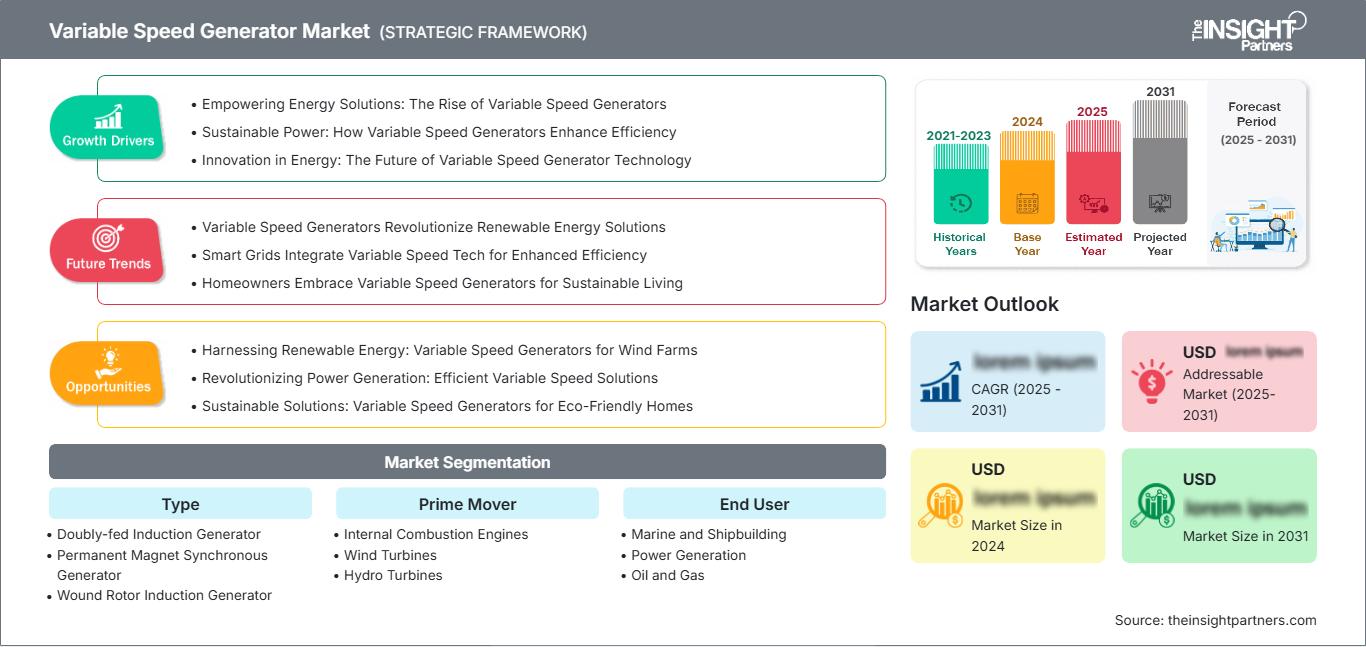
Variable Speed Generator Market: Strategic Insights
Regional Insights
North America Variable Speed Generator Market
North America is estimated to represent 27–31% of the Variable Speed Generator Market share in 2025, with a projected 4.8–5.5% CAGR through 2034. The US accounts for most regional demand because of large-scale data-center construction, industrial electrification, healthcare facilities, telecommunications infrastructure, and requirements for resilient standby generation. Canada contributes through mining, remote power, marine operations, and renewable-generation projects.
Demand is increasingly influenced by the need to manage variable loads efficiently. Variable-speed systems can operate closer to optimal conditions when electrical requirements fluctuate, reducing unnecessary fuel consumption in appropriate applications. Generac Power Systems, Inc., Cummins Inc., and General Electric Company maintain significant regional relevance, while industrial customers increasingly evaluate equipment according to lifecycle efficiency, emissions compliance, service availability, and integration capability rather than purchase price alone.
U.S. Variable Speed Generator Market
The U.S. represents approximately 78–83% of North America's 2025 Variable Speed Generator Market share and is expected to expand at a 4.7–5.4% CAGR through 2034. Demand is supported by data centers, commercial buildings, healthcare, manufacturing, utilities, and backup-power applications requiring reliable operation during grid interruptions.
Application trends increasingly favor intelligent generator controls and systems capable of responding to changing loads. Cummins Inc., Generac Power Systems, Inc., ABB Ltd., and General Electric Company maintain relevant capabilities across generation, controls, or adjacent power infrastructure. The market is also influenced by increasingly stringent emissions requirements, resilience planning, and the rapid expansion of electricity-intensive infrastructure. Buyers are consequently placing greater emphasis on fuel efficiency, automation, remote monitoring, maintenance intervals, and compatibility with distributed-energy architectures.
Europe Variable Speed Generator Market
Europe is estimated at 22–26% share of the v in 2025 and is forecast to grow at a 4.6–5.3% CAGR through 2034. Germany leads the pack, followed by UK, France, Italy, and Spain due to their renewable integration and industrial upgrading. Variable speed systems find applications where generation units need to adapt to fluctuating loads and conditions.
UK and Germany offer good prospects for growth through offshore wind farms, industrial electrification, and grid balancing. The efficient generation and control systems are encouraged by the developed manufacturing sector and the level of penetration of renewables in Germany. France, Italy, and Spain are making contributions in terms of distributed generation, marine, industrial, and renewable projects. Across Europe, there are higher expectations regarding efficiencies and emissions that favor equipment adaptable to wider load range applications.
APAC Variable Speed Generator Market
APAC is estimated to hold 31–35% share of the Variable Speed Generator Market in 2025, expanding at a 5.8–6.5% CAGR through 2034, with China representing the leading market. Japan, South Korea, India, and Australia also contribute through industrial generation, renewable deployment, marine applications, and infrastructure modernization.
There is a significant volume opportunity available from China and India due to growing electricity networks and manufacturing. In Japan and South Korea, there is a focus on efficient industrial and marine products, whereas in Australia, opportunities are available for mining, remote generation, and renewable energy integration. Domestic manufacturing policy and low-emission generation help create regional opportunities. The companies Yanmar Co., Ltd., Cummins Inc., and ABB Ltd. have regional strengths.
Middle East & Africa Variable Speed Generator Market
Middle East & Africa Variable Speed Generator Market is projected to expand at a 4.3–5.0% CAGR through 2034. Saudi Arabia and the UAE are major players due to their investment in infrastructure, diversification of industry, and rising electrical demands, whereas South Africa participates because of their industrial uses and reliability applications on the grid. Saudi Arabia and the UAE are developing large infrastructure and energy projects that need dependable distributed power generation. South Africa still shows demand for products relating to grid reliability, mining, and industries. The rest of MEA has opportunities for remote generation, telecommunications, oil and gas, and hybrid renewables. Variable speed machines can help in variable load conditions.
Segmentation Analysis
Type
The Type segment is led by Doubly-fed Induction Generator configurations, supported by established deployment in wind and pumped-storage systems. These machines balance controllability and converter requirements, while permanent-magnet systems gain attention where efficiency, compactness, and reduced maintenance are prioritized. Overall, the segment is projected to expand at a 5.1–5.9% CAGR from 2026–2034, according to the Variable Speed Generator Market forecast.
- Doubly-fed Induction Generator: Doubly-fed Induction Generator systems remain strategically important where partial-scale power conversion and variable-speed operation are required, particularly in wind and pumped-storage installations requiring controllable operating ranges.
- Permanent Magnet Synchronous Generator: Permanent Magnet Synchronous Generator systems benefit from high efficiency and compact construction, supporting applications where reduced losses, high power density, and dependable operation justify higher component costs.
- Wound Rotor Induction Generator: Wound Rotor Induction Generator configurations retain relevance in applications requiring controllable rotor characteristics, especially where established engineering practices and service familiarity influence equipment selection.
- Variable Speed Self Excited Induction Generator: Variable Speed Self Excited Induction Generator systems offer application flexibility where independent excitation and variable-speed operation are valued, creating opportunities in decentralized generation and specialized industrial installations.
Prime Mover
The Prime Mover segment is projected to grow at a 4.9–5.7% CAGR from 2026–2034, supported by increasing demand for speed adaptability across renewable and conventional generation. Wind and hydro applications benefit particularly from operating flexibility, while engines remain important for distributed and standby generation, reflecting key Variable Speed Generator Market trends.
- Internal Combustion Engines: Internal Combustion Engines support distributed and standby generation where variable loads require efficient operation, especially across commercial facilities, remote sites, marine applications, and industrial installations.
- Wind Turbines: Wind Turbines represent a strategically important application because variable rotational speed allows turbines to respond to changing wind conditions and improve energy capture across operating ranges.
- Hydro Turbines: Hydro Turbines benefit from adjustable-speed operation in pumped-storage and flexible hydropower systems, enabling improved load response, broader operating conditions, and enhanced grid-support capabilities.
- Steam and Gas Turbines: Steam and Gas Turbines provide opportunities where flexible thermal generation is required, particularly in power systems balancing variable renewable generation and fluctuating industrial electricity requirements.
End User
The End User segment is expected to register a 5.0–5.8% CAGR from 2026–2034, supported by demand for reliable, efficient, and adaptable generation. Power generation remains central, while marine, oil and gas, and commercial applications provide diversified demand across the Variable Speed Generator Market.
- Marine and Shipbuilding: Marine and Shipbuilding applications increasingly value compact, efficient generation systems that can respond to variable onboard loads while supporting fuel optimization and operational reliability.
- Power Generation: Power Generation remains strategically significant because variable-speed equipment supports renewable integration, pumped storage, flexible generation, and improved operating performance under changing system conditions.
- Oil and Gas: Oil and Gas applications require dependable generation across production, processing, and remote facilities, creating opportunities for systems capable of maintaining efficiency across variable operating loads.
- Commercial and Residential: Commercial and Residential applications are supported by backup-power requirements, distributed generation, resilience planning, and increasing interest in intelligent systems capable of adapting output to changing electricity demand.
Opportunity Snapshot
| End User | Revenue Contribution | Trend Tag | Adoption Stage |
| Marine and Shipbuilding | Medium | Marine Efficiency | Scaling |
| Power Generation | High | Grid Flexibility | Mature |
| Oil and Gas | Medium | Remote Power | Scaling |
| Commercial and Residential | Medium | Resilience Power | Scaling |
Variable Speed Generator Market Growth Drivers and Impact Analysis
Renewable Power Integration Increases Demand for Flexible Generation
Variable renewables have increased the value of equipment that is able to adapt to dynamic electrical and mechanical changes. The operation of wind turbines involves working at different rotational speeds, while pumped-storage plants are increasingly utilizing designs of adjustable speed. This makes way for generator manufacturers, converters and control system producers to supply an integrated system rather than a separate device. This trend has wide-ranging implications on the economics of projects as operators are now able to optimize their equipment for efficiency across broader ranges of operation as opposed to designing them around a narrow point. Power grid operators also stand to gain from generation facilities that offer higher controllability.
Rising Need for High-Efficiency Distributed Power Systems
Today's commercial buildings, industrial plants, ships, telecommunications facilities, and remote installations find themselves working with varying electrical loads. While traditional fixed-speed generation may suffer from inefficiency due to operation well below its capacity, the variable speed technology can manage to adapt to the demand situation if the system allows such adjustments. Thus, there emerges a practical case in point for consumers who consider the parameters of fuel efficiency, maintenance, emission levels, and utilization of assets together. This issue gains special relevance in those applications that incorporate intermittent renewables with generators, where the generator may run for less time or at different load levels. In this regard, manufacturers may distinguish themselves by intelligent control, optimization of generator-engine pairings, diagnostics at a distance, and modularity of their designs.
Industrial Decarbonization and Efficiency Policies Strengthen Technology Adoption
Changing regulations related to decarbonizing the generation industry and efficiency standards will have an effect on the way that industrial customers assess generation equipment. Decisions regarding purchasing such equipment will become more focused on lifecycle carbon footprint, energy efficiency, flexibility and the ability to work within a low-carbon environment. Variable speed generators may help address these challenges through better matching of mechanical and electrical load and by being part of the renewable or hybrid energy systems architecture. Regulatory pressures will provide differentiation by geography because of the different regulations in terms of emissions, grid codes and energy efficiency. In this case, manufacturers will be able to access projects that will require tailored equipment instead of only focusing on generator ratings.
Variable Speed Generator Market Future Trends
Advanced Power Electronics Enable Wider Operating Envelopes
Performance limits of variable-speed generator systems will be defined by power electronics. Enhancements in semiconductor switches, converter topology, cooling, and control strategies will enable tighter regulation and lower conversion losses as well as smaller converters. Medium-voltage systems will also gain from advancements in converter technologies that will become feasible in larger generator systems. Digital control systems will become a common platform for regulating generator speed, excitation, voltage, and grid responses. Such an approach will make variable-speed systems appealing to pumped storage, large-scale renewable systems, marine propulsion generator systems, and industrial microgrids. In the long run, converter capabilities will become one of the differentiators between generator equipment manufacturers, where response time, efficiency at various load ranges, harmonics, serviceability, and compatibility will become important criteria in addition to conventional generator criteria.
Digital Monitoring Moves Generator Procurement Toward Lifecycle Optimization
Monitoring digitally is projected to become more common in generator packages as customers aim for greater availability and reduced maintenance expenses. Monitoring devices can provide data on temperature, vibration, electrical attributes, bearing status, and load, which would be processed by analytics software to detect anomalies before there is any problem. Variable speed technology produces further data as changes occur in terms of speed, load, excitation, and converter conditions. The resulting information could contribute to preventive maintenance and better dispatch decisions. Accordingly, service agreements could migrate to performance-based models that include remote diagnostics, condition monitoring, software maintenance and optimization, among others. For the owner of the equipment, the financial benefit of the transaction would move away from the cost of acquisition and towards availability, efficiency, maintainability and life.
Variable Speed Generator Market Opportunities
Pumped-Storage Modernization Creates High-Value Equipment Opportunities
Modernization of pumped-storage facilities presents a significant opportunity because existing fixed-speed assets can be upgraded where technical and economic conditions support variable-speed operation. Adjustable-speed systems can provide more granular pumping control, broader operating ranges, and improved response to changing electricity conditions. This capability becomes increasingly valuable as power systems incorporate greater volumes of intermittent renewable generation. Equipment suppliers can target brownfield projects by offering integrated generator, motor, converter, excitation, control, and protection packages. Engineering services are equally important because modernization requires a detailed assessment of hydraulic conditions, electrical infrastructure, civil interfaces, and grid requirements. Suppliers that can reduce outage periods and provide phased modernization programs may gain an advantage. The opportunity extends beyond new equipment sales into engineering, retrofit, commissioning, and long-term service contracts.
Hybrid Microgrids Expand Applications Beyond Conventional Generation
Hybrid microgrids combining generators, batteries, renewable resources, and intelligent energy-management systems create new applications for variable-speed generation. In such systems, the generator may operate as a flexible resource rather than continuously supplying a fixed electrical output. This operating profile can favor architectures capable of adjusting speed and output efficiently while maintaining voltage and frequency performance. Remote industrial sites, islands, mines, commercial campuses, ports, and critical infrastructure are potential applications. Suppliers can capture value by packaging generation with storage interfaces, controls, monitoring, and service agreements. The opportunity is particularly relevant where grid connection is weak or fuel logistics are expensive. Strategic partnerships among generator manufacturers, battery providers, microgrid integrators, and engineering firms can accelerate deployment and create integrated offerings tailored to site-specific load profiles.
Frequently Asked Questions

- Comprehensive Market Sizing and Forecast Analysis
- Detailed Segmentation Analysis
- In-Depth Market Dynamics Assessment
- Regional and Country-Level Insights
- Competitive Landscape and Company Benchmarking
- Strategic Business Intelligence
Recent Reports
Testimonials

The Insight Partners' SCADA System Market report is comprehensive, with valuable insights on current trends and future forecasts. The team was highly professional, responsive, and supportive throughout. We are very satisfied and highly recommend their services.
RAN KEDEM Partner, Reali Technologies LTDs
I requested a report on a very specific software market and the team produced the report in a few days. The information was very relevant and well presented. I then requested some changes and additions to the report. The team was again very responsive and I got the final report in less than a week.
JEAN-HERVE JENN Chairman, Future Analytica
We worked with The Insight Partners for an important market study and forecast. They gave us clear insights into opportunities and risks, which helped shape our plans. Their research was easy to use and based on solid data. It helped us make smart, confident decisions. We highly recommend them.
PIYUSH NAGPAL Sr. Vice President, High Beam Global
The Insight Partners delivered insightful, well-structured market research with strong domain expertise. Their team was professional and responsive throughout. The user-friendly website made accessing industry reports seamless. We highly recommend them for reliable, high-quality research services
YUKIHIKO ADACHI CEO, Deep Blue, LLC.
This is the first time I have purchased a market report from The Insight Partners.While I was unsure at first, I visited their web site and felt more comfortable to take the risk and purchase a market report.I am completely satisfied with the quality of the report and customer service. I had several questions and comments with the initial report, but after a couple of dialogs over email with their analyst I believe I have a report that I can use as input to our strategic planning process.Thank you so much for taking the extra time and making this a positive experience.I will definitely recommend your service to others and you will be my first call when we need further market data.
JOHN SUZUKI President and Chief Executive Officer, Board Director, BK Technologies
I wish to appreciate your support and the professionalism you displayed in the course of attending to my request for information regarding to infectious disease IVD market in Nigeria. I appreciate your patience, your guidance, and the fact that you were willing to offer a discount, which eventually made it possible for us to close a deal. I look forward to engaging The Insight Partners in the future, all thanks to the impression you have created in me as a result of this first encounter.
DR CHIJIOKE ONYIA MANAGING DIRECTOR, PineCrest Healthcare Ltd.Reason to Buy
- Informed Decision-Making
- Understanding Market Dynamics
- Competitive Analysis
- Identifying Emerging Markets
- Customer Insights
- Market Forecasts
- Risk Mitigation
- Boosting Operational Efficiency
- Strategic Planning
- Investment Justification
- Tracking Industry Innovations
- Aligning with Regulatory Trends





 Get Free Sample for