
Video Encoder Market Size, Demand & Growth by 2034
Coverage: By Channel (Single Channel, Multi-channel); Type (Stand-alone, Rack-mounted); Application (Broadcast, Surveillance) , and Geography (North America, Europe, Asia Pacific, and South and Central America)
- Status : Data Released
- Report Code : TIPRE00009569
- Category : Electronics and Semiconductor
- No. of Pages : 150
- Available Report Formats :


- Last update date : September 22, 2026


2025 Market Size
US$ 3.08 Bn
Base year value
2034 Forecast
US$ 5.64 Bn
Projected by 2034
CAGR 2026-2034
6.94 %
Growth rate
Addressable Market
US$ 39.35 Bn
(2026-2034)
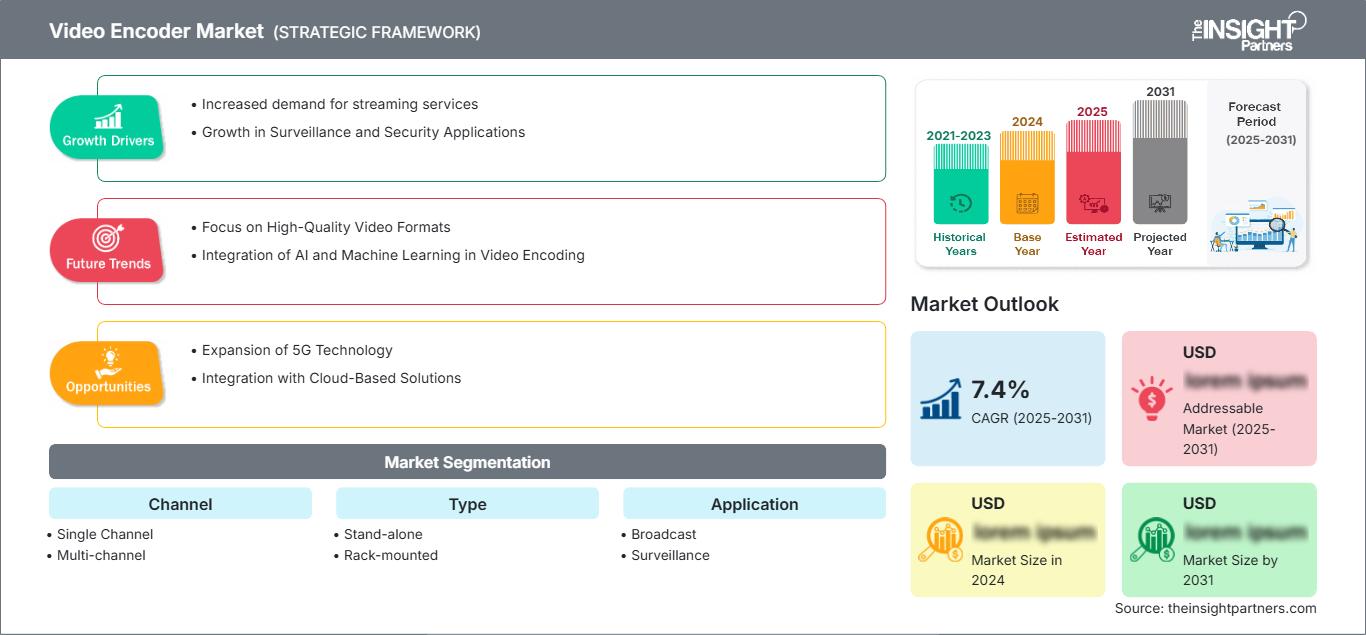
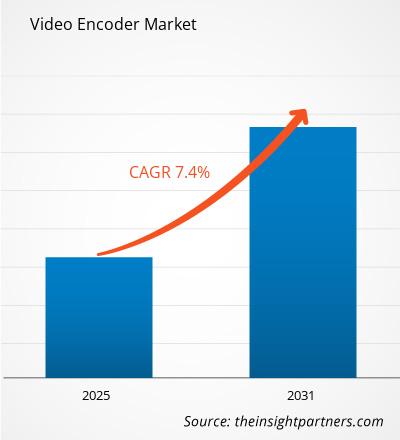
The video encoder market is projected to grow from US$ 3.08 billion in 2025 to US$ 5.64 billion by 2034, registering a CAGR of 6.94% during 2026–2034. Demand is being shaped by high-definition broadcast migration, IP surveillance upgrades, cloud video workflows, and compressed delivery of live and stored content across enterprise, public safety, and media networks.
North America remains a high-value demand center as broadcasters modernize contribution workflows and public agencies extend IP-based monitoring. The video encoder market size in the region is expected to expand steadily at a mid-single-digit to high-single-digit CAGR range, supported by 4K production, smart city surveillance, and hybrid hardware-plus-cloud deployments.
Video Encoder Market Assessment and Insights
- North America accounted for an estimated 30–34% share in 2025 and is projected to grow at a CAGR of 6.5–7.2% during 2026–2034, led by broadcast modernization, enterprise streaming, and security upgrades.
- U.S. represented nearly 78–82% of North America demand in 2025, expanding at a CAGR of 6.6–7.3% as IP video systems and low-latency streaming scale.
- Europe held an estimated 24–28% share in 2025 and is forecast to grow at 5.8–6.5%, with Germany, the UK, and France leading professional broadcast and security deployments.
- Asia Pacific represented 28–32% share in 2025 and is expected to grow at 7.4–8.2%, driven by China, Japan, South Korea, India, and Australia.
- Largest Segment: was multi-channel encoders with a 58–62% market share in 2025 and a CAGR of 7.0–7.7% due to broadcast, surveillance, and campus deployments.
- High Growth Segment: was rack-mounted encoders with a 39–43% market share in 2025 and a CAGR of 7.5–8.3% as centralized video operations expand.
- Key companies analyzed in detail: Avigilon Corporation, Axis Communications AB, Delta Digital Video, Harmonic Inc., Honeywell International Inc., Hangzhou Hikvision Digital Technology Co., Ltd., Matrox Video, Merit LILIN Ent. Co., Ltd., VITEC, and Z3 Technology, LLC.
Source: The Insight Partners' analysis based on proprietary research, government publications, company annual reports, investor presentations, industry databases, and expert interviews.
In terms of encoding solutions, we have seen the trend move from simple analog-to-digital conversion towards sophisticated, low-latency, high-performance platforms that can encode H.264, H.265, AV1, and future codec technologies. Market growth is driven by changes in video traffic trends, cloud contribution, edge computing, and hardware acceleration remains key wherever uptime and determinism are critical.
Future demand is going to be influenced by hybrid implementations, retention mandates for surveillance footage, and investments in robust public video infrastructures. Increasingly, software control layers are used together with appliances to enable quality, bandwidth, and security management of video infrastructures.
Video Encoder Market Report Scope
| Report Attribute | Details |
|---|---|
| Market size in 2025 | US$ 3.08 Billion |
| Market Size by 2034 | US$ 5.64 Billion |
| Global CAGR (2026 - 2034) | 6.94% |
| Historical Data | 2021-2024 |
| Forecast period | 2026-2034 |
Video Encoder Market Analysis
Market analysis suggests that the demand for the technology is high where video compression, transmission, and monitoring without any losses in quality is required. Operators need reliable encoding for contribution and distribution while security applications depend on encoders to facilitate the transition from analog cameras to IP-based video management without complete replacement of cameras. This drives demand for replacements and expansion in developed and developing countries.
Supply depends on the supply of semiconductors, licensing issues regarding codecs, energy efficiency and ability to integrate with video management software. The competition is based on processing efficiency, codec capabilities, latency, cybersecurity features and remote management abilities. The multi-channel solutions are in demand where the control over multiple video streams is required from a single command center.
There is competition balance among broadcast experts, surveillance system providers, and embedded systems providers. Companies such as Harmonic Inc., VITEC, Matrox Video, and Z3 Technology, LLC are focused on video work processes, whereas Axis Communications AB, Avigilon Corporation, Honeywell International Inc., and Hangzhou Hikvision Digital Technology Co., Ltd have a security systems ecosystem advantage.
In the Video Encoder market report, strategic positioning increasingly depends on software integration rather than hardware specifications alone. Buyers evaluate encoders as part of ingest, storage, analytics, streaming, and monitoring architectures. Vendors able to support cloud-managed updates, cybersecurity hardening, and codec roadmap flexibility are better positioned to capture replacement cycles.
● REPORT CUSTOMIZATION
Tailor This Report To Align With Your Specific Business Requirements
This report can be customized to align precisely with your business objectives, scope, and target markets. Customization options include tailored segmentation, geography, competitive analysis, and strategic insights to support informed decision-making.
Customize This Report →WHAT YOU CAN ADJUST
- ● Segmentations
- ● Geography
- ● Competitive Analysis
- ● Language Preferences
Video Encoder Market: Strategic Insights
Regional Insights
North America Video Encoder Market
North America held an estimated 30–34% video encoder market share in 2025, supported by mature broadcast infrastructure, public safety surveillance, and enterprise live video communication. Regional CAGR is projected at 6.5–7.2% during 2026–2034 as broadcasters upgrade to IP contribution and agencies connect legacy cameras to centralized monitoring platforms. Investments have been made in cloud-managed video infrastructure, network upgrades, and monitoring systems within the areas of transportation, critical infrastructure, and defense.
This region has also enjoyed media production facilities and has seen the use of low-latency streaming at its earliest stage. Purchasing encoders is increasingly tied to security measures, remote control, and 4K processing capabilities; thus, providers of systems that integrate appliances and software management are getting an upper hand. The growing demand for video delivery architecture, disaster recovery, and video management is pushing replacement cycles.
U.S. Video Encoder Market
The U.S. accounted for approximately 78–82% of North America demand in 2025 and is forecast to grow at 6.6–7.3% CAGR. The market demand is driven by demand in broadcast networks, municipal security, defense installations, transportation control, and commercial campuses that rely on encoders to increase IP video visibility. Modernization of surveillance systems and broadcast systems is driving consistent demand from both the government and enterprise sectors.
Market presence in surveillance, broadcast, and embedded systems markets is high. Multi-channel systems and rack-mounted systems are preferred due to their continuous functioning, redundancy, and maintenance capabilities. Growing interest in AI-enabled video analytics, remote monitoring through cloud, and hybrid production systems has pushed companies to make investments in encoder technology that can fulfill future demands.
Europe Video Encoder Market
Europe represented an estimated 24–28% share in 2025 and is projected to grow at 5.8–6.5% CAGR. Germany acts through strong broadcast engineering and security in industry, whereas the United Kingdom profits through media production, public infrastructure surveillance, and professional streaming needs. Further expansion is possible due to constant efforts toward digital transformation, implementation of connected infrastructure, and upgrades in the security and communication networks.
France, Italy, and Spain participate through transport surveillance, live event broadcasting, and smart city upgrades. The regional customers tend to focus on compliance, interoperability, and longevity, which allows encoders to be integrated with already established video management software systems. Increased needs for reliable video transmission in various distributed operating environments and government infrastructure projects are also driving the demand for such encoders.
APAC Video Encoder Market
APAC held an estimated 28–32% share in 2025 and is expected to grow at 7.4–8.2% CAGR. In terms of the number of deployments made, China leads the pack, with Japan and South Korea preferring quality broadcasting and surveillance purposes. The advantages in the region include fast urbanization, significant investment in digital infrastructure, and deployment of connected devices that produce lots of video content to be encoded efficiently.
India and Australia contribute to the growth in the market, thanks to their infrastructure security, education streaming, and enterprise video needs. The fast digitization of governments, 5G backhaul, and increasing deployments of video analytics make this region one of the fastest-growing clusters for the encoder market demand.
Middle East & Africa Video Encoder Market
The Middle East and Africa market is projected to grow at 6.2–6.9% CAGR through 2034. Saudi Arabia and the UAE drive the demand for video coding through their initiatives in the area of smart cities, energy, transportation, and public safety, which require efficient video transmission capabilities of distributed systems. Large-scale infrastructure initiatives, growing digital transformation activities, and increasing security spending are among some of the factors leading to higher use of video encoding technologies in the region.
South Africa and other parts of MEA have their demand driven by security for business, mining, logistics, and sports event broadcasting applications. Procurement focuses on equipment that is rugged, capable of remote monitoring, and works in environments of both analog and IP-based networks.
Segmentation Analysis
Channel
Channel segmentation captures the video encoder market scope across single-channel and multi-channel systems. The channel segment is expected to grow at a CAGR of 6.8–7.6% during 2026–2034 as users balance compact site-level needs with centralized video operations in broadcast and surveillance environments.
- Single Channel encoders remain important for remote cameras, small studios, branch locations, and targeted analog-to-IP migration where one feed requires reliable compression and network delivery.
- Multi-channel encoders support command centers, broadcast facilities, campuses, and transport hubs by consolidating several feeds into scalable appliances that reduce rack space and operational complexity.
Type
Type segmentation covers stand-alone and rack-mounted designs, with the main segment projected to grow at a CAGR of 6.9–7.8%. Stand-alone units serve distributed sites, while rack-mounted platforms gain traction where density, redundancy, and centralized operations are required.
- Stand-alone encoders are preferred for localized installations, temporary contribution, remote monitoring sites, and smaller surveillance networks requiring flexible deployment without complex infrastructure.
- Rack-mounted encoders are strategically important in broadcast headends, operations centers, and large security rooms where multiple feeds, high uptime, and structured maintenance are critical.
Application
Application segmentation includes broadcast and surveillance, with the main segment expected to grow at a CAGR of 6.7–7.5%. Broadcast remains value-intensive because quality, latency, and codec efficiency affect viewer experience, while surveillance provides scale through IP migration.
- Broadcast applications require dependable encoding for live contribution, OTT delivery, remote production, and distribution workflows where compression quality and low latency influence service reliability.
- Surveillance applications use encoders to connect legacy analog cameras, support command centers, enable remote viewing, and extend video analytics capabilities across public and private sites.
Opportunity Snapshot
| Application | Revenue Contribution | Trend Tag | Adoption Stage |
| Broadcast | High | Remote Production | Scaling |
| Surveillance | High | IP Migration | Mature |
Video Encoder Market Growth Drivers and Impact Analysis
Expansion of Low-Latency Streaming Workflows
Live sports, news, corporate communications, and public events require compressed video with minimal delay and stable quality. This need is pushing broadcasters and enterprises toward encoders that support hardware acceleration, adaptive bitrates, and resilient transport protocols. As audiences expect uninterrupted multi-device viewing, buyers are prioritizing systems that can handle 4K inputs, manage bandwidth efficiently, and integrate with cloud distribution. This driver strengthens demand for both stand-alone and rack-mounted platforms.
Migration from Analog Surveillance to IP Networks
Many organizations still operate large analog camera estates in airports, campuses, transport corridors, factories, and municipal areas. Encoders provide a cost-effective migration path by digitizing existing feeds and making them compatible with IP networks, centralized monitoring, and video management systems. This reduces the need for immediate camera replacement while enabling remote access and analytics readiness. The result is steady replacement demand across public safety, commercial security, and infrastructure monitoring.
Rising Need for Efficient Codec Support
Bandwidth pressure is increasing as video resolution, frame rates, and retention requirements rise. Encoders that support HEVC, AV1, and optimized H.264 workflows help reduce transport and storage costs while preserving image quality. Buyers increasingly view codec flexibility as a lifecycle issue because content formats and network constraints change over time. Vendors offering firmware updates, multi-codec support, and efficient power consumption are therefore better positioned in procurement decisions.
Video Encoder Market Future Trends
Hybrid Edge-Cloud Encoding
The video encoder market trends are moving toward hybrid architectures in which critical compression occurs at the edge and orchestration happens through cloud software. This model helps organizations reduce bandwidth consumption before transmission while using central dashboards for monitoring, updates, and workflow control. It is especially relevant for distributed surveillance, remote production, and enterprise video networks. Over the forecast period, hybrid deployment will influence product design, vendor partnerships, and buyer expectations for manageability.
AI-Assisted Video Optimization
AI-assisted encoding is emerging as a practical technology for adapting compression settings to scene complexity, motion, network conditions, and quality targets. While the market remains hardware-reliant, intelligence at the software layer can improve bitrate efficiency and operational automation. Surveillance systems may use AI to prioritize critical feeds, while broadcasters can optimize live streams more dynamically. This trend will gradually shift competitive differentiation from basic encoding capacity toward smarter decision-making.
Video Encoder Market Opportunities
Modernization of Public Infrastructure Monitoring
The video Encoder Market forecasts point to opportunities in airports, rail networks, ports, utilities, and city command centers where legacy systems must be connected to modern IP monitoring platforms. Encoders allow asset owners to extend the life of existing cameras while improving accessibility, storage compatibility, and incident response. Vendors can pursue this opportunity by offering ruggedized products, cybersecurity features, and integration support for video management systems used in critical infrastructure environments.
Broadcast Remote Production and Contribution
Remote production reduces travel, equipment movement, and on-site control room requirements, but depends on dependable encoding at venues and field locations. Low-latency, high-quality encoders are essential for transmitting multiple synchronized feeds back to centralized production facilities. This creates opportunities for vendors offering compact contribution appliances, redundant network paths, and codec flexibility. Sports, live events, education, and enterprise broadcasting are expected to drive continued investment in these workflows.
Frequently Asked Questions

- Comprehensive Market Sizing and Forecast Analysis
- Detailed Segmentation Analysis
- In-Depth Market Dynamics Assessment
- Regional and Country-Level Insights
- Competitive Landscape and Company Benchmarking
- Strategic Business Intelligence
Recent Reports
Testimonials

The Insight Partners provided valuable market intelligence that supported our global go-to-market strategy. Their team was professional, responsive, and attentive to our feedback, providing thoughtful analysis and helpful methodological clarifications throughout the project.
Junmo Kim Chief Financial Officer (CFO), Enertech Co., Ltd.
The Insight Partners' SCADA System Market report is comprehensive, with valuable insights on current trends and future forecasts. The team was highly professional, responsive, and supportive throughout. We are very satisfied and highly recommend their services.
RAN KEDEM Partner, Reali Technologies LTDs
I requested a report on a very specific software market and the team produced the report in a few days. The information was very relevant and well presented. I then requested some changes and additions to the report. The team was again very responsive and I got the final report in less than a week.
JEAN-HERVE JENN Chairman, Future Analytica
We worked with The Insight Partners for an important market study and forecast. They gave us clear insights into opportunities and risks, which helped shape our plans. Their research was easy to use and based on solid data. It helped us make smart, confident decisions. We highly recommend them.
PIYUSH NAGPAL Sr. Vice President, High Beam Global
The Insight Partners delivered insightful, well-structured market research with strong domain expertise. Their team was professional and responsive throughout. The user-friendly website made accessing industry reports seamless. We highly recommend them for reliable, high-quality research services
YUKIHIKO ADACHI CEO, Deep Blue, LLC.
This is the first time I have purchased a market report from The Insight Partners.While I was unsure at first, I visited their web site and felt more comfortable to take the risk and purchase a market report.I am completely satisfied with the quality of the report and customer service. I had several questions and comments with the initial report, but after a couple of dialogs over email with their analyst I believe I have a report that I can use as input to our strategic planning process.Thank you so much for taking the extra time and making this a positive experience.I will definitely recommend your service to others and you will be my first call when we need further market data.
JOHN SUZUKI President and Chief Executive Officer, Board Director, BK Technologies
I wish to appreciate your support and the professionalism you displayed in the course of attending to my request for information regarding to infectious disease IVD market in Nigeria. I appreciate your patience, your guidance, and the fact that you were willing to offer a discount, which eventually made it possible for us to close a deal. I look forward to engaging The Insight Partners in the future, all thanks to the impression you have created in me as a result of this first encounter.
DR CHIJIOKE ONYIA MANAGING DIRECTOR, PineCrest Healthcare Ltd.Reason to Buy
- Informed Decision-Making
- Understanding Market Dynamics
- Competitive Analysis
- Identifying Emerging Markets
- Customer Insights
- Market Forecasts
- Risk Mitigation
- Boosting Operational Efficiency
- Strategic Planning
- Investment Justification
- Tracking Industry Innovations
- Aligning with Regulatory Trends





 Get Free Sample for