
Volt VAR Management Market Size, Share & Forecast by 2034
Coverage: By Component (Hardware, Software); Application (Distribution, Transmission, Generation); End User (Electric Utility, Industrial) , and Geography (North America, Europe, Asia Pacific, and South and Central America)
- Status : Data Released
- Report Code : TIPRE00009153
- Category : Electronics and Semiconductor
- No. of Pages : 150
- Available Report Formats :


- Last update date : September 28, 2026


2025 Market Size
US$ 2.29 Bn
Base year value
2034 Forecast
US$ 4.32 Bn
Projected by 2034
CAGR 2026-2034
7.33 %
Growth rate
Addressable Market
US$ 29.85 Bn
(2026-2034)
The Volt-VAR management market was valued at US$ 2.29 Billion in 2025 and is projected to reach US$ 4.32 Billion by 2034, expanding at a CAGR of 7.33% from 2026 to 2034. The market includes hardware and software employed in distribution, transmission, and generation sectors, with electric utilities and industrial consumers employing coordinated voltage and reactive power control for optimizing grid performance, efficiency, and operation.
North America Volt-VAR management market report is forecasted to experience a CAGR of 6.8-7.6% from 2026 to 2034 on account of grid transformation, intelligent metering, and increasing adoption of distributed energy resources. Investments made by utilities in automated feeder technology, smart inverters, capacitor controls, and advanced distribution management systems are contributing to the consistent demand for coordinated voltage optimization solutions, especially where aged systems need to be retrofitted for higher electrification.
Volt VAR Management Market Assessment and Insights
- North America: The region is estimated to represent 31–35% share in 2025 and expand at a CAGR of 6.8–7.6% between 2026–2034, supported by smart-grid investment, renewable integration, and distribution automation.
- US: The US is estimated to account for 82–86% of North American revenue in 2025, growing at a CAGR of 6.9–7.7% during 2026–2034 as utilities modernize feeders and manage DER-driven voltage variability.
- Europe: Europe is estimated to hold 23–27% share in 2025 and grow at a CAGR of 6.6–7.4% through 2034, led by Germany, the UK, France, Italy, and Spain as renewable integration accelerates grid digitalization.
- Asia Pacific: Asia Pacific is estimated at 25–29% share in 2025 and is projected to grow at a CAGR of 8.0–8.8%, led by China, Japan, India, South Korea, and Australia amid expanding networks and renewable capacity.
- Largest Segment: Hardware is estimated to hold a 58–63% market share in 2025 and grow at a CAGR of 6.8–7.5%, reflecting continued spending on regulators, capacitors, controllers, and grid-edge equipment.
- High Growth Segment: Software is estimated at a 37–42% market share in 2025 and is expected to expand at a CAGR of 8.3–9.1%, driven by analytics, automation, DER coordination, and digital grid platforms.
- Key companies analyzed in detail: ABB Limited, Beckwith Electric Co., Inc., Eaton Corporation plc, General Electric Company, Landis+Gyr AG, Open Systems International, Inc., Schneider Electric SE, Siemens AG, Utilidata, Inc., and Varentec, Inc.
Source: The Insight Partners' analysis based on proprietary research, government publications, company annual reports, investor presentations, industry databases, and expert interviews.
The method of volt-VAR control involves digital coordination of the ever-more complex power grids, consisting of various separate voltage control mechanisms. Modernization is carried out through software-based optimization of capacitor banks, voltage regulators, transformer taps, sensors, advanced inverters, and automated feeders coordination. The reason behind this modernization process is the presence of two-way power flows caused by distributed energy resources, changes in load profile, electric vehicles, and increased operating requirements for power quality.
In the coming years, the capital investment will be directed at platform solutions that will involve the integration of distribution management systems, management of distributed energy resources, forecasting, and automatic voltage control. Emerging markets will consist of the developing countries of the Asian Pacific and selected economies of the Middle East. Issues of reliability, energy efficiency, renewable energy, and resilience are the focus of regulatory attention.
Volt VAR Management Market Report Scope
| Report Attribute | Details |
|---|---|
| Market size in 2025 | US$ 2.29 Billion |
| Market Size by 2034 | US$ 4.32 Billion |
| Global CAGR (2026 - 2034) | 7.33% |
| Historical Data | 2021-2024 |
| Forecast period | 2026-2034 |
Volt VAR Management Market Analysis
The demand for efficient operation of the current electrical network infrastructure becomes increasingly more relevant than the need for physical expansion. Voltage regulators, capacitors, tap changers, and reactive compensation are used as the physical control layer, while sensors, communications, SCADA, ADMS, and optimization software are used for visibility and decision making. Hence, the development of the Volt-VAR management market will largely depend on interoperability between these layers and on integration with legacy assets.
On the supply side of the market, equipment manufacturers provide control and compensation hardware, software vendors develop optimization algorithms, systems integrators integrate field devices with the control center, and utilities specify operating requirements. Supply of these products is determined by the availability of semiconductors, manufacturing of power electronics, transformers, and switchgears, as well as cybersecurity requirements. Communication standards and modular architecture will become strategically important in the future, as utilities start seeking multi-vendor solutions.
Positioning is now more concerned with the capability to integrate hardware, software, automation, and grid analytics. The competitors in the Volt-VAR management market report include ABB Limited, Eaton Corporation plc, General Electric Company, Schneider Electric SE, and Siemens AG in terms of the wide portfolio of power systems. Other competitors that stand out due to their specialty are Beckwith Electric Co., Inc. and Varentec, Inc. due to their unique voltage-control systems. On the other hand, Landis+Gyr AG, Open Systems International, Inc. and Utilidata, Inc. enhance the digital and grid-intelligence aspect of competition.
The investment strategy is also now focusing on platforms that coordinate distributed energy resources as well as field equipment in real time. There is now emphasis on predictive control, digital twins, cloud connectivity, edge computing, and cybersecurity apart from traditional voltage equipment. The competitive differentiator in the current market environment is the ability to provide flexible deployment, easy integration into utility systems, lifecycle management, and value generation.
● REPORT CUSTOMIZATION
Tailor This Report To Align With Your Specific Business Requirements
This report can be customized to align precisely with your business objectives, scope, and target markets. Customization options include tailored segmentation, geography, competitive analysis, and strategic insights to support informed decision-making.
Customize This Report →WHAT YOU CAN ADJUST
- ● Segmentations
- ● Geography
- ● Competitive Analysis
- ● Language Preferences
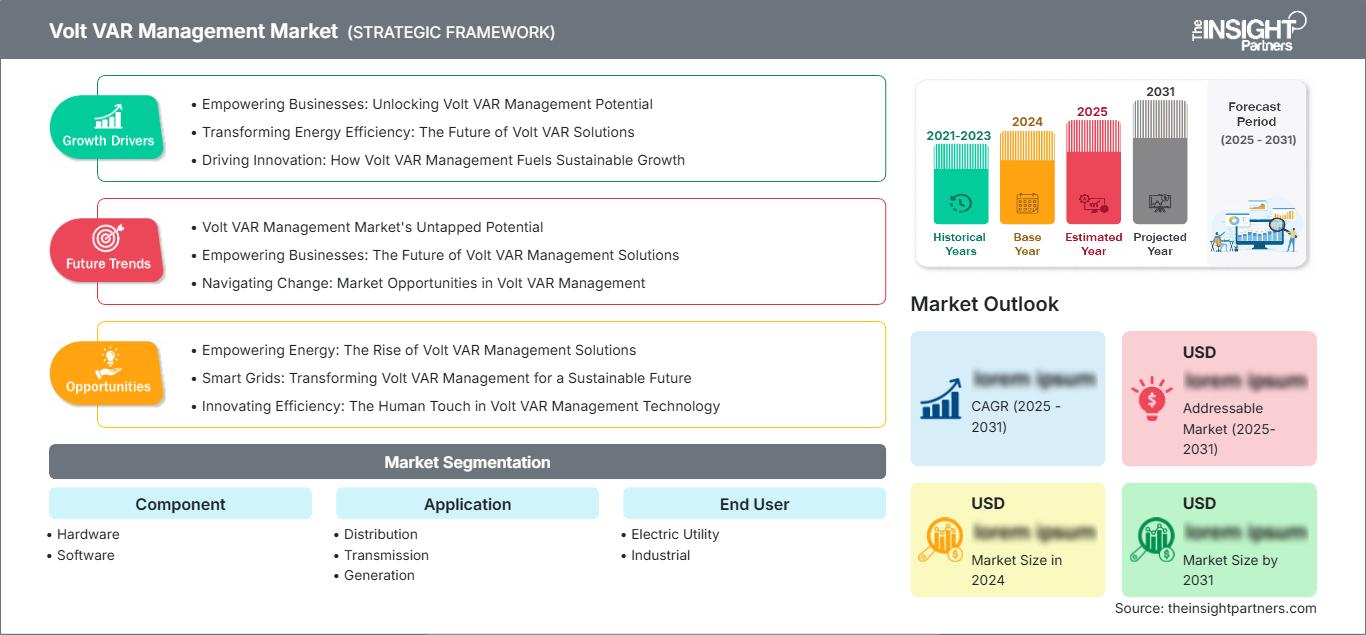
Volt VAR Management Market: Strategic Insights
Regional Insights
North America Volt-VAR Management Market
North America makes up 31-35% of the total revenue Volt-VAR management market share globally till 2025, and the market growth rate is expected to be 6.8-7.6% CAGR till 2034. The market enjoys several advantages such as already existing electric power grids, utilities being automated, smart meters, and investment in grid reliability. Increased solar power production, batteries, and electrification result in voltage management issues.
The trend is for utilities to integrate automated voltage control with distributed energy resources management, feeder control, and advanced distribution management systems. The US remains the main source of revenues due to high installed base of utilities and ongoing need for their modernization, with Canada adding more revenues via renewable energy integration and transmission system improvements. More regional purchases emphasize interoperability solutions which allow enhancing voltage performance without upgrading existing field assets.
U.S. Volt-VAR Management Market
The United States will account for 82-86% of the revenue from North America in 2025 and is projected to register a CAGR of 6.9-7.7% between 2026 and 2034. The expected share of this nation in the global market will be 26-30%. There has been an increased focus on voltage control in the distribution network since these networks have started accommodating residential PVs, battery storage, electric vehicles, and large loads.
ABB Limited, Beckwith Electric Co., Inc., Eaton Corporation plc, General Electric Company, Landis+Gyr AG, Schneider Electric SE, Siemens AG, and Utilidata, Inc. are some companies working in this market. The maximum demand for the application is observed in the distribution network, where voltage control, reactive power compensation, conservation voltage reduction, and DER management can enhance feeder efficiency.
Europe Volt-VAR Management Market
Europe holds a share between 23–27% in 2025 and will see a CAGR of 6.6–7.4% between 2025 and 2034. Germany is one of the most promising markets due to the high renewable energy share in the power mix, which results in increased voltage and reactive power management needs.
In the United Kingdom, the trend towards digital management of the distribution system is being encouraged by the need to get ready for electrification, generation and demand flexibility. Germany features both renewable energy integration and grid modernization and automation needs. France, Italy and Spain are also moving toward digital monitoring and control, generation integration, and voltage management needs.
APAC Volt-VAR Management Market
In APAC region, the projected market share will be in the range of 25-29%, and CAGR will be in the range of 8.0-8.8% till 2034, and hence APAC region will emerge as the fastest-growing major regional market. The grid control systems deployment in this region is mainly driven by grid expansion, renewable energy integration, and distribution automation in China.
In addition, the demand in this region will be driven by India and Australia as well due to network upgrade, distributed solar PV systems, and load change. The growing demand for automatic voltage regulation and reactive power control, smart inverters, and software systems is also contributing to the grid control systems market.
Middle East & Africa Volt-VAR Management Market
MEA market will grow at a CAGR of 6.0-6.8% over 2026-2034. Saudi Arabia is a major region due to large scale power system investment and industrial growth, while the United Arab Emirates invests in digitization of electricity infrastructure. South Africa plays an important role due to network reliability and need for modernization.
In other parts of MEA, the installation of generation and transmission infrastructures offers opportunities for reactive and voltage management. Solar installations, industrial loads, large distance for transmission lines, and resilience of the network are key factors. Increasingly, utilities will be in need of products which can control voltage in case of variable generation and reduce technical losses in the network.
Segmentation Analysis
Component
The Component segment in the Volt-VAR management market comprises Hardware and Software. Hardware is estimated to remain the largest component category, while software is expected to advance faster as utilities digitize network operations. The overall component segment benefits from replacement of aging controls, smart-grid investment, DER integration, and demand for coordinated field-to-control-center optimization. Hardware remains foundational, but software increasingly determines how effectively installed assets are coordinated.
- Hardware: Hardware represents the physical control layer, including voltage regulators, capacitor controls, sensors, and associated equipment. Demand remains closely connected to feeder modernization, substation upgrades, asset replacement, and requirements for reliable voltage regulation.
- Software: Software enables monitoring, forecasting, optimization, automation, and coordination of voltage and reactive-power resources. Its strategic importance is increasing as utilities seek real-time control, DER integration, analytics, and interoperability across heterogeneous grid assets.
Application
The Application segment includes Distribution, Transmission, and Generation, with distribution representing the principal demand center. The application segment is estimated to grow at a CAGR of 7.0–7.7% during 2026–2034. Distribution networks face the greatest operational complexity from bidirectional power flows and variable customer-side generation, while transmission and generation applications support voltage stability across larger power-system structures.
- Distribution: Distribution is the core deployment environment because feeders experience changing voltage profiles, distributed generation, electric-vehicle charging, and localized load growth. Automated controls can improve feeder efficiency while increasing hosting capacity.
- Transmission: Transmission applications support reactive-power balancing, voltage stability, and network transfer capability. Demand is associated with renewable generation corridors, long-distance power flows, and the need to maintain system stability as generation portfolios change.
- Generation: Generation applications coordinate excitation, reactive-power resources, and plant-level voltage requirements. They become increasingly relevant where renewable and conventional generation must operate together while meeting changing grid-support requirements.
End User
The End User segment in the Volt-VAR management market consists of Electric Utility and Industrial, with the segment expected to expand at a CAGR of 7.1–7.8% during 2026–2034. Electric utilities account for the larger demand base because of network-scale deployment, while industrial users increasingly adopt voltage and power-factor controls to protect production continuity and optimize electrical assets.
- Electric Utility: Electric utilities require coordinated voltage management across substations and feeders to maintain service quality, integrate DERs, reduce losses, and optimize existing infrastructure. Long asset lives make scalable retrofit capability strategically important.
- Industrial: Industrial users deploy voltage and reactive-power controls where sensitive processes, large motors, variable loads, and power-quality requirements create operational risks. Adoption is particularly relevant for energy-intensive manufacturing and continuous-process facilities.
Opportunity Snapshot
| End User | Revenue Contribution | Trend Tag | Adoption Stage |
|---|---|---|---|
| Electric Utility | High | Grid Automation | Mature |
| Industrial | Medium | Power Quality | Scaling |
Volt VAR Management Market Growth Drivers and Impact Analysis
Distributed Energy Resources Increase Feeder-Level Voltage Complexity
With the proliferation of distributed solar, batteries, flexible loads, and electric vehicle charging stations, the distribution network is shifting from predominantly unidirectional to a dynamic bi-directional network. Voltage performance may differ significantly based on the presence of local generation, weather, charging behavior, and load profile. Consequently, there is more benefit in implementing coordinated reactive power and voltage controls that can operate without human interference. The incentive for utilities to integrate smart inverters, voltage regulation devices, capacitors, and feeder sensors through optimization, either centrally or distributively, is becoming greater. The market opportunity goes beyond the cost of equipment since utilities need software to forecast and coordinate assets as well. In terms of increased DER penetration, voltage control will be necessary to increase hosting capacity and serve new customers without overinvesting in feeders.
Grid Modernization Creates Demand for Coordinated Control Architectures
In terms of the distribution infrastructure, the trend encourages utilities to automate instead of using only traditional maintenance and augmentation. Programs aimed at modernizing power grids involve interconnection of substations, feeders, meters, sensors, and control centers with the help of digital communication systems. Voltage and reactive power functionalities can then be integrated into overall systems, which will allow utilities to automate their switching, control their voltage levels, and detect the constraints of the network. It impacts procurement needs in the sense that now more often customers assess different products based on their ability to provide interoperability, security, scalability, and lifecycle cost-effectiveness. In this way, the market will be positively impacted by the integration of the voltage management system into a larger modernization program rather than treating it as a stand-alone solution.
Industrial Electrification Raises Requirements for Power Quality
Industrial facilities are adding automated machinery, variable-speed drives, data-intensive systems, and electrified processes that can increase sensitivity to voltage disturbances and reactive-power conditions. At the same time, manufacturing expansion and large new electrical loads are placing greater emphasis on efficient use of onsite distribution infrastructure. Voltage and reactive-power management can help industrial users maintain operating conditions, manage power factor, and limit avoidable electrical losses. The resulting demand differs from utility procurement because industrial buyers often evaluate projects through production continuity, energy cost, equipment protection, and return-on-investment criteria. Suppliers that package monitoring, compensation, control, and analytics into manageable industrial architectures can address these requirements more effectively. This driver broadens the customer base beyond utilities and supports adoption in energy-intensive facilities where electrical performance has a direct relationship with production economics.
Volt VAR Management Market Future Trends
AI-Assisted Predictive Voltage Optimization
Artificial intelligence is expected to increasingly influence voltage optimization by allowing control platforms to combine historical operating data, weather information, load forecasts, DER output, and equipment conditions. Instead of reacting only after voltage deviations occur, future systems will increasingly predict feeder conditions and recommend or execute control actions before constraints emerge. Machine-learning models can also improve asset coordination where conventional deterministic settings become difficult to maintain because of rapidly changing generation and demand. The strongest implementations in the Volt-VAR management market Trends are likely to retain engineering constraints and operator oversight rather than replace established protection logic. As utility data quality improves, predictive capabilities can become more granular, extending optimization from substations toward individual feeders and grid-edge resources. This trend is likely to increase software value relative to standalone control hardware.
DER-Aware Closed-Loop Grid Control
Future architectures are expected to treat distributed energy resources as active voltage-support assets rather than passive sources of variability. Smart inverters, batteries, controllable loads, and flexible demand can provide reactive-power or voltage-support functions when coordinated through utility control platforms. Closed-loop systems will increasingly combine DER visibility, feeder-state estimation, voltage constraints, and automated dispatch. This approach can improve hosting capacity while reducing dependence on traditional infrastructure reinforcement in selected locations. Adoption will depend on communications reliability, interoperability, cybersecurity, utility operating rules, and clear responsibilities between network operators and asset owners. Standards-based interfaces are therefore likely to become increasingly important. Vendors that enable coordinated control across legacy regulators and newer inverter-based resources will be positioned to address increasingly heterogeneous distribution networks.
Volt VAR Management Market Opportunities
Software-Led Retrofit Programs for Aging Distribution Assets
A major opportunity exists in software-led modernization programs that improve the performance of installed voltage-control equipment without requiring complete replacement. Many utilities operate long-lived regulators, capacitor banks, transformers, and protection devices that remain physically serviceable but have limited coordination or visibility. Adding sensors, communications, edge controllers, and optimization software can create a pathway toward automated operation while spreading capital expenditure across multiple budget cycles. Vendors can develop modular retrofit packages that support legacy protocols and integrate with existing SCADA or ADMS environments. Such offerings can be particularly attractive to smaller utilities that cannot justify wholesale platform replacement. The commercial opportunity therefore lies in reducing integration complexity, proving measurable operating benefits, and creating upgrade paths toward increasingly autonomous network management.
Voltage Optimization for High-Density New Loads
Large new electricity loads in the Volt-VAR management market forecast from data centers, advanced manufacturing, electrified transport, and industrial facilities create another opportunity for voltage and reactive-power management. These customers often require dependable power quality while network operators face constraints on connection capacity and reinforcement timelines. Coordinated voltage control can help optimize existing network assets and manage reactive-power requirements around high-demand facilities. Suppliers can target projects by combining utility-side controls with industrial power-quality equipment, monitoring, and analytics. Partnerships between utilities, technology providers, engineering firms, and major electricity consumers may become increasingly important because the technical solution must address both network and facility requirements. The strongest opportunities are likely to emerge where rapid load growth intersects with constrained distribution capacity and where customers have a clear economic incentive to improve electrical efficiency.
Frequently Asked Questions

- Comprehensive Market Sizing and Forecast Analysis
- Detailed Segmentation Analysis
- In-Depth Market Dynamics Assessment
- Regional and Country-Level Insights
- Competitive Landscape and Company Benchmarking
- Strategic Business Intelligence
Recent Reports
Testimonials

The Insight Partners provided valuable market intelligence that supported our global go-to-market strategy. Their team was professional, responsive, and attentive to our feedback, providing thoughtful analysis and helpful methodological clarifications throughout the project.
Junmo Kim Chief Financial Officer (CFO), Enertech Co., Ltd.
The Insight Partners' SCADA System Market report is comprehensive, with valuable insights on current trends and future forecasts. The team was highly professional, responsive, and supportive throughout. We are very satisfied and highly recommend their services.
RAN KEDEM Partner, Reali Technologies LTDs
I requested a report on a very specific software market and the team produced the report in a few days. The information was very relevant and well presented. I then requested some changes and additions to the report. The team was again very responsive and I got the final report in less than a week.
JEAN-HERVE JENN Chairman, Future Analytica
We worked with The Insight Partners for an important market study and forecast. They gave us clear insights into opportunities and risks, which helped shape our plans. Their research was easy to use and based on solid data. It helped us make smart, confident decisions. We highly recommend them.
PIYUSH NAGPAL Sr. Vice President, High Beam Global
The Insight Partners delivered insightful, well-structured market research with strong domain expertise. Their team was professional and responsive throughout. The user-friendly website made accessing industry reports seamless. We highly recommend them for reliable, high-quality research services
YUKIHIKO ADACHI CEO, Deep Blue, LLC.
This is the first time I have purchased a market report from The Insight Partners.While I was unsure at first, I visited their web site and felt more comfortable to take the risk and purchase a market report.I am completely satisfied with the quality of the report and customer service. I had several questions and comments with the initial report, but after a couple of dialogs over email with their analyst I believe I have a report that I can use as input to our strategic planning process.Thank you so much for taking the extra time and making this a positive experience.I will definitely recommend your service to others and you will be my first call when we need further market data.
JOHN SUZUKI President and Chief Executive Officer, Board Director, BK Technologies
I wish to appreciate your support and the professionalism you displayed in the course of attending to my request for information regarding to infectious disease IVD market in Nigeria. I appreciate your patience, your guidance, and the fact that you were willing to offer a discount, which eventually made it possible for us to close a deal. I look forward to engaging The Insight Partners in the future, all thanks to the impression you have created in me as a result of this first encounter.
DR CHIJIOKE ONYIA MANAGING DIRECTOR, PineCrest Healthcare Ltd.Reason to Buy
- Informed Decision-Making
- Understanding Market Dynamics
- Competitive Analysis
- Identifying Emerging Markets
- Customer Insights
- Market Forecasts
- Risk Mitigation
- Boosting Operational Efficiency
- Strategic Planning
- Investment Justification
- Tracking Industry Innovations
- Aligning with Regulatory Trends





 Get Free Sample for