
Volumetric Display Market Share, Growth & Forecast by 2034
Coverage: by Display Type (Static, Swept, and Multi-Planar Volumetric Display); End User (Aerospace & Defense, Automotive, Healthcare, Education, and Others), and Geography (North America, Europe, Asia Pacific, and South and Central America)
- Status : Data Released
- Report Code : TIPRE00003285
- Category : Electronics and Semiconductor
- No. of Pages : 150
- Available Report Formats :


- Last update date : September 28, 2026


2025 Market Size
US$ 536.84 Mn
Base year value
2034 Forecast
US$ 4,882.8 Mn
Projected by 2034
CAGR 2026-2034
27.80 %
Growth rate
Addressable Market
US$ 19,976.51 Mn
(2026-2034)
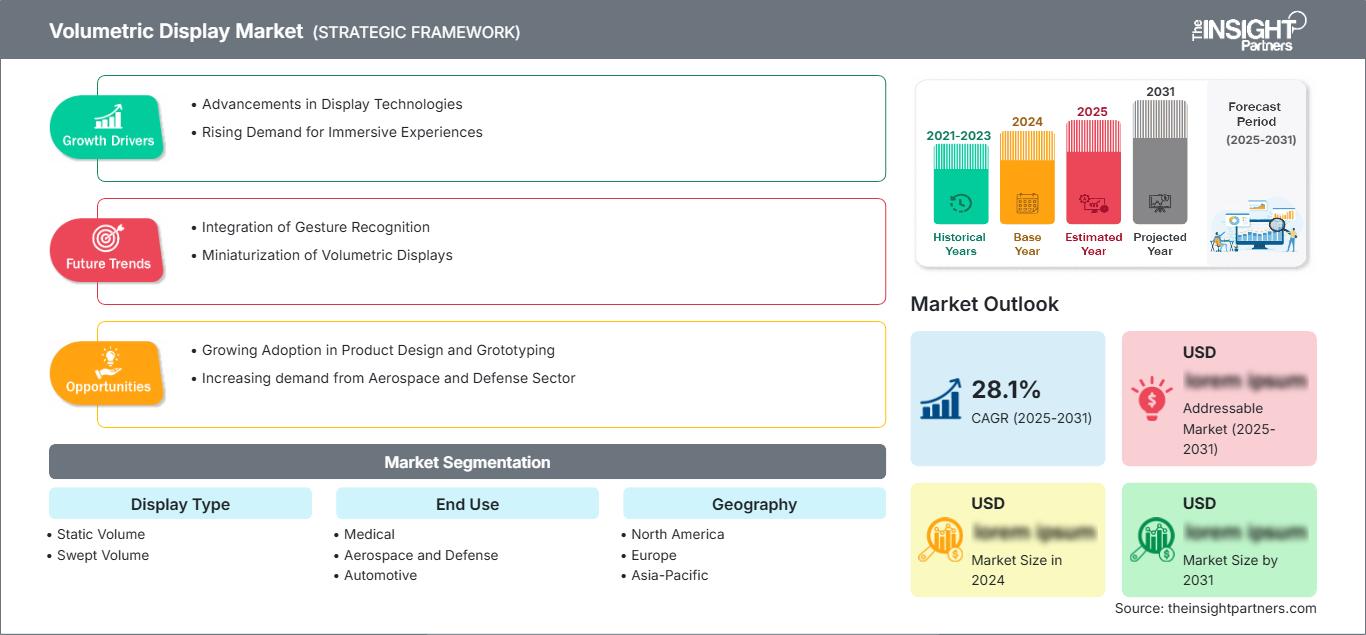
The volumetric display market was valued at US$ 536.84 Million in 2025 and is projected to reach US$ 4,882.8 Million by 2034, expanding at a CAGR of 27.80% during 2026–2034. The market reflects accelerating commercialization of three-dimensional visualization systems that generate spatial images without conventional stereoscopic viewing. Adoption is progressing across medical visualization, aerospace and defense simulation, automotive design, entertainment, and education, supported by advances in optical engineering, rendering, sensing, and display architectures.
North America is expected to maintain a strong position, with the volumetric display market size supported by an estimated CAGR of 26–29% through 2034. Structural growth is associated with defense visualization programs, advanced medical imaging, automotive design, and established photonics ecosystems. The United States remains the principal demand center because technology developers, research institutions, system integrators, and early enterprise adopters are concentrated across the region.
Volumetric Display Market Assessment and Insights
- North America: North America is estimated to represent a 32–35% share in 2025 and is expected to expand at a 26–29% CAGR between 2026–2034, supported by defense visualization, medical imaging, automotive engineering, and established photonics capabilities.
- US: The US accounts for approximately 69–72% of North America's 2025 share and is projected to grow at a 26–29% CAGR between 2026–2034, led by healthcare, defense, and enterprise visualization.
- Europe: Europe is estimated at a 23–26% share in 2025, with a 27–30% CAGR between 2026–2034. Germany, the UK, France, and Italy benefit from automotive engineering, photonics research, medical technology, and industrial visualization programs.
- Asia Pacific: Asia Pacific is estimated at a 28–31% share in 2025 and is expected to record a 30–33% CAGR between 2026–2034. China, Japan, South Korea, and India provide strong electronics, display manufacturing, automotive, and research ecosystems.
- Largest Segment: Static Volume is estimated to hold a 58–62% market share in 2025, with a 25–28% CAGR between 2026–2034, reflecting demand for stable, high-resolution visualization.
- High Growth Segment: Education and Training is estimated at a 15–18% market share in 2025, with a 31–34% CAGR between 2026–2034, driven by immersive technical and medical instruction.
- Key companies analyzed in detail: Alioscopy; Holografika Kft.; Holoxica Limited; Leia, Inc.; Lightspace Technologies Ltd.; Jiangmen Seekway Technology Limited; SeeReal Technologies S.A.; Soscho GmbH; The Coretec Group, Inc.; Voxon Photonics Pty Ltd.
Source: The Insight Partners' analysis based on proprietary research, government publications, company annual reports, investor presentations, industry databases, and expert interviews.
Market trends indicate that visualization technology has moved away from laboratory-centered 3-D visualization towards integrated visualization solutions consisting of optical elements, fast rendering systems, motion control systems, sensors, and dedicated software solutions. Swept volume technology solutions focus on improving refresh rates, colors, voxel resolution, and interoperability, whereas static volume solutions have a tendency towards higher precision and stability, together with larger volumes of visualized data.
Further growth of the market should be observed beyond specialized installations as rendering power increases and the cost of individual elements comes down. Potential deployments of swept volume systems in Asia Pacific can take advantage of electronics manufacturing, whereas Europe can use its expertise in photonics and health innovations. The North American procurement will be relatively advanced due to defense, healthcare, and engineering applications needing specialized visualization systems.
Volumetric Display Market Report Scope
| Report Attribute | Details |
|---|---|
| Market size in 2025 | US$ 536.84 Million |
| Market Size by 2034 | US$ 4,882.8 Million |
| Global CAGR (2026 - 2034) | 27.80% |
| Historical Data | 2021-2024 |
| Forecast period | 2026-2034 |
Volumetric Display Market Analysis
Demands are increasing in those circumstances where normal two-dimensional displays fail to depict spatial relationships in an effective manner. For example, medical professionals are able to view complicated anatomy structures. Similarly, the defense and aerospace industries have the opportunity to visualize their terrain, systems, and mission data. In contrast, automotive designers are capable of viewing 3-D designs. Entertainment and educational consumers would gain by the ability to share viewing experience without the requirement for any special glasses.
The supply side of the volumetric display market remains very much technology-driven because the technologies involved in optics, image generation, thermal management, mechanical stability, and software integration need to function together at the same time. Voxon's VX2 system exemplifies the role of the combination of rotating LED arrays, fast image generation, and software development kits in producing a deployable solution. Holografika provides volumetric-data and light-field rendering technologies.
As per the volumetric display market report, positioning is fragmented because there are varied architectures pursued and not one standard technology architecture that exists. Voxon focuses on swept volume commercialization, Lightspace concentrates on multifocal visualization for the health and defense sector, and SeeReal on holography based on the principles of phase modulation and viewing window. Holografika specializes in light field systems as well as the software, and The Coretec Group on CSpace static volumetric technology.
The investment is therefore geared towards optical architecture differentiation, cost-effective materials, efficient rendering, content ecosystem creation, and specific application integration. Small technology firms are able to compete using their intellectual property through licensing or development partnerships and do not have to establish full manufacturing chains. Positioning strategy is increasingly about demonstrating concrete workflow advantages like enhanced spatial perception, faster interpretation, or collaboration visualization, and not just innovation alone.
● REPORT CUSTOMIZATION
Tailor This Report To Align With Your Specific Business Requirements
This report can be customized to align precisely with your business objectives, scope, and target markets. Customization options include tailored segmentation, geography, competitive analysis, and strategic insights to support informed decision-making.
Customize This Report →WHAT YOU CAN ADJUST
- ● Segmentations
- ● Geography
- ● Competitive Analysis
- ● Language Preferences
Volumetric Display Market: Strategic Insights
Regional Insights
North America Volumetric Display Market
North America accounted for an estimated 32-35% volumetric display market share in 2025 and is forecast to grow at a CAGR of 26-29% over 2034. The region derives advantage from substantial investments in aerospace and defense, advanced medical technology infrastructure, and concentration of technologies such as display, semiconductor, photonics and software. The US makes up for the largest regional market while Canada participates via research and advanced technology.
Healthcare and defense continue to be major commercial avenues, given that users in these segments can rationalize expensive visualization systems on the grounds that depth perception is vital for planning or training. Automotive engineering, simulations, museums and advanced learning constitute other adoption paths. Regional players are giving increasing importance to interoperability with existing digital processes.
U.S. Volumetric Display Market
United States constitutes about 69–72% of North America's total share in 2025 and expected to grow at 26–29% CAGR. Demand is focused on applications related to medical imaging, aerospace and defense, automotive design, R&D, education, and interactive visualization. Suppliers in the commercial sector have already made their mark with regard to demonstrations, customization, software integration, and enterprise implementations.
Increasingly, application trends are shifting towards technologies capable of presenting complicated 3D data without necessitating the use of head-mounted devices. Defense and healthcare sectors are especially important since visualization precision can help in training, planning, and collaborative analysis. Moreover, there are many academic and technical institutions exploring photonics, computer graphics, spatial computing, and advanced display technologies.
Europe Volumetric Display Market
Europe is expected to contribute 23-26% of worldwide revenues by 2025, expanding at a 27-30% CAGR. Germany stands out due to automotive engineering and industrial technology; the UK through research and creative technology as well as defense applications; and France, Italy, and Spain through opportunities in aerospace, healthcare, education, and media.
There is an established industry in Germany for three-dimensional visualization of engineering and automotive design. Integration with digital design and simulation processes could help enable the adoption of the solution when the physical prototypes are expensive and time-consuming. European vendors will also have access to the photonics expertise and multinational research projects in Europe.
There are different demand conditions in the UK, France, Italy, and Spain. Applications in healthcare education, aerospace visualization, museums, cultural installations, automotive design, and creative productions could be potential drivers of deployment. Extended reality initiatives in Europe that aim at the implementation of the technology in healthcare will also create opportunities for specialist vendors to demonstrate their business applications. Participation of Lightspace in the €7.8 million VR Health Champions project in Europe is indicative of that trend.
APAC Volumetric Display Market
APAC is estimated to have a market share of 28%-31% in 2025 and expected to register a 30%-33% CAGR, which makes APAC the fastest growing region among all the regions. China, Japan, South Korea, India, and Australia have complementary strengths in displays, electronics, automobiles, research, education, and entertainment.
China is the lead country in the region due to electronics manufacturing and commercial display developments, while Japan and South Korea have strengths in advanced display and automotive technology, India has strengths in education, healthcare and technology services, and Australia has strengths in research and visualization.
Middle East & Africa Volumetric Display Market
The Middle East and Africa region will have a CAGR of 24-27%. The leading countries in terms of commercialization will be Saudi Arabia and UAE. Investments in digital infrastructure, museums, smart cities, defense, and tourism lead to applications in visualizations. South Africa will serve as an alternative hub for technology and education.
The countries of Saudi Arabia and UAE will continue to dominate the market due to large infrastructure and cultural projects being able to use premium interactive visualizations. However, South Africa and the rest of MEA will develop slower, with applications mainly in education, healthcare, defense, exhibitions, and industrial visualizations.

Segmentation Analysis
Display Type
Display Type segmentation reflects two fundamentally different approaches to producing spatial imagery. Static Volume systems prioritize stable three-dimensional image spaces, precision, and potentially larger or more detailed objects. Swept Volume systems emphasize dynamic images through controlled movement of a display surface or optical element. Static Volume is projected to grow at a 25–28% CAGR, while Swept Volume is expected to expand at a 29–32% CAGR as interactive applications mature.
- Static Volume: Static-volume architectures are strategically important for medical, scientific, engineering, and analytical visualization where spatial stability and precise object representation are more important than rapid mechanical movement.
- Swept Volume: Swept-volume systems support dynamic scenes and interactive content, making them relevant to entertainment, education, simulation, and collaborative visualization where motion and real-time responsiveness influence user engagement.
End Use
End Use segmentation is shaped by the value of spatial information within each application. Medical deployments emphasize anatomical interpretation, Aerospace and Defense focuses on simulation and mission visualization, while automotive users prioritize design and engineering. Media and Entertainment benefits from immersive shared experiences, and Education and Training can use spatial content for interactive learning. The segment is projected to grow at a 29–32% CAGR.
- Medical: Medical applications require detailed three-dimensional visualization for anatomy, imaging, education, and procedure planning, making spatial displays valuable where depth and structure are difficult to communicate through conventional screens.
- Aerospace and Defense: Aerospace and defense users prioritize mission visualization, terrain interpretation, simulation, and system training. The ability to inspect three-dimensional information collaboratively can strengthen analytical and instructional workflows.
- Automotive: Automotive applications include design review, human-machine interface research, simulation, and future head-up visualization. Integration with digital engineering platforms can reduce dependence on physical visualization models.
- Media and Entertainment: Entertainment applications use volumetric imagery to create shared viewing experiences in which audiences can observe dynamic content from different positions without specialized eyewear.
- Education and Training: Education and training applications can present anatomy, engineering systems, scientific structures, and technical procedures as interactive spatial objects, improving the usefulness of visualization-led instruction.
Opportunity Snapshot
| End Use | Revenue Contribution | Trend Tag | Adoption Stage |
|---|---|---|---|
| Medical | High | Surgical Planning | Scaling |
| Aerospace and Defense | High | Mission Simulation | Scaling |
| Automotive | Medium | Spatial HUD | Emerging |
| Media and Entertainment | Medium | Immersive Venues | Scaling |
| Education and Training | Medium | Spatial Learning | Scaling |
Volumetric Display Market Growth Drivers and Impact Analysis
Expansion of spatial visualization in medical and defense workflows
The demand is catalyzed by medical imaging and defense simulation due to the nature of spatial data that these applications rely on. There will be more intuitive display of spatial data in 3D form than using 2D images. This is especially relevant for multi-user applications where the sharing of spatial information can minimize the constraints placed on individuals through the display devices. An example of how Lightspace has positioned the multifocal display architecture is in its healthcare and defense applications such as surgical visualization, remote assistance and mission-oriented applications. Institutions digitizing their processes of training and planning would find the specialized display systems more valuable for workflows than just visualization devices.
Advances in high-speed rendering and optical architectures
Advances in graphics processing, LED matrices, optical technology, sensors, and mechanical control are addressing some of the classic weaknesses of spatial display technologies. Today's systems are capable of processing large amounts of data at high refresh speeds, making it possible for dynamic objects to be displayed stably and with increased definition. The VLED architecture from Voxon brings graphics processing, compression, communication, multiplexing, rapid spatial LED imaging, and feedback together in a single system. Future advances in rendering efficiency may make it possible for smaller systems to have larger amounts of content and greater compatibility with popular 3D creation environments. This would result in less friction with the technical aspects of the systems and allow for the creation of reusable spatial content.
Growing demand for glasses-free collaborative visualization
The fact that glasses-free systems can be used to view three-dimensional objects makes them stand out as a differentiated proposal for collaborative settings. Traditional stereoscopic systems may confine people to specific locations or use specific devices such as headsets while glasses-free technologies make it possible for several people to examine an object from various angles. It is beneficial when it comes to education, museum display, design assessment, exhibitions, medicine education, and command centers. Products such as VX2 developed by Voxon Company offer 360-degree viewing capabilities together with the support of common 3D files, Unity compatibility, and development tools.
Volumetric Display Market Future Trends
Integration of spatial displays with AI-assisted content generation
AI-assisted content creation is expected to become an important enabler as spatial display adoption expands. Generative systems can help convert conventional images, CAD assets, medical datasets, and simulation outputs into optimized three-dimensional representations, reducing the specialist effort required to prepare content. Future platforms may combine automated segmentation, object recognition, depth estimation, and real-time rendering to create interactive spatial scenes. The volumetric display market trend could be especially meaningful in healthcare, engineering, and education, where users generate large volumes of specialized visual material. As software abstraction improves, display suppliers may compete increasingly on content pipelines and application ecosystems rather than optical hardware alone.
Convergence of volumetric, holographic, and multifocal architectures
Technology boundaries are likely to become less distinct as suppliers combine principles from volumetric, holographic, light-field, and multifocal displays. SeeReal's approach, for example, uses viewing windows and sub-holograms to manage computational and optical requirements for real-time holographic imagery, while Lightspace emphasizes multifocal architectures for professional applications. This convergence can create systems optimized for particular viewing distances, numbers of users, image depths, and application requirements. Instead of one universal architecture dominating, the industry is likely to develop differentiated platforms optimized for medical, automotive, defense, entertainment, and enterprise environments.
Volumetric Display Market Opportunities
Enterprise visualization platforms for specialized decision-making
An important opportunity lies in developing complete enterprise platforms rather than selling displays as standalone equipment. Buyers increasingly need hardware, visualization software, data connectors, calibration, content conversion, training, and ongoing support. Vendors can package these capabilities around specific workflows such as surgical planning, aircraft design, defense simulation, engineering review, or technical education. The volumetric display market share can therefore expand through verticalized solutions that demonstrate measurable operational value. Partnerships with software developers, hospitals, universities, engineering companies, and system integrators can accelerate adoption by reducing implementation complexity and allowing technology providers to access established customer relationships.
Regional manufacturing and component localization
Localization of optical components, display modules, controllers, and precision mechanical assemblies creates another opportunity. Supply-chain concentration can expose advanced display producers to component availability, transportation costs, tariffs, and long procurement cycles. Regional manufacturing partnerships could shorten lead times and enable customized systems for local applications. Asia Pacific is particularly relevant because of its electronics and display manufacturing base, while North America and Europe offer specialized photonics, defense, and medical technology ecosystems. Companies that establish modular architectures and qualified regional suppliers may improve scalability while reducing production risk. The opportunity is strongest where local customers require tailored display volumes, interfaces, software, or regulatory support.
Frequently Asked Questions

- Comprehensive Market Sizing and Forecast Analysis
- Detailed Segmentation Analysis
- In-Depth Market Dynamics Assessment
- Regional and Country-Level Insights
- Competitive Landscape and Company Benchmarking
- Strategic Business Intelligence
Recent Reports
Testimonials

The Insight Partners provided valuable market intelligence that supported our global go-to-market strategy. Their team was professional, responsive, and attentive to our feedback, providing thoughtful analysis and helpful methodological clarifications throughout the project.
Junmo Kim Chief Financial Officer (CFO), Enertech Co., Ltd.
The Insight Partners' SCADA System Market report is comprehensive, with valuable insights on current trends and future forecasts. The team was highly professional, responsive, and supportive throughout. We are very satisfied and highly recommend their services.
RAN KEDEM Partner, Reali Technologies LTDs
I requested a report on a very specific software market and the team produced the report in a few days. The information was very relevant and well presented. I then requested some changes and additions to the report. The team was again very responsive and I got the final report in less than a week.
JEAN-HERVE JENN Chairman, Future Analytica
We worked with The Insight Partners for an important market study and forecast. They gave us clear insights into opportunities and risks, which helped shape our plans. Their research was easy to use and based on solid data. It helped us make smart, confident decisions. We highly recommend them.
PIYUSH NAGPAL Sr. Vice President, High Beam Global
The Insight Partners delivered insightful, well-structured market research with strong domain expertise. Their team was professional and responsive throughout. The user-friendly website made accessing industry reports seamless. We highly recommend them for reliable, high-quality research services
YUKIHIKO ADACHI CEO, Deep Blue, LLC.
This is the first time I have purchased a market report from The Insight Partners.While I was unsure at first, I visited their web site and felt more comfortable to take the risk and purchase a market report.I am completely satisfied with the quality of the report and customer service. I had several questions and comments with the initial report, but after a couple of dialogs over email with their analyst I believe I have a report that I can use as input to our strategic planning process.Thank you so much for taking the extra time and making this a positive experience.I will definitely recommend your service to others and you will be my first call when we need further market data.
JOHN SUZUKI President and Chief Executive Officer, Board Director, BK Technologies
I wish to appreciate your support and the professionalism you displayed in the course of attending to my request for information regarding to infectious disease IVD market in Nigeria. I appreciate your patience, your guidance, and the fact that you were willing to offer a discount, which eventually made it possible for us to close a deal. I look forward to engaging The Insight Partners in the future, all thanks to the impression you have created in me as a result of this first encounter.
DR CHIJIOKE ONYIA MANAGING DIRECTOR, PineCrest Healthcare Ltd.Reason to Buy
- Informed Decision-Making
- Understanding Market Dynamics
- Competitive Analysis
- Identifying Emerging Markets
- Customer Insights
- Market Forecasts
- Risk Mitigation
- Boosting Operational Efficiency
- Strategic Planning
- Investment Justification
- Tracking Industry Innovations
- Aligning with Regulatory Trends





 Get Free Sample for