
VRT Technology Market Trends, Size & Growth by 2034
Coverage: By Application (Soil Sensing VRT, Fertilizer VRT, Seeding VRT, Crop Protection Chemical VRT, Yield Monitor VRT, Irrigation VRT, Other VRT Types); Application Method (Sensor Based VRT, Map Based VRT); Farm Size (Large Farms, Small Farms, Mid-Size Farms), and Geography (North America, Europe, Asia Pacific, and South and Central America)
- Status : Data Released
- Report Code : TIPRE00016024
- Category : Electronics and Semiconductor
- No. of Pages : 150
- Available Report Formats :


- Last update date : September 22, 2026


2025 Market Size
US$ 2.41 Bn
Base year value
2034 Forecast
US$ 5.4 Bn
Projected by 2034
CAGR 2026-2034
9.36 %
Growth rate
Addressable Market
US$ 34.84 Bn
(2026-2034)
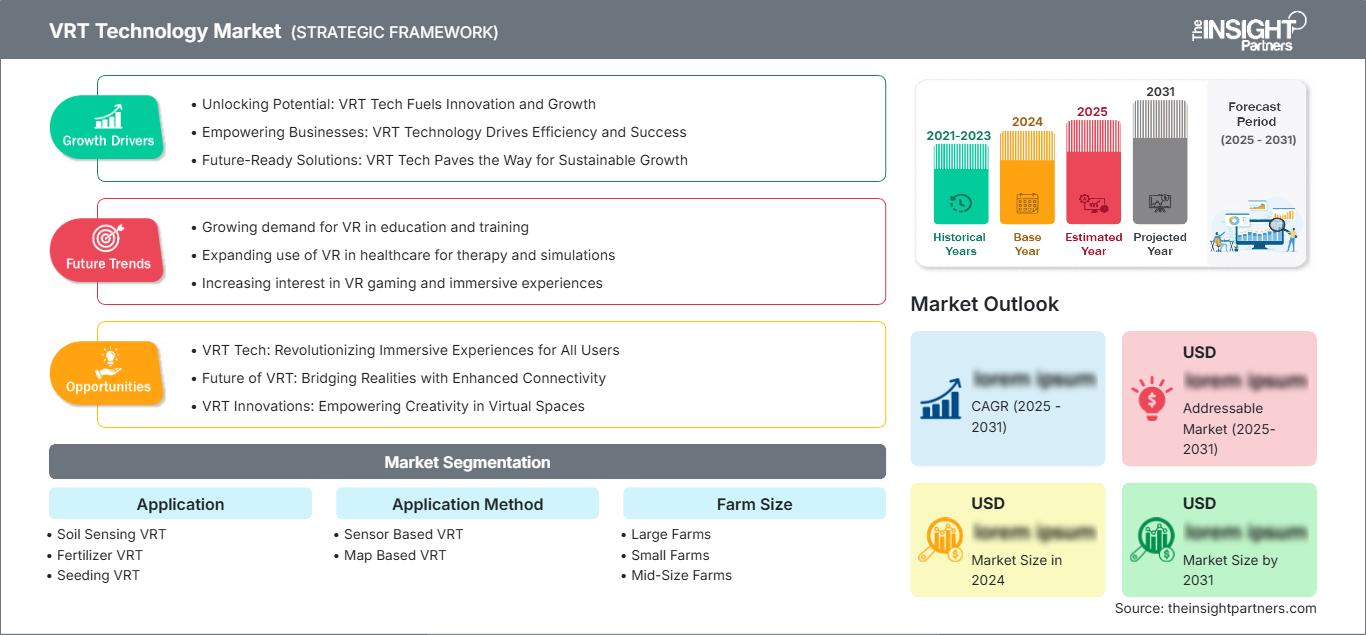
The VRT technology market is projected to grow from US$ 2.41 Billion in 2025 to US$ 5.4 Billion by 2034, registering a CAGR of 9.36% during 2026–2034. Demand is being shaped by precision input management, higher fertilizer efficiency, data-linked machinery, and farm-level pressure to raise productivity while controlling crop production costs.
North America remains a high-adoption region because large row-crop farms use connected machinery, yield monitors, soil maps, and GPS-enabled application tools at scale. The VRT technology market size in the region is supported by mature equipment fleets, sustainability-linked nutrient management programs, and rapid upgrades in sensor-based spraying and variable-rate seeding systems.
VRT Technology Market Assessment and Insights
- North America: The region accounted for 34–38% share in 2025 and is expected to grow at 8.6–9.2% CAGR between 2026–2034, led by high mechanization, dealer support, and large-farm adoption.
- US: The U.S. represented 72–76% of North America in 2025 and is projected to expand at 8.7–9.3% CAGR, supported by corn, soybean, cotton, and wheat applications.
- Europe: Europe held 24–28% share in 2025 and is forecast to register 8.1–8.8% CAGR, with Germany, France, the UK, Italy, and Spain leading adoption.
- Asia Pacific: APAC captured 20–24% share in 2025 and is expected to grow at 10.1–10.8% CAGR, driven by China, India, Japan, Australia, and South Korea.
- Largest Segment: Fertilizer VRT held 28–32% market share in 2025 and is expected to grow at 8.8–9.4% CAGR as nutrient optimization remains the clearest return-on-investment case.
- High Growth Segment: Sensor Based VRT represented 38–42% share in 2025 and is projected to grow at 10.4–11.1% CAGR as machine vision and real-time crop sensing accelerate.
- Key companies analyzed in detail: Aarkay Food Product, Ag Leader Technology, AGCO Corporation, CNH Industrial N.V., Deere & Company, Kubota Corporation, Lindsay Corporation, Raven Industries Inc., SST Software, and Yara International ASA.
Source: The Insight Partners' analysis based on proprietary research, government publications, company annual reports, investor presentations, industry databases, and expert interviews.
This growth in the market arises due to the transition from simple navigation aids to closed-loop system implementations in fields. More and more farmers are resorting to the use of yield maps, soil sampling, sensors installed underground, and prescription maps in order to determine areas where fertilizers, seeds, crop protection materials, or irrigation need to be varied within a particular field.
The move towards investment in retrofits, mixed fleets, and sensing technology is growing in importance. The growing policy concern related to nutrient runoff, water conservation, and proper use of pesticides has expanded the addressable base. Emerging geographies are expected to adopt lower-cost VRT configurations first, while large commercial farms use more advanced connected platforms and autonomous application workflows, according to the VRT Technology Market report.
VRT Technology Market Report Scope
| Report Attribute | Details |
|---|---|
| Market size in 2025 | US$ 2.41 Billion |
| Market Size by 2034 | US$ 5.4 Billion |
| Global CAGR (2026 - 2034) | 9.36% |
| Historical Data | 2021-2024 |
| Forecast period | 2026-2034 |
VRT Technology Market Analysis
Market demand is getting a boost from expensive fertilizers, labor issues, weather changes, and the need to turn field information into business action. The variable rate approach lets farmers address the challenges of soil nutrition differences, canopy density, weeds and water availability more precisely than any uniform program would allow. The ecosystem consists of equipment makers, control devices suppliers, sensor makers, software for agronomy, dealers, crop consultants, and farm data systems.
The supply is getting better because the technology of ISOBUS connectivity, cloud mapping, wireless data transfer and machine telematics is getting increasingly common among tractors, sprayers, planters and irrigation equipment. The adoption is growing faster on big farms since the equipment price can be distributed over a larger area, but the use of retrofit devices and subscriptions makes midsize operations consider phased adoption.
Market analysis points to competition extending beyond product specifications into decision support. Deere & Company, AGCO Corporation, CNH Industrial N.V. and Kubota Corporation are enhancing their connected machine ecosystem, whereas Ag Leader Technology, Raven Industries Inc., SST Software, Lindsay Corporation and Yara International ASA deliver value through control systems, agronomy platforms, irrigation solutions and nutrient intelligence.
Positioning is more and more about interoperability, services and demonstrable return on investment. Firms that offer capabilities such as multi-vendor fleet integration, prescription writing, sensor calibration and field-based analytics are well-positioned to capture repeat software sales and upgrades. The future belongs to solutions that enable growers to leverage agronomic recommendations along with implementation tools, and demonstrate sustainable practices to customers, regulators and lenders.
● REPORT CUSTOMIZATION
Tailor This Report To Align With Your Specific Business Requirements
This report can be customized to align precisely with your business objectives, scope, and target markets. Customization options include tailored segmentation, geography, competitive analysis, and strategic insights to support informed decision-making.
Customize This Report →WHAT YOU CAN ADJUST
- ● Segmentations
- ● Geography
- ● Competitive Analysis
- ● Language Preferences
VRT Technology Market: Strategic Insights
Regional Insights
North America vrt technology market
North America held 34–38% of global revenue in 2025 and is expected to grow at 8.6–9.2% CAGR through 2034. The region benefits from large commercial farms, advanced dealer networks, high GPS guidance penetration, and widespread use of yield maps. The vrt technology market share in North America also reflects strong demand for variable-rate fertilizer, seeding, and spraying in corn, soybean, wheat, and cotton systems.
Adoption is supported by better data availability and evidence that precision tools help reduce input waste. U.S. government reporting indicates that precision practices were used by 27% of farms or ranches in 2023, while variable-rate adoption has increased across several major crops. These patterns support continued upgrades in controllers, displays, sensors, software, and targeted application equipment.
U.S. vrt technology Market
The U.S. accounted for 72–76% of North American demand in 2025 and is expected to grow at 8.7–9.3% CAGR. Large farms remain the core users because VRT improves fertilizer placement, seed population decisions, spray efficiency, and irrigation scheduling. Corn, soybean, cotton, and winter wheat acreage provide a substantial operating base for variable-rate implementation.
USDA data shows corn VRT adoption reached 37.4% of planted acres in 2016, while cotton acreage using VRT reached 22.7% in 2019. Recent precision agriculture reporting also shows stronger adoption among large-scale crop farms. These indicators support continued demand for Deere & Company, AGCO Corporation, CNH Industrial N.V., Raven Industries Inc., and Ag Leader Technology solutions.
Europe vrt technology Market
Europe represented 24–28% share in 2025 and is projected to grow at 8.1–8.8% CAGR. In this region, Germany takes precedence in the uptake of VRT technology through its mechanized systems of growing grains, oilseeds, and forages, whereas France and the UK have been consistently using nutrient management technologies. The countries of Italy and Spain have begun adopting VRT in specialty crop production, irrigation, and mixed farming situations.
The growth in this region is driven by the need for fertilizer efficiency, soil conservation, and environmental compliance. This region has different farm sizes compared to North America and, therefore, unequal adoption of the technology, although service-based mapping, calibrated dealerships, and cooperatively-owned equipment are helping in improving access.
APAC vrt technology Market
APAC held 20–24% share in 2025 and is forecast to expand at 10.1–10.8% CAGR. China through size, Australia via mechanized broadacre implementation, Japan and South Korea through controlled farming systems, and India as a growing market where cheap sensors, service providers, and rent models can enable further penetration.
The drivers behind the market development include food security issues, water stress, labor shortage, and agricultural digitalization policies. The adoption pattern will be diverse, but variable rate fertilization, irrigation VRT, and plant protection sensors are likely to make inroads into commercial farming hubs.
Middle East & Africa vrt technology Market
Middle East & Africa is expected to grow at 7.2–8.0% CAGR during 2026–2034. The Gulf states are resorting to precision irrigation techniques and controlled agriculture in response to water shortages, whereas South Africa continues to be the most advanced region in terms of the use of broadacre precision equipment.
Regional factors that influence the opportunities include the modernization of irrigation systems, food security policies, and investments into commercial farms. The use of VRT technology is feasible under conditions when there are high-value crops, water shortage, and mechanized farming processes. Financing and infrastructure issues continue to limit the use of technologies, but service-based approach can mitigate these problems.
Segmentation Analysis
Application
Application is expected to grow at 8.9–9.6% CAGR as farmers apply VRT across fertilizer, seeding, crop protection, yield monitoring, irrigation, and soil sensing. The vrt technology market scope is broadening because each application improves a different farm decision, from nutrient placement and seed density to water scheduling and weed control.
- Soil Sensing VRT: Demand is rising as growers use soil variability data to refine prescriptions, manage fertility zones, and improve input planning before planting and in-season application.
- Fertilizer VRT: This is the largest application because nutrient placement provides clear cost control, yield protection, and environmental benefits in row crop and broadacre operations.
- Seeding VRT: Adoption is increasing where growers adjust plant population by soil productivity, moisture capacity, and yield potential to improve stand consistency and seed efficiency.
- Crop Protection Chemical VRT: Growth is tied to targeted spraying, weed-density detection, canopy sensing, and pressure to reduce pesticide use while maintaining agronomic performance.
- Yield Monitor VRT: Yield data remains foundational because historic productivity maps guide prescriptions, validate input strategies, and support repeatable return-on-investment assessment.
- Irrigation VRT: Demand is strongest in water-stressed regions where variable application supports moisture balance, pumping efficiency, and crop stress management.
Application Method
Application Method is forecast to grow at 9.4–10.1% CAGR as sensor-based and map-based systems address different adoption needs. Map-based VRT remains practical for farms with soil, yield, and prescription data, while sensor-based VRT is gaining momentum because real-time detection improves responsiveness during spraying, fertilization, and irrigation.
- Sensor Based VRT: This method is gaining share as cameras, biomass sensors, moisture probes, and machine vision adjust application rates using current field conditions.
- Map Based VRT: This approach remains important for farms with mature agronomic datasets, planned prescriptions, and stable field zones that support pre-defined application decisions.
Farm Size
Farm Size is expected to grow at 8.5–9.2% CAGR as adoption patterns differ by capital availability, acreage scale, and service access. Large farms lead because fixed technology costs can be distributed across more hectares, while mid-size and small farms rely more on dealers, custom applicators, and retrofit systems.
- Large Farms: Large operations show the highest adoption because VRT can reduce input waste across extensive acreage and support more sophisticated machinery and data workflows.
- Small Farms: Small farms adopt selectively, often through service providers or basic map-based tools where the economic case is strongest for fertilizer or irrigation savings.
- Mid-Size Farms: Mid-size farms are a growth bridge as retrofit kits, subscription software, and dealer support lower the barrier to controlled precision application.
Opportunity Snapshot
| Application | Revenue Contribution | Trend Tag | Adoption Stage |
| Soil Sensing VRT | Medium | Soil Mapping | Scaling |
| Fertilizer VRT | High | Nutrient Efficiency | Mature |
| Seeding VRT | Medium | Population Control | Scaling |
| Crop Protection Chemical VRT | High | Targeted Spray | Scaling |
| Yield Monitor VRT | Medium | Yield Mapping | Mature |
| Irrigation VRT | Medium | Water Precision | Scaling |
VRT Technology Market Growth Drivers and Impact Analysis
Rising Need to Improve Input Efficiency
In the face of input cost volatility, there is a need for farmers to apply fertilizers, seeds, water, and pesticides when and where they are needed. Variable rate technology eliminates waste through uniform applications, as prescriptions are based on agronomic zones, sensor readings, and biomass. In addition, environmental concerns favor adoption as a means of avoiding run-off and documenting compliance.
Expansion of Connected Machinery and Farm Data Platforms
Smart tractors, sprayers, planters, and irrigation systems are facilitating variable-rate application on behalf of farmers. Wireless data transmission, cloud-based maps, telemetry data from machines, and multi-machine fleets ease the connection between planning and implementation. As the farms create more data regarding yield, soil, and machines, the importance of VRT is rising since recommendations can be used to change the rate automatically.
Large-Farm Adoption and Retrofit Availability
Large-scale operations continue to be the most enthusiastic adopters as economies of scale work in their favor. But retrofits and support by dealerships have made the technology accessible to mid-sized farms and mixed fleets. This is critical since many farmers use equipment from several different vendors and cannot afford a whole new fleet of machinery. Retrofitted versions have created adoption paths for smaller customers of VRT technology.
VRT Technology Market Future Trends
Sensor-Based Real-Time Application
The vrt technology market trends are moving rapidly toward real-time sensing, especially in spraying, fertilization, and irrigation. Camera, biomass, soil probes, and machine learning have the ability to make the machines adapt to field variation through current data rather than depending on past field maps. This will ensure that precision is enhanced in areas where weeds, moisture, and canopy conditions change quickly. With falling sensor prices and better calibration, it is anticipated that sensor-based VRT will be within easy reach of premium fleets.
Autonomous and Mixed-Fleet Precision Workflows
The future use of VRT will become increasingly associated with autonomous farming operations, digital work orders, and mixed-fleet management systems. Farmers will want to use technology that integrates the planning, execution, recording, and analysis of variable-rate operations into a single process. This will help to alleviate labor needs while also helping to maintain consistency during the critical window period. Interoperability will be important as farmers will need to use technology with existing equipment and other implement manufacturers.
VRT Technology Market Opportunities
Service-Based VRT for Mid-Size and Small Farms
The vrt technology market forecasts indicate an opportunity for dealers, agronomists, and custom applicators to deliver VRT as a service. Most mid-sized and smaller farms could benefit from precision agriculture advantages but may not have enough funds, know-how, or land mass to afford whole systems. Service providers could offer packages that include soil sampling, prescription maps, equipment calibration, application, and performance measurement.
Sustainability Reporting and Verified Input Reduction
Food organizations, banks, and governments are more and more becoming increasingly concerned with concrete evidence of sustainable farm operations. VRT systems can track where reductions occurred, how the nutrient program was impacted, and where the water and chemical usage became better. This provides an opportunity for tech firms to integrate farm performance information and the sustainability reporting applications. Firms able to convert farm data into environmental metrics will be able to build up customer loyalty and engage in new incentive programs.
Frequently Asked Questions

- Comprehensive Market Sizing and Forecast Analysis
- Detailed Segmentation Analysis
- In-Depth Market Dynamics Assessment
- Regional and Country-Level Insights
- Competitive Landscape and Company Benchmarking
- Strategic Business Intelligence
Recent Reports
Testimonials

The Insight Partners' SCADA System Market report is comprehensive, with valuable insights on current trends and future forecasts. The team was highly professional, responsive, and supportive throughout. We are very satisfied and highly recommend their services.
RAN KEDEM Partner, Reali Technologies LTDs
I requested a report on a very specific software market and the team produced the report in a few days. The information was very relevant and well presented. I then requested some changes and additions to the report. The team was again very responsive and I got the final report in less than a week.
JEAN-HERVE JENN Chairman, Future Analytica
We worked with The Insight Partners for an important market study and forecast. They gave us clear insights into opportunities and risks, which helped shape our plans. Their research was easy to use and based on solid data. It helped us make smart, confident decisions. We highly recommend them.
PIYUSH NAGPAL Sr. Vice President, High Beam Global
The Insight Partners delivered insightful, well-structured market research with strong domain expertise. Their team was professional and responsive throughout. The user-friendly website made accessing industry reports seamless. We highly recommend them for reliable, high-quality research services
YUKIHIKO ADACHI CEO, Deep Blue, LLC.
This is the first time I have purchased a market report from The Insight Partners.While I was unsure at first, I visited their web site and felt more comfortable to take the risk and purchase a market report.I am completely satisfied with the quality of the report and customer service. I had several questions and comments with the initial report, but after a couple of dialogs over email with their analyst I believe I have a report that I can use as input to our strategic planning process.Thank you so much for taking the extra time and making this a positive experience.I will definitely recommend your service to others and you will be my first call when we need further market data.
JOHN SUZUKI President and Chief Executive Officer, Board Director, BK Technologies
I wish to appreciate your support and the professionalism you displayed in the course of attending to my request for information regarding to infectious disease IVD market in Nigeria. I appreciate your patience, your guidance, and the fact that you were willing to offer a discount, which eventually made it possible for us to close a deal. I look forward to engaging The Insight Partners in the future, all thanks to the impression you have created in me as a result of this first encounter.
DR CHIJIOKE ONYIA MANAGING DIRECTOR, PineCrest Healthcare Ltd.Reason to Buy
- Informed Decision-Making
- Understanding Market Dynamics
- Competitive Analysis
- Identifying Emerging Markets
- Customer Insights
- Market Forecasts
- Risk Mitigation
- Boosting Operational Efficiency
- Strategic Planning
- Investment Justification
- Tracking Industry Innovations
- Aligning with Regulatory Trends





 Get Free Sample for