
Water Quality Monitoring Systems Market Trends, Size & Growth by 2034
Coverage: By Component (Dissolved Oxygen Sensors, PH Sensors, Turbidity Sensors, Temperature Sensors, TOC Analyzer, Others); End-user (Industrial, Utility, Commercial, Residential) , and Geography (North America, Europe, Asia Pacific, and South and Central America)
- Status : Data Released
- Report Code : TIPRE00004998
- Category : Electronics and Semiconductor
- No. of Pages : 150
- Available Report Formats :


- Last update date : September 28, 2026


2025 Market Size
US$ 6.34 Bn
Base year value
2034 Forecast
US$ 10.33 Bn
Projected by 2034
CAGR 2026-2034
5.57 %
Growth rate
Addressable Market
US$ 75.56 Bn
(2026-2034)
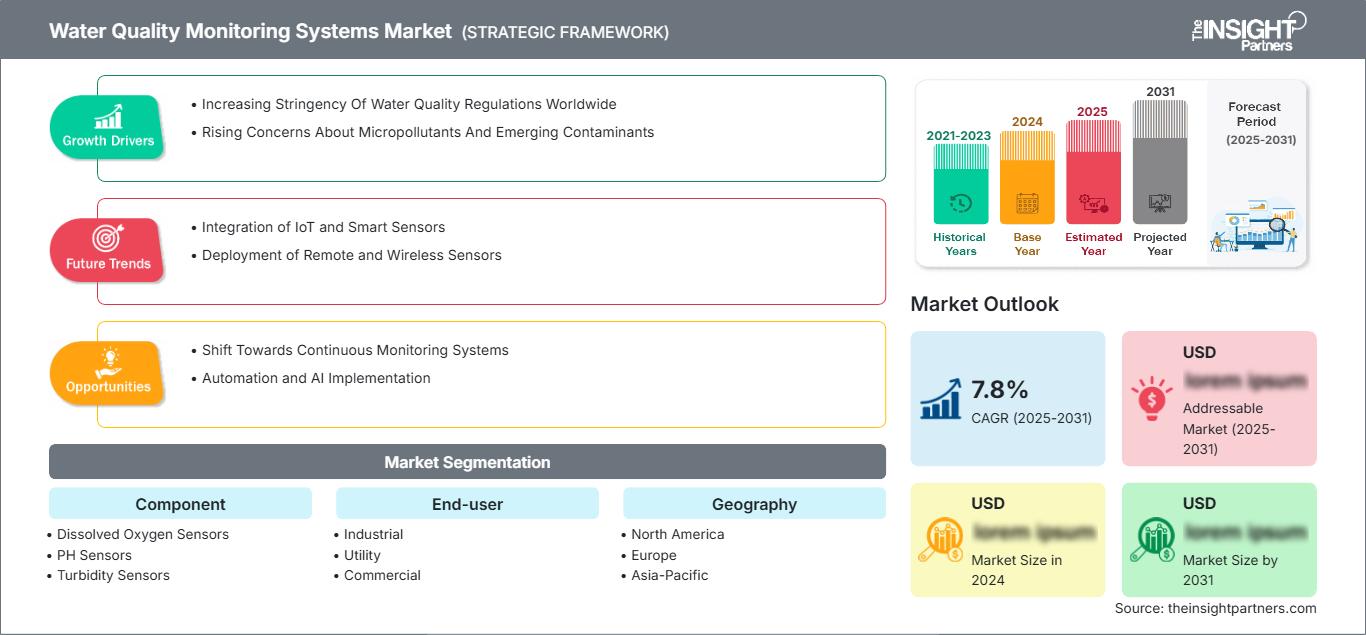
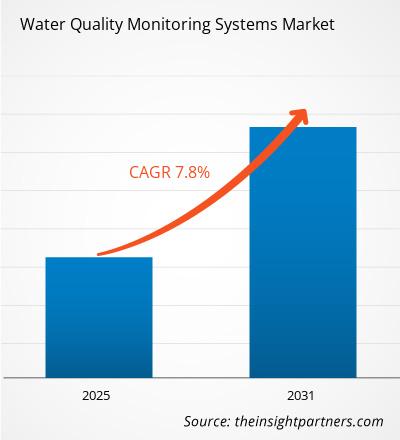
The global Water Quality Monitoring Systems market was valued at US$ 6.34 billion in 2025 and is expected to reach US$ 10.33 billion by 2034; it is estimated to record a CAGR of 5.57% during 2026-2034.
Water Quality Monitoring Systems Market Assessment and Insights
- North America: North America is expected to account for 32–35% share in 2025, growing at a 5.8–6.4% CAGR between 2026–2034, supported by infrastructure renewal, regulatory compliance, industrial discharge monitoring, and digital utility investments.
- US: The US is estimated to represent 82–85% of North American revenue in 2025, expanding at a 5.7–6.3% CAGR between 2026–2034, led by municipal modernization and industrial compliance.
- Europe: Europe is projected to hold 21–23% share in 2025 and expand at a 5.4–6.0% CAGR between 2026–2034. Germany, the UK, France, Italy, and Spain are leading adoption through wastewater controls and water-efficiency programs.
- Asia Pacific: Asia Pacific is estimated at 30–32% share in 2025, with a 7.5–8.5% CAGR between 2026–2034. China, Japan, India, South Korea, and Australia are strengthening deployment through industrialization and water-security initiatives.
- Largest Segment: Utility end users are estimated at 38–42% market share in 2025, advancing at a 6.0–6.7% CAGR between 2026–2034 as continuous compliance monitoring becomes standard.
- High Growth Segment: Industrial end users are estimated at 31–35% share in 2025, growing at a 6.8–7.5% CAGR between 2026–2034, supported by wastewater reuse and process optimization.
- Key companies analyzed in detail: Danaher Corporation, Evoqua Water Technologies LLC, General Electric Company, HORIBA, Ltd., OAKTON Instruments, Pentair plc., Shimadzu Corporation, Thermo Fisher Scientific Inc., Uponor Corporation, and Xylem Inc.
Source: The Insight Partners' analysis based on proprietary research, government publications, company annual reports, investor presentations, industry databases, and expert interviews.
The water quality monitoring systems market has evolved from periodic laboratory sampling toward connected, automated measurement architectures combining sensors, analyzers, communications, and software. Advancements in electrochemical sensing, optical measurements, sensor robustness, calibration, and telemetry capabilities are allowing operators to monitor changes in water quality without requiring more labor-intensive actions. Modular design, extended maintenance intervals, compatibility, and instrumentation ready to deliver data have become important characteristics of the production cycle.
The future perspectives include development in emerging Asian markets, industrial water recycling, decentralized treatment facilities, and infrastructure digitization. Increased regulatory requirements have established recurring demand for accurate measurement, while utilities consider lifecycle costs instead of purchase cost only. Investment is also moving toward systems that combine monitoring with process control, allowing water operators to use measured conditions to optimize aeration, chemical dosing, filtration, and maintenance decisions, according to the Water Quality Monitoring Systems Market report.
Water Quality Monitoring Systems Market Report Scope
| Report Attribute | Details |
|---|---|
| Market size in 2025 | US$ 6.34 Billion |
| Market Size by 2034 | US$ 10.33 Billion |
| Global CAGR (2026 - 2034) | 5.57% |
| Historical Data | 2021-2024 |
| Forecast period | 2026-2034 |
Water Quality Monitoring Systems Market Analysis
The water quality monitoring systems market growth is closely linked to water scarcity, industrial discharge requirements, treatment capacity expansion, and the transition toward continuous measurement. The value chain covers sensing devices, analyzers, calibrators, communication devices, software, integration, installation, and maintenance. The competition among suppliers is getting intense due to the need for measurement accuracy, serviceability, connection to data, and compatibility with existing treatment facilities.
There is a demand for such equipment when water quality affects the operations or regulations directly. In the case of municipal water companies, there is a need for reliable measurement throughout their treatment facilities and distribution networks, while industries make use of measurements of pH, dissolved oxygen, turbidity, temperature, and organic load for controlling their operations.
The water quality monitoring systems market analysis indicates a competitive environment combining diversified technology companies with specialized analytical-instrument manufacturers. Danaher Corp. is present via its water analysis offerings, whereas Xylem Inc. leverages its measurement technology together with wider offerings in water infrastructure technology. HORIBA, Ltd., Shimadzu Corp., Thermo Fisher Scientific Inc., and OAKTON Instruments focus on precision and application-specific instrument technology.
The competitive strategy now revolves more and more around installed base support, sensor economics of life cycle and digital integration. Pentair plc. and General Electric Company enjoy the advantage of wider water and industrial technology offerings, whereas Evoqua Water Technologies LLC still has its ties to advanced water treatment technologies belonging to Xylem Inc. Uponor Corp. offers knowledge in water infrastructure technology.
● REPORT CUSTOMIZATION
Tailor This Report To Align With Your Specific Business Requirements
This report can be customized to align precisely with your business objectives, scope, and target markets. Customization options include tailored segmentation, geography, competitive analysis, and strategic insights to support informed decision-making.
Customize This Report →WHAT YOU CAN ADJUST
- ● Segmentations
- ● Geography
- ● Competitive Analysis
- ● Language Preferences
Water Quality Monitoring Systems Market: Strategic Insights
Regional Insights
North America Water Quality Monitoring Systems Market
North America is estimated to command 32–35% share of the Water Quality Monitoring Systems Market in 2025, with a 5.8–6.4% CAGR through 2034. The US accounts for most regional revenue, while Canada contributes through municipal, mining, energy, and environmental applications. The presence of regulatory control, aging of treatment infrastructure, PFAS issues, and infrastructure upgrades is driving the adoption of online monitors by utility companies rather than periodic sampling. Industrial companies are also turning to connected analyzers to provide evidence of discharge compliance and process control.
The regional purchasing system is now giving preference to instruments that can be integrated into supervisory control systems and remote dashboards via cloud connections. For utility companies, reliable operation of equipment over a wide area is crucial, thus making remote diagnostics and alarms more and more important. For industrial users, reliable measurements are equally important when water quality influences production yield or treatment cost. All this makes the combination of environmental regulations at the federal and state levels, capital investment, and labor force shortage supportive of continuous adoption.
U.S. Water Quality Monitoring Systems Market
The US is estimated to represent 82–85% of North American Water Quality Monitoring Systems Market revenue in 2025 and is projected to expand at a 5.7–6.3% CAGR through 2034. The market gains from federal and state standards for drinking water, discharge of wastewater, industrial sites, and environmental monitoring. Remote analyzers, multi-parameter probes, and remote telemetry are gaining in popularity where continuous data provides protection against regulatory non-compliance or process uncertainty.
Applications range from municipal treatment facilities to power production, chemicals, food processing, pharmaceuticals, and mining. Firms including Danaher Corporation, Xylem Inc., Thermo Fisher Scientific Inc., and Pentair plc have significant exposure to the technology via their water analysis or treatment product offerings. US purchasing decisions for connected monitoring platforms are becoming more concerned about cybersecurity, interoperability, calibration needs, and total cost of ownership. Infrastructure upgrades and contaminant monitoring will keep equipment demand stable.
Europe Water Quality Monitoring Systems Market
Europe is estimated to have 21–23% of the Water Quality Monitoring Systems Market share in 2025, with a 5.4–6.0% CAGR. Germany is still a major market due to its industrial nature and the sophistication of its wastewater management. In the UK, there is more focus on the modernization of utilities as well as environmental standards. In France, Italy, and Spain, there are growing opportunities for monitoring due to rising water stress and the need to use water efficiently and for wastewater quality needs.
Germany has advantages due to advanced industries that require reliable monitoring of wastewater and process water. There is a need for modernizing the assets of utilities in the UK market, as well as meeting environmental standards. France has an ongoing focus on sustainable water management and digital infrastructure. Italy and Spain have a higher need for monitoring due to the existence of drought and irregular distribution of water resources.
APAC Water Quality Monitoring Systems Market
APAC is estimated to hold 30–32% share of the Water Quality Monitoring Systems Market in 2025 and is expected to record a 7.5–8.5% CAGR, making it the leading high-growth region. Regional market leadership is held by China, followed by Japan, India, South Korea, and Australia. The growing requirements for industrial wastewater management, urban development, river rehabilitation, and smart cities are driving the monitoring needs in municipal and industrial applications.
China combines the need for big treatment infrastructure with the industrial pollution control requirements. Japan focuses on automation and precise measurements, whereas India requires treatment and water quality infrastructure due to urbanization. South Korea supports advanced industrial monitoring, and water security and resource management are important for Australia. Continuous sensing and remote monitoring are gaining more investment in the region.
Middle East & Africa Water Quality Monitoring Systems Market
The Middle East and Africa Water Quality Monitoring Systems Market is expected to expand at a 6.0–6.5% CAGR through 2034. Saudi Arabia and UAE form significant demand centers owing to the continuous monitoring required for desalination, water reuse, and infrastructural projects. South Africa is involved through municipal treatment and industrial usage, while the remaining part of MEA is an opportunity area that is related to decentralized treatment and security of resources.
Highly energy-consuming desalination and wastewater treatment make process optimization highly desirable in the Gulf. In Saudi Arabia and the UAE, more attention is paid to water reuse and infrastructure stability, while South Africa requires compliance with municipal and industrial water quality standards. Monitoring implementation in the wider region is still dependent on the financing of the project, service provision, and environmental regulations. Thus, suppliers with high installation and maintenance services can benefit from this situation.
Segmentation Analysis
Component
The Component segment is projected to grow at a 6.1–6.7% CAGR from 2026–2034. Sensors remain central because they provide the primary measurement layer for automated systems. Buyers increasingly seek longer sensor life, lower calibration frequency, resistance to fouling, and compatibility with digital communication protocols. Integration of multiple parameters into compact platforms is also reducing installation complexity across treatment facilities, as outlined in the Water Quality Monitoring Systems Market forecast.
- Dissolved Oxygen Sensors: These sensors remain important in biological wastewater treatment, aquaculture, and process applications because dissolved oxygen directly influences aeration control, microbial activity, and treatment efficiency.
- PH Sensors: pH sensors serve broad industrial and municipal applications, particularly where chemical dosing, corrosion control, neutralization, and discharge compliance require continuous measurement and dependable calibration.
- Turbidity Sensors: Turbidity sensors support drinking-water treatment, filtration control, environmental monitoring, and wastewater applications where suspended particles provide an immediate indicator of changing water conditions.
- Temperature Sensors: Temperature sensors provide a foundational measurement for treatment control and process interpretation because temperature influences reaction rates, dissolved oxygen behavior, biological activity, and sensor compensation.
- TOC Analyzer: TOC analyzers address applications requiring organic-load measurement, particularly industrial water, pharmaceutical processing, semiconductor manufacturing, and high-purity water systems where contamination control is strategically important.
End-user
The End-user segment is projected to expand at a 6.2–6.9% CAGR from 2026–2034. Utilities maintain the largest installed base, while industrial users represent an important growth engine because water reuse, discharge compliance, and process optimization increasingly require continuous measurement. Commercial and residential applications remain more fragmented and generally prioritize compact, affordable monitoring solutions, reflecting key Water Quality Monitoring Systems Market trends.
- Industrial: Industrial users increasingly deploy monitoring to control treatment processes, document discharge quality, reduce water consumption, and protect production assets where poor water conditions can increase operating costs.
- Utility: Utilities represent the largest demand center because drinking-water treatment, wastewater management, distribution surveillance, and regulatory reporting require dependable measurements across multiple operational points.
- Commercial: Commercial facilities adopt monitoring for building water systems, hospitality, healthcare, and institutional applications where operational reliability, water safety, and preventive maintenance justify connected measurement.
- Residential: Residential adoption remains comparatively selective, with demand centered on compact testing devices and connected systems that provide accessible information about household water conditions.
Opportunity Snapshot
| End-user | Revenue Contribution (High/Medium/Low) | Trend Tag (MAX 2 words) | Adoption Stage (Emerging/Scaling/Mature) |
| Industrial | High | Process Reuse | Scaling |
| Utility | High | Smart Networks | Mature |
| Commercial | Medium | Remote Testing | Scaling |
| Residential | Low | Home Sensors | Emerging |
Water Quality Monitoring Systems Market Growth Drivers and Impact Analysis
Stricter Water Quality Compliance and Continuous Measurement
The changing nature of regulatory demands is moving measurement from periodic checks to continuous and verifiable measurement. Drinking water, wastewater plants and industry are increasingly requiring documented proof that their treatment processes are within acceptable limits. This will lead to ongoing needs for sensors, analyzers, calibration and data management services instead of simply buying the equipment once. The effect is especially noticeable where penalties, shutdowns, or health risks make the reliability of the measurement economically important. Connected instruments can help the plant operator detect the anomaly and record its correction more quickly. The growing number of parameters that need to be controlled as part of regulatory programs will favor suppliers who are able to combine multiple measurements into systems.
Industrial Water Reuse and Process Optimization
Industrial plants are increasingly viewing water not as a utility but as a managed production input. Industries that use large quantities of water need to monitor processes to know whether recycling of water is possible, whether treatment efficiencies have been compromised, or whether process conditions demand correction. Monitoring of parameters such as pH, dissolved oxygen, turbidity, temperature, and organic loading may help improve treatment efficiency, as well as control chemical and energy usage. The greatest effect of monitoring is achieved in industries in which water quality plays an integral part in determining production efficiency or discharge requirements. With monitoring, the adoption of closed or semi-closed water circuits by industry will be greatly facilitated due to the accumulation of contaminants through the reuse of the same water.
Digitization of Distributed Water Infrastructure
Utilities and industrial operators are increasingly connecting distributed monitoring points geographically through wireless communications, remote telemetry, and centralized software. Digital connectivity reduces dependence on manual sampling and allows operators to prioritize interventions according to real-time conditions. The commercial value extends beyond data collection because alerts can support faster responses to contamination events, equipment degradation, or abnormal treatment performance. Distributed systems are particularly relevant where staffing limitations make frequent physical inspections expensive or difficult. Integration with supervisory control platforms can further convert measurement data into automated operational decisions. As infrastructure owners modernize legacy treatment networks, connected monitoring becomes an incremental layer of digital transformation. This creates opportunities for suppliers offering modular sensors, secure communications, analytics, and lifecycle support rather than standalone instruments.
Water Quality Monitoring Systems Market Future Trends
AI-Assisted Water Quality Prediction and Anomaly Detection
The next phase of monitoring will increasingly combine sensor measurements with analytical models capable of identifying patterns before water-quality deviations become operational problems. AI-assisted systems can compare current readings with historical behavior, weather conditions, treatment performance, and asset information to distinguish normal fluctuations from anomalies. Such capabilities could help utilities prioritize sampling, identify developing process instability, and improve maintenance scheduling. Industrial facilities may use predictive models to anticipate treatment requirements and adjust chemical dosing or aeration before efficiency deteriorates. Adoption will depend on sensor reliability, sufficient historical datasets, transparent model outputs, and secure data architectures. Vendors that integrate predictive analytics with established instrumentation can therefore create differentiated solutions without requiring operators to replace entire monitoring infrastructures.
Self-Diagnostic and Low-Maintenance Sensor Platforms
Sensor maintenance is a significant consideration for distributed monitoring networks because fouling, calibration drift, harsh environments, and difficult access can reduce measurement reliability. Future platforms are likely to incorporate stronger self-diagnostic capabilities, automated cleaning, improved calibration workflows, and modular replacement designs. These developments can reduce technician travel and shorten equipment downtime, particularly for utilities operating large numbers of remote assets. Improvements in materials and protective coatings should also extend sensor operating life in wastewater and industrial environments. Compact multi-parameter designs may further reduce installation requirements while increasing measurement coverage. The commercial effect will be a shift toward lifecycle value, with buyers evaluating maintenance frequency, reliability, data continuity, and service requirements alongside initial equipment cost.
Water Quality Monitoring Systems Market Opportunities
Expansion of Monitoring in Industrial Water Reuse Projects
Industrial water reuse presents a significant investment opportunity because treatment systems require dependable measurement at multiple stages to maintain water quality and prevent contaminant accumulation. Suppliers can target power generation, chemicals, food processing, pharmaceuticals, mining, and advanced manufacturing facilities where water availability and discharge requirements influence operational planning. The water quality monitoring systems forecasts indicate that industrial applications can benefit from solutions combining process sensors, automated analytics, and treatment-control interfaces. Vendors can strengthen positioning by offering modular architectures that allow additional parameters to be added as reuse loops become more sophisticated. Service contracts, calibration programs, and remote diagnostics can provide recurring revenue while reducing adoption barriers. The strongest opportunity lies in integrated monitoring packages rather than isolated sensors.
Localized Monitoring for Water-Stressed Urban Areas
Urban water stress creates opportunities for distributed monitoring across reservoirs, treatment facilities, pipelines, reuse plants, and decentralized systems. Cities in rapidly developing regions may avoid some legacy constraints by deploying connected measurement networks directly within new infrastructure projects. Suppliers can address this opportunity with compact systems designed for limited technical staffing, harsh environments, and intermittent connectivity. Partnerships with engineering contractors and local utilities can improve deployment capabilities and provide application-specific support. The opportunity is particularly relevant in APAC, the Middle East, Africa, and selected Latin American markets where infrastructure investment is expanding. Successful offerings will need to balance measurement accuracy with affordability, maintenance simplicity, communications flexibility, and long-term service availability.
Frequently Asked Questions

- Comprehensive Market Sizing and Forecast Analysis
- Detailed Segmentation Analysis
- In-Depth Market Dynamics Assessment
- Regional and Country-Level Insights
- Competitive Landscape and Company Benchmarking
- Strategic Business Intelligence
Recent Reports
Testimonials

The Insight Partners' SCADA System Market report is comprehensive, with valuable insights on current trends and future forecasts. The team was highly professional, responsive, and supportive throughout. We are very satisfied and highly recommend their services.
RAN KEDEM Partner, Reali Technologies LTDs
I requested a report on a very specific software market and the team produced the report in a few days. The information was very relevant and well presented. I then requested some changes and additions to the report. The team was again very responsive and I got the final report in less than a week.
JEAN-HERVE JENN Chairman, Future Analytica
We worked with The Insight Partners for an important market study and forecast. They gave us clear insights into opportunities and risks, which helped shape our plans. Their research was easy to use and based on solid data. It helped us make smart, confident decisions. We highly recommend them.
PIYUSH NAGPAL Sr. Vice President, High Beam Global
The Insight Partners delivered insightful, well-structured market research with strong domain expertise. Their team was professional and responsive throughout. The user-friendly website made accessing industry reports seamless. We highly recommend them for reliable, high-quality research services
YUKIHIKO ADACHI CEO, Deep Blue, LLC.
This is the first time I have purchased a market report from The Insight Partners.While I was unsure at first, I visited their web site and felt more comfortable to take the risk and purchase a market report.I am completely satisfied with the quality of the report and customer service. I had several questions and comments with the initial report, but after a couple of dialogs over email with their analyst I believe I have a report that I can use as input to our strategic planning process.Thank you so much for taking the extra time and making this a positive experience.I will definitely recommend your service to others and you will be my first call when we need further market data.
JOHN SUZUKI President and Chief Executive Officer, Board Director, BK Technologies
I wish to appreciate your support and the professionalism you displayed in the course of attending to my request for information regarding to infectious disease IVD market in Nigeria. I appreciate your patience, your guidance, and the fact that you were willing to offer a discount, which eventually made it possible for us to close a deal. I look forward to engaging The Insight Partners in the future, all thanks to the impression you have created in me as a result of this first encounter.
DR CHIJIOKE ONYIA MANAGING DIRECTOR, PineCrest Healthcare Ltd.Reason to Buy
- Informed Decision-Making
- Understanding Market Dynamics
- Competitive Analysis
- Identifying Emerging Markets
- Customer Insights
- Market Forecasts
- Risk Mitigation
- Boosting Operational Efficiency
- Strategic Planning
- Investment Justification
- Tracking Industry Innovations
- Aligning with Regulatory Trends





 Get Free Sample for