
Waveguide Circulators Market Trends, Size & Growth by 2034
Coverage: By Type (Below 5 GHz, 5-10 GHz, 10-15 GHz, 15-20 GHz, Above 20 GHz); Application (Civil, Military, Aerospace, Others) , and Geography (North America, Europe, Asia Pacific, and South and Central America)
- Status : Data Released
- Report Code : TIPTE100001298
- Category : Electronics and Semiconductor
- No. of Pages : 150
- Available Report Formats :


- Last update date : September 28, 2026


2025 Market Size
US$ 133.45 Mn
Base year value
2034 Forecast
US$ 267.17 Mn
Projected by 2034
CAGR 2026-2034
8.02 %
Growth rate
Addressable Market
US$ 1,801.62 Mn
(2026-2034)
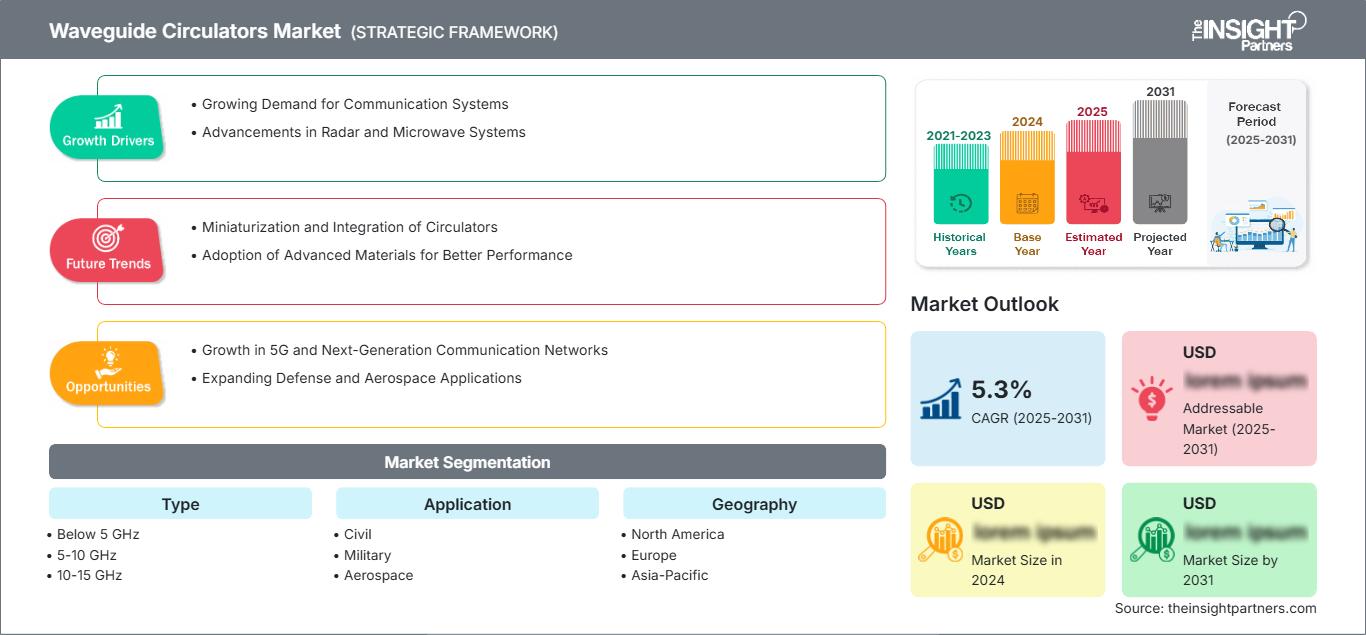
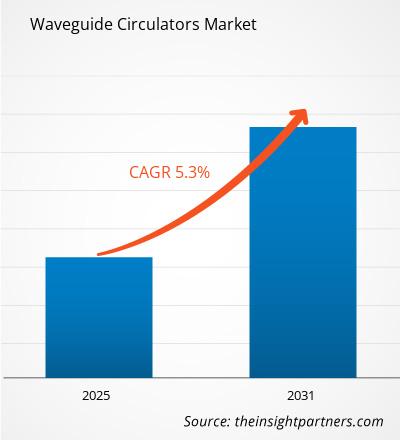
The waveguide circulators market is projected to grow from US$ 133.45 million in 2025 to US$ 267.17 million by 2034, registering a CAGR of 8.02% during 2026–2034. Demand is supported by higher deployment of microwave signal-routing components in radar, satellite communication, aerospace payloads, telecom backhaul, and high-frequency test systems, where isolation, power handling, and insertion-loss control remain central to system reliability.
North America continues to represent a major revenue base for waveguide circulators market size expansion, supported by defense radar modernization, satellite ground infrastructure, and domestic microwave component manufacturing. Regional demand is expected to advance at a high-single-digit CAGR through 2034 as military electronics, aerospace platforms, and secure communications systems require compact, frequency-specific circulators across the below 5 GHz through above 20 GHz bands.
Waveguide Circulators Market Assessment and Insights
- North America: The region is estimated to account for 34–38% share in 2025 and is expected to grow at a CAGR of 7.6–8.4% during 2026–2034, driven by radar, satellite, and defense electronics programs.
- US: The US is expected to represent 72–78% of North America in 2025, supported by aerospace contractors, RF component suppliers, and military communications demand.
- Europe: Europe is estimated to hold 22–26% share in 2025 and grow at a CAGR of 7.0–7.8%, led by the UK, Germany, France, Italy, and Spain.
- Asia Pacific: APAC is expected to account for 26–30% share in 2025 and grow at a CAGR of 8.5–9.4%, led by China, Japan, South Korea, India, and Australia.
- Largest Segment: Military applications are estimated to hold 38–42% market share in 2025 and grow at a CAGR of 7.7–8.5% due to radar and electronic warfare programs.
- High Growth Segment: Aerospace applications are expected to hold 20–24% share in 2025 and grow at a CAGR of 8.8–9.6%, supported by satellite payload and avionics upgrades.
- Key companies analyzed in detail: Corry Micronics Inc., Ducommun Incorporated, ETG Canada Inc., M2 Global Technology Ltd., Microwave Communications Laboratories Inc., Raditek Inc., Renaissance Electronics & Communications LLC, Richardson Electronics Ltd., ERAVANT, and UTE Microwave Inc.
Source: The Insight Partners' analysis based on proprietary research, government publications, company annual reports, investor presentations, industry databases, and expert interviews.
Technology evolution in the waveguide circulators market has shifted from standard isolation components toward higher-power, frequency-optimized devices for mission-critical microwave systems. Manufacturers are refining ferrite material selection, thermal dissipation, and waveguide geometry to support operation across 5–10 GHz, 10–15 GHz, 15–20 GHz, and above 20 GHz bands. Production dynamics are also changing as customers seek shorter lead times, customized assemblies, and greater qualification support for defense, satellite, and aerospace applications.
Future growth will be shaped by emerging geographies, satellite communication investment, and greater adoption of electronically scanned radar architectures. The Waveguide Circulators Market report highlights that the growth outlook is also linked to resilient sourcing strategies, as customers increasingly value suppliers that can provide precision machining, RF testing, documentation, and application-specific engineering support. Regulatory and procurement tailwinds in defense and space programs should keep demand stable across advanced economies and selected APAC markets.
Waveguide Circulators Market Report Scope
| Report Attribute | Details |
|---|---|
| Market size in 2025 | US$ 133.45 Million |
| Market Size by 2034 | US$ 267.17 Million |
| Global CAGR (2026 - 2034) | 8.02% |
| Historical Data | 2021-2024 |
| Forecast period | 2026-2034 |
Waveguide Circulators Market Analysis
Demand in the waveguide circulators market is tied closely to systems requiring controlled signal direction, transmitter protection, and receiver isolation. Radar, satellite communication, microwave backhaul, and test equipment platforms use circulators to reduce reflected power and preserve signal integrity. The value chain includes ferrite suppliers, precision machining firms, RF design specialists, component manufacturers, system integrators, and defense or aerospace customers.
Supply dynamics remain specialized because waveguide circulators require tight mechanical tolerances, magnetic biasing expertise, and validated performance across temperature, vibration, and power conditions. The Waveguide Circulators Market forecast indicates that suppliers with custom design capabilities are positioned more favorably than catalog-only providers, particularly where customers require low insertion loss, high isolation, and frequency-band optimization.
The market consists of specialized microwave suppliers as well as diversified electronic equipment manufacturers. Corry Micronics Inc., M2 Global Technology Ltd., Microwave Communications Laboratories Inc., Raditek Inc., ERAVANT, and UTE Microwave Inc. compete in customized RF engineering, whereas Ducommun Incorporated and Richardson Electronics Ltd. provide capabilities in aerospace and electronics manufacturing. Competition is bolstered by the presence of ETG Canada Inc. and Renaissance Electronics & Communications LLC in mission-specific microwave systems.
Market players will need to rely on frequency coverage, rapid engineering support, quality systems, and customer relationships for defense and aerospace markets. Investment focus will be on products beyond 20 GHz frequencies, as well as space RF components and rugged, high-power assemblies. Companies that offer both a broad product line and customization capability will benefit from the customer’s desire to accelerate time to market.
● REPORT CUSTOMIZATION
Tailor This Report To Align With Your Specific Business Requirements
This report can be customized to align precisely with your business objectives, scope, and target markets. Customization options include tailored segmentation, geography, competitive analysis, and strategic insights to support informed decision-making.
Customize This Report →WHAT YOU CAN ADJUST
- ● Segmentations
- ● Geography
- ● Competitive Analysis
- ● Language Preferences
Waveguide Circulators Market: Strategic Insights
Regional Insights
North America waveguide circulators market
North America is expected to maintain a 34–38% waveguide circulators market share in 2025, supported by defense modernization, satellite ground systems, aerospace electronics, and specialized RF component manufacturing. The region is projected to grow at a CAGR of 7.6–8.4% during 2026–2034 as radar upgrades, secure communications, and electromagnetic spectrum management remain funding priorities.
US-based suppliers and defense contractors sustain a deep ecosystem for high-frequency components. Demand is concentrated in military radar, satellite communication, aerospace payloads, and test laboratories, where qualification standards and reliable supply are decisive. Canada contributes through microwave engineering specialists and selected aerospace applications, while Mexico remains more relevant to electronics assembly and regional supply-chain support.
U.S. waveguide circulators Market
The US is projected to account for 72–78% of North American demand in 2025 and expand at a CAGR of 7.8–8.6% through 2034. Demand is supported by the procurement of military radar, satellite communication terminals, electronic warfare, and aerospace manufacturing. Domestic vendors are additionally favored due to demand for trackability, export control expertise, and shorter engineering feedback loops.
There are a number of companies participating in the industry, such as Corry Micronics Inc., Ducommun Incorporated, M2 Global Technology Ltd., Microwave Communications Laboratories Inc., Raditek Inc., Renaissance Electronics & Communications LLC, ERAVANT, and UTE Microwave Inc., providing customized or off-the-shelf solutions. The emerging applications of waveguide terminations include increasing demand for X-band, Ku-band, and higher frequency products with high reliability of isolation.
Europe waveguide circulators Market
Europe is expected to represent 22–26% share in 2025 and advance at a CAGR of 7.0–7.8% during 2026–2034. The UK leads demand through defense electronics, satellite payload work, and research infrastructure. Germany follows with industrial microwave, aerospace, and test applications, while France benefits from space, defense communication, and avionics programs.
Italy and Spain contribute through aerospace supply chains, naval radar, and satellite ground-segment projects. European demand is characterized by qualification rigor, long program cycles, and preference for stable suppliers able to support documentation, testing, and legacy-system continuity. Regional growth remains moderate compared with APAC but resilient because defense and space programs require repeatable high-reliability microwave components.
APAC waveguide circulators Market
APAC is estimated to hold 26–30% share in 2025 and grow at a CAGR of 8.5–9.4% through 2034. China leads regional consumption through telecom, radar, and satellite programs, while Japan and South Korea support demand through advanced electronics, space activities, and high-frequency test infrastructure.
India and Australia are expected to increase procurement as defense modernization, satellite communications, and indigenous electronics manufacturing expand. Industrial policy, domestic sourcing goals, and broader microwave component localization should support regional suppliers. APAC growth is likely to be faster than Europe because new platform development and communication infrastructure investment are still expanding across multiple countries.
Middle East & Africa waveguide circulators Market
The Middle East & Africa market is expected to grow at a CAGR of 6.8–7.6% during 2026–2034. Saudi Arabia and the UAE lead regional demand through defense procurement, air-surveillance systems, satellite communication networks, and critical infrastructure investments. South Africa contributes through aerospace, research, and defense electronics capabilities.
The rest of MEA demand remains project-based and linked to imported radar, telecom, and satellite systems. Growth is supported by energy infrastructure security, airport modernization, and national communication resilience programs. However, the region relies heavily on international suppliers because local waveguide component manufacturing remains limited compared with North America, Europe, and APAC.
Segmentation Analysis
Type
Type segmentation covers below 5 GHz, 5–10 GHz, 10–15 GHz, 15–20 GHz, and above 20 GHz products. The type segment is expected to grow at a CAGR of 7.9–8.7% through 2034 as customers require frequency-specific designs for radar, satellite, telecom, and laboratory systems. The waveguide circulators market scope is widening toward higher bands as mmWave, space, and advanced defense applications mature.
- Below 5 GHz: These circulators serve legacy radar, industrial microwave, and selected communication systems where power handling and durability are more important than compact high-frequency design.
- 5–10 GHz: Demand is supported by radar, test systems, and communication equipment that require stable isolation and manageable component cost across established frequency bands.
- 10–15 GHz: This band remains strategically important for radar and satellite communication, offering strong demand from defense and aerospace platforms requiring predictable RF behavior.
- 15–20 GHz: Products in this band support higher-resolution radar, satellite payloads, and specialized microwave links where low insertion loss and thermal stability matter.
- Above 20 GHz: Above 20 GHz devices are gaining relevance in mmWave, advanced satellite, and high-frequency test applications that require compact, precision-engineered components.
Application
Application segmentation includes civil, military, aerospace, and other sectors. The application segment is projected to grow at a CAGR of 8.0–8.8% during 2026–2034, with military and aerospace uses accounting for the strongest strategic demand. Civil applications add stable volume through telecom, research, and industrial microwave systems, while mission-critical applications command higher performance and qualification requirements.
- Civil: Civil demand is linked to telecom backhaul, laboratory systems, industrial microwave platforms, and research equipment, where reliable signal routing supports repeatable system performance.
- Military: Military applications dominate due to radar, electronic warfare, secure communications, and surveillance systems that require robust isolation and transmitter protection.
- Aerospace: Aerospace demand is increasing through satellite payloads, avionics, space communication links, and aircraft systems requiring qualified high-frequency microwave components.
Opportunity Snapshot
| Application | Revenue Contribution | Trend Tag | Adoption Stage |
| Airborne Radar | High | AESA Upgrade | Scaling |
| Satellite Payloads | High | LEO Links | Scaling |
| Telecom Backhaul | Medium | mmWave Routing | Emerging |
| Test Equipment | Medium | Precision Labs | Mature |
| Industrial Microwave | Low | Process Control | Mature |
Waveguide Circulators Market Growth Drivers and Impact Analysis
Defense Radar Modernization
Defense radar modernization will be the key growth driver since circulators help to isolate transmitters, direct the signal and provide reliable operation of microwave power chains. Modern radar systems rely on electronically scanned arrays, higher frequencies and multifunction design requiring isolation even in harsh environments. This will lead to a rising demand for specialized waveguide assemblies, particularly at X, Ku bands and beyond 20 GHz. Qualified suppliers with the ability to customize waveguides at lower volumes are expected to benefit from procurement programs focused on reliability rather than cost minimization.
Satellite Communication Expansion
The growth in satellite communications is creating more needs for smaller and robust waveguide circulators in earth stations, payloads, gateway systems, and test setups. The need to handle higher throughputs, usage of Ku and Ka bands, and Low Earth Orbit constellations has made it essential to choose components that will be able to control the signal flow without losses. This development favors manufacturers of devices that meet the needs for high-frequency operations, thermal management, and testability.
Shift Toward Higher Frequency Systems
The shift toward higher frequency systems is reshaping product development across the waveguide circulators market. Above 20 GHz demand is increasing in mmWave communications, advanced radar, satellite payloads, and precision measurement applications. Higher frequencies mean stricter tolerances, unique materials, and advanced magnetic design, all of which present challenges for manufacturers. Thus, there is a significant edge for the suppliers who have RF engineers working within the company as well as controls on machining and testing applications. In addition to this, it also facilitates premium pricing.
Waveguide Circulators Market Future Trends
Higher Integration in Compact RF Modules
The waveguide circulators market trends point toward greater integration of circulators into compact RF modules rather than standalone component use. Designers of the system would like to have a smaller footprint, less assembly risk, and simpler qualification in aerospace, defense, and satellite platforms. In the future, this would lead manufacturers of subsystems to offer subassembly products that include not only circulators but also transitions, adapters, filters, or isolators.
Rising Qualification Requirements for Space and Defense
Higher qualification standards will be needed due to the usage of circulators in more expensive defense and space applications. Customers are likely to demand additional environmental testing, material traceability, thermal studies, and lengthy documentation. These trends may make it more difficult for small firms that lack quality assurance capabilities to enter the market but may give an advantage to those having proven expertise in aerospace and defense. Eventually, the procurement process may begin to include lifecycle support and test repeatability in addition to the RF performance and price evaluation.
Waveguide Circulators Market Opportunities
Custom High-Power Designs for Mission-Critical Platforms
There is an excellent chance for custom, high-power devices, as there is a need for many defense, aerospace, and satellite programs for frequency-tuned circulators as well as circulators designed for power, size, and environmental requirements. Off-the-shelf catalog devices may not be able to match isolation, insertion loss, thermal, or mechanical requirements in such systems. Companies with capabilities to provide co-engineering, fast prototyping, and the qualification of parts will create added value beyond just selling parts. Waveguide Circulator Forecasts
Regional Supply-Chain Diversification
Regional supply-chain diversification offers another opportunity as customers seek secure sourcing for critical RF components. Defense and aerospace buyers increasingly prefer suppliers with domestic or allied-country production, export-control awareness, and reliable documentation. This creates room for manufacturers in North America, Europe, and selected APAC countries to expand capacity and deepen customer relationships. Companies that can reduce lead times, provide consistent quality, and support legacy platform requirements may strengthen their share even when competing against lower-cost international suppliers.
Frequently Asked Questions

- Comprehensive Market Sizing and Forecast Analysis
- Detailed Segmentation Analysis
- In-Depth Market Dynamics Assessment
- Regional and Country-Level Insights
- Competitive Landscape and Company Benchmarking
- Strategic Business Intelligence
Recent Reports
Testimonials

The Insight Partners' SCADA System Market report is comprehensive, with valuable insights on current trends and future forecasts. The team was highly professional, responsive, and supportive throughout. We are very satisfied and highly recommend their services.
RAN KEDEM Partner, Reali Technologies LTDs
I requested a report on a very specific software market and the team produced the report in a few days. The information was very relevant and well presented. I then requested some changes and additions to the report. The team was again very responsive and I got the final report in less than a week.
JEAN-HERVE JENN Chairman, Future Analytica
We worked with The Insight Partners for an important market study and forecast. They gave us clear insights into opportunities and risks, which helped shape our plans. Their research was easy to use and based on solid data. It helped us make smart, confident decisions. We highly recommend them.
PIYUSH NAGPAL Sr. Vice President, High Beam Global
The Insight Partners delivered insightful, well-structured market research with strong domain expertise. Their team was professional and responsive throughout. The user-friendly website made accessing industry reports seamless. We highly recommend them for reliable, high-quality research services
YUKIHIKO ADACHI CEO, Deep Blue, LLC.
This is the first time I have purchased a market report from The Insight Partners.While I was unsure at first, I visited their web site and felt more comfortable to take the risk and purchase a market report.I am completely satisfied with the quality of the report and customer service. I had several questions and comments with the initial report, but after a couple of dialogs over email with their analyst I believe I have a report that I can use as input to our strategic planning process.Thank you so much for taking the extra time and making this a positive experience.I will definitely recommend your service to others and you will be my first call when we need further market data.
JOHN SUZUKI President and Chief Executive Officer, Board Director, BK Technologies
I wish to appreciate your support and the professionalism you displayed in the course of attending to my request for information regarding to infectious disease IVD market in Nigeria. I appreciate your patience, your guidance, and the fact that you were willing to offer a discount, which eventually made it possible for us to close a deal. I look forward to engaging The Insight Partners in the future, all thanks to the impression you have created in me as a result of this first encounter.
DR CHIJIOKE ONYIA MANAGING DIRECTOR, PineCrest Healthcare Ltd.Reason to Buy
- Informed Decision-Making
- Understanding Market Dynamics
- Competitive Analysis
- Identifying Emerging Markets
- Customer Insights
- Market Forecasts
- Risk Mitigation
- Boosting Operational Efficiency
- Strategic Planning
- Investment Justification
- Tracking Industry Innovations
- Aligning with Regulatory Trends





 Get Free Sample for