
Weather Radar Market Trends, Size & Growth by 2034
Coverage: By Platform (Airborne, Land-Based); Application (Meteorology and Hydrology, Aerospace Industry, Military) , and Geography (North America, Europe, Asia Pacific, and South and Central America)
- Status : Data Released
- Report Code : TIPRE00021949
- Category : Electronics and Semiconductor
- No. of Pages : 150
- Available Report Formats :


- Last update date : September 28, 2026


2025 Market Size
US$ 338.25 Mn
Base year value
2034 Forecast
US$ 492.5 Mn
Projected by 2034
CAGR 2026-2034
4.26 %
Growth rate
Addressable Market
US$ 3,772.12 Mn
(2026-2034)
The Weather radar market was valued at US$ 338.25 Million in 2025 and is projected to reach US$ 492.5 Million by 2034, expanding at a CAGR of 4.26% from 2026 to 2034. Demand is supported by modernization of meteorological infrastructure, increased requirements for precipitation monitoring, aviation safety, hydrological forecasting, and severe-weather early warning. Adoption is also shifting toward dual-polarization, Doppler, solid-state, and digitally integrated radar platforms.
Across North America, the weather radar market is estimated to expand at approximately 4.8–5.4% CAGR between 2026 and 2034, supported by the replacement of aging surveillance infrastructure and the greater integration of radar observations with numerical weather prediction. Federal and state investments in resilient aviation, flood monitoring, wildfire preparedness, and emergency-management systems are reinforcing demand for higher-resolution observation capabilities.
Weather Radar Market Assessment and Insights
- North America holds an estimated 32–36% share in 2025 and is expected to grow at a 4.8–5.4% CAGR between 2026–2034, supported by established radar networks, replacement cycles, aviation requirements, and investments in severe-weather preparedness.
- US represents approximately 58–63% of North America's 2025 market, with a 4.7–5.3% CAGR between 2026–2034 as federal weather observation modernization and aviation-weather applications sustain equipment demand.
- Europe accounts for an estimated 27–31% share in 2025 and is projected to grow at 3.9–4.5% CAGR between 2026–2034, led by Germany, the UK, France, Italy, and Spain through network modernization and climate-resilience programs.
- Asia Pacific represents approximately 23–27% share in 2025 and is anticipated to expand at 5.0–5.7% CAGR between 2026–2034, led by China, Japan, India, South Korea, and Australia as observation networks expand.
- Largest Segment: Land-Based, estimated at 68–72% market share in 2025, with a 3.9–4.5% CAGR between 2026–2034 because national meteorological networks require persistent, wide-area surveillance.
- High Growth Segment: Airborne, representing approximately 28–32% market share in 2025, with a 5.0–5.8% CAGR between 2026–2034 as aviation operators prioritize localized weather awareness.
- Key companies analyzed in detail: Anhui Sun Create Electronics Co., Ltd.; AERODATA AG; Beijing-min as Da Leida Ltd.; EWR Radar Systems; Furuno Electric Co., Ltd.; Glarun Technology Co., Ltd.; Garmin Ltd.; Honeywell International Inc.; Leonardo Germany GmbH; Vaisala Corporation.
Source: The Insight Partners' analysis based on proprietary research, government publications, company annual reports, investor presentations, industry databases, and expert interviews.
The weather radar market is evolving from conventional mechanically scanned systems toward digitally processed Doppler and dual-polarization architectures. Transmitters built from solid-state components, better clutter cancellation capabilities, automation of calibration routines, remote diagnostics, and increased processing power are revolutionizing the economics of equipment. The production process is becoming more dependent on the availability of semiconductors, radio frequency components, antenna design, software solutions, and the need for lifecycle service support.
During the forecast period, investments will probably be made in countries that lack sufficient observation coverage and whose radar systems have become outdated. Multiyear replacement programs could result from public sector procurement, aviation upgrade programs, flood protection programs, and climate change adaptation programs. Regulatory emphasis on safety and resilience further supports investment, while cloud-connected analytics and interoperability standards encourage buyers to evaluate radar systems as part of broader observation ecosystems rather than as standalone instruments, according to the Weather Radar Market report.
Weather Radar Market Report Scope
| Report Attribute | Details |
|---|---|
| Market size in 2025 | US$ 338.25 Million |
| Market Size by 2034 | US$ 492.5 Million |
| Global CAGR (2026 - 2034) | 4.26% |
| Historical Data | 2021-2024 |
| Forecast period | 2026-2034 |
Weather Radar Market Analysis
Growing demand is connected to the need for faster and more precise detection of precipitation, storms, hail, and other atmospheric phenomena. The weather radar market size is influenced by national observation budgets, aviation activity, hydrological requirements, and the condition of installed radar fleets. The value chain includes microwave devices, antennas, transmitters, receivers, signal processing systems, visualization software, installation, calibration, maintenance, and data services. Differentiation among suppliers is increasingly based on lifecycle reliability and integration capabilities.
As for the ecosystem, the purchaser category now encompasses meteorological authorities along with airports, military organizations, research institutions, and hydrology authorities. Land-based systems have to be engineered and have considerable communication equipment, while airborne systems are more concerned with miniaturization, reliability, and integration with avionics. In other words, the decision-making process is determined by measurement performance versus installation, cost, cybersecurity, maintenance, and forecast infrastructure compatibility.
The weather radar market analysis also indicates a competitive structure shaped by technical specialization and installed-base relationships. Vaisala Corporation provides skills for radar equipment, processing, weather intelligence, and lifecycle services, and Furuno Electric Co., Ltd. and Garmin Ltd. have their strong positions in marine and aviation areas. Honeywell International Inc. integrates weather sensors into more extensive aerospace systems, and Leonardo Germany GmbH provides radar engineering and modernization skills for governmental and aviation projects.
Some of the firms concentrate on certain geographical or technical segments. Anhui Sun Create Electronics Co., Ltd., Beijing-min as Da Leida Ltd., and Glarun Technology Co., Ltd. provide specialized radar skills, and AERODATA AG, EWR Radar Systems, and related suppliers for aviation segment compete in terms of application skills. The investment focuses more on solid state transmission, digital beam processing, remote monitoring, modular maintenance, and software-driven visualization. Consequently, the strategic positioning will be defined by the combination of skills.
● REPORT CUSTOMIZATION
Tailor This Report To Align With Your Specific Business Requirements
This report can be customized to align precisely with your business objectives, scope, and target markets. Customization options include tailored segmentation, geography, competitive analysis, and strategic insights to support informed decision-making.
Customize This Report →WHAT YOU CAN ADJUST
- ● Segmentations
- ● Geography
- ● Competitive Analysis
- ● Language Preferences
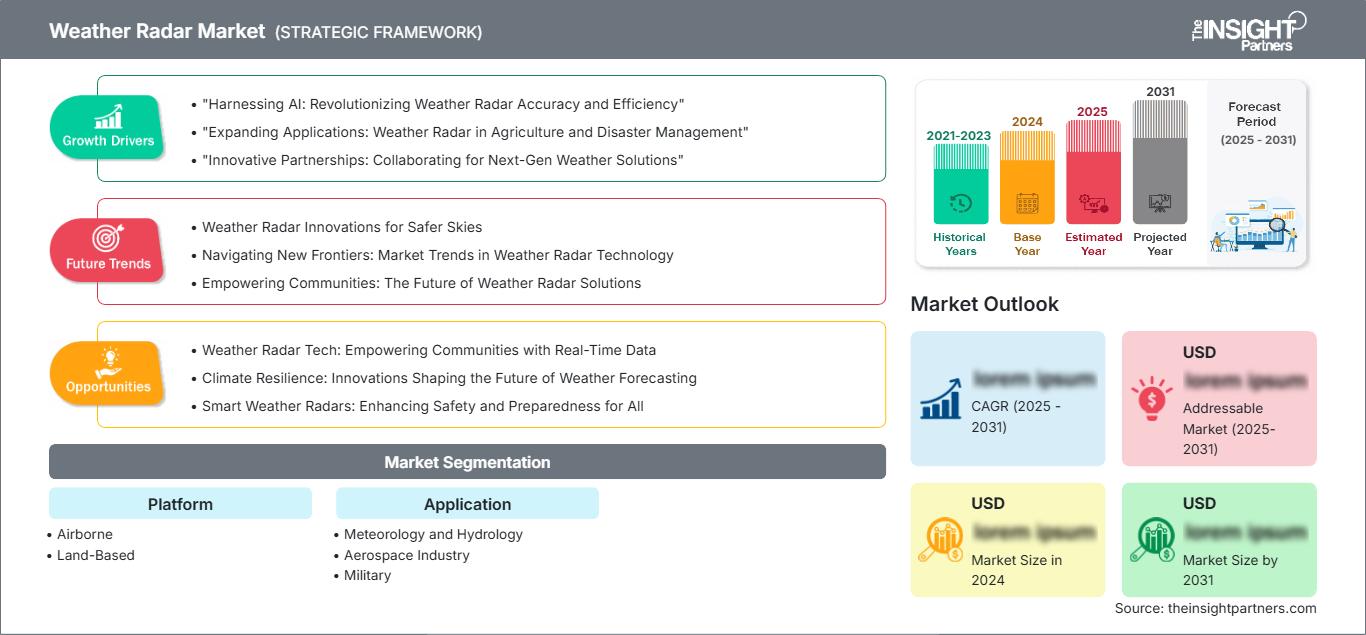
Weather Radar Market: Strategic Insights
Regional Insights
North America Weather Radar Market
North America maintains the largest regional position, with a 32–36% share in 2025 and an estimated 4.8–5.4% CAGR through 2034. The USA comprises the main demand source due to the extensive infrastructure for weather observation, aviation needs, hydrometeorological observation, and frequent modernization programs. The Canadian contribution includes weather forecasts, aviation services, natural resource management, and meteorology in the northern regions. The procurement process is becoming more oriented toward systems providing high levels of data availability, remote diagnosis, and advanced precipitation classification.
The aging of radar systems is an important structural aspect, since the dependability of the radar network is crucial for severe weather warnings and decisions. Also, there is a growing need for airports and aviation services for more sophisticated weather information in order to make better decisions about flights. Research institutions and emergency management agencies are asking for more precise observations in order to address problems of storms, floods, and wildfires.
U.S. Weather Radar Market
The U.S. market is estimated to represent 58–63% of North America's 2025 Weather Radar Market revenue, expanding at approximately 4.7–5.3% CAGR from 2026–2034. The demand for these systems is facilitated by the advanced meteorological network, aviation weather requirements, hydrological studies, and the modernization of observing equipment. Governmental organizations, airports, universities and institutes, and military organizations serve as major buyers.
Application demands increasingly include fast scanning, dual-polarization analysis, effective clutter suppression, and efficient data distribution. Firms such as Honeywell International Inc., Garmin Ltd., and Vaisala Corporation possess relevant expertise in this application area. Linking to digital forecasting software solutions is becoming increasingly important as providers of services require continuous data input instead of sporadic radar output.
Europe Weather Radar Market
Europe accounts for an estimated 27–31% of the Weather Radar Market share in 2025, with a projected 3.9–4.5% CAGR through 2034. Market leadership in the area is represented by Germany, while the United Kingdom, France, Italy, and Spain provide support.
In particular, both the United Kingdom and Germany have highly developed observation and forecast ecosystems, thus there is a need in reliable radar information and a stable network performance. On the one hand, Germany has an already developed meteorology and industrial infrastructure; on the other hand, the United Kingdom still gives preference to severe weather warnings and aviation applications. Moreover, France and Italy are important for consideration due to their hydrological vulnerability and complex climate. Lastly, Spain stands out due to national radar modernization.
APAC Weather Radar Market
APAC represents approximately 23–27% share of the Weather Radar Market in 2025 and is projected to expand at 5.0–5.7% CAGR through 2034, making it the fastest-growing major regional cluster. China leads regional deployment, followed by Japan, South Korea, India, and Australia. Expanding observation coverage and modernization are key drivers.
Both China and Japan have vast infrastructure in meteorology, along with radar requirements, whereas India has developed its capabilities of high-resolution forecasts and local weather observations. South Korea focuses on severe weather and aviation needs, whereas Australia needs radar coverage of larger areas. The industrial development, urbanization, flooding risks, and government investments in forecasting infrastructure are helping the market to grow stronger. Buyers are demanding digitally enabled solutions for automated forecasting and emergency responses.
Middle East & Africa Weather Radar Market
The Middle East and Africa Weather Radar Market region is expected to record approximately 4.1–4.8% CAGR through 2034, supported by aviation expansion, water-resource management, infrastructure development, and severe-weather monitoring. Saudi Arabia and the UAE represent important Gulf markets, while South Africa anchors demand in the southern part of the continent.
The sophistication of the technology used for aviation and environmental observation is being developed in Saudi Arabia and the United Arab Emirates, but South Africa needs radar systems for agricultural, hydrological, and weather services. The needs of RoMEA are determined by the level of coverage and the necessity for reliable infrastructure. Radar deployment will allow better monitoring of rainfall, water management, and early warning systems.
Segmentation Analysis
Platform
The Platform segment is divided between Airborne and Land-Based systems. Land-based installations remain dominant because national meteorological services require persistent regional coverage, while airborne platforms address aviation-specific sensing requirements. The segment is projected to grow at approximately 4.2–4.8% CAGR from 2026–2034, with procurement increasingly influenced by digital processing and lifecycle efficiency.
- Airborne: Airborne radar systems support flight operations through localized detection of precipitation and hazardous weather. Demand depends on aircraft deliveries, avionics upgrades, operational safety requirements, compact system architecture, and integration with cockpit displays and onboard navigation.
- Land-Based: Land-based systems provide persistent atmospheric surveillance for meteorological agencies, hydrological authorities, airports, and emergency services. Their strategic importance stems from wide-area coverage, network integration, long operating lifecycles, and the ability to support severe-weather warning.
Application
The Application segment covers Meteorology and Hydrology, Aerospace Industry, and Military uses. It is projected to expand at approximately 4.3–4.9% CAGR between 2026–2034, as radar observations become more deeply integrated into forecasting, aviation operations, defense surveillance, and disaster-management workflows.
- Meteorology and Hydrology: This application remains central to precipitation estimation, storm monitoring, flood forecasting, and weather-warning systems. Agencies increasingly prioritize dual-polarization observations, higher resolution, reliable data transmission, and integration with numerical prediction models.
- Aerospace Industry: Aerospace users require dependable weather awareness for aircraft operations, airport management, and mission planning. Demand is shaped by aviation safety standards, aircraft modernization, improved cockpit visualization, and the need to identify hazardous weather rapidly.
- Military: Military applications emphasize reliable atmospheric awareness for mission planning, operational safety, and environmental monitoring. Procurement priorities include ruggedized equipment, secure communications, rapid data processing, and compatibility with broader surveillance and command systems.
Opportunity Snapshot
| Application | Revenue Contribution (High/Medium/Low) | Trend Tag | Adoption Stage |
| Meteorology and Hydrology | High | Flood Warning | Mature |
| Aerospace Industry | Medium | Flight Safety | Scaling |
| Military | Medium | Mission Weather | Scaling |
Weather Radar Market Growth Drivers and Impact Analysis
Rising Need for High-Resolution Severe-Weather Monitoring
The growing incidence of extreme rainfall events, floods, convective storms, and other types of disruptive weather is prompting governments to enhance their observation networks. The benefits of radar are in providing frequent spatial information alongside satellites, surface observations, and computer models, thus making it useful for forecasting. The commercial effect is most pronounced in places where there are gaps in the coverage of current systems and old equipment, limiting the quality of data. The advanced dual-polarization radars are capable of enhancing the ability to determine precipitation type and estimate precipitation amounts, thereby improving their practical significance. This presents new business prospects for replacement projects, expansions of radar networks, software updates, and servicing contracts. In terms of buying decision, the performance of the entire observation system is now evaluated instead of just the transmitter parameters.
Modernization of Aging Meteorological and Aviation Infrastructure
The large inventory of radar hardware needs regular maintenance, replacement of worn-out components, and a technology upgrade. The old transmitters, mechanical systems, processing units, and communication systems may not only need more maintenance but also become incompatible with today’s weather forecasting solutions. The modernization process, therefore, creates the demand even if the overall growth rate for radars is modest. The aviation companies have one more reason to enhance local weather data because their operations rely on precipitation detection and other meteorological factors. Companies able to offer phased upgrades and retrofitting gain opportunities to generate revenue without having to replace the entire radar network. Such a situation also promotes modular design and remote diagnostics, enabling buyers to enhance performance while controlling the installation process. The purchase decision is increasingly based on the cost of ownership, serviceability, security, and compatibility, besides measurement capabilities.
Integration of Radar Data with Digital Forecasting Ecosystems
Radar data is now being increasingly supplemented by satellite data, lightning detection, weather forecasting, modeling, hydrological modeling, and alert systems. This provides greater benefits for the data gathered at every individual radar location, since it allows for multiple applications of the same data instead of being confined to one particular display only. Connected computing and standardized data interfaces could also be used to allow for central monitoring of network locations spread over an area. Commercially, this leads to the gradual transition from purely equipment-focused purchase of hardware to the sale of observation systems as a whole. Radar manufacturers who also provide software and analytics services can therefore compete based on more than just their antennas and transmitters.
Weather Radar Market Future Trends
Solid-State Radar and Lower-Maintenance Architectures
It seems that the solid-state approach is going to gain more significance in light of the growing emphasis by meteorological bodies on reliability, reduced need for maintenance, and consistent performance over the lifecycle of the product. New designs will allow for a decrease in reliance on expendables as well as a capability to operate consistently through redundancy and remote monitoring features. This approach is especially advantageous for radar networks with multiple locations in which maintenance on-site would be costly or inconvenient. It seems that vendors will increasingly highlight such qualities as self-calibration capabilities, health monitoring capabilities, modular electronics, and diagnostic software. On the buyer’s side, there is likely to be an increased focus on mean time between failures, accessibility of service, power consumption, and lifecycle costs, along with the classic range and resolution parameters.
AI-Assisted Radar Interpretation and Predictive Maintenance
Artificial intelligence is expected to influence radar workflows through automated quality control, anomaly detection, precipitation classification, clutter identification, and predictive maintenance. Rather than replacing conventional radar processing, AI can enhance the interpretation of large volumes of observations and identify patterns requiring operator attention. Predictive maintenance can analyze equipment health indicators to identify potential failures before they interrupt data availability. The weather radar market trends will therefore increasingly connect sensing hardware with software intelligence and operational decision support. Successful deployments will depend on high-quality historical datasets, transparent validation, cybersecurity, and reliable integration with existing forecasting systems. Vendors that combine domain-specific radar expertise with machine-learning capabilities can improve the usefulness of observations while reducing manual workload for meteorological agencies, airports, and other organizations operating complex radar networks.
Weather Radar Market Opportunities
Modernization Programs in Emerging Observation Networks
Countries with expanding urban populations, substantial flood exposure, or incomplete weather observation coverage represent attractive investment opportunities. New radar installations can provide substantial improvements in localized forecasting when integrated with surface observations and numerical models. Governments increasingly have incentives to improve early-warning capability because accurate information can reduce disruption to transport, agriculture, water management, and emergency response. Suppliers can pursue these opportunities through scalable architectures that permit phased network expansion rather than requiring large initial deployments. Financing models combining equipment, software, maintenance, and training may also improve procurement feasibility in developing markets. Partnerships with local engineering firms can reduce installation barriers and strengthen after-sales support. The opportunity is particularly relevant in Asia Pacific, parts of the Middle East, and selected African markets where modernization requirements remain significant.
Integrated Radar Networks for Aviation and Hydrological Applications
A second opportunity lies in developing integrated radar networks serving multiple institutional users. A single observation infrastructure can support airport operations, flood forecasting, municipal planning, agriculture, and emergency response when data interfaces and governance frameworks are properly designed. This creates scope for suppliers to package radar hardware with processing software, communications, visualization, data services, and lifecycle support. Airports can benefit from localized weather information, while hydrological authorities can use precipitation observations for watershed monitoring. Joint procurement can potentially improve utilization and justify investment in strategically located systems. Providers capable of tailoring data products for different users may gain an advantage over equipment-only competitors. The weather radar market forecasts indicate that value creation will increasingly depend on network-level integration, recurring services, and application-specific analytics rather than hardware sales alone.
Frequently Asked Questions

- Comprehensive Market Sizing and Forecast Analysis
- Detailed Segmentation Analysis
- In-Depth Market Dynamics Assessment
- Regional and Country-Level Insights
- Competitive Landscape and Company Benchmarking
- Strategic Business Intelligence
Recent Reports
Testimonials

The Insight Partners provided valuable market intelligence that supported our global go-to-market strategy. Their team was professional, responsive, and attentive to our feedback, providing thoughtful analysis and helpful methodological clarifications throughout the project.
Junmo Kim Chief Financial Officer (CFO), Enertech Co., Ltd.
The Insight Partners' SCADA System Market report is comprehensive, with valuable insights on current trends and future forecasts. The team was highly professional, responsive, and supportive throughout. We are very satisfied and highly recommend their services.
RAN KEDEM Partner, Reali Technologies LTDs
I requested a report on a very specific software market and the team produced the report in a few days. The information was very relevant and well presented. I then requested some changes and additions to the report. The team was again very responsive and I got the final report in less than a week.
JEAN-HERVE JENN Chairman, Future Analytica
We worked with The Insight Partners for an important market study and forecast. They gave us clear insights into opportunities and risks, which helped shape our plans. Their research was easy to use and based on solid data. It helped us make smart, confident decisions. We highly recommend them.
PIYUSH NAGPAL Sr. Vice President, High Beam Global
The Insight Partners delivered insightful, well-structured market research with strong domain expertise. Their team was professional and responsive throughout. The user-friendly website made accessing industry reports seamless. We highly recommend them for reliable, high-quality research services
YUKIHIKO ADACHI CEO, Deep Blue, LLC.
This is the first time I have purchased a market report from The Insight Partners.While I was unsure at first, I visited their web site and felt more comfortable to take the risk and purchase a market report.I am completely satisfied with the quality of the report and customer service. I had several questions and comments with the initial report, but after a couple of dialogs over email with their analyst I believe I have a report that I can use as input to our strategic planning process.Thank you so much for taking the extra time and making this a positive experience.I will definitely recommend your service to others and you will be my first call when we need further market data.
JOHN SUZUKI President and Chief Executive Officer, Board Director, BK Technologies
I wish to appreciate your support and the professionalism you displayed in the course of attending to my request for information regarding to infectious disease IVD market in Nigeria. I appreciate your patience, your guidance, and the fact that you were willing to offer a discount, which eventually made it possible for us to close a deal. I look forward to engaging The Insight Partners in the future, all thanks to the impression you have created in me as a result of this first encounter.
DR CHIJIOKE ONYIA MANAGING DIRECTOR, PineCrest Healthcare Ltd.Reason to Buy
- Informed Decision-Making
- Understanding Market Dynamics
- Competitive Analysis
- Identifying Emerging Markets
- Customer Insights
- Market Forecasts
- Risk Mitigation
- Boosting Operational Efficiency
- Strategic Planning
- Investment Justification
- Tracking Industry Innovations
- Aligning with Regulatory Trends





 Get Free Sample for