
Whiteness Meter Market Growth, Demand & Size by 2034
Coverage: by Modularity (Portable/Handheld, Benchtop); Operation (Manual, Automatic); Industry (Textile, Construction, Paints, Chemical, Paper and Pulp, Plastics, Food and Beverages, Others) , and Geography (North America, Europe, Asia Pacific, and South and Central America)
- Status : Data Released
- Report Code : TIPRE00009564
- Category : Electronics and Semiconductor
- No. of Pages : 150
- Available Report Formats :


- Last update date : September 28, 2026


2025 Market Size
US$ 189.77 Mn
Base year value
2034 Forecast
US$ 264.02 Mn
Projected by 2034
CAGR 2026-2034
3.74 %
Growth rate
Addressable Market
US$ 2,061.35 Mn
(2026-2034)
The Whiteness meter market is valued at US$ 189.77 Million in 2025 and is projected to reach US$ 264.02 Million by 2034, registering a CAGR of 3.74% during 2026–2034. The market covers instruments used to quantify optical whiteness across solid surfaces and powders, with demand shaped by quality-control requirements in paper, textiles, coatings, construction materials, plastics, chemicals, and food processing.
Across North America, the whiteness meter market size is expected to expand at an estimated 3.2–4.2% CAGR through 2034, supported by laboratory automation, tighter product consistency requirements, and continued adoption of portable optical instruments. Demand is reinforced by paper, packaging, specialty chemicals, and construction-material producers that require repeatable reflectance measurements.
Whiteness Meter Market Assessment and Insights
- North America: North America is estimated to account for 24–28% share in 2025, with the market growing at a CAGR of 3.2–4.2% between 2026–2034. Demand is supported by mature quality-control practices, paper production, coatings, plastics, and laboratory modernization.
- US: The US is estimated to represent 68–72% of North American demand in 2025 and is projected to grow at a CAGR of 3.3–4.3% during 2026–2034, supported by automated inspection and standardized testing.
- Europe: Europe is estimated to hold 25–29% share in 2025 and grow at a CAGR of 3.0–4.0% between 2026–2034. Germany, the UK, France, Italy, and Spain provide established demand through paper, chemicals, coatings, textiles, and manufacturing laboratories.
- Asia Pacific: Asia Pacific is estimated to represent 31–35% share in 2025 and expand at a CAGR of 4.1–5.1% during 2026–2034. China, Japan, India, and South Korea lead demand through manufacturing scale, food processing, paper production, and laboratory investment.
- Largest Segment: Paper and Pulp is estimated to hold a 26–30% market share in 2025 and expand at a CAGR of 3.4–4.0% through 2034, reflecting standardized brightness and whiteness control.
- High Growth Segment: Food and Beverages is estimated to hold an 8–12% share in 2025 and grow at a CAGR of 4.5–5.2% during 2026–2034 as processors increasingly quantify flour, starch, sugar, and grain appearance.
- Key companies analyzed in detail: Caltech Instruments Private Limited, EIE Instruments Private Limited, Kett U.S., Labtron Equipment Ltd, Mangal Instrumentation, Mesu Lab Instruments (Guangzhou) Co., Ltd., MxRady Lab Solutions Private Limited, Optics Technology, PCE Deutschland GmbH, Konica Minolta, Inc., Datacolor AG, and AMETEK HunterLab, Inc.
Source: The Insight Partners' analysis based on proprietary research, government publications, company annual reports, investor presentations, industry databases, and expert interviews.
The whiteness meter market is evolving from simple reflectance instruments toward compact, digitally connected quality-control devices. LED illumination, improved optical detectors, automatic calibration, memory functions, rechargeable batteries, and computer interfaces are increasing measurement consistency. Instruments now address both flat materials and powders, while application-specific configurations support paper, textiles, coatings, plastics, cement, flour, starch, and rice. ISO methods for brightness and CIE whiteness reinforce the need for controlled illumination and reproducible measurements.
Looking ahead, adoption is likely to broaden in emerging manufacturing centers where laboratories are upgrading from visual inspection to objective optical measurement. China, India, Southeast Asia, and selected Middle Eastern economies offer opportunities as food processing, packaging, construction materials, and chemical production become more quality-intensive. The Whiteness Meter Market report highlights that investments will increasingly prioritize portable instruments, digital data transfer, calibration stability, and instruments capable of supporting multiple measurement standards without adding substantial operator complexity.
Whiteness Meter Market Report Scope
| Report Attribute | Details |
|---|---|
| Market size in 2025 | US$ 189.77 Million |
| Market Size by 2034 | US$ 264.02 Million |
| Global CAGR (2026 - 2034) | 3.74% |
| Historical Data | 2021-2024 |
| Forecast period | 2026-2034 |
Whiteness Meter Market Analysis
The whiteness meter market growth is supported by the need to reduce subjective visual assessment in production and laboratory environments. The paper and board industry needs consistent values of whiteness, whereas the textile, paint, plastics, and construction materials industry relies on reflection readings to keep their batches consistent. The supply chain is made up of optical component suppliers, instrument makers, suppliers of calibration standards, distributors, testing labs, and industrial customers. Differentiation among products relies more on the stability of the measurement, sample preparation, portability, compatibility of software, and ease of calibration, rather than on measurement capability itself.
The supply dynamics continue to be fragmented since there is the existence of a diverse set of whiteness testers along with colorimeters and spectrophotometers in the market. Caltech Instruments Private Limited and PCE Deutschland GmbH focus on portable and general-purpose applications, respectively. Kett U.S. has specialized machines for measuring rice and powder samples. According to the Whiteness Meter Market forecast, demand is therefore influenced by replacement cycles, laboratory standardization, export-quality requirements, and the increasing need to maintain traceable measurement procedures across geographically dispersed facilities.
Positioning in the whiteness meter analysis requires the right balance between application specialization and broad optical measurements. Kett U.S. focuses on quick whiteness evaluation of rice and powder, while Caltech Instruments Private Limited develops portable and probe-based solutions for paper, textiles, plastics, coatings, cement, and powders. PCE Deutschland GmbH develops portable meters for various surfaces. Konica Minolta, Inc., Datacolor AG, and AMETEK HunterLab, Inc. are competitors in the larger color and appearance measurement environment, providing opportunities to combine whiteness measurements with full-fledged color management workflows.
The key investment trends are miniaturization, optical stability, connectivity, and application software. The players that enter into competition include EIE Instruments Private Limited, Mangal Instrumentation, Mesu Lab Instruments (Guangzhou) Co., Ltd., MxRady Lab Solutions Private Limited, Optics Technology, and Labtron Equipment Ltd. through laboratory and industrial instruments channels. Competitors who provide solid calibration capabilities and regional distribution capabilities are able to compete in the market where service continuity is important for buyers. The whiteness meter market therefore combines specialist manufacturers with diversified measurement companies, creating a competitive structure based on application coverage, reliability, and channel reach.
● REPORT CUSTOMIZATION
Tailor This Report To Align With Your Specific Business Requirements
This report can be customized to align precisely with your business objectives, scope, and target markets. Customization options include tailored segmentation, geography, competitive analysis, and strategic insights to support informed decision-making.
Customize This Report →WHAT YOU CAN ADJUST
- ● Segmentations
- ● Geography
- ● Competitive Analysis
- ● Language Preferences
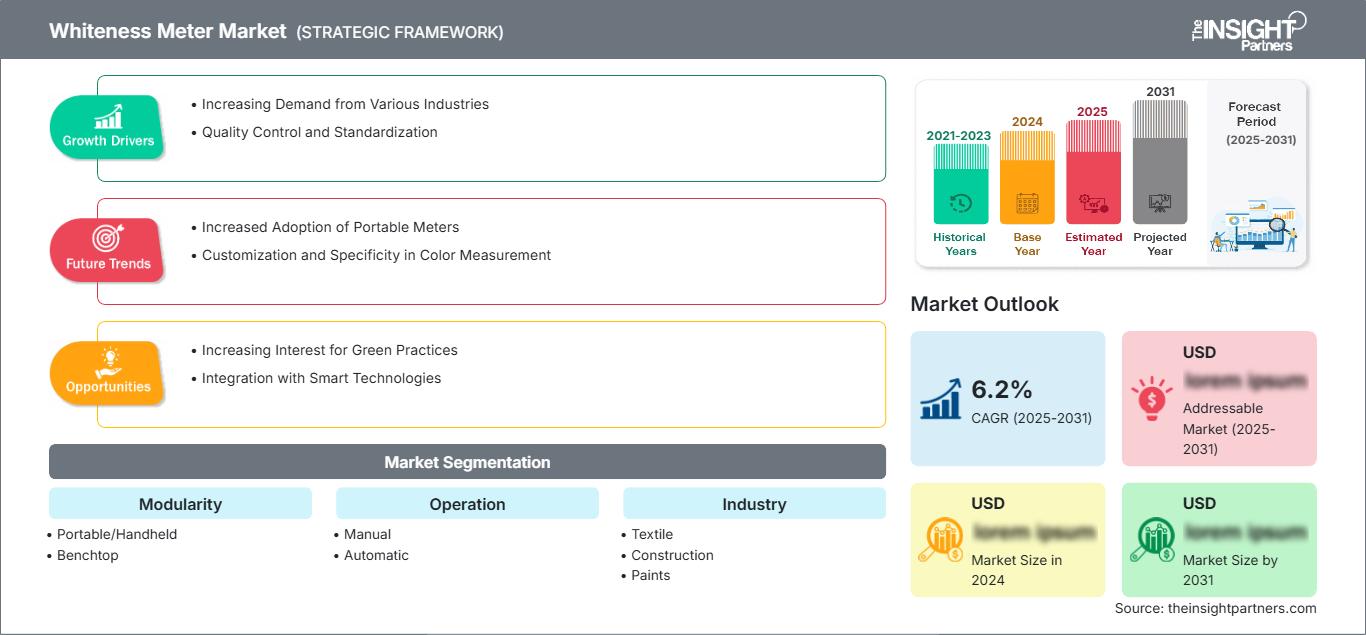
Whiteness Meter Market: Strategic Insights
Regional Insights
North America Whiteness Meter Market
North America is estimated to hold 24–28% share of the Whiteness Meter Market in 2025 and grow at a CAGR of 3.2–4.2% through 2034. The US represents the principal demand center, supported by established paper, packaging, coatings, plastics, chemicals, and food-processing industries. Canada contributes through pulp, paper, minerals, and laboratory testing, while Mexico adds manufacturing-oriented demand. Buyers increasingly favor portable instruments for incoming-material inspection and compact benchtop systems for laboratory verification. Quality programs also encourage repeatable optical measurements instead of visual assessment alone, particularly where product appearance affects specifications, printing performance, or customer acceptance.
Across the region, structural growth is linked to laboratory automation and replacement of aging optical instruments. Producers increasingly seek equipment that can store measurements, connect with computers, and maintain stable calibration over repeated testing cycles. The presence of specialized suppliers and distributors supports adoption across industrial laboratories, universities, and contract testing facilities. Construction materials and coatings provide additional opportunities because whiteness can influence perceived product uniformity. Demand should remain steady rather than rapid, with purchasing decisions emphasizing accuracy, serviceability, standards compatibility, and total ownership cost over basic instrument functionality.
U.S. Whiteness Meter Market
The US is estimated to account for 68–72% of North American Whiteness Meter Market demand in 2025, equivalent to roughly 16–20% of global demand, and is expected to grow at a CAGR of 3.3–4.3%. Applications span paper, textiles, plastics, paints, chemicals, food ingredients, and building materials. Instrument suppliers increasingly offer battery-powered handheld configurations alongside laboratory systems, enabling quality checks closer to production lines. This supports the shift toward decentralized inspection, especially for manufacturers operating multiple plants or receiving materials from several suppliers.
Application trends favor instruments that support documented quality procedures rather than isolated measurements. Paper and packaging laboratories require brightness-related measurements aligned with recognized standards, while food processors increasingly use whiteness as one indicator of flour, starch, grain, or powder consistency. Portable devices can reduce sampling delays, whereas benchtop systems remain important for controlled laboratory environments. Competitive presence from PCE Deutschland GmbH, Kett U.S., Caltech Instruments Private Limited, and broader color-measurement providers creates a varied supplier base with different levels of application specialization and digital integration.
Europe Whiteness Meter Market
Europe is estimated to represent 25–29% share of the Whiteness Meter Market in 2025 and grow at a CAGR of 3.0–4.0%. Germany leads regional demand through chemicals, industrial manufacturing, paper, coatings, and laboratory instrumentation. The UK maintains demand across testing laboratories, food processing, paper, and specialty manufacturing. France, Italy, and Spain add applications in packaging, textiles, ceramics, construction materials, and chemicals. The regional market favors instruments with traceable calibration, documented measurement procedures, and compatibility with internationally recognized optical standards.
European buyers increasingly connect appearance testing with broader quality-management programs. The emphasis on reproducibility benefits suppliers that provide calibration standards, software connectivity, and stable optical systems. Germany is expected to remain the leading country because of its concentration of industrial laboratories and advanced manufacturing. Italy and Spain provide notable opportunities in ceramics, construction products, food ingredients, and textiles, while France and the UK contribute through paper, chemicals, packaging, and research laboratories. Replacement demand should remain important as facilities modernize measurement equipment and consolidate quality-control workflows.
APAC Whiteness Meter Market
APAC is estimated to hold 31–35% of the Whiteness Meter Market share in 2025 and grow at a CAGR of 4.1–5.1%, making it the fastest-growing major region. China leads regional demand, followed by Japan, India, South Korea, and Australia. Expanding paper, food processing, textiles, plastics, chemicals, and construction-material production supports broader instrument deployment. India and Southeast Asian economies provide additional opportunities as manufacturing laboratories upgrade quality-control capabilities.
Industrial expansion is reinforced by export-oriented production and greater standardization of laboratory procedures. Portable systems are attractive where manufacturers operate dispersed production facilities, while benchtop systems serve centralized quality laboratories. China is expected to remain the leading country because of manufacturing scale, whereas India offers strong incremental demand from food, paper, textile, pharmaceutical, and construction-material applications. Japan and South Korea maintain technologically mature demand focused on precision and automation.
Middle East & Africa Whiteness Market
Middle East and Africa Whiteness Meter Market demand is expected to expand at a CAGR of 2.8–3.8% through 2034. Saudi Arabia and the UAE lead regional adoption, supported by industrial diversification, construction activity, food processing, and laboratory modernization. South Africa contributes through mining-related materials, chemicals, food production, and manufacturing. Rest of MEA demand remains more fragmented but is supported by infrastructure development and expanding testing capacity.
Energy and infrastructure investment indirectly supports measurement demand because new construction-material, coatings, plastics, and chemical facilities require laboratory quality systems. Saudi Arabia is positioned as the leading country, with the UAE acting as an important distribution and testing hub. Buyers generally prioritize portable instruments, straightforward calibration, and regional service availability. Growth will remain measured because purchasing is often project driven, but modernization of industrial laboratories should gradually increase demand for objective whiteness measurement.
Segmentation Analysis
Modularity
Modularity is divided into portable/handheld and benchtop configurations and is expected to expand at a CAGR of 3.6–4.4% during 2026–2034. Portable systems benefit from line-side inspection and mobility, while benchtop equipment remains preferred where laboratories require controlled sample handling, repeated measurements, and higher workflow stability. Current Whiteness Meter Market trends indicate growing demand for portable measurement solutions, digital data management capabilities, and enhanced calibration consistency as manufacturers seek more efficient and standardized quality-control processes across production and laboratory environments.
- Portable/Handheld: Compact battery-powered instruments support decentralized inspection across production floors, incoming-material checks, and field applications. Their strategic value comes from rapid measurements without requiring dedicated laboratory space.
- Benchtop: Benchtop systems remain important for laboratories conducting standardized, repeatable testing. Larger sample compartments and stable optical arrangements support controlled workflows across paper, powders, food ingredients, and industrial materials.
Operation
Operation comprises manual and automatic systems and is projected to grow at a CAGR of 3.2–4.0% during 2026–2034. Automation is gaining relevance where testing frequency is high, while manual systems remain attractive for cost-sensitive laboratories and straightforward inspection procedures. Current Whiteness Meter Market trends indicate increasing adoption of automated testing solutions, driven by the need for higher throughput, improved measurement consistency, reduced operator dependency, and enhanced quality-control efficiency across industrial and laboratory applications.
- Manual: Manual instruments remain widely applicable where operators conduct periodic checks and need simple controls. Their affordability and limited setup requirements support adoption among smaller manufacturers and laboratories.
- Automatic: Automatic systems improve repeatability by reducing operator-dependent sample positioning and calculation steps. They are strategically important for high-throughput facilities seeking standardized measurements and stronger digital quality records.
Industry
Industry is expected to grow at a CAGR of 3.5–4.2% during 2026–2034 as appearance consistency becomes more important across diverse manufacturing processes. Paper and pulp remain core applications, while food, plastics, coatings, and construction materials broaden the addressable customer base.
- Textile: Textile producers use whiteness measurements to evaluate bleached fabrics, dyed materials, and finishing consistency. Portable testing supports production-floor verification where shade and appearance variations can create rework or customer-quality issues.
- Construction: Cement, concrete, ceramics, and related materials use optical whiteness to support visual consistency. Demand is tied to architectural finishes, product grading, and laboratory verification of raw material and finished product properties.
- Paints: Paint manufacturers apply whiteness measurements to assess white formulations, coatings, and finished surfaces. Objective readings help control batch-to-batch consistency and support formulation adjustments during laboratory and production testing.
- Chemical: Chemical producers use whiteness as an appearance or purity-related indicator for selected powders and compounds. Measurement instruments support incoming raw-material checks, formulation control, and finished-product verification.
- Paper and Pulp: Paper and pulp represent the largest application base because brightness and whiteness are directly connected with appearance, printing characteristics, and standardized product specifications. Laboratory measurement remains central to production quality control.
- Plastics: Plastics manufacturers use whiteness measurements for compounds, molded products, films, and additives. Optical consistency supports formulation control and helps identify discoloration or processing-related appearance changes.
- Food and Beverages: Food processors increasingly quantify whiteness in flour, starch, sugar, rice, salt, and related powders. Objective measurement reduces visual subjectivity and supports consistent product grading across production batches.
Opportunity Snapshot
| Industry | Revenue Contribution (High/Medium/Low) | Trend Tag (MAX 2 words) | Adoption Stage (Emerging/Scaling/Mature) |
| Textile | Medium | Fabric Consistency | Scaling |
| Construction | Medium | White Cement | Scaling |
| Paints | Medium | Coating Uniformity | Mature |
| Chemical | Medium | Powder Purity | Scaling |
| Paper and Pulp | High | Brightness Control | Mature |
| Plastics | Medium | Resin Appearance | Scaling |
| Food and Beverages | Medium | Flour Quality | Scaling |
| Others | Low | Niche Testing | Emerging |
Whiteness Meter Market Growth Drivers and Impact Analysis
Expansion of Objective Quality Control Across Manufacturing
Subjective visual inspection is being replaced by objective measurement of optical characteristics because of potential discrepancies in lighting, human assessment, placement of samples, and operator fatigue in a manufacturing environment. A standardized measurement allows the laboratory or production facility to make comparisons between batches according to predetermined internal specifications. This becomes especially important for applications such as white paper, fabrics, paints, plastics, building materials, and food products in powdered form, in which minor changes in appearance could affect consumer satisfaction. The effects go beyond selling instruments themselves since customers are increasingly demanding calibration, data acquisition, software interface, and servicing requirements. Manufacturers that offer simple operation combined with reliable optical properties can meet both demands.
Increasing Use of Portable Instruments for Decentralized Inspection
Mobile measuring devices have become increasingly important because manufacturers need to make faster decisions at their receiving points, production lines, warehouses, and satellite labs. Mobile devices do not require sample transportation from one place to another and detect problems with material at an earlier stage in the manufacturing process. Such an approach to the problem will be especially useful for textiles, construction materials, coatings, plastics, and food ingredients that could be sampled at several places. Portability of the device can be supported by battery power, small size, recording capability, and connectivity to the computer. The business benefit of this trend is the expansion of the customer base because smaller laboratories and plants will be able to use such measuring instruments.
Growth of Standardized Optical Measurement Procedures
Measurement procedures, international and domestic, urge the manufacturer to manage lighting, reflection conditions, calibration, and sample preparation. ISO distinguishes various approaches to brightness and CIE whiteness, especially in cases when fluorescent whitening agents affect the result of measurement. In other words, there is a need for the equipment that would be able to create certain measurement conditions, not just compare visually. The effect is most felt by the industry of paper and pulp; however, the importance of reproducibility is also very high for textile, chemical, construction, and food industries. Providers of the equipment, which are capable of implementing several standards on one platform, will be able to serve a wider range of laboratories. At the same time, the user will be able to compare results among plants and providers better.
Whiteness Meter Market Future Trends
Convergence of Whiteness Measurement With Digital Color Platforms
The future generation of instruments is expected to be designed in such a way that they will integrate calculations for whiteness along with other color, yellowness, opacity and reflectance tests. Such integration could reduce the number of instruments needed in laboratories, as well as allow the use of one sample run to provide several indicators on the appearance of an object. Cloud-based software and databases can help make comparisons between different plants, suppliers, and production batches. As manufacturers move toward the use of digital quality systems, measurement instruments will become more like data-generating nodes, not just measurement devices. In this case, whiteness meters, which are still relevant in some situations, are expected to follow general trends and become increasingly interoperable.
Application-Specific Optical Algorithms and Smarter Sampling
The next wave of innovation is likely to center on enhanced consistency in measuring irregular powders, varying surfaces, and application-dependent materials. The new generations of instruments are capable of incorporating guided sampling, automatic averaging, calibration reminders, and even software heuristics that minimize differences caused by the tester. In the field of food and agricultural products, application-dependent algorithms might facilitate correlation of whiteness measurements with the processing conditions or material grades. In industrial materials, a better sampling geometry will enable the minimization of errors caused by the surface roughness and compositional variations. Such features will enhance the usefulness of the instruments beyond the traditional laboratory environment, potentially motivating their broader usage by smaller manufacturers. As a result, product differentiation will be based on intelligence in measurements, workflow design, and application libraries, with hardware innovations supplemented by software ones.
Whiteness Meter Market Opportunities
Localized Solutions for Emerging Manufacturing Hubs
An expansion in manufacturing in India, Southeast Asia, Latin America, and select countries in the Middle East region is a chance for suppliers who can offer instruments at competitive prices with regional calibration and technical services. Users in these markets usually require instruments that can process several materials instead of instruments with narrow applications. The market penetration of distributors can be increased by offering not only the instruments but also reference standards, training programs, software, and preventive maintenance services together. Food processing, textiles, paper, plastics, paints, and building materials each present an opportunity for entering the market in different application-specific channels. Localization of documentation, technical services, and calibration will help to overcome the adoption obstacles.
Integrated Quality-Control Platforms for Multi-Industry Facilities
Increasingly large manufacturing groups have started to maintain central laboratories that provide services to multiple manufacturing units, thus presenting the case for the development of multi-functional optical measurement systems. An instrument that is capable of providing information on the whiteness, color, yellowness, reflectance, and other appearance properties can be advantageous in terms of efficient use of equipment and ease of training the personnel. In addition, vendors can come up with the software linking the results of measurements with batch numbers, specifications, and quality reports. This kind of platform would be most useful for diversified manufacturers who manufacture coatings, plastics, paper, chemicals, or food ingredients using a common manufacturing plant. Decision makers would favor such instruments that are repeatable, compatible with the standards, easily calibrated, and integrated with laboratory processes.
Frequently Asked Questions

- Comprehensive Market Sizing and Forecast Analysis
- Detailed Segmentation Analysis
- In-Depth Market Dynamics Assessment
- Regional and Country-Level Insights
- Competitive Landscape and Company Benchmarking
- Strategic Business Intelligence
Recent Reports
Testimonials

The Insight Partners' SCADA System Market report is comprehensive, with valuable insights on current trends and future forecasts. The team was highly professional, responsive, and supportive throughout. We are very satisfied and highly recommend their services.
RAN KEDEM Partner, Reali Technologies LTDs
I requested a report on a very specific software market and the team produced the report in a few days. The information was very relevant and well presented. I then requested some changes and additions to the report. The team was again very responsive and I got the final report in less than a week.
JEAN-HERVE JENN Chairman, Future Analytica
We worked with The Insight Partners for an important market study and forecast. They gave us clear insights into opportunities and risks, which helped shape our plans. Their research was easy to use and based on solid data. It helped us make smart, confident decisions. We highly recommend them.
PIYUSH NAGPAL Sr. Vice President, High Beam Global
The Insight Partners delivered insightful, well-structured market research with strong domain expertise. Their team was professional and responsive throughout. The user-friendly website made accessing industry reports seamless. We highly recommend them for reliable, high-quality research services
YUKIHIKO ADACHI CEO, Deep Blue, LLC.
This is the first time I have purchased a market report from The Insight Partners.While I was unsure at first, I visited their web site and felt more comfortable to take the risk and purchase a market report.I am completely satisfied with the quality of the report and customer service. I had several questions and comments with the initial report, but after a couple of dialogs over email with their analyst I believe I have a report that I can use as input to our strategic planning process.Thank you so much for taking the extra time and making this a positive experience.I will definitely recommend your service to others and you will be my first call when we need further market data.
JOHN SUZUKI President and Chief Executive Officer, Board Director, BK Technologies
I wish to appreciate your support and the professionalism you displayed in the course of attending to my request for information regarding to infectious disease IVD market in Nigeria. I appreciate your patience, your guidance, and the fact that you were willing to offer a discount, which eventually made it possible for us to close a deal. I look forward to engaging The Insight Partners in the future, all thanks to the impression you have created in me as a result of this first encounter.
DR CHIJIOKE ONYIA MANAGING DIRECTOR, PineCrest Healthcare Ltd.Reason to Buy
- Informed Decision-Making
- Understanding Market Dynamics
- Competitive Analysis
- Identifying Emerging Markets
- Customer Insights
- Market Forecasts
- Risk Mitigation
- Boosting Operational Efficiency
- Strategic Planning
- Investment Justification
- Tracking Industry Innovations
- Aligning with Regulatory Trends





 Get Free Sample for