
Wireless Display Market Share, Size & Demand by 2034
Coverage: By Offering (Hardware, Software and Services); Technology Protocol (WIDI, WirelessHD, Google Cast, Airplay, Others); Application (Consumer, Commercial) , and Geography (North America, Europe, Asia Pacific, and South and Central America)
- Status : Data Released
- Report Code : TIPRE00003375
- Category : Electronics and Semiconductor
- No. of Pages : 150
- Available Report Formats :


- Last update date : September 30, 2026


2025 Market Size
US$ 6.81 Bn
Base year value
2034 Forecast
US$ 16.44 Bn
Projected by 2034
CAGR 2026-2034
10.30 %
Growth rate
Addressable Market
US$ 103.30 Bn
(2026-2034)
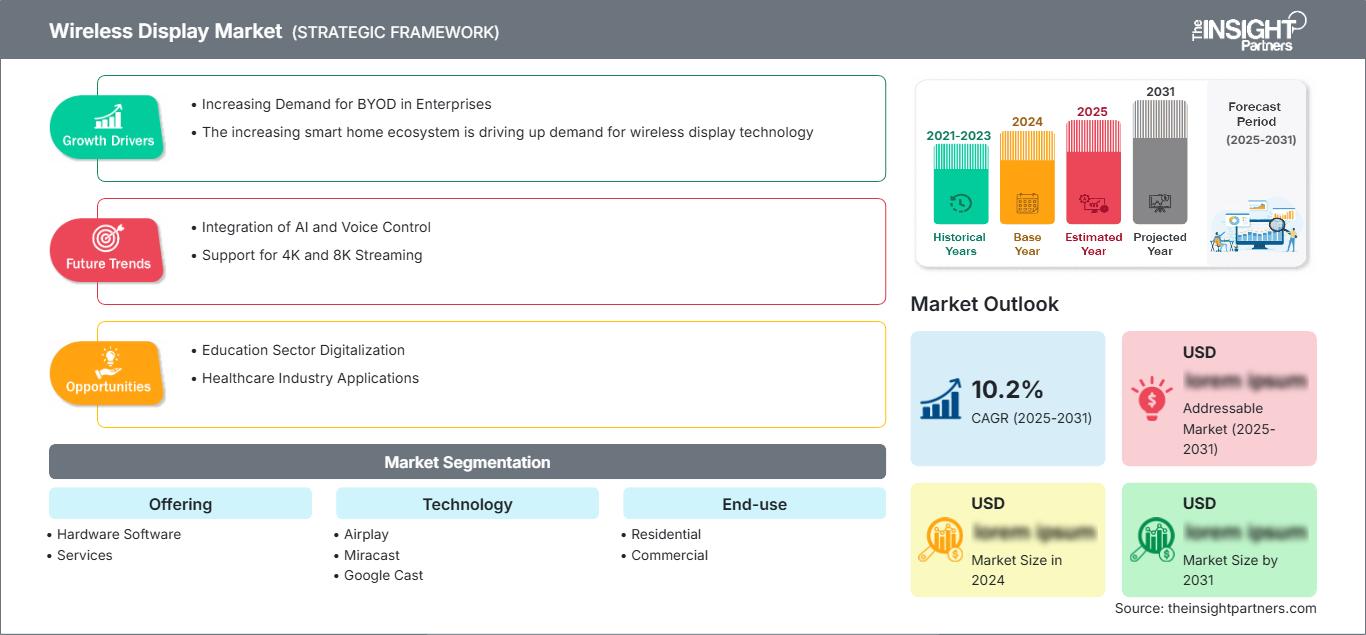
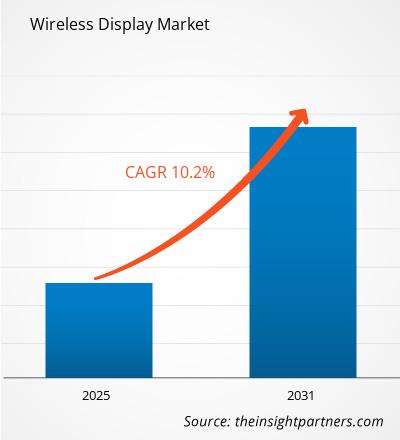
The wireless display market was valued at US$ 6.81 Billion in 2025 and is projected to reach US$ 16.44 Billion by 2034, expanding at a CAGR of 10.30% during 2026–2034. The market covers hardware, software, and services that enable wireless transmission, casting, mirroring, and collaborative display experiences across residential and commercial environments using established and evolving connectivity protocols.
Across North America, wireless display market size is supported by hybrid workplace modernization, smart-room deployments, and the installed base of connected laptops, smartphones, televisions, and interactive panels. The regional outlook indicates a 10.8–11.6% CAGR, with enterprise collaboration and managed device administration providing structural support as organizations standardize flexible meeting and presentation environments.
Wireless Display Market Assessment and Insights
- North America: North America is estimated to account for 32–36% share in 2025 and expand at a 10.8–11.6% CAGR between 2026–2034, supported by enterprise collaboration, smart-home connectivity, and rapid Wi-Fi infrastructure upgrades.
- US: The US represents 68–72% of North American demand in 2025 and is expected to grow at a 10.6–11.4% CAGR during 2026–2034 as businesses modernize meeting rooms and connected entertainment systems.
- Europe: Europe holds an estimated 25–29% share in 2025 and is projected to register a 9.6–10.4% CAGR during 2026–2034, with Germany, the UK, France, Italy, and Spain supporting adoption through workplace digitization and connected building programs.
- Asia Pacific: Asia Pacific accounts for approximately 23–27% share in 2025 and is forecast to grow at a 12.4–13.2% CAGR between 2026–2034, led by China, Japan, South Korea, India, and Australia.
- Largest Segment: Hardware represents approximately 52–56% market share in 2025 and is expected to expand at a 9.2–10.0% CAGR during 2026–2034 as receivers, adapters, and embedded display components remain widely deployed.
- High Growth Segment: Commercial end-use holds approximately 43–47% market share in 2025 and is projected to grow at an 11.8–12.6% CAGR between 2026–2034 through collaboration rooms, education, hospitality, and digital workplace deployments.
- Key companies analyzed in detail: Actiontec Electronics, Inc.; Airtame Inc.; Amazon.com, Inc.; App Dynamic ehf.; Apple Inc.; Google LLC; Lattice Semiconductor Corporation; NETGEAR, Inc.; Roku, Inc.; Squirrels LLC; Barco NV; Mersive Technologies, Inc.; Crestron Electronics, Inc.
Source: The Insight Partners' analysis based on proprietary research, government publications, company annual reports, investor presentations, industry databases, and expert interviews.
The industry is changing from dongles and adapters into integrated software-based solutions embedded within televisions, projectors, interactive panels, conferencing solutions, and digital signage endpoints, as native support for AirPlay, Miracast, and Google Cast lowers dependence on external receivers, in addition to better throughput and latency from Wi-Fi 6E and Wi-Fi 7 technologies. The shift will therefore be towards more sophisticated chipsets, certified software stacks, security-oriented device management, and multi-protocol interoperability.
Over the next few years, investments will be made into segments in which connected-device adoption and digitization are not yet at the level seen in developed markets. The geographical opportunity for expansion lies in the Asia-Pacific region, as commercial installations in education, healthcare, hospitality, and corporate real estate increase the applications for wireless display products. The regulatory push for cybersecurity, network segmentation, and managed access will play in favor of solutions combining wireless display functionality with central management, authentication, monitoring, and firmware management.
Wireless Display Market Report Scope
| Report Attribute | Details |
|---|---|
| Market size in 2025 | US$ 6.81 Billion |
| Market Size by 2034 | US$ 16.44 Billion |
| Global CAGR (2026 - 2034) | 10.30% |
| Historical Data | 2021-2024 |
| Forecast period | 2026-2034 |
Wireless Display Market Analysis
The demand for the solution is increasing due to the requirement to enable a hassle-free switching of data between personal devices and displays in the absence of cables. The trend of hybrid working is leading to a continuous requirement of flexible presentation solutions, and smart TVs, in addition to connected projectors, are making it common to cast in households. Value chain participants include semiconductors, protocol providers, display manufacturers, receivers, software providers, systems integrators, and managed services providers. In a study done by the Wireless Broadband Alliance, 38 percent of the companies surveyed planned to implement Wi-Fi 7 in 2025 or 2026.
According to the wireless display market report, supply-side dynamics favor multi-protocol solutions because enterprises operate multiple endpoints running Windows, Android, ChromeOS, macOS, and iOS. Therefore, providers differentiate themselves on the grounds of interoperability, security, ease of deployment, and central management, rather than connectivity alone. Hardware is still necessary, but the recurring software and services component is acquiring greater strategic significance among buyers who need remote management, access policy enforcement, analytics, firmware management, and lifecycle management of their distributed screen estate.
Competitive positioning is turning into one focused on platforms. Apple Inc. derives benefits from an ecosystem where integration goes deep, whereas Google LLC caters to Android and Chrome platforms. Amazon.com Inc. is developing casting technology using Matter Casting; meanwhile, Airtame Inc. focuses on unifying screen sharing, conferencing, signage, and remote management solutions. Wireless presentation continues to be served by Actiontec Electronics Inc. and Squirrels LLC; meanwhile, NETGEAR Inc. provides networking know-how for wireless displays.
Barco NV, Mersive Technologies Inc., and Crestron Electronics Inc. focus on enterprise market needs such as room integration, security, collaboration, and device management capabilities. Meanwhile, Lattice Semiconductor Corporation enters the market via programmable connectivity and processing solutions, and consumer and application-oriented solutions are provided by Roku Inc. and App Dynamic ehf. The current trends show that investment is going towards software-defined control, protocol certification, network security, and conferencing capability.
● REPORT CUSTOMIZATION
Tailor This Report To Align With Your Specific Business Requirements
This report can be customized to align precisely with your business objectives, scope, and target markets. Customization options include tailored segmentation, geography, competitive analysis, and strategic insights to support informed decision-making.
Customize This Report →WHAT YOU CAN ADJUST
- ● Segmentations
- ● Geography
- ● Competitive Analysis
- ● Language Preferences
Wireless Display Market: Strategic Insights
Regional Insights
North America Wireless Display Market
The North American market will retain its 32–36% wireless display market share in 2025 and continue growing at a 10.8–11.6% CAGR till 2034. North America enjoys mature broadband connectivity, high adoption of smart devices, prevalence of hybrid work, and a developed AV purchasing ecosystem for enterprises. Corporate campuses are becoming more dependent on meeting rooms that allow using employee-possessed and operated equipment without setting up complicated cable connections. Education, health care, hospitality, and digital signage create extra demand outside typical office deployments.
The US is driving regional activity due to vendor concentration, SI presence, and the dominance of big enterprise customers there. Canada brings in value through connected workplaces and education modernization. The market demand shifts to centralized device management, encryption, access control based on roles, and interaction with conferencing solutions. High investments in Wi-Fi 6E and Wi-Fi 7 contribute to an improved environment for high-quality wireless content. Mature cycles of product renewal help generate more lifetime revenue from software subscriptions.
U.S. Wireless Display Market
US accounts for around 68-72% of North America demand by 2025 and will exhibit a 10.6-11.4% CAGR through 2034. Enterprise organizations, academic institutions, healthcare facilities, hotels, and retail establishments are rapidly adopting wireless display solutions in conjunction with video conferencing and digital signs. The installed base of Apple, Windows, Android, and ChromeOS endpoints drives a robust demand for multi-protocol support.
Trends in application areas are moving away from just screen mirroring applications to those that provide collaborative work environments. Security, authentication capabilities, remote support capabilities, and centralized management are becoming important criteria for corporate IT departments along with performance of the display applications. Some of the critical technology ecosystems such as Apple Inc., Google LLC, Amazon.com, Inc., and Microsoft office products determine buyer requirements. Professional AV channels in US installations enable vendors to provide wireless display solutions along with conferencing solutions, room bookings, etc.
Europe Wireless Display Market
Europe will have a share of 25-29% in 2025 and it will grow at a rate of 9.6-10.4% CAGR until 2034. UK will remain an important market owing to the presence of hybrid collaboration and flexibility in office spaces that will require the use of wireless systems in meeting rooms. Germany will benefit from its industrial digitalization process as well as its investment in audiovisual equipment for enterprises. France will continue its trend of adoption of connected workplaces and education solutions. Italy and Spain will be helped by the development of hospitality venues, education, corporate modernization, and smart buildings. In Europe, the focus of the procurement will include inter-operability, data security, and energy-efficient infrastructure. Germany will emerge as the top country within the regional market owing to its industrial base, enterprise technology adoption, and significant commercial base.
APAC Wireless Display Market
APAC is projected to account for 23–27% share in 2025 and grow at a 12.4–13.2% CAGR through 2034, making it the fastest-expanding major region. China leads regional demand, followed by Japan, South Korea, India, and Australia. Smart-device adoption, education digitization, enterprise modernization, and expanding commercial display installations support the market.
The electronic ecosystem of China ensures the availability of supplies within the locality, but the focus of Japan and South Korea is on the application of advanced electronics in workplaces and for consumers. India provides great potential with digital classrooms and improved technologies for corporations and smart infrastructure. Australia has the advantage of existing corporate and education network connectivity. Improvement in Wi-Fi 6E and Wi-Fi 7 deployment will help enhance performance.
Middle East & Africa Wireless Display Market
Middle East and Africa is expected to register a 9.0–9.8% CAGR through 2034. Saudi Arabia and the UAE are leading regional adopters as smart-city programs, hospitality investments, airports, corporate facilities, and premium entertainment venues expand demand for flexible visual connectivity. South Africa remains a major market for enterprise and education applications.
UAE enjoys a lot of tourism, business real estate development, and digital infrastructure investment opportunities, whereas the infrastructure pipeline in Saudi Arabia facilitates connected places and technological infrastructures. South Africa is a relatively advanced location for business and educational purposes. Other countries in MEA region see more selective usage in premium projects. The efficiency of energy networks, robust connectivity, and ease of deployment will play a role in the buying decision process.
Segmentation Analysis
Offering
Hardware is expected to grow at a 9.2–10.0% CAGR during 2026–2034. Hardware includes receivers, adapters, transmitters, embedded connectivity modules, and compatible display components. Demand remains strong because wireless capabilities are increasingly integrated directly into televisions, monitors, projectors, and interactive panels. Replacement cycles and new installations continue to sustain unit demand.
- Hardware: Hardware remains central to deployment because physical endpoints establish the connection between source devices and shared screens. Buyers increasingly favor compact, multi-protocol devices that simplify installation while supporting high-resolution content.
- Software: Software adoption is shaped by centralized management, security policies, analytics, device provisioning, and integration with conferencing environments. Subscription models can reduce lifecycle administration burdens for distributed screen fleets.
- Services: Services gain importance as enterprises require deployment assistance, network configuration, monitoring, firmware management, and technical support. Professional and managed services can improve reliability where internal IT resources are constrained.
Technology
The Technology segment is expected to expand at a 10.8–11.6% CAGR during 2026–2034 as protocol ecosystems mature and displays increasingly support multiple standards. Device diversity makes interoperability strategically important, while improvements in wireless networking allow higher-resolution and lower-latency experiences across consumer and commercial environments.
- Airplay: AirPlay benefits from seamless integration with Apple devices and strong familiarity among consumers and enterprises using iPhone, iPad, and Mac endpoints. Hospitality and education applications broaden its commercial relevance.
- Miracast: Miracast remains important for Windows and Android environments where direct wireless display connections are valued. Enterprise, classroom, and industrial deployments benefit from broad endpoint compatibility and controlled network operation.
- Google Cast: Google Cast is positioned for strong expansion through Android, Chrome, smart-TV, and streaming ecosystems. Its software-oriented approach supports consumer entertainment while increasingly addressing commercial casting scenarios.
Application
The Application segment is forecast to grow at a 10.6–11.4% CAGR during 2026–2034. Residential deployments benefit from connected entertainment and smart-TV adoption, while commercial demand is supported by collaboration rooms, classrooms, healthcare environments, hospitality, and digital signage. Commercial buyers increasingly prioritize security and centralized administration.
- Consumer: Consumer demand centers on convenient streaming, gaming, screen mirroring, and multi-device entertainment. Smart televisions with native casting reduce setup friction and make wireless connectivity an expected feature.
- Commercial: Commercial adoption is driven by hybrid meetings, flexible classrooms, healthcare visualization, hospitality entertainment, and managed digital signage. Interoperability and remote administration are becoming decisive purchasing criteria.
Opportunity Snapshot
| End-use | Revenue Contribution | Trend Tag | Adoption Stage |
|---|---|---|---|
| Residential | High | Smart Casting | Mature |
| Commercial | High | Hybrid Collaboration | Scaling |
Wireless Display Market Growth Drivers and Impact Analysis
Expansion of Wi-Fi 6E and Wi-Fi 7 Infrastructure
Wi-Fi infrastructure in the next generation will be instrumental in meeting the technical requirements needed for wireless displays with a high resolution. According to the results of a study by the Wireless Broadband Alliance, 37% of the companies that were studied have installed Wi-Fi 6E, while 19% have installed Wi-Fi 7 in the 2025 industry forecast, and further research reveals that 38% plan to install Wi-Fi 7 during 2025 and 2026. This upgrade in technology will help in increasing the bandwidth and reducing congestion. For the wireless display manufacturer, this means improved network performance which would facilitate 4K collaborations and presentations.
Growth of Flexible Collaboration and Shared Workspaces
The adoption of hybrid working practices is influencing the way organizations plan their meeting space solutions and budget for technology. Rather than installing a separate computer for each room or hardwiring a presentation source, organizations require adaptable facilities where workers can participate from their laptops, tablets, and smartphones. It widens the potential customer base for multi-protocol wireless display solutions and makes the management of these solutions more valuable. Education and healthcare institutions stand to gain from adaptable content sharing as well, since professors, doctors, and hospital staff will frequently change their places and devices. In terms of market implications, there is a trend towards room systems that feature wireless presentation, collaboration, digital signage, and device management.
Rising Demand for Connected Consumer Entertainment
The expectation is increasing among consumers for their smartphones and tablets to act as remote control for bigger screens, and smart TVs and streaming services allow easy casting through wireless connections. The consumer behavior here contributes to the demands for native casting, screen mirroring, and application-based streaming in household scenarios. Similarly, according to the passenger survey in 2025 by the International Air Transport Association (IATA), about 78 percent of the travelers expected a smartphone featuring digital wallet, digital passport, and loyalty functions, highlighting the growing trend towards mobile-based digital experience. Such expectations can be seen in hotels and other venues where guests demand connecting their devices with the screens in their rooms.
Wireless Display Market Future Trends
Protocol Convergence and Secure Multi-Platform Casting
The wireless display market trends are moving toward protocol convergence, where a single endpoint supports AirPlay, Miracast, Google Cast, browser-based casting, and emerging interoperability frameworks. Buyers increasingly view compatibility as a baseline requirement because mixed device fleets are standard in workplaces, schools, hotels, and healthcare facilities. Future systems are likely to emphasize automated device discovery, identity verification, session permissions, encrypted transport, and network segmentation rather than simple connection initiation. Matter Casting developments also indicate a broader industry direction toward standardized discovery and control across connected ecosystems. This convergence can reduce dependence on proprietary receivers while increasing software differentiation. Vendors that combine broad protocol coverage with centralized policy enforcement will be better positioned to serve organizations managing diverse endpoint environments.
Embedded Intelligence Across Shared Display Environments
Future wireless display systems are likely to incorporate greater intelligence at the endpoint and management layers. Analytics can identify room utilization, connection failures, recurring performance issues, and device-health patterns, allowing IT teams to optimize infrastructure without physically inspecting every display. Edge processing may also support adaptive quality, automatic bandwidth management, and context-aware content routing. In commercial environments, artificial intelligence can connect wireless presentation with room scheduling, conferencing, occupancy information, and digital signage workflows. This evolution changes the value proposition from connectivity hardware toward an intelligent shared-screen platform. Vendors that develop open application programming interfaces and cloud-managed architectures may gain stronger ecosystem positions because they can integrate with workplace, education, hospitality, and building-management applications without requiring customers to replace their existing display hardware.
Wireless Display Market Opportunities
Managed Wireless Display Fleets for Distributed Enterprises
The wireless display market Forecasts indicate an expanding opportunity for managed deployments across organizations operating hundreds or thousands of shared screens. Distributed retailers, banks, universities, healthcare networks, hotel groups, and corporate campuses need consistent configuration, security, monitoring, and firmware management across locations. A cloud-managed model can provide centralized provisioning, access policies, diagnostics, usage analytics, and remote troubleshooting while reducing the need for site-level technical intervention. Vendors can create differentiated offerings by combining hardware with subscription software and professional services. The opportunity is particularly attractive where customers already operate managed Wi-Fi and unified communications platforms because wireless display management can become an extension of the existing infrastructure stack. Partnerships with systems integrators can further accelerate adoption.
Wireless Casting for Hospitality and Transportation Venues
Hospitality and transportation facilities provide a distinct opportunity because users increasingly carry powerful personal devices but interact with large shared screens during their journeys. Hotels can offer secure guest casting without exposing internal networks, while airports, lounges, rail stations, and conference venues can deploy managed wireless presentation or information displays. IATA reported that global passenger demand increased 5.3% in 2025, reinforcing the scale of environments where digital passenger experiences matter. Vendors can address this opportunity through isolated casting networks, short-lived authentication, QR-based onboarding, centralized content control, and multilingual interfaces. Solutions that combine guest convenience with strict network separation can appeal to operators seeking digital experiences without creating unmanaged access points or significant support requirements.
Frequently Asked Questions

- Comprehensive Market Sizing and Forecast Analysis
- Detailed Segmentation Analysis
- In-Depth Market Dynamics Assessment
- Regional and Country-Level Insights
- Competitive Landscape and Company Benchmarking
- Strategic Business Intelligence
Recent Reports
Testimonials

The Insight Partners' SCADA System Market report is comprehensive, with valuable insights on current trends and future forecasts. The team was highly professional, responsive, and supportive throughout. We are very satisfied and highly recommend their services.
RAN KEDEM Partner, Reali Technologies LTDs
I requested a report on a very specific software market and the team produced the report in a few days. The information was very relevant and well presented. I then requested some changes and additions to the report. The team was again very responsive and I got the final report in less than a week.
JEAN-HERVE JENN Chairman, Future Analytica
We worked with The Insight Partners for an important market study and forecast. They gave us clear insights into opportunities and risks, which helped shape our plans. Their research was easy to use and based on solid data. It helped us make smart, confident decisions. We highly recommend them.
PIYUSH NAGPAL Sr. Vice President, High Beam Global
The Insight Partners delivered insightful, well-structured market research with strong domain expertise. Their team was professional and responsive throughout. The user-friendly website made accessing industry reports seamless. We highly recommend them for reliable, high-quality research services
YUKIHIKO ADACHI CEO, Deep Blue, LLC.
This is the first time I have purchased a market report from The Insight Partners.While I was unsure at first, I visited their web site and felt more comfortable to take the risk and purchase a market report.I am completely satisfied with the quality of the report and customer service. I had several questions and comments with the initial report, but after a couple of dialogs over email with their analyst I believe I have a report that I can use as input to our strategic planning process.Thank you so much for taking the extra time and making this a positive experience.I will definitely recommend your service to others and you will be my first call when we need further market data.
JOHN SUZUKI President and Chief Executive Officer, Board Director, BK Technologies
I wish to appreciate your support and the professionalism you displayed in the course of attending to my request for information regarding to infectious disease IVD market in Nigeria. I appreciate your patience, your guidance, and the fact that you were willing to offer a discount, which eventually made it possible for us to close a deal. I look forward to engaging The Insight Partners in the future, all thanks to the impression you have created in me as a result of this first encounter.
DR CHIJIOKE ONYIA MANAGING DIRECTOR, PineCrest Healthcare Ltd.Reason to Buy
- Informed Decision-Making
- Understanding Market Dynamics
- Competitive Analysis
- Identifying Emerging Markets
- Customer Insights
- Market Forecasts
- Risk Mitigation
- Boosting Operational Efficiency
- Strategic Planning
- Investment Justification
- Tracking Industry Innovations
- Aligning with Regulatory Trends





 Get Free Sample for