
Smartphone Display Market Size, Growth & Trends by 2034
Coverage: by Type (Capacitive Display, Resistive Display); Display Technology (TFT-LCD, IPS-LCD, OLED, AMOLED, Others); Size (0"4 Inches, 4"5 Inches, 5"6 Inches, Above 6 Inches); Resolution (720 X 1280, 1920 X 1080, Others) , and Geography (North America, Europe, Asia Pacific, and South and Central America)
- Status : Data Released
- Report Code : TIPRE00011996
- Category : Electronics and Semiconductor
- No. of Pages : 150
- Available Report Formats :


- Last update date : September 28, 2026


2025 Market Size
US$ 52.86 Bn
Base year value
2034 Forecast
US$ 71.14 Bn
Projected by 2034
CAGR 2026-2034
3.36 %
Growth rate
Addressable Market
US$ 563.26 Bn
(2026-2034)
The global Smartphone Display market was valued at US$ 52.86 billion in 2025 and is expected to reach US$ 71.14 billion by 2034; it is estimated to record a CAGR of 3.36% during 2026-2034.
Smartphone Display Market Assessment and Insights
- North America: North America is expected to hold a 16–19% share in 2025 and grow at a CAGR of 3–5% between 2026–2034, supported by premium smartphones, OLED penetration, replacement demand, and sustained carrier financing.
- US: The US is estimated to represent 65–70% of North America's 2025 value, expanding at a CAGR of 3–5% between 2026–2034 as premium OLED devices dominate upgrades.
- Europe: Europe is projected to account for a 17–20% share in 2025 and grow at a CAGR of 2–4% between 2026–2034. Germany, the UK, France, Italy, and Spain remain important demand centers.
- Asia Pacific: Asia Pacific is estimated at a 51–55% share in 2025 and is expected to expand at a CAGR of 4–6% through 2034, led by China, Japan, South Korea, India, and regional manufacturing ecosystems.
- Largest Segment: AMOLED is estimated to hold a 48–52% market share in 2025, with a CAGR of 7–9%, reflecting broad adoption across flagship and increasingly mid-range smartphones.
- High Growth Segment: Above 6 Inches is estimated at a 58–62% market share in 2025 and is projected to grow at a CAGR of 4–6%, supported by large-screen usage.
- Key companies analyzed in detail: Apple Inc.; Fujitsu Limited; Japan Display Inc.; LG Electronics Inc.; Mitsubishi Electric Corporation; Motorola Mobility LLC; Samsung Electronics Co., Ltd.; Sharp Corporation; Sony Corporation; Toshiba Corporation.
Source: The Insight Partners' analysis based on proprietary research, government publications, company annual reports, investor presentations, industry databases, and expert interviews.
In terms of Smartphone Display Market, the transition has been from TFT-LCD technology to OLED and AMOLED that enable thinner designs, high contrast levels, adjustable refresh rates, and better power management. The flexible displays have become quite essential in advanced manufacturing by the suppliers. Data from the industry reveals that AMOLED made up 51% of total shipments of smartphone displays in 2024, whereas flexible AMOLED comprised 40%.
With regard to future trends, differentiation of panel technologies is expected to be more toward higher brightness levels, lower power usage, privacy features, built-in sensors, and flexibility. The emerging markets would continue to be key in terms of volume, and the premium markets would help in value addition through advanced technologies. In terms of regulations, there would be greater importance given to repairability, energy efficiency, electronic waste, and standardization of charging.
Smartphone Display Market Report Scope
| Report Attribute | Details |
|---|---|
| Market size in 2025 | US$ 52.86 Billion |
| Market Size by 2034 | US$ 71.14 Billion |
| Global CAGR (2026 - 2034) | 3.36% |
| Historical Data | 2021-2024 |
| Forecast period | 2026-2034 |
Smartphone Display Market Analysis
Drivers of Smartphone Display Market Growth include replacement cycles, premiumization, bigger screen sizes, and increasing preference for high refresh rate displays. Panel manufacturers, smartphone OEMs, semiconductor companies, material manufacturers, glass makers, and equipment suppliers are part of the highly interdependent value chain. There is a trend towards flexible OLED demand from consumers whereas LCD will be used in budget smartphones where costs prevail over premium display features.
As far as supply trends, there is an increasing dominance of Asia-based manufacturing regions such as China, South Korea, Japan, and Taiwan. Increased capacity of OLEDs has made flexible OLED displays more accessible and affordable, making them available in lower price segments. On the other hand, panel makers have to deal with challenges such as utilization, yields, materials, and capital intensity issues.
The Smartphone Display Market Report suggests that competition in the market arises from panel quality, yield, customer qualification, capacity allocation, and technology roadmaps. Apple Inc. relies more on using advanced OLED specifications as a means of differentiating its products, whereas Samsung Electronics Co., Ltd. integrates display technology into its handsets. Other players include LG Electronics Inc., Japan Display Inc., Sharp Corporation, Sony Corporation, and Fujitsu Limited through their capabilities in display and electronics.
In the positioning strategy today, emphasis is put on the economics of flexible OLEDs, backplane technology, brightness architecture, and unique form factors. The significance of Mitsubishi Electric Corporation and Toshiba Corporation relates to their display engineering expertise, while Motorola Mobility LLC takes part in the industry owing to its demand for handsets. The investment strategy should thus revolve around maximizing OLED efficiency, materials usage, panel longevity, and manufacturing flexibility.
● REPORT CUSTOMIZATION
Tailor This Report To Align With Your Specific Business Requirements
This report can be customized to align precisely with your business objectives, scope, and target markets. Customization options include tailored segmentation, geography, competitive analysis, and strategic insights to support informed decision-making.
Customize This Report →WHAT YOU CAN ADJUST
- ● Segmentations
- ● Geography
- ● Competitive Analysis
- ● Language Preferences
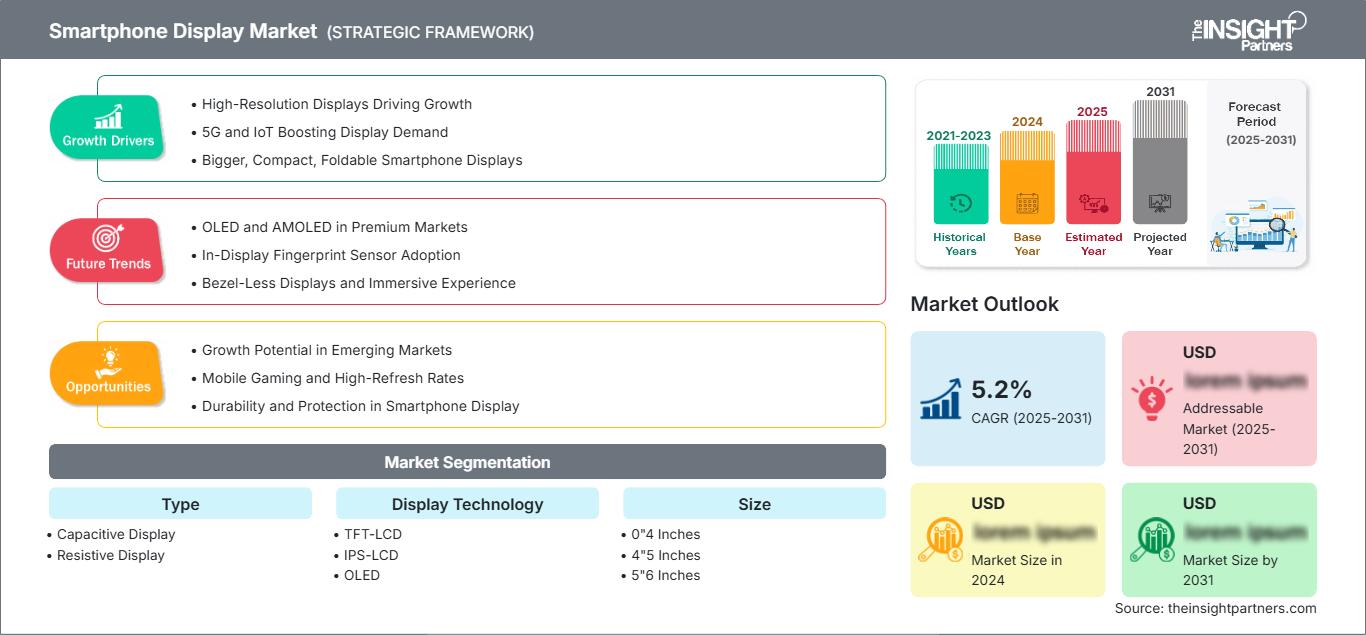
Smartphone Display Market: Strategic Insights
Regional Insights
North America Smartphone Display Market
North America is estimated to make up 16-19% of the Smartphone Display Market Share by 2025, growing at a CAGR of 3-5% through 2034. The North America region is supported by high phone replacement values, a healthy presence of high-end devices, and a solid carrier financing ecosystem. Adoption of OLED is higher in high-end phones as parameters such as brightness, contrast, refresh performance, and outdoor visibility affect purchase decisions. The US will be the main market in the region.
The increase in the demand can be attributed to purchases of high-end phones as well as relatively high rates of smartphone penetration amongst Canadians. The emphasis is more on screen durability and power management rather than just the resolution. The other demand driver is the purchase of foldable phones despite being in relatively lower quantities as compared to the flagships.
U.S. Smartphone Display Market
North American market represents around 65-70% of the total market value in 2025 and is expected to grow at a CAGR of 3-5% between 2026 and 2034. Premium devices contribute significantly towards value generation in the display segment due to the fact that consumers prefer OLED handsets having high refresh rates, good outdoor brightness, and large active areas. Companies like Apple Inc. and Samsung Electronics Co., Ltd. exert considerable influence over the respective ecosystems.
Emerging application trends tend to focus on gaming, video streaming, photography, productivity, and always-on functions. OLED displays will benefit from such application trends as they feature high contrast, thin form factors, and adaptive refresh capabilities. The installment plans provided by carriers and the possibility of trade-ins help to lower the entry barriers for the premium segment. The component availability may be affected by tariffs, logistics, cycle times, and supplier diversification.
Europe Smartphone Display Market
Europe market share will be around 17-20% for 2025 and grow by CAGR 2-4% till 2034, whereas Germany will remain an important demand center. Consumers in the UK, Germany, France, Italy, and Spain are increasingly oriented towards quality display and durability of their devices, software and energy efficient performance.
UK has emerged as a matured high-end smartphone market with Apple and Samsung holding dominant market positions. Germany is the place where demands for the high value phone combine with industrial needs and sustainable development. Premium smartphones and long replacement cycles have great importance in France, whereas demands for mid and high-end Android phones prevail in Italy and Spain. Sustainable development in the EU is affecting the product design, serviceability, materials and lifecycle. Adoption of OLED technology will be structurally high because of panel price drop.
APAC Smartphone Display Market
APAC is expected to account for 51–55% of the total value in 2025 and show a CAGR of 4–6% until 2034. China plays an important role in the region due to the large capability of panels and smartphones manufacturing. Japan, South Korea, India, and Australia are some of the supportive premium and volume markets.
Government policies, semiconductor investments, manufacturing incentives, and electronics ecosystems improve the competitiveness of the region. China is particularly dominant due to panel manufacturing capability, South Korea due to OLED manufacturing. India is growing in terms of handset and premium smartphone demand, Japan in terms of components design, while Australia offers a smaller but premium market due to smartphone penetration.
Middle East & Africa Smartphone Display Market
MEA region is anticipated to grow at CAGR of 3-5% till 2034, with Saudi Arabia and UAE being the biggest contributors of value in Middle East. South Africa is the main demand center for the continent of Africa, while rest of the MEA countries are driven by growing penetration of smartphones.
Investments in energy, infrastructure, urbanization and mobile broadband drives handset demand. High-end display is becoming a significant driver in the Gulf markets, while affordability continues to be a critical factor in many African countries. Screen size is essential for media viewing and business purposes, while robust LCD panels continue to cater to affordability requirements.
Segmentation Analysis
Type
Type is projected to expand at a CAGR of 2–4% during 2026–2034. Capacitive displays remain dominant because modern smartphones require responsive multitouch interfaces, while resistive architectures occupy limited specialized applications. The Smartphone Display Market scope increasingly favors capacitive technology because gesture control, gaming, biometric interaction, and seamless software interfaces require precise touch response and durable surface integration.
- Capacitive Display: Capacitive Display maintains the leading position because smartphones require accurate multitouch input, low activation force, and compatibility with modern user interfaces. Its integration with protective glass supports thin device architectures.
- Resistive Display: Resistive Display serves specialized and legacy applications where pressure-based interaction, glove use, or cost considerations remain relevant. Its smartphone role is constrained by lower multitouch capability and reduced consumer preference.
Display Technology
Display Technology in the Smartphone Display Market is expected to register a CAGR of 5–7% during 2026–2034. OLED and AMOLED are reshaping procurement priorities through high contrast, thin construction, flexible integration, and lower power consumption in selected usage conditions. TFT-LCD and IPS-LCD remain relevant where cost, supply stability, and entry-level device economics are more important than premium visual performance.
- TFT-LCD: TFT-LCD retains strategic importance in cost-sensitive smartphones because established manufacturing infrastructure and mature supply chains support economical panel production and broad device compatibility.
- IPS-LCD: IPS-LCD remains relevant where wide viewing angles, consistent color performance, and competitive pricing are required. Its position is strongest in value-oriented smartphones and replacement markets.
- OLED: OLED benefits from self-emissive pixels, strong contrast, thin construction, and flexible form factors. Its adoption supports premiumization and creates opportunities for innovative smartphone industrial designs.
- AMOLED: AMOLED has become a mainstream premium and upper-mid-range technology, supported by flexible panels, adaptive refresh, high brightness, and increasing cost competitiveness as manufacturing capacity expands.
Size
Size is expected to grow at a CAGR of 4–5% through 2034. Larger screens increasingly support streaming, gaming, multitasking, and productivity, encouraging manufacturers to maximize active display area while controlling device thickness. Foldable designs extend this trend by creating larger viewing surfaces without proportionally increasing pocket footprint, strengthening demand for advanced flexible panel architectures.
- 0"4 Inches: This size category serves compact smartphone configurations and specialized designs. Its market position is constrained by consumer preference for larger viewing areas and improved multimedia usability.
- 4"5 Inches: This range supports compact devices where portability remains important. Demand is sustained by consumers seeking manageable form factors, although larger displays increasingly influence mainstream smartphone specifications.
- 5"6 Inches: This category represents a practical balance between portability and content consumption. It remains strategically relevant for mainstream smartphones, combining manageable dimensions with sufficient space for applications, video, and gaming.
- Above 6 Inches: Above 6 Inches benefits from premiumization, multimedia consumption, gaming, and multitasking. Large-screen smartphones increasingly use narrow bezels and flexible architectures to preserve usability while expanding viewing area.
Resolution
Resolution is projected to expand at a CAGR of 3–4% during 2026–2034. Resolution improvements are becoming increasingly linked with screen size, pixel density, image processing, gaming, and camera output. Manufacturers are balancing resolution against power consumption and component cost, while premium devices increasingly use sophisticated display engines to improve perceived quality without relying solely on higher pixel counts.
- 720 X 1280: This resolution remains relevant in cost-sensitive smartphones where low component cost and adequate everyday viewing are prioritized. Its strategic role is supported by entry-level demand across emerging economies.
- 1920 X 1080: Full-HD resolution remains a widely established configuration, offering an effective balance of sharpness, performance, and power consumption across mainstream smartphone categories.
- Others: Other resolutions cover advanced and non-standard configurations used for premium, large-format, foldable, and specialized devices. Their importance increases as manufacturers optimize aspect ratios and flexible form factors.
Opportunity Snapshot
| Display Technology | Revenue Contribution (High/Medium/Low) | Trend Tag | Adoption Stage |
|---|---|---|---|
| TFT-LCD | Medium | Cost Efficiency | Mature |
| IPS-LCD | Medium | Wide Viewing | Mature |
| OLED | High | Flexible Panels | Scaling |
| AMOLED | High | Adaptive Refresh | Scaling |
Smartphone Display Market Growth Drivers and Impact Analysis
Premiumization Raises the Value of Display Specifications
With premiumization, the acquisition of displays will shift away from basic display functions towards superior brightness, adaptive refresh rate, colors, longevity, and energy efficiency. With such considerations, the value of each panel will change since premiumization allows for advanced materials and production methods for the higher end devices. OEMs have come to realize that using displays as a means of distinguishing products from the competitors is now the norm; thus, manufacturers must compete in terms of panel performance and not capacity. The implications go even further into the ecosystem of the components used, hence an increased demand for advanced backplanes, optical films, cover glass, driver ICs, and OLED materials. Higher value specifications of the displays could also mean longer replacement periods by making the older devices look outdated.
Flexible OLED Expands the Addressable Design Space
Flexible OLEDs have brought changes to the handset design by making curved edges, small bezels, folding possible, and allowing better utilization of internal spaces. In addition, it enables device makers to try handsets which feature larger display screens but smaller form factors. Flexible OLEDs have become feasible due to the higher efficiency of manufacturers in improving production yield and reducing the cost of materials. It also generates extra demands in encapsulation, flexible substrates, touch capability, and cover materials. What follows is the broader effect of the ecosystem than replacing panels since every new form factor involves the collaboration in engineering of batteries, hinges, cameras, processors, chassis parts, and many more. Suppliers who can satisfy the reliability, bending, brightness, and longevity requirements will definitely affect the OEM’s design decisions.
Higher Display Quality Supports Digital Content Consumption
The use of smartphones has evolved into an activity that includes HD video, cloud gaming, photography, short-form content, and productive applications. Such activities highlight the significance of refresh rate, brightness, color accuracy, contrast, and touch sensitivity. The effect of the market is felt where smartphones serve as the main personal computer, especially for places with a high usage of mobile internet and no reliance on computing devices. High performance of displays further adds to premium positioning of smartphones because the visual difference becomes very clear to users. The manufacturers, therefore, have reason to improve displays even when it is hard to see the changes in processor and cameras.
Smartphone Display Market Future Trends
AI-Aware Displays Become More Contextual
Future smartphone displays are likely to become more responsive to user context, device activity, privacy requirements, and ambient conditions. AI-enabled systems can dynamically adjust brightness, refresh behavior, color profiles, and information visibility according to application type and surroundings. The Smartphone Display Market trends will increasingly connect display hardware with software intelligence rather than treating the panel as a passive output component. Panel-integrated sensing may also enable biometric functions, environmental interaction, and more sophisticated user authentication. Such convergence could reduce the need for separate sensors while creating new design opportunities around uninterrupted screens. Suppliers will therefore compete on display intelligence, sensor integration, power optimization, and software compatibility, potentially making display architecture a more active part of smartphone computing and user-interface design.
Ultra-Efficient OLED Architectures Gain Strategic Importance
Energy efficiency may become an essential factor for display development as the batteries, screen refresh rates, and brightness become more advanced in smartphones. Future OLED display architecture designs may take advantage of improved emitters, optimal optical design, adaptive driving, and enhanced backplane technology to decrease energy usage while not compromising on brightness. It will be a benefit to companies that will develop efficient architectures while ensuring lifetime and color consistency. It will be essential for companies to define their panels not only through resolution and luminance but also through energy efficiency. Efficiency will allow for thinner designs since thermal management and battery usage become less challenging.
Smartphone Display Market Opportunities
Advanced Panel Platforms for Emerging Premium Devices
Investors and component suppliers can target premium growth opportunities by supporting flexible OLED platforms designed for foldables, thin smartphones, and high-performance conventional handsets. The opportunity extends beyond panel production into encapsulation, cover materials, driver electronics, testing, and manufacturing equipment. Smartphone Display Market Forecasts indicate that value creation will increasingly favor suppliers that can combine high yield with differentiated performance. Partnerships with OEM engineering teams can reduce qualification risk and provide earlier visibility into product roadmaps. Strategic investment should prioritize technologies that improve brightness, lifetime, power efficiency, and mechanical reliability simultaneously. Companies with scalable manufacturing and strong process control are better positioned to capture demand as advanced panels migrate from flagship devices into upper-mid-range products.
Localized Manufacturing and Resilient Component Networks
Regional manufacturing diversification creates opportunities for panel producers, materials suppliers, and equipment companies to establish closer relationships with smartphone assembly ecosystems. China, South Korea, India, Japan, and Southeast Asia offer different combinations of manufacturing scale, policy support, technical expertise, and consumer demand. Investors can reduce supply-chain exposure by developing multi-region sourcing arrangements for critical display materials and components. Localization also improves responsiveness to OEM requirements and can reduce logistics complexity for high-volume programs. The most attractive strategies will balance capital expenditure with utilization risk, because display fabrication requires substantial upfront investment. Companies that combine flexible capacity with long-term customer agreements can strengthen resilience while supporting the geographic diversification of smartphone production and display procurement.
Recent Developments
- August 2026: LG Display Co., Ltd. unveiled FLiPP, an FMM-less OLED pixel-patterning technology designed to improve manufacturing flexibility. The company reported 1.6 times higher brightness, 2.4 times longer panel lifetime, and 13% lower power consumption versus conventional FMM production under comparable conditions. LG Display plans to demonstrate the technology at IMID 2026 in Busan.
- May 2026: Samsung Display Co., Ltd. showcased Flex Chroma Pixel, a smartphone OLED technology supporting up to 3,000 nits in high-brightness mode and 96% BT.2020 color coverage at SID Display Week 2026. The company also demonstrated a 500 PPI Sensor OLED Display integrating organic photodiodes for biometric sensing, highlighting convergence between display and sensing functions.
- September 2025: Apple Inc. introduced the iPhone 17 with a 6.3-inch Super Retina XDR display, ProMotion adaptive refresh rates up to 120Hz, and peak outdoor brightness of 3,000 nits. The company also introduced Ceramic Shield 2 with improved scratch resistance and reduced glare, reinforcing the role of display durability and outdoor readability in premium smartphone differentiation.
Frequently Asked Questions

- Comprehensive Market Sizing and Forecast Analysis
- Detailed Segmentation Analysis
- In-Depth Market Dynamics Assessment
- Regional and Country-Level Insights
- Competitive Landscape and Company Benchmarking
- Strategic Business Intelligence
Recent Reports
Testimonials

The Insight Partners provided valuable market intelligence that supported our global go-to-market strategy. Their team was professional, responsive, and attentive to our feedback, providing thoughtful analysis and helpful methodological clarifications throughout the project.
Junmo Kim Chief Financial Officer (CFO), Enertech Co., Ltd.
The Insight Partners' SCADA System Market report is comprehensive, with valuable insights on current trends and future forecasts. The team was highly professional, responsive, and supportive throughout. We are very satisfied and highly recommend their services.
RAN KEDEM Partner, Reali Technologies LTDs
I requested a report on a very specific software market and the team produced the report in a few days. The information was very relevant and well presented. I then requested some changes and additions to the report. The team was again very responsive and I got the final report in less than a week.
JEAN-HERVE JENN Chairman, Future Analytica
We worked with The Insight Partners for an important market study and forecast. They gave us clear insights into opportunities and risks, which helped shape our plans. Their research was easy to use and based on solid data. It helped us make smart, confident decisions. We highly recommend them.
PIYUSH NAGPAL Sr. Vice President, High Beam Global
The Insight Partners delivered insightful, well-structured market research with strong domain expertise. Their team was professional and responsive throughout. The user-friendly website made accessing industry reports seamless. We highly recommend them for reliable, high-quality research services
YUKIHIKO ADACHI CEO, Deep Blue, LLC.
This is the first time I have purchased a market report from The Insight Partners.While I was unsure at first, I visited their web site and felt more comfortable to take the risk and purchase a market report.I am completely satisfied with the quality of the report and customer service. I had several questions and comments with the initial report, but after a couple of dialogs over email with their analyst I believe I have a report that I can use as input to our strategic planning process.Thank you so much for taking the extra time and making this a positive experience.I will definitely recommend your service to others and you will be my first call when we need further market data.
JOHN SUZUKI President and Chief Executive Officer, Board Director, BK Technologies
I wish to appreciate your support and the professionalism you displayed in the course of attending to my request for information regarding to infectious disease IVD market in Nigeria. I appreciate your patience, your guidance, and the fact that you were willing to offer a discount, which eventually made it possible for us to close a deal. I look forward to engaging The Insight Partners in the future, all thanks to the impression you have created in me as a result of this first encounter.
DR CHIJIOKE ONYIA MANAGING DIRECTOR, PineCrest Healthcare Ltd.Reason to Buy
- Informed Decision-Making
- Understanding Market Dynamics
- Competitive Analysis
- Identifying Emerging Markets
- Customer Insights
- Market Forecasts
- Risk Mitigation
- Boosting Operational Efficiency
- Strategic Planning
- Investment Justification
- Tracking Industry Innovations
- Aligning with Regulatory Trends





 Get Free Sample for