
Application Control Market Analysis, Size, and Share by 2034
Coverage: By Component [Solution and Services (Managed Services and Professional Services)]; Access Points (Desktops/Laptops, Servers, Mobiles/Tablets, and Others); Organization Size (SMEs and Large Enterprises); Vertical (Government and Defense, BFSI, IT and Telecom, Healthcare, Retail, and Others), and Geography
- Status : Data Released
- Report Code : TIPRE00011158
- Category : Technology, Media and Telecommunications
- No. of Pages : 150
- Available Report Formats :


- Last update date : August 27, 2026


2025 Market Size
US$ 2.06 Bn
Base year value
2034 Forecast
US$ 3.17 Bn
Projected by 2034
CAGR 2026-2034
4.9 %
Growth rate
Addressable Market
US$ 23.73 Bn
(2026-2034)
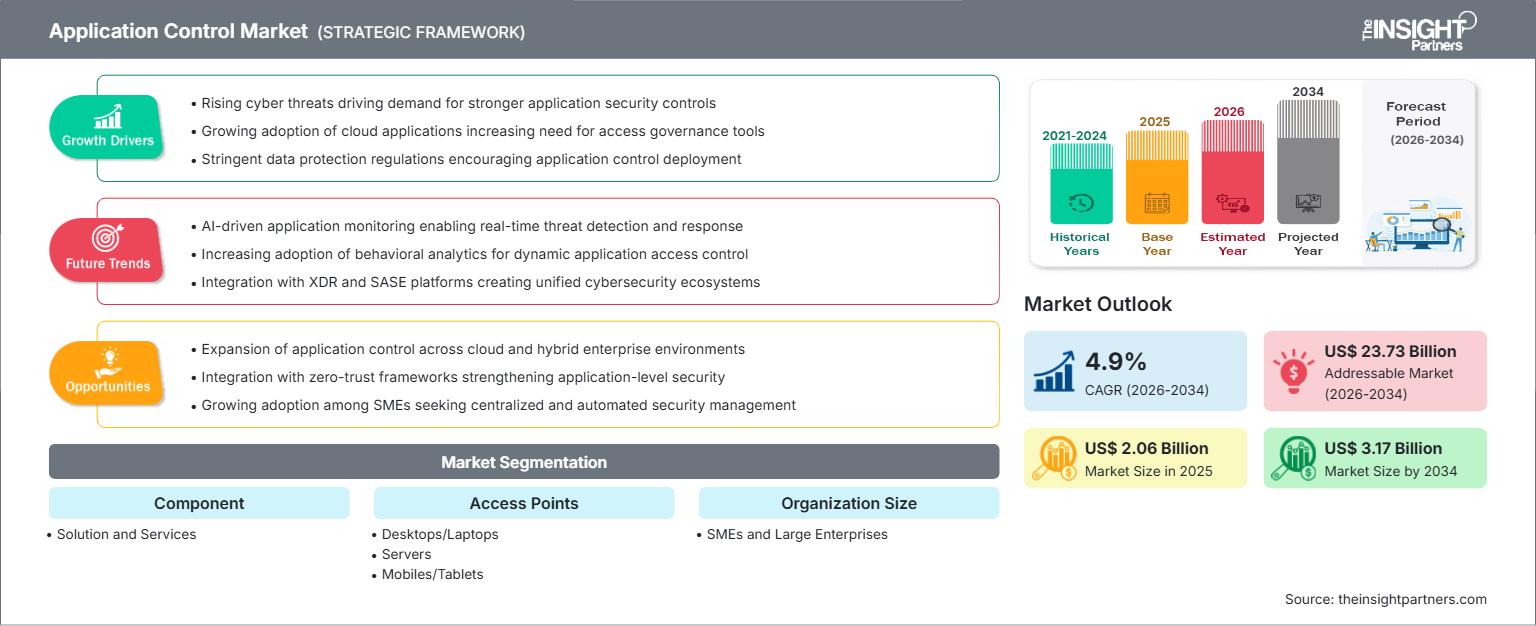
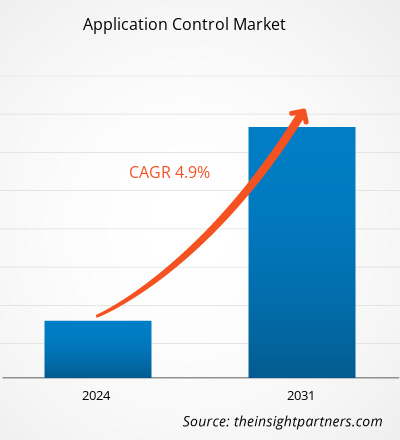
The application control market is projected to grow from US$ 2.06 Billion in 2025 to US$ 3.17 Billion by 2034, recording a CAGR of 4.9% during 2026–2034. The market is shaped by enterprise demand for allowlisting, endpoint lockdown, privileged execution controls, and compliance-ready application governance across desktops, servers, mobile devices, and hybrid infrastructure.
North America remains the most mature regional environment, supported by federal cybersecurity mandates, regulated-sector spending, and broad adoption of endpoint security platforms. The application control market size in the region is expected to expand at a CAGR of 4.6–5.1% during 2026–2034, with demand concentrated in government, defense, BFSI, healthcare, and critical infrastructure enterprises seeking stricter control over unauthorized software execution.
Application Control Market Assessment and Insights
- North America held a 36–39% share in 2025 and is projected to grow at a CAGR of 4.6–5.1% during 2026–2034, supported by zero-trust programs, endpoint governance, and regulated infrastructure spending.
- US accounted for 78–82% of North America in 2025 and is projected to grow at a CAGR of 4.7–5.2% during 2026–2034, driven by federal security modernization.
- Europe represented 25–28% in 2025 and is forecast to grow at a CAGR of 4.3–4.8% during 2026–2034, led by Germany, the UK, and France.
- Asia Pacific held 21–24% in 2025 and is expected to grow at a CAGR of 5.2–5.8% during 2026–2034, with China, Japan, India, South Korea, and Australia leading adoption.
- Largest Segment: Solution held 63–67% market share in 2025 and is projected to grow at a CAGR of 4.5–5.0% during 2026–2034 as enterprises prioritize policy engines.
- High Growth Segment: Mobiles/Tablets held 18–22% market share in 2025 and is anticipated to grow at a CAGR of 5.7–6.3% during 2026–2034 due to mobile workforce expansion.
- Key companies analyzed in detail: Broadcom Inc.; Cambium Networks Corporation; Carbon Black, Inc. (a Broadcom company); Check Point Software Technologies Ltd.; CyberArk Software Ltd.; Ivanti, Inc.; McAfee, LLC; Trend Micro Incorporated; Veracode, Inc.; WatchGuard Technologies, Inc.
Source: The Insight Partners' analysis based on proprietary research, government publications, company annual reports, investor presentations, industry databases, and expert interviews.
The execution control of enterprise application software is evolving from static allow listing to adaptive policy enforcement through endpoints, servers, and cloud-managed devices. Currently, software execution control providers are integrating file reputation checks, hash matching, publisher verification, script control, and behavioral monitoring to restrict ransomware execution paths. Platform vendors are also altering production by embedding application governance within their endpoint suites, thus minimizing standalone adoption hassles.
Over the forecast period, the industry will expand in geographies like Asia Pacific, the Middle East, and regulated Europe, owing to an evolving cybersecurity baseline that requires prevention-first controls at endpoints. Government contracts, managed security services, and an industry-based compliance framework will boost adoption rates. The industry will see an investment in an AI-powered policy recommendation engine, automatic exception management, and cloud console development.
Application Control Market Report Scope
| Report Attribute | Details |
|---|---|
| Market size in 2025 | US$ 2.06 Billion |
| Market Size by 2034 | US$ 3.17 Billion |
| Global CAGR (2026 - 2034) | 4.9% |
| Historical Data | 2021-2024 |
| Forecast period | 2026-2034 |
Application Control Market Analysis
Rising endpoint complexity is the central demand driver behind application control market growth. Businesses are implementing diverse device environments in which users execute SaaS programs, local productivity applications, remote desktop applications, scripts, and sector-specific software. Every piece of executable code represents an opportunity for misuse if permissions are lax. This is solved by application control, which allows for limited execution of only sanctioned software, making less reliance on signature-based detection, and enhancing defenses against zero-day malware attacks.
The value chain consists of endpoint software vendors, identity management vendors, security operations, managed services providers, and system integrators. The supply chain is influenced by increased bundling within endpoint protection products and demand for policy testing prior to enforcement. With businesses streamlining their tool sets, buyers are looking for products that provide visibility of devices, application inventory, privileges, and audit reporting.
The application control market analysis indicates a competitive structure split between endpoint security suites and specialist control engines. Broadcom Inc. and Carbon Black, Inc. are focused on server lockdowns and system lockdowns, while Ivanti, Inc. caters to workflow processes in enterprise endpoint management. Trend Micro Incorporated and McAfee, LLC have their competition in terms of offering comprehensive endpoint and workload security solutions, whereas WatchGuard Technologies, Inc. offers network-level application control.
Trends in investment are inclined towards administration by API, cloud policy orchestration and integration with SIEM, XDR and vulnerability management solutions. Check Point Software Technologies Ltd., CyberArk Software Ltd., Veracode, Inc., and Cambium Networks Corporation are adjacent security controls players in the fields of network protection, privileged access governance, application security, and secure connectivity.
● REPORT CUSTOMIZATION
Tailor This Report To Align With Your Specific Business Requirements
This report can be customized to align precisely with your business objectives, scope, and target markets. Customization options include tailored segmentation, geography, competitive analysis, and strategic insights to support informed decision-making.
Customize This Report →WHAT YOU CAN ADJUST
- ● Segmentations
- ● Geography
- ● Competitive Analysis
- ● Language Preferences
Application Control Market: Strategic Insights
Regional Insights
North America application control market
North America accounted for 36–39% of global revenue in 2025 and is projected to grow at a CAGR of 4.6–5.1% during 2026–2034. The region’s application control market share is supported by high endpoint density, cyber insurance scrutiny, government procurement, and strict security expectations across BFSI, healthcare, defense, and technology enterprises.
Adoption is moving beyond malware prevention toward operational resilience. Enterprises are prioritizing default-deny execution, privileged command restriction, and server change control for critical workloads. Vendor ecosystems are mature, with strong presence from Broadcom Inc., Carbon Black, Inc., Ivanti, Inc., Trend Micro Incorporated, McAfee, LLC, and WatchGuard Technologies, Inc.
U.S. application control Market
The U.S. represented 78–82% of North America's revenue in 2025 and is expected to grow at a CAGR of 4.7–5.2% during 2026–2034. Growth is tied to federal zero-trust modernization, defense contractor compliance, healthcare ransomware mitigation, and financial-sector endpoint hardening.
Application trends in the U.S. include server lockdown for legacy estate protection, application governance for hybrid workforces, and policy automation for security operations centers. Broadcom Inc., Carbon Black, Inc., Ivanti, Inc., McAfee, LLC, Trend Micro Incorporated, CyberArk Software Ltd., and Veracode, Inc. maintain meaningful enterprise visibility through direct sales, channel networks, and managed security partnerships.
Europe application control Market
Europe held 25–28% of the global application control market revenue in 2025 and is forecast to grow at a CAGR of 4.3–4.8% during 2026–2034. Germany is the leading country, supported by industrial cybersecurity, operational technology convergence, and strong demand from manufacturing, automotive, and regulated enterprise environments.
The UK shows steady demand from financial services, public-sector modernization, managed service providers, and healthcare trusts seeking stronger executable control. Germany emphasizes compliance, industrial continuity, and server protection, while France, Italy, and Spain are expanding adoption through digital public services, regional banking modernization, and retail cybersecurity upgrades.
APAC application control Market
APAC represented 21–24% of the global application control market revenue in 2025 and is projected to grow at a CAGR of 5.2–5.8% during 2026–2034. China is the leading country, followed by Japan, India, South Korea, and Australia, where cyber resilience rules and enterprise digitization are accelerating demand.
Growth is supported by industrial automation, expanding mobile workforces, cloud migration, and national cybersecurity strategies. Japanese and Australian buyers emphasize compliance and maturity frameworks, while India and Southeast Asian markets show rising managed service adoption among SMEs and digitally expanding enterprises.
Middle East & Africa application control Market
The Middle East & Africa application control market is forecast to grow at a CAGR of 4.8–5.4% during 2026–2034. Saudi Arabia is the leading country, followed by the UAE, South Africa, and the rest of MEA, where energy, utilities, telecom, and public infrastructure remain priority sectors.
Adoption is linked to critical infrastructure protection, smart city programs, data-center expansion, and operational continuity. Buyers are prioritizing controls that reduce unauthorized software execution on administrative endpoints, servers, and operational systems while supporting regional compliance and centralized security monitoring.
Segmentation Analysis
Component
Component is projected to grow at a CAGR of 4.6–5.1% during 2026–2034. The application control market scope across this segment includes standalone software, embedded endpoint modules, consulting, deployment, managed monitoring, and policy optimization. Enterprises are increasingly buying solutions with implementation support because poorly tuned allowlisting can disrupt users, software updates, and business workflows.
- Solution remains the dominant sub-segment as organizations invest in policy engines, application inventories, file reputation systems, and endpoint enforcement modules to reduce unauthorized execution risk.
- Services are gaining strategic importance as enterprises need policy design, application discovery, pilot testing, exception handling, integration, and managed operations to maintain enforcement quality.
Access Points
Access Points is projected to grow at a CAGR of 5.0–5.6% during 2026–2034. Demand is shifting from traditional desktops toward broader protection across servers and mobile devices. Security teams increasingly need consistent application policies across user endpoints, administrative machines, virtual desktops, and tablets used for field work, clinical workflows, logistics, and customer-facing operations.
- Desktops/Laptops remain the largest access point because enterprise users still execute productivity tools, browsers, scripts, collaboration apps, and downloaded files on managed workstations.
- Servers require stricter enforcement because unauthorized changes can affect business-critical applications, regulated databases, payment systems, industrial workloads, and legacy platforms.
- Mobiles/Tablets are rising fastest as enterprises extend application rules to mobile workforces, healthcare staff, field technicians, logistics operators, and hybrid employees.
Organization Size
Organization Size is projected to grow at a CAGR of 4.7–5.3% during 2026–2034. Large enterprises adopt application control to manage distributed endpoint estates and satisfy audit requirements, while SMEs increasingly consume the capability through security suites and managed service providers. The market is therefore expanding through both direct enterprise procurement and partner-led delivery models.
- SMEs are adopting packaged application control through endpoint suites, managed security bundles, and cloud consoles that reduce operational complexity and internal staffing pressure.
- Large Enterprises remain the higher revenue contributors due to complex estates, compliance obligations, server lockdown needs, and integration with SIEM, XDR, and identity systems.
Vertical
Vertical is projected to grow at a CAGR of 4.8–5.4% during 2026–2034. Adoption is strongest where downtime, data exposure, or unauthorized software execution creates direct operational, financial, or public-service risk. Government, defense, BFSI, healthcare, retail, IT, and telecom buyers are aligning application control with endpoint detection, privileged access, network security, and compliance reporting.
- Government and Defense prioritize application allowlisting for mission systems, administrative endpoints, and contractors because policy enforcement supports cyber hygiene and national security objectives.
- BFSI uses application control to protect payment systems, trading environments, employee endpoints, and regulated data workflows from unauthorized tools and script-based threats.
- IT and Telecom buyers focus on software governance across distributed infrastructure, support operations, customer platforms, and high-volume endpoint environments.
- Healthcare adoption is driven by ransomware risk, medical workflow continuity, legacy systems, and protection of patient information across clinical endpoints and servers.
- Retail uses application control to secure point-of-sale systems, back-office devices, inventory platforms, and store networks with limited local IT resources.
Opportunity Snapshot
| Vertical | Revenue Contribution | Trend Tag | Adoption Stage |
| Government and Defense | High | Zero Trust | Scaling |
| BFSI | High | Fraud Shield | Mature |
| IT and Telecom | Medium | Network Lockdown | Scaling |
| Healthcare | High | Ransomware Defense | Scaling |
| Retail | Medium | POS Security | Scaling |
Application Control Market Growth Drivers and Impact Analysis
Rising Need to Reduce Unauthorized Code Execution
Unauthorized executable execution continues to be one of the worst attack vectors for ransomware, credential harvesting, and lateral movement. Application control mitigates such an attack vector by allowing only approved software, scripts, installation programs, and libraries to execute in the first place. The business implications of this vulnerability are most relevant in BFSI, health care, government, and retail environments, where downtime on endpoints can disrupt any number of processes from transactions to patient services, government functions, and retail point-of-sale. Organizations are also using enforcement logs to bolster audit readiness and forensic capabilities in case of a breach.
Expansion of Compliance-Led Endpoint Governance
There is an ongoing requirement within regulated businesses to demonstrate that the endpoint and server estates comply with the software policies approved. Application control can be a solution as it facilitates transforming the security requirements into executable rules through creating a list of approved applications, preventing any exceptions, and providing audit data. It is particularly important for finance companies, defense contractors, healthcare firms, utility companies, and government entities. The benefits to the organization include minimal efforts to maintain compliance, improved change management, and minimized uncertainty while auditing. Suppliers providing solutions that simulate policies, create exception workflows, and create reporting dashboards are increasingly favored as customers require enforcement without business disruption.
Hybrid Work and Multi-Device Enterprise Environments
There has been an increase in the number of endpoints that are working in areas beyond their typical network perimeters due to the concept of hybrid working. Workers gain access to the corporate infrastructure via managed laptops, virtual desktops, tablets, and other mobile devices, which can be used over home networks and in public areas. Application control offers an additional preventive measure that still works even if users are away from the network perimeter. The effect is especially relevant for IT teams that cannot rely on perimeter-only controls alone. Using application control makes it possible to lower risks related to unauthorized utilities, collaboration tools, downloads, and scripts.
Application Control Market Future Trends
AI-Assisted Policy Optimization
AI-assisted policy optimization will become one of the most important application control market trends as enterprises seek stronger enforcement with fewer false blocks. Future platforms will analyze executable behavior, user roles, software lineage, update cycles, and historical exceptions to recommend safer allowlisting rules. This will reduce manual review work for security teams and improve rollout success across complex estates. Vendors are expected to add explainable policy recommendations so administrators can understand why an application is trusted, restricted, or escalated for review. Wider adoption will depend on transparent governance, audit trails, and controls that prevent automated decisions from enabling excessive access.
Convergence with Privilege and Identity Controls
Application control will increasingly converge with privileged access management, identity governance, and endpoint detection workflows. Instead of treating software execution as a standalone decision, platforms will evaluate user role, device posture, application trust, network context, and privilege request history. This will help enterprises prevent risky combinations, such as unapproved tools running with elevated permissions. The shift will be relevant for administrators, developers, contractors, and operational technology users who require controlled flexibility. Vendors with strong integrations across identity, endpoint, and security operations systems will be better positioned as buyers move toward context-aware policy enforcement.
Application Control Market Opportunities
Managed Services for SMEs and Mid-Market Buyers
Managed service delivery offers a strong route for application control market Forecasts because SMEs and mid-market firms often lack the staff needed to maintain allowlists, test updates, and process exceptions. Providers can package application discovery, policy design, enforcement monitoring, and compliance reporting into recurring services. This model reduces buyer hesitation by shifting operational complexity to specialists. It also creates opportunities for vendors to build partner-friendly consoles, multi-tenant dashboards, and automated policy templates. Demand will be strongest in healthcare clinics, regional banks, retailers, professional services firms, and industrial suppliers that face rising cyber risk but operate with lean IT teams.
Server Lockdown for Critical and Legacy Systems
Critical and legacy systems present a high-value opportunity because many organizations continue to run older operating systems, proprietary software, and fixed-function applications that are difficult to patch quickly. Application control can protect these environments by allowing only known-good software and blocking unauthorized changes. The opportunity is significant in utilities, manufacturing, healthcare, banking, transportation, and government infrastructure. Vendors can differentiate through low-overhead agents, maintenance-mode workflows, file integrity monitoring, and integration with change management systems. Buyers will prioritize solutions that preserve uptime while reducing exposure from unpatched vulnerabilities, unauthorized tools, and operational misconfiguration.
Frequently Asked Questions

- Comprehensive Market Sizing and Forecast Analysis
- Detailed Segmentation Analysis
- In-Depth Market Dynamics Assessment
- Regional and Country-Level Insights
- Competitive Landscape and Company Benchmarking
- Strategic Business Intelligence
Recent Reports
Testimonials

The Insight Partners' SCADA System Market report is comprehensive, with valuable insights on current trends and future forecasts. The team was highly professional, responsive, and supportive throughout. We are very satisfied and highly recommend their services.
RAN KEDEM Partner, Reali Technologies LTDs
I requested a report on a very specific software market and the team produced the report in a few days. The information was very relevant and well presented. I then requested some changes and additions to the report. The team was again very responsive and I got the final report in less than a week.
JEAN-HERVE JENN Chairman, Future Analytica
We worked with The Insight Partners for an important market study and forecast. They gave us clear insights into opportunities and risks, which helped shape our plans. Their research was easy to use and based on solid data. It helped us make smart, confident decisions. We highly recommend them.
PIYUSH NAGPAL Sr. Vice President, High Beam Global
The Insight Partners delivered insightful, well-structured market research with strong domain expertise. Their team was professional and responsive throughout. The user-friendly website made accessing industry reports seamless. We highly recommend them for reliable, high-quality research services
YUKIHIKO ADACHI CEO, Deep Blue, LLC.
This is the first time I have purchased a market report from The Insight Partners.While I was unsure at first, I visited their web site and felt more comfortable to take the risk and purchase a market report.I am completely satisfied with the quality of the report and customer service. I had several questions and comments with the initial report, but after a couple of dialogs over email with their analyst I believe I have a report that I can use as input to our strategic planning process.Thank you so much for taking the extra time and making this a positive experience.I will definitely recommend your service to others and you will be my first call when we need further market data.
JOHN SUZUKI President and Chief Executive Officer, Board Director, BK Technologies
I wish to appreciate your support and the professionalism you displayed in the course of attending to my request for information regarding to infectious disease IVD market in Nigeria. I appreciate your patience, your guidance, and the fact that you were willing to offer a discount, which eventually made it possible for us to close a deal. I look forward to engaging The Insight Partners in the future, all thanks to the impression you have created in me as a result of this first encounter.
DR CHIJIOKE ONYIA MANAGING DIRECTOR, PineCrest Healthcare Ltd.Reason to Buy
- Informed Decision-Making
- Understanding Market Dynamics
- Competitive Analysis
- Identifying Emerging Markets
- Customer Insights
- Market Forecasts
- Risk Mitigation
- Boosting Operational Efficiency
- Strategic Planning
- Investment Justification
- Tracking Industry Innovations
- Aligning with Regulatory Trends





 Get Free Sample for