
Bio-Emulsion Polymers Market Overview, Opportunities and Development 2034
Coverage: By Type (Acrylonitrile Butadiene Styrene, Ethylene Vinyl Acetate, Polyacrylic Acid and Polyamide); Application (Paints and Coatings, Adhesives, Textiles and Paper), and Geography (North America, Europe, Asia Pacific, and South and Central America)
- Status : Data Released
- Report Code : TIPRE00015606
- Category : Chemicals and Materials
- No. of Pages : 150
- Available Report Formats :


- Last update date : August 28, 2026


2025 Market Size
US$ 819.47 Mn
Base year value
2034 Forecast
US$ 1719.31 Mn
Projected by 2034
CAGR 2026-2034
6.94 %
Growth rate
Addressable Market
US$ 10,470.66 Mn
(2026-2034)
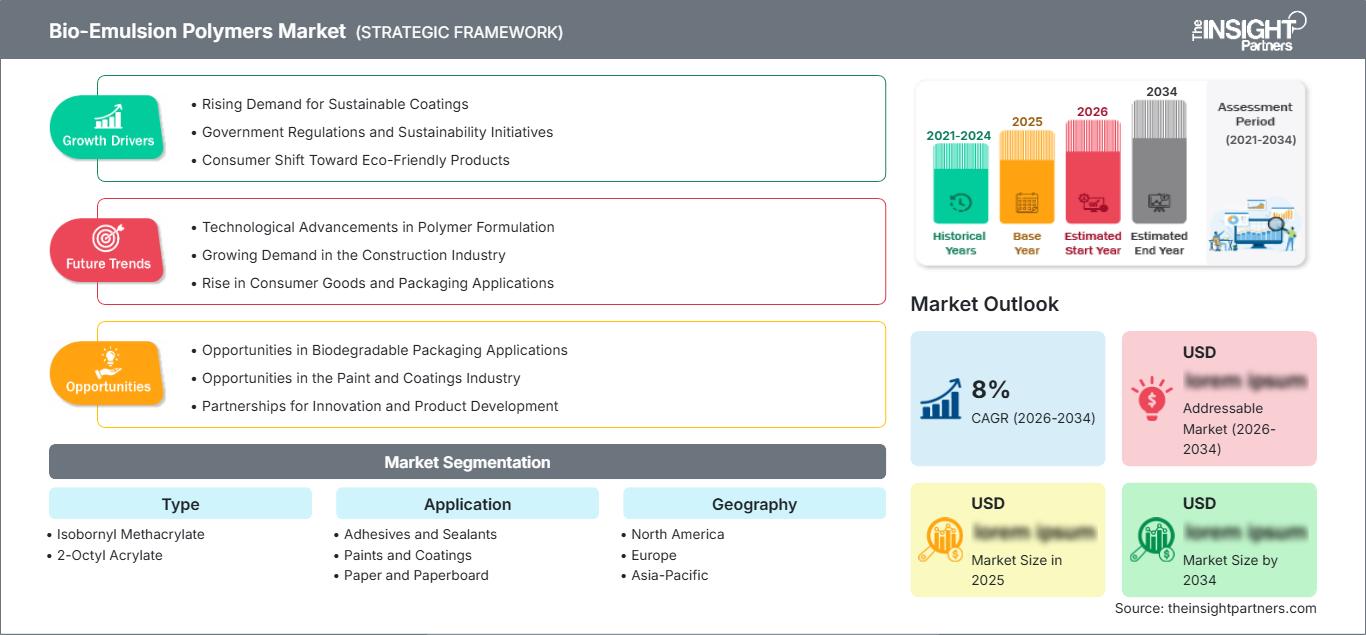
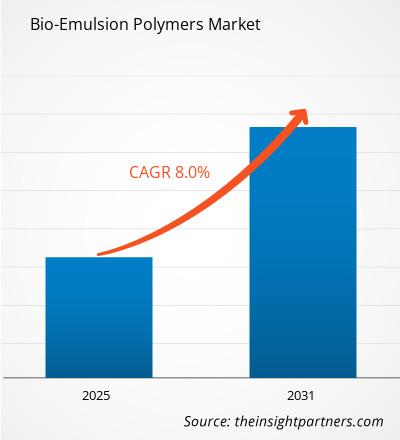
The Bio-Emulsion Polymers Market was valued at US$ 819.47 Million in 2025 and is expected to grow to US$ 1719.31 Million by 2034, growing at a CAGR of 6.94% during 2026-2034 owing to increased use of alternatives to fossil-based raw materials and sustainable polymers dispersion. The market is positioned at the intersection of renewable feedstocks, water-based formulation technologies, and lower-carbon coating and adhesive systems.
North America is anticipated to continue its prominence in the regional market with the help of sustainable building materials, water-based coatings, and eco-friendly adhesive technologies. The growth of Bio-Emulsion Polymers Market Size is attributed to a CAGR of 6.6-7.4% in North America during 2026-2034 owing to the regulatory push against volatile organic compounds and carbon reduction policies by companies.
Bio-Emulsion Polymers Market Assessment and Insights
- North America: North America is estimated to account for a 28–32% share in 2025 and expand at a 6.6–7.4% CAGR between 2026–2034, supported by sustainable coatings, packaging adhesives, construction applications, and renewable-content procurement requirements.
- U.S.: The U.S. represents approximately a 24–27% share of the global market in 2025 and is expected to grow at a 6.7–7.5% CAGR during 2026–2034, led by architectural coatings and adhesives.
- Europe: Europe is projected to hold a 30–34% share in 2025 and grow at a 6.8–7.6% CAGR during 2026–2034, with Germany, France, Italy, the UK, and Spain supported by carbon-reduction policies and sustainable formulation requirements.
- Asia Pacific: Asia Pacific is estimated at a 25–29% share in 2025, advancing at a 7.2–8.1% CAGR during 2026–2034. China, Japan, South Korea, and India benefit from expanding coatings, paper, packaging, and construction production.
- Largest Segment: Paints and Coatings is estimated at 39–43% market share in 2025, with a 7.0–7.8% CAGR during 2026–2034, supported by renewable-content binders and waterborne formulation adoption.
- High Growth Segment: Adhesives and Sealants is estimated at 28–32% market share in 2025, recording a 7.4–8.2% CAGR during 2026–2034 as packaging and construction applications increasingly adopt lower-carbon formulations.
- Key companies analyzed in detail: Allnex Netherlands B.V., Arkema S.A., BASF SE, CH-Polymers Oy, Covestro AG, Evonik Industries AG, Synthomer plc, OMNOVA Solutions Inc., Asahi Kasei Corporation, and Celanese Corporation.
Source: The Insight Partners' analysis based on proprietary research, government publications, company annual reports, investor presentations, industry databases, and expert interviews.
Bio-Emulsion Polymers are progressing via renewable monomers, biomass-balanced feedstocks, and aqueous dispersion systems. The growing focus on commercial development is on providing similar performance with reduced dependency on non-renewable resources. For instance, BASF supplies acrylic dispersions and binders with a high level of bio-renewable content, while Arkema manufactures bio-based aqueous acrylic dispersions. This shows a transition from sustainable formulations to technically equivalent products suitable for existing coating and adhesive formulations.
Future growth will probably rely on feedstock availability, certification frameworks, and customer acceptance of renewable content. Mass balance solutions will help in this process, since they allow the unchanged use of current production capacities and formulation requirements. Celanese currently offers certified bio-based products for some emulsion systems, whereas Synthomer has implemented ISCC PLUS certified value chains for bio-based nitrile latexes.
Bio-Emulsion Polymers Market Report Scope
| Report Attribute | Details |
|---|---|
| Market size in 2025 | US$ 819.47 Million |
| Market Size by 2034 | US$ 1719.31 Million |
| Global CAGR (2026 - 2034) | 6.94% |
| Historical Data | 2021-2024 |
| Forecast period | 2026-2034 |
Bio-Emulsion Polymers Market Analysis
Sustainability factors affect demand in terms of coating, adhesive, and paper applications. Growth in the market of Bio-Emulsion Polymers depends on the search for renewable ingredients that would not impair the performance properties of the materials in terms of adhesion, flexibility, film forming, durability, and efficient manufacturing. Polymerization using water is of particular interest since this method could cut down the use of solvents and allow bio-based monomers and raw materials.
The value chain starts from renewable agricultural and biomass-based raw materials through the monomer manufacturing, polymerization, dispersion formulation, additives, and further conversions. Supply is still dependent on the availability of the feedstock, its certification, raw material cost, and technological compatibility. Manufacturers that manage to get reliable renewable sources and maintain the consistency of batches will benefit when customers make gradual shift instead of abrupt change.
Positioning has come to depend more and more on polymer performance, formulation compatibility, and the ability to use renewable content within coatings, adhesives, and paper applications. According to the Bio-Emulsion Polymers Market report, firms are now competing based on bio-based feedstock use, formulation development for reduced emissions, and polymer formulations for particular applications. BASF SE, Arkema S.A., Covestro AG, Allnex Netherlands B.V., and Synthomer plc have broad formulation capabilities, while others focus on specific applications that may benefit from sustainable chemistry.
As such, investment in drop-in products, renewable content chemistry, and manufacturing systems that utilize certified feedstocks is increasing. Dispersion firms that have a well-established platform for dispersing can bring sustainable products to market much quicker since their customers will not need to go through the requalification process. This is evident in BASF and Celanese offerings of sustainable polymer platforms.
● REPORT CUSTOMIZATION
Tailor This Report To Align With Your Specific Business Requirements
This report can be customized to align precisely with your business objectives, scope, and target markets. Customization options include tailored segmentation, geography, competitive analysis, and strategic insights to support informed decision-making.
Customize This Report →WHAT YOU CAN ADJUST
- ● Segmentations
- ● Geography
- ● Competitive Analysis
- ● Language Preferences
Bio-Emulsion Polymers Market: Strategic Insights
Regional Insights
North America Bio-Emulsion Polymers Market
North America is estimated to represent 28–32% of the Bio-Emulsion Polymers Market share in 2025, with a projected 6.6–7.4% CAGR through 2034. The U.S. remains the principal demand center because architectural coatings, packaging adhesives, construction materials, and specialty paper producers increasingly evaluate renewable-content binders.
Demand is driven by low-VOC formulation standards and carbon accounting goals for corporations. Canada adds through sustainable building material use and packaging, whereas U.S. companies see the value in certified biomass balance materials. Existing companies that make polymers have the advantage of already having customers and the ability to fit renewable content into current formulations without changing processes.
U.S. Bio-Emulsion Polymers Market
It is projected that the U.S. will have 24-27% share in worldwide demand in 2025 and about 76-84% in North America's demand, with a CAGR of 6.7-7.5% till 2034. Construction coating, packaging adhesives, and papers are some of the key applications of demand.
The country also has already developed manufacturing and sustainability certifications for specialty chemicals. Companies such as BASF, Celanese, and others can rely on their current dispersion technology and launch products made up of renewable content. Increasing demand is being driven by customers looking for low-carbon products but with adhesion, durability, film forming capability, and equipment compatibility.
Europe Bio-Emulsion Polymers Market
Europe is expected to account for a 30–34% share in 2025 and register a 6.8–7.6% CAGR through 2034, making it the leading regional market. Germany represents the largest country-level market, supported by advanced coatings, automotive materials, construction chemicals, and specialty manufacturing.
Sustainable packaging, construction materials, and environmental procurement practices are some of the key drivers in the UK. In Germany, the advantages lie in the dense network of chemical production and high levels of development of renewable formulations. France, Italy, and Spain provide support through their contributions in coatings, adhesives, packaging, furniture, and construction uses.
APAC Bio-Emulsion Polymers Market
In 2025, APAC accounts for 25-29%, having a 7.2-8.1% CAGR until 2034. China is leading in consumption in the region, with Japan, South Korea, India, and Australia coming next. Growing construction, packaging, paper, and textile production drive the demand.
China is characterized by the broadness of its scope since of the volume of manufacturing. However, Japan and South Korea focus on sustainable materials. India is important due to coating and packaging usage. Infrastructure is also essential for India. Australia is known for low-carbon materials.
Middle East & Africa Bio-Emulsion Polymers Market
The Middle East and Africa region is forecast to achieve 6.1-6.9% CAGR until 2034. Leading regional prospects include Saudi Arabia, the UAE, and South Africa. Opportunities for application are available in construction, infrastructure investment, packaging, and industrial coatings.
For Saudi Arabia and the UAE, the prospects depend on major investment in infrastructure projects and expertise in the chemical industry, while the prospects for South Africa rely on expertise in coatings and packaging. For the rest of the MEA, there is a diversified outlook; adoption will be hindered by high cost of formulations and lack of domestic renewable polymer infrastructure.
Segmentation Analysis
Type
The Type segment is strategically important because monomer selection directly determines polymer performance, compatibility, flexibility, and sustainability characteristics. The Type segment is expected to expand at a 6.7–7.5% CAGR during 2026–2034. The market increasingly favors specialty monomers capable of delivering renewable-content benefits while preserving established performance specifications.
- Isobornyl Methacrylate: This monomer supports formulations requiring hardness, weathering resistance, and optical properties. Its specialty positioning makes it relevant for higher-performance coatings and adhesive systems where durability and formulation stability influence purchasing decisions.
- 2-Octyl Acrylate: This material provides flexibility and low-temperature performance characteristics, making it strategically relevant for adhesive and coating formulations. Demand is supported by applications requiring balanced flexibility, adhesion, and film-forming behavior.
Application
Application diversification determines how rapidly sustainable emulsion polymers move beyond specialty formulations. The Application segment is projected to grow at a 7.0–7.8% CAGR during 2026–2034. Increasing renewable-content targets across industrial coatings, packaging, and construction adhesives are broadening opportunities for compatible polymer dispersions. This supports the Bio-Emulsion Polymers Market scope across established downstream industries.
- Adhesives and Sealants: Packaging, construction, labeling, and consumer-product applications create demand for emulsions delivering adhesion, flexibility, moisture resistance, and controlled setting. Renewable-content alternatives gain relevance where customers require lower-carbon formulations without changing processing systems.
- Paints and Coatings: Architectural and industrial coatings remain major applications because waterborne formulations can incorporate renewable-content binders. Demand centers on durability, cleanability, low emissions, and carbon-footprint reduction while maintaining established application performance.
- Paper and Paperboard: Packaging conversion and recyclable-paper formats support polymer emulsion demand for coating, binding, and functional surface treatment. Sustainable packaging requirements increase interest in renewable-content materials compatible with paper recycling and established converting operations.
Opportunity Snapshot
| Application | Revenue Contribution | Trend Tag | Adoption Stage |
|---|---|---|---|
| Adhesives and Sealants | High | Bio Feedstocks | Scaling |
| Paints and Coatings | High | Low Carbon | Scaling |
| Paper and Paperboard | Medium | Fiber Packaging | Scaling |
Bio-Emulsion Polymers Market Growth Drivers and Impact Analysis
Increasing demand for lower-carbon coating formulations
Pressure is growing on coating makers to minimize reliance on fossil resources while maintaining current specifications. Renewable-content acrylic dispersions offer a way forward, given that they can be formulated into waterborne architectural and industrial coatings. This is shown by the portfolio of Acronal BIO from BASF, which comprises bio-based all-acrylic dispersions for interior architectural coatings. These materials can facilitate low-carbon purchasing without requiring downstream manufacturers to completely reformulate their product lines. This goes beyond the impact on premium products, as biomasse-balanced and certified feedstock-based strategies can enable more use of renewables in conventional grades. Customers who will begin comparing products based on their carbon footprint will find such polymers attractive.
Expansion of sustainable packaging and paper applications
Material recyclability, carbon footprint, and resource renewability are becoming increasingly important criteria used by packaging converters when assessing materials. Emulsion polymers play an important role in paper coating, adhesives, lamination, and surface finishing due to their unique film-forming properties and excellent bonding capacity. The Joncryl BRC line from BASF is an example of commercializing the bio-renewable and water-based binders for use in ink, overprint varnish, and paper coatings. The significance of this trend is that packaging converters can use renewable material polymers without having to change their existing water-based manufacturing technology. With more and more environmental material requirements from brand owners, converters will increasingly demand such information from material suppliers.
Growth of certified mass-balance chemical production
Mass-balance production is overcoming one of the biggest obstacles to the uptake of polymers sustainably through enabling renewable sources to be incorporated into conventional chemical manufacturing processes. Celanese provides ECO-B alternatives with ISCC PLUS certified mass-balance components and retaining chemically identical properties for specific emulsion materials. Synthomer has also created an ISCC PLUS certified value chain for biobased nitrile latexes, illustrating how renewable sources could be included into existing polymer manufacturing processes. Such a strategy would help to speed up customer approval process and keep existing facilities intact, along with offering sustainability benefits.
Bio-Emulsion Polymers Market Future Trends
Greater use of traceable renewable-content formulations
The Bio-Emulsion Polymers Market trends landscape is moving toward traceability rather than simple claims of renewable origin. Customers increasingly require evidence of feedstock provenance, certified content, carbon-footprint performance, and chain-of-custody controls. This will encourage suppliers to combine mass-balance certification with product-level environmental information. BASF's use of traceable biogenic content and carbon-footprint measurements illustrates this direction. Future formulations are likely to offer differentiated renewable-content levels, allowing customers to select sustainability performance according to regulatory, procurement, and product requirements. The trend should strengthen demand for standardized certification and lifecycle assessment methodologies while encouraging suppliers to publish clearer environmental data. Competitive differentiation will increasingly depend on the credibility and measurability of sustainability claims rather than renewable content alone.
Development of performance-equivalent bio-based polymer platforms
Polymer developers are increasingly targeting bio-based materials that replicate the performance of established fossil-derived grades. This strategy reduces technical barriers because customers can evaluate sustainable products using existing application specifications. BASF's transition of its Rheovis range to bio-based ethyl acrylate demonstrates the commercial potential of maintaining technical specifications while increasing biogenic content. Similar approaches are expected across acrylic dispersions, adhesives, coatings, and paper binders. Future development will emphasize molecular design, renewable monomer availability, polymerization efficiency, and compatibility with existing additives. Suppliers that achieve performance parity at commercially acceptable costs can accelerate conversion from pilot formulations to volume applications. This trend will gradually move sustainable emulsions from specialty niches into standardized industrial procurement programs.
Bio-Emulsion Polymers Market Opportunities
Expansion into renewable-content architectural coatings
Architectural coatings represent an attractive opportunity because waterborne acrylic systems can incorporate renewable-content binders while retaining familiar application characteristics. Suppliers can target paint manufacturers seeking lower-carbon products for residential, commercial, and institutional projects. BASF's Acronal BIO portfolio demonstrates how plant-based acrylic dispersions are being positioned for interior architectural coatings. The Bio-Emulsion Polymers Market Forecasts indicate that opportunities will increasingly emerge where builders, architects, and procurement teams evaluate environmental performance alongside durability and cost. Producers can differentiate through traceable feedstocks, verified carbon-footprint reductions, low-VOC characteristics, and compatibility with established formulation platforms. Regional opportunities are particularly relevant where sustainable building specifications and green procurement policies are becoming more influential in material selection.
Scaling bio-based binders through existing manufacturing platforms
A second opportunity lies in converting established polymer grades to renewable feedstocks without rebuilding production infrastructure. Mass-balance systems allow producers to integrate certified renewable inputs into existing chemical value chains while maintaining product consistency. Celanese's ECO-B approach illustrates this drop-in strategy, while Synthomer's certified bio-based latex value chain demonstrates its application at an industrial scale. Producers can therefore prioritize high-volume adhesive, coating, and paper grades where customers value simplified qualification. The opportunity is particularly relevant for suppliers with broad distribution networks and existing technical-service capabilities. Over time, expanding certification coverage across manufacturing sites can improve product availability and support wider adoption among multinational customers.
Recent Developments
- February 2025: Stockholm University — Researchers developed a fully biobased hair conditioner using lignin gel emulsions. The lignin gels stabilized oil-in-water emulsions without chemical modification or organic solvents. Testing showed comparable emulsion stability, viscosity, and conditioning performance to a commercial conditioner, while a formulation containing 6% coconut oil reduced wet-combing force by 13%. The development demonstrates the potential of bio-based emulsion systems for cosmetics and related formulations.
- August 2026: The Dow Chemical Company introduced RHOPLEX™ RN-128, a 100% acrylic, bio-based emulsion designed for decorative interior architectural coatings, including flat and semi-gloss paints. The product contains 27% bio-based carbon content, verified through ASTM D6866 C-14 testing, and is USDA Certified Biobased. It is formulated without intentionally added APEOs or PFAS and is positioned to provide performance comparable to petroleum-derived acrylic binders while reducing dependence on fossil-based feedstocks.
Frequently Asked Questions

- Comprehensive Market Sizing and Forecast Analysis
- Detailed Segmentation Analysis
- In-Depth Market Dynamics Assessment
- Regional and Country-Level Insights
- Competitive Landscape and Company Benchmarking
- Strategic Business Intelligence
Recent Reports
Testimonials

The Insight Partners' SCADA System Market report is comprehensive, with valuable insights on current trends and future forecasts. The team was highly professional, responsive, and supportive throughout. We are very satisfied and highly recommend their services.
RAN KEDEM Partner, Reali Technologies LTDs
I requested a report on a very specific software market and the team produced the report in a few days. The information was very relevant and well presented. I then requested some changes and additions to the report. The team was again very responsive and I got the final report in less than a week.
JEAN-HERVE JENN Chairman, Future Analytica
We worked with The Insight Partners for an important market study and forecast. They gave us clear insights into opportunities and risks, which helped shape our plans. Their research was easy to use and based on solid data. It helped us make smart, confident decisions. We highly recommend them.
PIYUSH NAGPAL Sr. Vice President, High Beam Global
The Insight Partners delivered insightful, well-structured market research with strong domain expertise. Their team was professional and responsive throughout. The user-friendly website made accessing industry reports seamless. We highly recommend them for reliable, high-quality research services
YUKIHIKO ADACHI CEO, Deep Blue, LLC.
This is the first time I have purchased a market report from The Insight Partners.While I was unsure at first, I visited their web site and felt more comfortable to take the risk and purchase a market report.I am completely satisfied with the quality of the report and customer service. I had several questions and comments with the initial report, but after a couple of dialogs over email with their analyst I believe I have a report that I can use as input to our strategic planning process.Thank you so much for taking the extra time and making this a positive experience.I will definitely recommend your service to others and you will be my first call when we need further market data.
JOHN SUZUKI President and Chief Executive Officer, Board Director, BK Technologies
I wish to appreciate your support and the professionalism you displayed in the course of attending to my request for information regarding to infectious disease IVD market in Nigeria. I appreciate your patience, your guidance, and the fact that you were willing to offer a discount, which eventually made it possible for us to close a deal. I look forward to engaging The Insight Partners in the future, all thanks to the impression you have created in me as a result of this first encounter.
DR CHIJIOKE ONYIA MANAGING DIRECTOR, PineCrest Healthcare Ltd.Reason to Buy
- Informed Decision-Making
- Understanding Market Dynamics
- Competitive Analysis
- Identifying Emerging Markets
- Customer Insights
- Market Forecasts
- Risk Mitigation
- Boosting Operational Efficiency
- Strategic Planning
- Investment Justification
- Tracking Industry Innovations
- Aligning with Regulatory Trends





 Get Free Sample for