
Container Glass Market Growth, Trends & Forecast by 2034
Coverage: Product Type (Bottles, Jugs and Jars, Vials and Ampoules); Forming Process (Blow and Blow Method, Press and Blow Method, Narrow Neck Press and Blow); End-Use Industry (Food and Beverages, Pharmaceuticals, Personal Care and Cosmetics, Consumer Goods) , and Geography (North America, Europe, Asia Pacific, and South and Central America)
- Status : Data Released
- Report Code : TIPRE00021457
- Category : Chemicals and Materials
- No. of Pages : 150
- Available Report Formats :


- Last update date : September 01, 2026


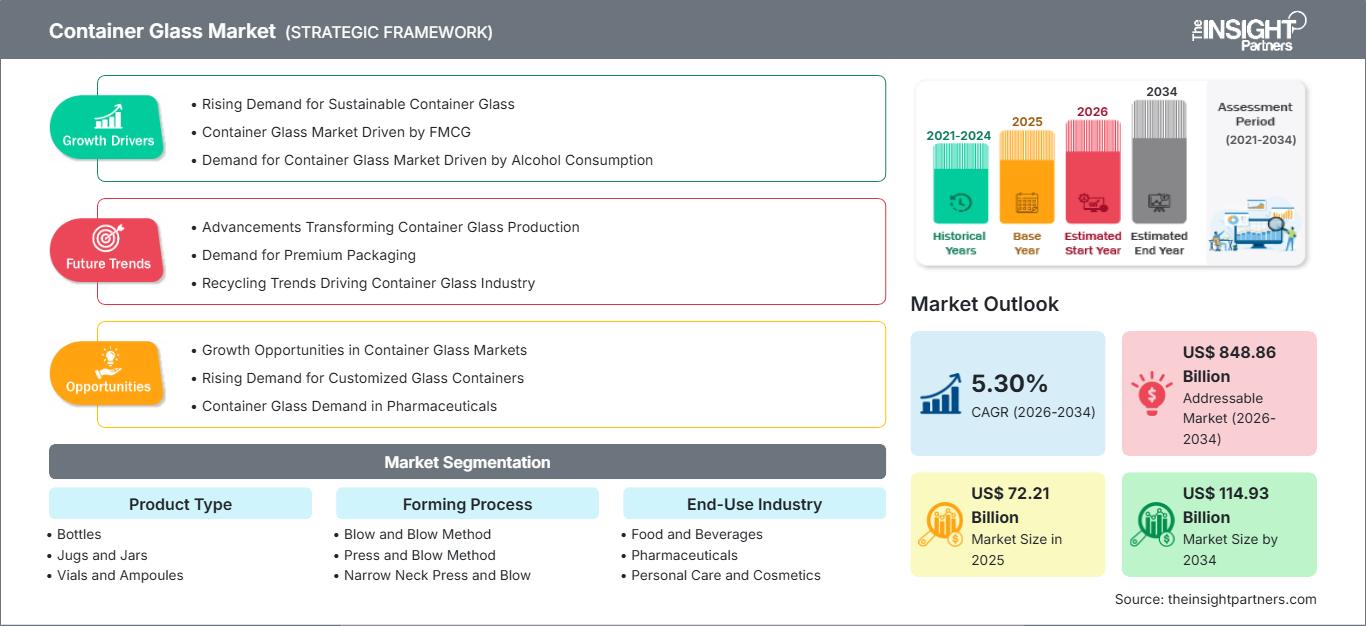
2025 Market Size
US$ 72.21 Bn
Base year value
2034 Forecast
US$ 114.93 Bn
Projected by 2034
CAGR 2026-2034
5.30 %
Growth rate
Addressable Market
US$ 848.86 Bn
(2026-2034)
The Container Glass Market was valued at US$ 72.21 Billion in 2025 and is projected to reach US$ 114.93 Billion by 2034, expanding at a CAGR of 5.30% during 2026–2034. The market encompasses glass containers manufactured for food, beverages, pharmaceuticals, personal care, cosmetics, and consumer goods, with demand shaped by packaging safety, recyclability, premiumization, lightweighting, and investments in efficient glass-forming and melting technologies.
North America is expected to maintain steady expansion, with the Container Glass Market size supported by beverage packaging, pharmaceutical containers, and premium spirits applications. A modelled CAGR of 4.5–5.0% during 2026–2034 reflects replacement demand, recycled-content initiatives, lightweighting programs, and investment in furnace efficiency. Established manufacturing infrastructure and a large installed base of food and beverage brands provide additional stability across the regional supply chain.
Container Glass Market Assessment and Insights
- North America: North America represented approximately 25–29% share in 2025 and is projected to grow at a 4.5–5.0% CAGR during 2026–2034, supported by beverage packaging, pharmaceuticals, premium spirits, and modernization of recycling infrastructure.
- US: The US accounted for approximately 78–82% of North America's 2025 share and is estimated to grow at a 4.4–4.9% CAGR during 2026–2034, led by beverage and pharmaceutical packaging.
- Europe: Europe held approximately 24–28% share in 2025 and is expected to register a 4.6–5.1% CAGR during 2026–2034, with Germany, France, Italy, Spain, and the UK supporting demand through beverages, food, cosmetics, and pharmaceutical packaging.
- Asia Pacific: Asia Pacific represented approximately 38–42% share in 2025 and is forecast to expand at a 5.8–6.4% CAGR during 2026–2034, with China, India, Japan, South Korea, and Australia providing substantial manufacturing and consumption demand.
- Largest Segment: Bottles represented approximately 68–72% market share in 2025 and are expected to expand at a 5.0–5.6% CAGR during 2026–2034, retaining dominance across beverage and food packaging.
- High Growth Segment: Vials and ampoules held approximately 8–12% market share in 2025 and are projected to grow at a 6.2–7.0% CAGR during 2026–2034, supported by pharmaceutical packaging requirements.
- Key companies analyzed in detail: Hindustan National Glass and Industries Limited, Nampak Limited, Amcor plc, Toyo Glass Co., Ltd., Consol Glass (Pty) Ltd, AGI Greenpac Limited, Saverglass SAS, O-I Glass, Inc., Ardagh Group S.A., and Vidrala, S.A.
Source: The Insight Partners' analysis based on proprietary research, government publications, company annual reports, investor presentations, industry databases, and expert interviews.
The industry is transitioning from traditional high temperature processing into lightweight vessels, advanced formation controls, greater amounts of recycled glass use, and low carbon furnaces. Process measurement and monitoring has become increasingly digital to achieve dimensional uniformity and reduction of defects, with the manufacturing of bottles and jars being redesigned for lighter materials that can withstand pressure. The recycling process has also become critical as cullet reduces material and energy demands.
Future visions will be increasingly defined through investment in emerging Asian market opportunities, pharmaceutical packaging capabilities, high-end beverages, and circular economy legislation. Europe remains the center of innovation and decarbonization while new capacity will be coming from India and South-East Asia. Melting technologies that use electric power, hybrid solutions, biofuels, and hydrogen power are being considered due to energy and carbon footprint considerations.
Container Glass Market Report Scope
| Report Attribute | Details |
|---|---|
| Market size in 2025 | US$ 72.21 Billion |
| Market Size by 2034 | US$ 114.93 Billion |
| Global CAGR (2026 - 2034) | 5.30% |
| Historical Data | 2021-2024 |
| Forecast period | 2026-2034 |
Container Glass Market Analysis
The Container Glass Market Growth can be attributed to beverages, food packaging, manufacturing of pharmaceuticals, cosmetic products, and premium packaging. This includes raw materials such as silica sand, soda ash, limestone, cullet, batching, melting, molding, annealing, testing, decoration, distribution, and recycling. The demand for container glass is particularly strong in cases where glass provides chemical inertness, packaging, display, and is compatible with expensive formulas.
The economics of production continue to be heavily reliant on furnace efficiency, energy rates, cullet availability, transportation, and closeness to large-scale filling operations. Glass furnaces have a continuous operating schedule, which makes capacity and maintenance considerations significant. Regional suppliers look more to having access to regional cullet and logistics that minimize energy and transportation costs.
From the Container Glass Market Report, it shows a highly concentrated competitive environment whereby global players compete against regional competitors with excellent customer connections. O-I Glass, Ardagh Group, Vidrala, Nampak, Toyo Glass, Consol Glass, and Hindustan National Glass operate manufacturing plants in different consuming regions while Saverglass concentrates on premium spirits and wine bottles. AGI Greenpac and Amcor offer a competitive advantage from their regional or wider packaging operations.
Investments have been allocated towards furnace rebuilding, lightweighting, recycling, automation, and energy efficiency projects. The recapitalization of Ardagh Group in 2025 involved the investment and expenditures in its packaging segments while Vidrala had nine glass production facilities with twenty-one furnaces by 2025. This means that competitive positioning does not only depend on capacities but also on technical quality, recycled content access, geographic reach, and customer specific container design.
● REPORT CUSTOMIZATION
Tailor This Report To Align With Your Specific Business Requirements
This report can be customized to align precisely with your business objectives, scope, and target markets. Customization options include tailored segmentation, geography, competitive analysis, and strategic insights to support informed decision-making.
Customize This Report →WHAT YOU CAN ADJUST
- ● Segmentations
- ● Geography
- ● Competitive Analysis
- ● Language Preferences
Container Glass Market: Strategic Insights
Regional Insights
North America Container Glass Market
North America holds an approximate Container Glass Market share of 25-29% in 2025 and is forecasted to grow at a rate of 4.5-5.0% CAGR between 2026 and 2034. The region has well-established needs of beverage, food, pharmaceuticals, and cosmetic packaging. There are diversified purchasing needs owing to the presence of large breweries, alcohol manufacturers, food processing companies, and health care industry players that limit dependency on any one application type. Lightweighting and premium bottles are also factors that affect procurement decisions.
The United States holds an approximate market share of 78-82% of North America's share in 2025 due to high demand for beverage packaging and pharmaceutical manufacturing. Recycling facilities are of strategic importance since reclaimed glass material can replace virgin raw material and save energy in the furnace. Canada has contributed in terms of beer, food, wine, and pharmaceutical uses, whereas Mexico contributes by means of beverages and food processing.
U.S. Container Glass Market
The US contributed about 78-82% of North America’s 2025 market share and is estimated to register a 4.4-4.9% CAGR from 2026-2034. The primary end-use applications include beer, wine, spirits, food and pharmaceutical packaging, with premiumization driving demand for differentiating designs, colors, closures, and decorations. Manufacturing in-house ensures short supply chain and reliable replenishment of products demanded in bulk.
Large producers are active in both beverage and food packaging applications, and demand from the pharmaceutical industry is favoring technically consistent vials and specialty containers. Glass bottle recycling is highly dependent on the type of system used to collect bottles, making glass cullet supplies and quality highly variable geographically. States that have a deposit system tend to perform better with regards to glass container recycling compared to states without deposit systems.
Europe Container Glass Market
Europe commanded around 24–28% market share in 2025 and is estimated to have a CAGR of 4.6–5.1% during 2026–2034. Germany is the biggest national market due to beer, food, pharmaceuticals, and household packaging applications. Well-developed collection facilities and availability of recycled glass drive circular production, whereas decarbonization initiatives accelerate the upgrading of furnaces at major manufacturing hubs.
The UK continues to be a key market for beer, spirits, food, and pharmaceutical bottles with increasing focus on lightweighting and reduced carbon footprint. Germany features high beverage consumption alongside recycling facilities and demand for premium packaging products. France, Italy, and Spain continue to matter because of wine, spirits, food, and cosmetics applications; Italy additionally accounts for a strong manufacturing base for specialty and premium glass.
APAC Container Glass Market
In 2025, APAC held a 38-42% market share and is expected to grow at a CAGR of 5.8-6.4% over 2026-2034, thus being the largest regional market. China is driven by the demand for beverages and food containers, while India receives support in terms of pharmaceutical products, alcoholic drinks, processed food, and cosmetics.
There are two countries, namely Japan and South Korea, which have sophisticated technology in terms of manufacturing and also have demands for sophisticated packaging. Wine, beer, and food production are what sustains Australia. Growth in the market is facilitated by industrialization, increased consumption of packaged foods and drugs, and also infrastructural development.
Middle East & Africa Container Glass Market
Middle East and Africa will see growth of approximately 5.0%-5.8% CAGR from 2026 to 2034 driven by consumption of beverages, food processing, pharmaceuticals, cosmetics, and hospitality industries. Saudi Arabia and the UAE have infrastructure development and higher demand for premium beverages, while South Africa continues to be the key region manufacturing and consumption base.
The glass market in the region is driven by the availability of energy sources, logistics, constructions, and diversified industry activities. Increased manufacturing base in Saudi Arabia drives packaging needs, while the UAE benefits from trading and re-export activities. The country of South Africa has the existing demand for beverages and food packaging, whereas MEA provides opportunities for the future as a result of developing retail, pharmaceutical distribution, and manufacturing facilities.
Segmentation Analysis
Product Type
The Product Type segment in the Container Glass Market is projected to grow at a 5.1–5.7% CAGR during 2026–2034. Bottles remain the principal format because beverages account for extensive container volumes, while jars serve food and household applications. Pharmaceutical packaging supports demand for smaller, technically precise formats, particularly where product stability and material inertness are essential.
- Bottles: Bottles hold the dominant position because beer, wine, spirits, water, soft drinks, and specialty beverages require high-volume primary containers. Lightweight designs and premium shapes support continued replacement and innovation.
- Jugs and Jars: Jugs and jars serve sauces, preserves, spreads, condiments, cosmetics, and household products. Their wide openings and filling compatibility make them strategically important for food and specialty consumer packaging.
- Vials and Ampoules: Vials and ampoules address pharmaceutical and healthcare applications requiring dimensional consistency, chemical resistance, and controlled product protection. Increasing pharmaceutical manufacturing capacity supports their strategic importance.
Forming Process
The Forming Process segment in the Container Glass Market is expected to register a 4.9–5.5% CAGR during 2026–2034. Process selection depends on container geometry, neck configuration, production speed, weight, and dimensional requirements. Manufacturers continue refining forming parameters to increase throughput and reduce defects while accommodating lightweight designs.
- Blow and Blow Method: The blow and blow method remains important for narrow-neck containers, particularly bottles requiring controlled wall distribution. It supports high-volume beverage production and established furnace-to-forming production lines.
- Press and Blow Method: Press and blow is strategically valuable for wide-mouth containers because it can support controlled glass distribution and lightweighting. Food jars and specialty containers are important applications.
- Narrow Neck Press and Blow: Narrow neck press and blow supports lightweight bottles requiring precise neck and wall geometry. The process is relevant where manufacturers seek material savings without sacrificing container strength.
End-Use Industry
The End-Use Industry segment in the Container Glass Market is projected to expand at a 5.2–5.9% CAGR during 2026–2034. Beverage and food applications provide the largest volume base, while pharmaceutical, cosmetics, and consumer-goods applications offer higher-value opportunities. Changing product formats and premium packaging requirements influence container specifications across industries.
- Food and Beverages: Food and beverages represent the principal consumption base, spanning beer, wine, spirits, sauces, preserves, dairy products, and specialty beverages. Packaging differentiation and recyclability support sustained glass adoption.
- Pharmaceuticals: Pharmaceuticals require chemically stable and protective packaging for medicines, injectable products, and specialized formulations. Regulatory quality requirements support demand for consistent, technically controlled glass containers.
- Personal Care and Cosmetics: Cosmetics and personal care brands use glass for perfumes, creams, serums, and premium formulations. High visual appeal, decoration options, and compatibility with premium positioning support demand.
- Consumer Goods: Consumer goods applications include household products, specialty foods, and selected personal-use products. Glass provides durability, inertness, and reusable or recyclable packaging characteristics for differentiated product positioning.
Opportunity Snapshot
| End-Use Industry | Revenue Contribution | Trend Tag | Adoption Stage |
| Food and Beverages | High | Premium Bottles | Mature |
| Pharmaceuticals | Medium | Injectable Vials | Scaling |
| Personal Care and Cosmetics | Medium | Luxury Packaging | Scaling |
| Consumer Goods | Low | Refillable Formats | Emerging |
Container Glass Market Growth Drivers and Impact Analysis
Premiumization and brand differentiation in beverages
Premium alcoholic beverages, specialty drinks, and upscale food products increasingly use packaging as a visible component of brand identity. Glass enables distinctive colors, embossing, surface decoration, unusual silhouettes, and heavier premium formats that can communicate product positioning at the point of sale. This trend creates opportunities for manufacturers to increase value per container even where unit volumes grow more slowly. It also encourages closer collaboration between container producers, designers, fillers, and brand owners during product development. Premium spirits and wine are particularly relevant because container appearance can influence perceived quality and shelf differentiation. As brands seek recognizable packaging architectures across markets, suppliers with flexible forming, decoration, and tooling capabilities can capture higher-value contracts and strengthen customer retention.
Expansion of pharmaceutical packaging requirements
Pharmaceutical manufacturing is broadening the addressable demand for technically consistent glass containers, particularly vials and ampoules used for injectable and specialized medicines. Container quality is closely tied to dimensional accuracy, chemical resistance, surface integrity, and compatibility with filling and sterilization processes. The expansion of biologics, vaccines, specialty drugs, and contract pharmaceutical manufacturing creates additional requirements for reliable primary packaging. Manufacturers able to provide controlled production environments, inspection technologies, and validated quality systems can compete for longer-duration pharmaceutical supply agreements. This demand also changes investment priorities because pharmaceutical containers generally require tighter process control than conventional beverage packaging. As healthcare production becomes more geographically distributed, regional suppliers can benefit from customers seeking shorter supply chains and dependable local availability.
Growth of circular packaging systems
Glass recycling infrastructure increasingly affects purchasing and production decisions because high-quality cullet reduces dependence on virgin raw materials and can lower melting energy requirements. In Europe, collection for recycling has reached 80.8%, while industry initiatives increasingly focus on improving the quality and availability of recovered glass. This creates a feedback mechanism in which better collection supports greater recycled-glass utilization, while stable demand for cullet encourages investment in sorting and processing. Manufacturers are therefore evaluating partnerships with recyclers, municipalities, and brand owners to improve closed-loop material flows. Regions with fragmented collection systems represent a longer-term infrastructure opportunity. Investments in color sorting, contamination reduction, collection efficiency, and furnace compatibility can increase usable cullet and improve the environmental performance of container production.
Container Glass Market Future Trends
Low-carbon melting technologies become commercially important
The Container Glass Market trends are increasingly centered on industrial decarbonization rather than incremental energy savings alone. Hybrid and electric furnaces, renewable electricity, biofuels, hydrogen trials, and improved heat recovery are moving from pilot programs toward broader deployment. The technology mix will differ by furnace size, product requirements, energy infrastructure, and local power economics. Manufacturers are likely to prioritize staged modernization during scheduled furnace rebuilds, reducing operational disruption while improving emissions intensity. Digital controls will complement these investments by optimizing combustion, temperature distribution, batch charging, and defect rates. Over time, customers with explicit carbon-reduction targets may increasingly incorporate verified production emissions into packaging procurement criteria. This could create commercial differentiation between suppliers that can document lower-carbon production and those relying primarily on conventional melting systems.
Smart inspection and digitally optimized production
Advanced machine vision, artificial intelligence, sensor networks, and real-time process analytics are expected to become more deeply embedded in container production. These systems can identify dimensional deviations, surface defects, thermal irregularities, and forming inconsistencies earlier in the manufacturing cycle, helping reduce scrap and improve furnace utilization. Digital twins and predictive maintenance can also support planning for molds, forming equipment, inspection systems, and furnace components. The resulting value extends beyond labor efficiency because fewer defects improve raw-material utilization and reduce the need for replacement production. Large producers with multiple plants may gain additional advantages by standardizing digital operating practices and comparing production data across facilities. Smaller regional producers could increasingly adopt modular inspection and analytics systems as technology costs decline and equipment suppliers integrate software directly into production platforms.
Container Glass Market Opportunities
Regional capacity development in pharmaceutical and specialty glass
The Container Glass Market Forecasts indicate that pharmaceutical and specialty packaging can provide attractive investment opportunities where healthcare manufacturing is expanding faster than local primary-packaging capacity. Producers can establish specialized lines near pharmaceutical clusters, contract manufacturers, and healthcare logistics hubs to reduce import dependence and improve supply reliability. Opportunity areas include small-volume vials, ampoules, specialty bottles, and containers designed for sensitive formulations. Investments should prioritize inspection capability, validated quality systems, controlled manufacturing environments, and flexible tooling rather than pursuing volume alone. Partnerships with pharmaceutical companies can provide visibility into qualification requirements and future product pipelines. Regional manufacturing may also improve resilience where customers are seeking dual sourcing. Suppliers that combine technical consistency with shorter delivery lead times can differentiate themselves from commodity-oriented container producers.
Closed-loop cullet ecosystems and regional recycling infrastructure
Investment opportunities also exist beyond furnace capacity through integrated collection, sorting, processing, and remelting ecosystems. Manufacturers can collaborate with recyclers and large packaging users to secure higher-quality, color-separated cullet and reduce material losses between collection and furnace charging. The opportunity is particularly relevant in markets where glass recovery is constrained by mixed waste streams, contamination, or inadequate processing infrastructure. Integrated models can include collection partnerships, dedicated processing capacity, quality monitoring, and long-term cullet purchase agreements. Such arrangements provide manufacturers with greater raw-material visibility while giving recyclers a stable industrial outlet. Over time, improved closed-loop infrastructure can strengthen the economics of glass against competing packaging materials and support customers seeking measurable improvements in recycled content and packaging circularity.
Recent Developments
- November 2025: HORN completed a greenfield project for SNJ India Glass at its facility in Tamil Nadu, India. The newly constructed 230 t/d end fired furnace is the first-ever container glass furnace to be established in the state of Tamil Nadu, India. The facility is equipped with most modern manufacturing technology and equipment by HORN to produce container glass products to the highest quality standards. The plant will produce glass containers in flint, green and amber colours on three production lines.
- October 2025: Independent Sugar Corporation Limited (INSCO), a part of Uganda-based Madhvani Group, completed the acquisition of Hindustan National Glass & Industries Limited (HNGIL), a container glass manufacturer, through the Insolvency and Bankruptcy Code (IBC) process.
Frequently Asked Questions

- Comprehensive Market Sizing and Forecast Analysis
- Detailed Segmentation Analysis
- In-Depth Market Dynamics Assessment
- Regional and Country-Level Insights
- Competitive Landscape and Company Benchmarking
- Strategic Business Intelligence
Recent Reports
Testimonials

The Insight Partners' SCADA System Market report is comprehensive, with valuable insights on current trends and future forecasts. The team was highly professional, responsive, and supportive throughout. We are very satisfied and highly recommend their services.
RAN KEDEM Partner, Reali Technologies LTDs
I requested a report on a very specific software market and the team produced the report in a few days. The information was very relevant and well presented. I then requested some changes and additions to the report. The team was again very responsive and I got the final report in less than a week.
JEAN-HERVE JENN Chairman, Future Analytica
We worked with The Insight Partners for an important market study and forecast. They gave us clear insights into opportunities and risks, which helped shape our plans. Their research was easy to use and based on solid data. It helped us make smart, confident decisions. We highly recommend them.
PIYUSH NAGPAL Sr. Vice President, High Beam Global
The Insight Partners delivered insightful, well-structured market research with strong domain expertise. Their team was professional and responsive throughout. The user-friendly website made accessing industry reports seamless. We highly recommend them for reliable, high-quality research services
YUKIHIKO ADACHI CEO, Deep Blue, LLC.
This is the first time I have purchased a market report from The Insight Partners.While I was unsure at first, I visited their web site and felt more comfortable to take the risk and purchase a market report.I am completely satisfied with the quality of the report and customer service. I had several questions and comments with the initial report, but after a couple of dialogs over email with their analyst I believe I have a report that I can use as input to our strategic planning process.Thank you so much for taking the extra time and making this a positive experience.I will definitely recommend your service to others and you will be my first call when we need further market data.
JOHN SUZUKI President and Chief Executive Officer, Board Director, BK Technologies
I wish to appreciate your support and the professionalism you displayed in the course of attending to my request for information regarding to infectious disease IVD market in Nigeria. I appreciate your patience, your guidance, and the fact that you were willing to offer a discount, which eventually made it possible for us to close a deal. I look forward to engaging The Insight Partners in the future, all thanks to the impression you have created in me as a result of this first encounter.
DR CHIJIOKE ONYIA MANAGING DIRECTOR, PineCrest Healthcare Ltd.Reason to Buy
- Informed Decision-Making
- Understanding Market Dynamics
- Competitive Analysis
- Identifying Emerging Markets
- Customer Insights
- Market Forecasts
- Risk Mitigation
- Boosting Operational Efficiency
- Strategic Planning
- Investment Justification
- Tracking Industry Innovations
- Aligning with Regulatory Trends





 Get Free Sample for