
EV Charging Cables Market Overview and Future Outlook (2026-2034)
Coverage: By Application (Public and Private), Power Type (AC Charging and DC Charging), Cable Length (2-5 Meters, 6-10 Meters, and >10 Meters), Charging Level (Level 1, Level 2, and Level 3);
- Status : Data Released
- Report Code : TIPRE00018382
- Category : Electronics and Semiconductor
- No. of Pages : 150
- Available Report Formats :


- Last update date : October 26, 2026


2025 Market Size
US$ 1.39 Bn
Base year value
2034 Forecast
US$ 5.90 Bn
Projected by 2034
CAGR 2026-2034
15.5 %
Growth rate
Addressable Market
US$ 27.53 Bn
(2026-2034)
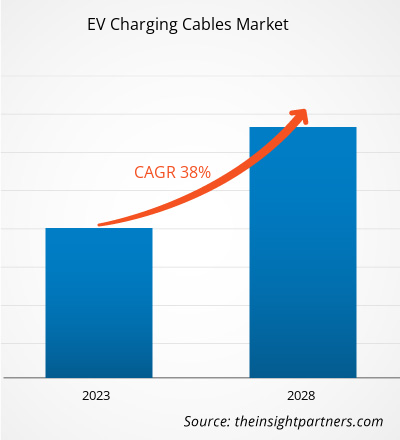
The EV Charging Cables Market size was estimated to be worth US$ 1.39 Billion in 2025 and reach US$ 5.90 Billion by 2034, exhibiting a CAGR of 15.5% between 2026–2034. The market is driven by growing use of electric vehicles, increased number of charging points, and transition from conventional AC connectors to liquid-cooled and high-power cable assemblies.
North America EV Charging Cables Market is projected to have a CAGR of 13.8–14.6% between 2026 and 2034, backed by government funding on charging corridors, workplace charging, and fleet electrification. Increasing charger deployment due to denser public charging networks and private charging due to home-based, depot-based, and vehicle-based installations needing better thermal performance and longevity.
EV Charging Cables Market Assessment and Insights
- North America held 24–27% EV Charging Cables Market share in 2025 and is growing at a CAGR of 13.8–14.6% during 2026–2034, supported by corridor fast charging, fleet depots, and workplace installations.
- US represented 80–84% of North American revenue in 2025 and is growing at a CAGR of 14.0–14.8% during 2026–2034, led by public networks and private fleets.
- Europe accounted for 27–30% share in 2025 and is growing at a CAGR of 14.2–15.0% during 2026–2034, with Germany, France, the UK, Netherlands, and Norway leading deployments.
- Asia Pacific captured 38–42% share in 2025 and is growing at a CAGR of 16.4–17.3% during 2026–2034, led by China, Japan, South Korea, India, and Australia.
- Largest Segment AC charging held 56–60% market share in 2025 and is growing at a CAGR of 13.9–14.7% during 2026–2034 as home and workplace charging scale.
- High Growth Segment DC charging represented 40–44% market share in 2025 and is growing at a CAGR of 17.1–18.0% during 2026–2034, supported by fast corridors and fleets.
- Key companies analyzed in detail: BESEN International Group Co., Ltd.; Coroplast Fritz Müller GmbH & Co. KG; Dyden Corporation; General Cable Technologies Corporation; Phoenix Contact E-Mobility GmbH; SINBON Electronics Co., Ltd.; Systems Wire and Cable; TE Connectivity plc; Teison Energy Technology Co., Ltd.; Aptiv PLC; LEONI AG; BRUGG eConnect AG; IONITY GmbH; Chengdu Khons Technology Co., Ltd.
Source: The Insight Partners' analysis based on proprietary research, government publications, company annual reports, investor presentations, industry databases, and expert interviews.
The evolution of cable technology has been from low current cable designs to temperature-controlled cable assemblies that can handle voltages ranging from 400V, 800V and megawatt charging cables. There are improvements being made to the insulation of cables, conductive structures, cooling and design of connectors to reduce temperatures, weight and service interruptions. Other factors that define the growth in the EV Charging Cables Market include sourcing of copper materials, elastomers and utilization rates.
Investments would be directed towards areas where the sales of electric vehicles and public charging stations are combined with depots being electrified. Government policies like the European AFIR targets, U.S. Corridor funding and industrial development plans in Asia would be inclined towards suppliers that have certified AC, DC and megawatt charging cables. New geographies would need cables that are cost-efficient and reliable.
EV Charging Cables Market Report Scope
| Report Attribute | Details |
|---|---|
| Market size in 2025 | US$ 1.39 Billion |
| Market Size by 2034 | US$ 5.90 Billion |
| Global CAGR (2026 - 2034) | 15.5% |
| Historical Data | 2021-2024 |
| Forecast period | 2026-2034 |
EV Charging Cables Market Analysis
The EV Charging Cables Market growth is fueled by an increasing number of battery electric cars, installation of more charging points, and consumers' interest in faster charging. In 2024, there were more than five million public chargers worldwide, according to the IEA, and cable strength, connector standardization, and thermal resistance become crucial buying factors. Manufacturers develop cables that can withstand frequent use, outdoor installation, and intensive loading.
Copper suppliers, compounders, connector manufacturers, cable assemblies, charger OEMs, charge point operators, utilities, automakers, fleets, and electrical installers form the supply chain. According to EV Charging Cables Market research, supply issues are related to the conductor's availability, liquid-cooling elements, testing for compliance, and different regional connector standards (CCS, Type 2, GB/T, CHAdeMO, NACS).
The competition is segmented among connector experts, automotive cables clusters, charging cables manufacturers, and regional cable suppliers. Phoenix Contact E-Mobility GmbH, TE Connectivity plc, Aptiv PLC, LEONI AG, BRUGG eConnect AG, SINBON Electronics Co., Ltd., and BESEN International Group Co., Ltd. compete using performance ratings, certifications, cable flexibility, cooling system, and OEM connections.
The EV Charging Cables Market analysis indicates that the strategic investments are being focused on liquid cooled DC cables, high current connectors, swappable contact modules, and temperature monitoring cables. Coroplast Fritz Müller GmbH & Co. KG, Dyden Corporation, Teison Energy Technology Co., Ltd., Chengdu Khons Technology Co., Ltd., Systems Wire and Cable, and General Cable Technologies Corporation provide regional supplier assurance with growing charger programs.
● REPORT CUSTOMIZATION
Tailor This Report To Align With Your Specific Business Requirements
This report can be customized to align precisely with your business objectives, scope, and target markets. Customization options include tailored segmentation, geography, competitive analysis, and strategic insights to support informed decision-making.
Customize This Report →WHAT YOU CAN ADJUST
- ● Segmentations
- ● Geography
- ● Competitive Analysis
- ● Language Preferences
EV Charging Cables Market: Strategic Insights

Regional Insights
North America EV Charging Cables Market
The market share of North America accounted for 24–27% in 2025 and expected to register a CAGR of 13.8–14.6% from 2026–2034. Increasing the need for public fast charging stations, workplace charging, and fleet depot electrification is driving the demand for EV cables in North America. In 2024, there was a rise in the charging infrastructure in the US by 20%.
As network reliability gains importance while making purchases, it becomes important to ensure that no damage happens to the plugs and that there is no overheating of the cables as they can reduce the uptime of the charger. UL listing, weather resistance, and ergonomics are important aspects of cables used in Level 2 and Level 3 chargers.
U.S. EV Charging Cables Market Market
U.S. held 80-84% market share in terms of North America region in 2025 and projected to witness 14.0-14.8% CAGR growth during 2026-2034. Market demand is majorly from highway, urban charge stations, workplace, retail parking, and depots application. Standardization of charge-point operators by cable providers results in easier maintenance and inventory.
Some of the companies operating in the industry include TE Connectivity plc, Aptiv PLC, Phoenix Contact E-Mobility GmbH, BESEN International Group Co., Ltd., and Systems Wire and Cable through direct supply, distributor, and charger OEM relationships. Charging method trend in terms of application includes DC charging for public network application and AC charging for home, workplace, and fleet yard.
Europe EV Charging Cables Market Market
Europe held 27-30% of the market share in 2025 and is projected to witness a CAGR of 14.2-15.0% in 2026-2034. Germany dominates due to automotive manufacturing, highways charging, and industrial logistics operations. The UK will provide office and destination charging options, whereas France will be providing charging facilities through national initiatives in public and fleet networks.
Netherlands is one of the key public charger networks, followed by Germany and France, which also have large network facilities. Italy and Spain will continue to increase corridor and urban charging facilities from smaller networks, thereby generating cable installation and replacement business opportunities. AFIR fast-charging needs on TEN-T corridors will drive demand for high-power DC cable systems with thermal and ergonomic performance.
APAC EV Charging Cables Market Market
APAC is estimated to hold 38–42% market share in 2025, with growth of CAGR between 16.4 and 17.3% expected during 2026–2034. China will be leading due to the world's largest network of EVs and public chargers, and Japan and South Korea are contributing quality connector demand. India and Australia will build up public and private charging infrastructure starting from smaller initial penetrations.
The region's industrial policies, presence of regional manufacturers of cables, chargers' export activities, and the density of urban chargers are all enabling the regional scale. The buyers value cost efficiency, compatibility of connectors, availability of large quantities, and durability in case of frequent public use.
Middle East & Africa EV Charging Cables Market Market
Regionally, the Middle East and Africa region is forecasted to record growth in a CAGR of 12.0-13.2% between 2026-2034. UAE takes the lead in terms of early awareness in public charger installation; Saudi Arabia focuses on EV infrastructure development in tandem with economic diversification; South Africa is supporting selected deployments for fleets and businesses.
Energy sector investments, tourism infrastructure, logistics electrification, and governmental sustainability programs can create a demand for rugged cables resistant to heat, dust, and outdoor conditions. Often, buyers depend on the manufacturers of chargers and systems integrators, which makes pre-certified cable systems more advantageous.
Segmentation Analysis
Application
Application is projected to grow at a CAGR of 15.0–15.8% during 2026–2034. The EV Charging Cables Market scope covers public and private charging environments, each with different duty cycles, ownership models, and service expectations. Public sites prioritize uptime, vandal resistance, liquid cooling, and fast connector replacement, while private users emphasize cost, safety certification, cable length, and compatibility with residential or depot chargers.
- Public charging uses cables in highway, retail, parking, and urban hubs where frequent handling, weather exposure, and uptime requirements increase demand for reinforced jackets and serviceable connectors.
- Private charging includes homes, workplaces, depots, and residential communities where users value safe AC cables, manageable length, lower replacement cost, and predictable overnight or shift-based charging.
Power Type
Power Type is forecast to grow at a CAGR of 15.2–16.0% during 2026–2034. AC charging remains the installed-base anchor because homes and workplaces dominate daily charging behavior. DC charging is gaining strategic importance as public networks, fleet depots, buses, and highway corridors require higher current, better thermal control, and stronger connector durability for repeated fast-charging sessions.
- AC Charging leads installed demand because private charging locations use lower-power systems that are cost-efficient, familiar to installers, and suitable for longer parking durations.
- DC Charging is strategically important for high-utilization public and fleet sites, requiring liquid-cooled cables, temperature sensing, and robust connectors that reduce charging downtime.
Cable Length
Cable Length is expected to grow at a CAGR of 14.8–15.6% during 2026–2034. Length selection affects installation design, user convenience, voltage drop, weight, and thermal performance. Shorter cables support compact charger layouts, mid-length cables serve most public and private sites, and longer assemblies are needed where parking geometry, fleet layouts, or accessibility requirements increase reach.
- 2-5 Meters cables are common in residential and compact public installations where vehicle positioning is predictable, minimizing weight, copper usage, and handling complexity.
- 6-10 Meters cables provide broader vehicle access in parking lots, depots, and public bays, balancing reach with manageable ergonomics and installation cost.
- >10 Meters cables serve specialized fleet, bus, and difficult parking layouts where reach is essential, though weight and thermal management become more important.
Charging Level
Charging Level is projected to grow at a CAGR of 15.4–16.2% during 2026–2034. Level 1 remains limited to basic residential or portable use, Level 2 supports mainstream home and workplace deployment, and Level 3 drives premium cable innovation. Higher charging levels require stronger insulation, better thermal pathways, robust strain relief, and connector designs that remain safe under frequent use.
- Level 1 charging serves portable and low-power use cases, mainly where installation cost matters more than charging speed or high utilization.
- Level 2 charging is central to daily private and semi-public charging, using cables that balance safety, cost, flexibility, and compatibility with common EV platforms.
- Level 3 charging drives advanced cable demand because high-current public and fleet sites need liquid cooling, durable connectors, and fast maintenance access.
Opportunity Snapshot
| Application | Revenue Contribution | Trend Tag | Adoption Stage |
| Public | High | Fast Corridors | Scaling |
| Private | Medium | Depot Charging | Mature |
EV Charging Cables Market Growth Drivers and Impact Analysis
Public Charging Expansion Raises Cable Replacement Demand
Operating requirements for public charging systems are tough, as the cables have to endure constant usage, weather exposure, car alignment, and possible mishandling. With the introduction of fast charging systems, the operator’s earnings depend directly on cable failures. In the market, there will be a transition towards robust jackets, replaceable contacts, liquid cooling, embedded temperature sensing, and easy maintenance. For vendors whose products help minimize downtime, the opportunity would be in framework deals with charge point operators, utilities, retailers, and road construction companies. This is a driver for recurring business, not just initial sales.
Fleet Electrification Increases Depot Charging Complexity
Commercial fleets need reliable charging windows because vans, buses, trucks, and service vehicles must return to operation on schedule. Depot layouts often require longer cable reach, repeated plugging, cable management systems, and durable connectors that withstand shift-based use. The market impact is higher specification demand for Level 2 and DC charging cables designed around uptime rather than lowest purchase price. Fleet operators also prefer standardized products that simplify training and maintenance. Suppliers can capture value by offering cable assemblies matched to chargers, reels, overhead dispensers, thermal monitoring, and service programs for large depots.
Higher Vehicle Voltage Platforms Require Thermal Innovation
Automakers are introducing higher-voltage vehicle platforms to reduce charging time and improve power electronics efficiency. These architectures increase current and heat-management requirements for cable systems, especially at high-power DC stations. The market impact is stronger demand for liquid-cooled cables, optimized conductor design, lighter connector housings, and real-time thermal sensing. Cable suppliers must balance current capacity with ergonomics because heavy cables reduce user satisfaction and increase physical strain. Companies that can deliver high amperage, manageable weight, certified safety, and repairable components will be better positioned as public networks move toward ultra-fast charging.
EV Charging Cables Market Future Trends
Smart Cable Monitoring Moves Into Mainstream Chargers
EV Charging Cables Market trends point toward cables becoming monitored assets rather than passive power-transfer parts. Future assemblies will increasingly track temperature, connector wear, insulation condition, bending stress, and charging-event history. This data will help operators identify failure risk before outages occur, schedule maintenance, and validate safe operation at higher currents. Smart cable monitoring also supports warranty management and fleet uptime planning. The trend will favor suppliers that integrate sensors without reducing flexibility, increasing weight, or complicating field replacement, especially for public DC chargers with high daily utilization.
Megawatt Charging Accelerates Heavy-Duty Cable Design
Heavy-duty electrification will push cable engineering beyond passenger-car requirements. Electric trucks, buses, construction equipment, and port vehicles need high energy transfer within short operating windows. Future megawatt-class cable systems will require advanced cooling, stronger strain relief, safer connector locking, and maintainable contact modules. The trend will also influence charger site design because cable weight, reach, and routing affect driver workflow. Suppliers with experience in both automotive connectors and industrial power distribution will be positioned to serve early commercial vehicle corridors and depot charging programs.
EV Charging Cables Market Opportunities
Fast-Charging Corridor Standardization
EV Charging Cables Market Forecasts support investment in standardized cable platforms for highway fast-charging corridors. Operators want consistent plug feel, cable reach, maintenance procedures, and spare-part inventory across multiple sites. Suppliers can target this opportunity by offering modular DC cable systems with replaceable contacts, liquid-cooling service kits, and certifications for regional connector standards. Standardization reduces operational complexity for charging networks and improves user familiarity for drivers. Manufacturers that align with charger OEMs, energy companies, and corridor programs can secure recurring demand as utilization rises and early-generation equipment reaches replacement cycles.
Private Depot Electrification Packages
Private depots create an actionable opportunity for suppliers that can bundle cables with chargers, mounting hardware, cable management, and maintenance support. Logistics companies, municipal fleets, school buses, and last-mile delivery operators need practical systems that fit site layouts and vehicle schedules. Cable length, connector ruggedness, and strain relief become procurement variables because a single depot can involve repeated daily use by many drivers. Suppliers can differentiate by providing site-specific cable recommendations, installer documentation, and replacement programs that reduce downtime. This opportunity is especially attractive where fleet electrification is mandated or financially incentivized.
Recent Developments
- May 2026: Transit depots, logistics hubs, and public charging corridors share a problem that more capacity does not resolve. Isolated clusters accumulate energy losses and operational friction as load grows. At that point, adding infrastructure compounds the problem rather than solving it. ABB E-mobility introduced the OM X-Series: a distributed charging system that replaces isolated clusters with one coordinated site architecture, scaling from 800 kW to 10 MW and beyond, across more than 100 charge points.
- January 2026: Delta, a global leader in power management and smart green solutions, announced the launch of its 350kW (HPC 350) fast EV Charger in the EMEA market for electric passenger vehicles, buses, trucks and heavy-duty vehicles. Designed for grid-constrained and high-utilization environments, the HPC 350 combines ultra-fast charging with intelligent energy management, enabling dynamic load distribution, backend connectivity, and seamless integration into smart charging networks. Suited to the requirements of charge point operators, highway charging hubs, logistics and fleet operators, service/gas station operators as well as commercial and industrial application sectors, the HPC 350 is an ideal solution for highway rest stops, traditional fuel stations, and large-scale charging hubs.
- July 2025: Delta Electronics (Thailand) PCL., a global leader in power management and smart green solutions is unveiling its full portfolio of integrated smart energy solutions at Asia Sustainable Energy Week 2025 (ASEW). The showcase demonstrates how Delta’s advanced EV charging solutions, battery energy storage systems, solar inverters, and digital energy platforms are helping organizations across Thailand progress toward energy resilience and long-term decarbonization. A key highlight is the EV Charger for high-traffic charging stations, fleet operators, and highways, which delivers up to 500 kW to a single EV or 250 kW to two EVs simultaneously.
Frequently Asked Questions

- Comprehensive Market Sizing and Forecast Analysis
- Detailed Segmentation Analysis
- In-Depth Market Dynamics Assessment
- Regional and Country-Level Insights
- Competitive Landscape and Company Benchmarking
- Strategic Business Intelligence
Recent Reports
Testimonials

The Insight Partners provided valuable market intelligence that supported our global go-to-market strategy. Their team was professional, responsive, and attentive to our feedback, providing thoughtful analysis and helpful methodological clarifications throughout the project.
Junmo Kim Chief Financial Officer (CFO), Enertech Co., Ltd.
The Insight Partners' SCADA System Market report is comprehensive, with valuable insights on current trends and future forecasts. The team was highly professional, responsive, and supportive throughout. We are very satisfied and highly recommend their services.
RAN KEDEM Partner, Reali Technologies LTDs
I requested a report on a very specific software market and the team produced the report in a few days. The information was very relevant and well presented. I then requested some changes and additions to the report. The team was again very responsive and I got the final report in less than a week.
JEAN-HERVE JENN Chairman, Future Analytica
We worked with The Insight Partners for an important market study and forecast. They gave us clear insights into opportunities and risks, which helped shape our plans. Their research was easy to use and based on solid data. It helped us make smart, confident decisions. We highly recommend them.
PIYUSH NAGPAL Sr. Vice President, High Beam Global
The Insight Partners delivered insightful, well-structured market research with strong domain expertise. Their team was professional and responsive throughout. The user-friendly website made accessing industry reports seamless. We highly recommend them for reliable, high-quality research services
YUKIHIKO ADACHI CEO, Deep Blue, LLC.
This is the first time I have purchased a market report from The Insight Partners.While I was unsure at first, I visited their web site and felt more comfortable to take the risk and purchase a market report.I am completely satisfied with the quality of the report and customer service. I had several questions and comments with the initial report, but after a couple of dialogs over email with their analyst I believe I have a report that I can use as input to our strategic planning process.Thank you so much for taking the extra time and making this a positive experience.I will definitely recommend your service to others and you will be my first call when we need further market data.
JOHN SUZUKI President and Chief Executive Officer, Board Director, BK Technologies
I wish to appreciate your support and the professionalism you displayed in the course of attending to my request for information regarding to infectious disease IVD market in Nigeria. I appreciate your patience, your guidance, and the fact that you were willing to offer a discount, which eventually made it possible for us to close a deal. I look forward to engaging The Insight Partners in the future, all thanks to the impression you have created in me as a result of this first encounter.
DR CHIJIOKE ONYIA MANAGING DIRECTOR, PineCrest Healthcare Ltd.Reason to Buy
- Informed Decision-Making
- Understanding Market Dynamics
- Competitive Analysis
- Identifying Emerging Markets
- Customer Insights
- Market Forecasts
- Risk Mitigation
- Boosting Operational Efficiency
- Strategic Planning
- Investment Justification
- Tracking Industry Innovations
- Aligning with Regulatory Trends






 Get Free Sample for