
Fiber Optic Test Equipment Market Demand, Share & Growth by 2034
Coverage: By Type (Optical Time Domain Reflectometer (OTDR), Optical Power Meter (OPM), Optical Loss Test Set (OTLS), Remote Fiber Test Systems (RFTS)); Application (Installation, Manufacturing, Research); End-Use (Telecom, Cabel TV, Data Center, Others) , and Geography (North America, Europe, Asia Pacific, and South and Central America)
- Status : Data Released
- Report Code : TIPRE00006126
- Category : Electronics and Semiconductor
- No. of Pages : 150
- Available Report Formats :


- Last update date : September 09, 2026


2025 Market Size
US$ 1.43 Bn
Base year value
2034 Forecast
US$ 2.79 Bn
Projected by 2034
CAGR 2026-2034
7.71 %
Growth rate
Addressable Market
US$ 19.00 Bn
(2026-2034)
The Fiber Optic Test Equipment Market was valued at US$ 1.43 Billion in 2025 and is projected to reach US$ 2.79 Billion by 2034, expanding at a CAGR of 7.71% during 2026–2034. The market includes devices that help with the characterization, certification, troubleshooting, and monitoring of optical connectivity in telecommunications, cable TV, data centers, manufacturing facilities, and research organizations. Higher fiber densities, faster data transmission, and stricter standards in installation have led to shifts in specifications for purchasing new equipment.
North America is still an important Fiber Optic Test Equipment Market due to the existing fiber optics installations that must constantly be certified and the construction of new fiber optic networks and broadband and data center infrastructure that creates additional demand for testing solutions. North America is forecasted to experience about 6.2-6.9% CAGR until 2034 thanks to broadband upgrades, hyperscale data center interconnects, and 5G densification.
Fiber Optic Test Equipment Market Assessment and Insights
- North America: The region is estimated to represent 20–23% share in 2025 and grow at a CAGR of 6.2–6.9% during 2026–2034, supported by broadband upgrades, data center expansion, and mature testing practices.
- US: The US represents approximately 13–16% of global demand in 2025 and is expected to grow at a CAGR of 6.1–6.8%, led by broadband and data center investment.
- Europe: Europe accounts for an estimated 12–15% share in 2025 and is projected to grow at 6.0–6.7% CAGR, with Germany, the UK, France, Italy, and Spain supporting fiber rollout and network modernization.
- Asia Pacific: Asia Pacific holds approximately 28–32% share in 2025 and is expected to expand at 7.4–8.1% CAGR, with China, Japan, South Korea, India, and Australia driving deployment.
- Largest Segment: Optical Time Domain Reflectometer holds an estimated 34–38% market share in 2025 and is projected to grow at 6.5–7.2% CAGR through 2034.
- High Growth Segment: Remote Fiber Test Systems represent approximately 10–14% share in 2025 and are expected to advance at 7.8–8.5% CAGR through 2034.
- Key companies analyzed in detail: AFL, Anritsu Corporation, EXFO Inc., Fluke Networks, GAO Group Inc., Kingfisher International PTY Ltd, Multicom, Inc., VeEX Inc., VIAVI Solutions Inc., Yokogawa Electric Corporation.
Source: The Insight Partners' analysis based on proprietary research, government publications, company annual reports, investor presentations, industry databases, and expert interviews.
Fiber Optic Test Equipment Market has seen a shift from isolated measurement devices to software-based platforms which include OTDR, power, loss, inspection, and reporting functionalities. Growing fiber counts and faster optics are creating demands for automated measurement, multi-fiber verification, faster test cycle times, and traceability. For manufacturing facilities, emphasis is being laid on repeatable results, calibration, connector inspection, and support for high density optical configurations. However, field engineers will demand small form factor devices that can work with PON, Ethernet, and complex data center structures.
In the coming years, Fiber Optic Test Equipment Market will witness growth opportunities in broadband fiber optic networks and dense computing environments. Connectivity initiatives, data centers, and regulatory support for fiber optics installations will continue to fuel the demand for testing services beyond the construction stage. Manufacturers of testing equipment will place greater focus on remote diagnostics, cloud connected processes, upgradeable systems, and software definable functionalities. Such solutions will optimize the use of assets while lowering truck rolls and fault isolation time.
Fiber Optic Test Equipment Market Report Scope
| Report Attribute | Details |
|---|---|
| Market size in 2025 | US$ 1.43 Billion |
| Market Size by 2034 | US$ 2.79 Billion |
| Global CAGR (2026 - 2034) | 7.71% |
| Historical Data | 2021-2024 |
| Forecast period | 2026-2034 |
Fiber Optic Test Equipment Market Analysis
Demand is related to the actual expansion and modernization of the optical network. For example, fiber-optics technicians need to have access to OTDRs, optical power meter, and loss-test equipment to check attenuation, connectors, splicing, and fiber integrity before the handover. With network operators demanding more monitoring tools due to growing service level requirements, the market ecosystem consists of instrument manufacturers, optical components vendors, fiber-optics installers, telecom companies, cable companies, data centers, labs, and calibration companies.
The supply dynamics will be affected by the availability of electronics, precision optics, software development, calibration ability, and geographic distribution. Fiber Optic Test Equipment Market suppliers offering not only hardware but also software that analyzes results can deal with several stages of the testing process. Mobile solutions remain necessary for field installations, while modular and desktop ones are needed in manufacturing and research settings. Growing fiber numbers require equipment that can check many fibers at once without increasing the number of man hours.
Competitive positioning includes considerations of accuracy, automation, interoperability, portability, software ecosystem, and established customer relationship. Companies such as AFL, Anritsu Corporation, EXFO Inc., Fluke Networks, GAO Group Inc., Kingfisher International PTY Ltd, Multicom, Inc., VeEx Inc., VIAVI Solutions Inc., and Yokogawa Electric Corporation concentrate on providing solutions to a variety of field, lab, manufacturing, and network assurance applications. Hence, the competition within the Fiber Optic Test Equipment market Report is differentiation based and not price-based.
Companies are investing in faster validation, remote testing, automatic reporting, and data center testing applications. EXFO and VIAVI have focused on multi-fiber and high-speed testing capabilities, whereas traditional Japanese and American firms continue to hold their positions through precision instruments and widespread distribution. Competitive strength will be based on integrating test data into the network management records, minimizing technician interaction, and compatibility with changing optical infrastructure without needing new instruments.
● REPORT CUSTOMIZATION
Tailor This Report To Align With Your Specific Business Requirements
This report can be customized to align precisely with your business objectives, scope, and target markets. Customization options include tailored segmentation, geography, competitive analysis, and strategic insights to support informed decision-making.
Customize This Report →WHAT YOU CAN ADJUST
- ● Segmentations
- ● Geography
- ● Competitive Analysis
- ● Language Preferences
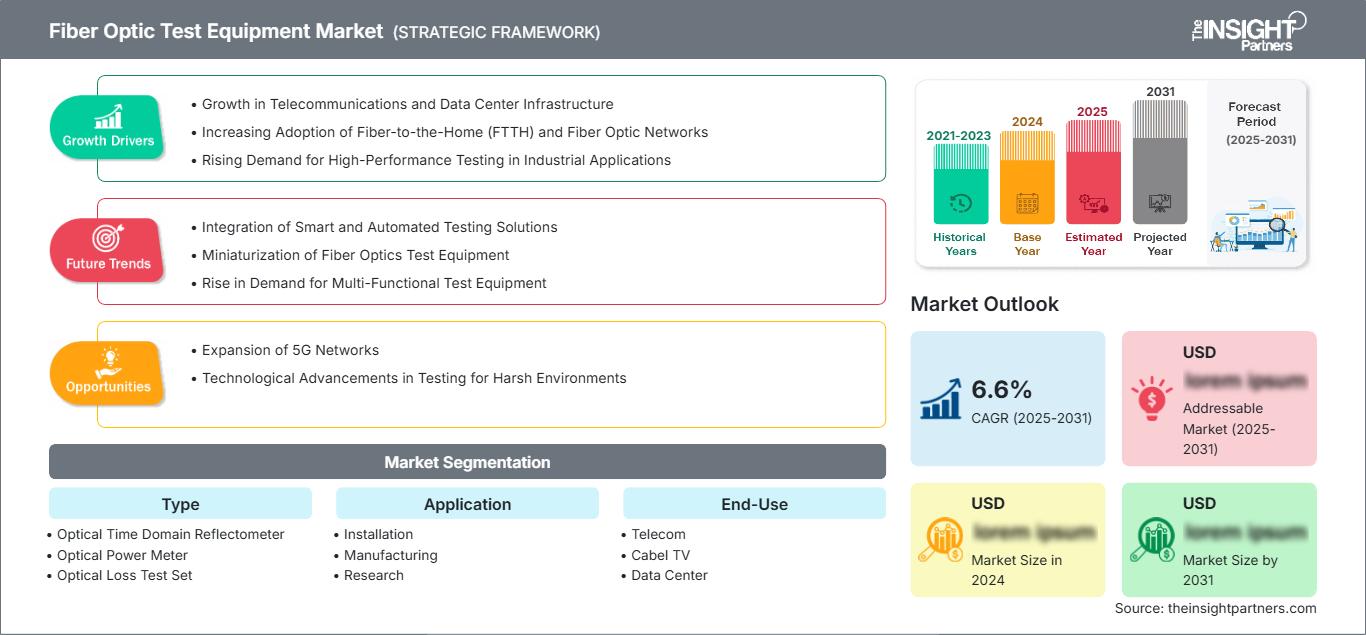
Fiber Optic Test Equipment Market: Strategic Insights
Regional Insights
North America Fiber Optic Test Equipment Market
North America is projected to represent Fiber Optic Test Equipment Market Share between 20% and 23% of worldwide demand in 2025, with an expected growth rate of 6.2% to 6.9% CAGR until 2034. North America takes advantage of already installed optical fiber networks that need regular maintenance and certification, as well as new fiber deployment. Data center interconnects, rural broadband rollouts, and 5G densification generate continuous demand for portable OTDRs, optical power meters, and automated certification systems.
The US is the major market, while Canada plays a role thanks to broadband deployments and network upgrades. Purchasing trends include multifunctional devices capable of speeding up field testing and working with larger fiber counts. Data centers are also setting higher standards for connector inspection, polarity testing, and high speed link validation.
U.S. Fiber Optic Test Equipment Market
North America constitutes about 63-70% of the overall demand of the U.S. market in 2025 and is projected to have a 6.1-6.8% CAGR over 2034. The factors that contribute to the demand include broadband deployment, development of the hyperscale data centers, enterprise networks, and 5G network infrastructures that provide a broad customer base. The test requirements range from field construction to data center commissioning and assurance of services.
There is a robust competitive landscape due to the presence of VIAVI Solutions Inc., Fluke Networks, AFL, EXFO Inc. and other such specialists in the area. The applications are moving towards certification automation, multi-fiber inspections, and software-based reporting features. The high-density data center architectures need fast tests on parallel optical fibers, while the broadband contractors need compact instruments for testing PON and locating faults.
Europe Fiber Optic Test Equipment Market
Europe is expected to account for 12-15% of worldwide demand in 2025 and register a growth rate of 6.0-6.7% CAGR, led by Germany in the region. The UK, Germany, France, Italy, and Spain play crucial roles in regional deployments as they roll out FTTP networks and dismantle their existing networks. According to the European Commission report, FTTP covered 74.1% of EU27 households in 2025.
The UK continues to be an important market due to its requirement for extensive field testing before the country completes its nationwide full-fiber deployment. On the other hand, Germany is investing heavily in fiber-optic networks from its relatively low legacy network position. France still reaps the benefits of its vast FTTH network infrastructure, and Italy and Spain deploy new high-speed network infrastructures in both urban and unserved regions.
APAC Fiber Optic Test Equipment Market
APAC is estimated to account for 28–32% of global demand in 2025 and grow at 7.4–8.1% CAGR, making it the leading high-growth region. China, Japan, South Korea, India, and Australia combine large broadband programs with expanding mobile and data infrastructure. China alone had 74.99 million km of optical fiber cable at the end of 2025.
China continues to dominate in this regard, with Japan and South Korea coming next with their highly advanced optical technologies, and India and Australia offering good prospects for deployment. The industrial digitization process, the development of 5G network, FTTH, cloud infrastructure, and other national broadband plans create equipment demand. According to Chinese 2025 data, there were 12.1 billion FTTH/O ports and 31.62 million 10G PON ports.
Middle East & Africa Fiber Optic Test Equipment Market
The Middle East and Africa region is expected to experience growth between 7.5-8.1% CAGR up to 2034. In the Middle East, Saudi Arabia is the leader in terms of regional demand due to its huge investment in digital infrastructure and Smart Cities. The United Arab Emirates on the other hand is still investing in data centers and connectivity.
There are possibilities within Rest of MEA as operators roll out fiber into the less covered regions and governments focus on achieving digital inclusion. Energy infrastructure is also important in that fiber is useful for communication in utilities and operational monitoring networks. Huge infrastructure projects need reliable solutions for commissioning and maintenance.
Segmentation Analysis
Type
The Type segment is led by OTDR-based testing because fault localization, splice verification, attenuation measurement, and network characterization remain fundamental across installation and maintenance workflows. Fiber Optic Test Equipment Market scope is expanding toward automated, multi-fiber, and software-assisted instruments. The Type segment is estimated to grow at 6.7–7.3% CAGR through 2034 as network complexity rises.
- Optical Time Domain Reflectometer: Remains the leading instrument category because it provides event-level visibility for fiber faults, splices, connectors, and attenuation, supporting both installation certification and troubleshooting.
- Optical Power Meter: Maintains broad field adoption for basic optical power verification, service activation, maintenance, and rapid link checks across telecom and enterprise environments.
- Optical Loss Test Set: Supports standardized end-to-end insertion-loss and optical-return-loss validation, making it strategically important where certification requires repeatable transmitter-receiver measurements.
- Remote Fiber Test Systems: Gain strategic importance as operators seek continuous network visibility, centralized fault detection, and reduced field intervention across geographically distributed fiber assets.
Application
The Application segment is estimated to grow at 7.0–7.7% CAGR through 2034. Installation remains central because every new optical link requires qualification before service activation. Manufacturing demand is strengthened by higher component complexity, while research applications benefit from experimentation with advanced fibers, photonic devices, and higher-speed optical systems.
- Installation: Represents the largest practical testing workload, with contractors requiring portable instruments for acceptance testing, PON characterization, splice verification, and documentation.
- Manufacturing: Requires controlled, repeatable measurements for component and assembly validation, supporting demand for accurate benchtop and automated systems.
- Research: Serves laboratories developing advanced fibers, photonic components, and transmission technologies, where flexible measurement configurations are more important than field portability.
End-Use
The End-Use segment is estimated to expand at 6.8–7.5% CAGR through 2034. Telecom remains the principal customer base because network construction and maintenance require extensive testing. Data centers represent an increasingly important application as optical density and transmission speeds rise, while cable TV and other users sustain specialized demand.
- Telecom: Represents the largest recurring demand base because operators and contractors require testing throughout deployment, activation, maintenance, restoration, and network upgrades.
- Cabel TV: Uses fiber testing for hybrid fiber-coaxial networks, PON transitions, signal verification, fault isolation, and service-quality assurance.
- Data Center: Shows strong strategic importance as higher-density architectures require rapid multi-fiber inspection, polarity validation, and high-speed optical link certification.
- Others: This category includes industrial, institutional, utility, and specialized network applications, but is excluded from detailed analysis under the stated market scope.
Opportunity Snapshot
| Application | Revenue Contribution | Trend Tag | Adoption Stage |
| Installation | High | PON Certification | Mature |
| Manufacturing | Medium | Automated QA | Scaling |
| Research | Low | Advanced Fiber | Emerging |
Fiber Optic Test Equipment Market Growth Drivers and Impact Analysis
Rapid Expansion of High-Capacity Fiber Infrastructure
Fiber deployment is expanding beyond conventional backbone networks into access, data center, enterprise, and specialized infrastructure. Each incremental link creates requirements for continuity checks, attenuation measurement, connector inspection, and acceptance documentation. China's 2025 statistics illustrate the scale, with 2.113 million km of new optical cable lines added during the year and FTTH/O ports reaching 1.21 billion. Such infrastructure growth increases the number of commissioning events and maintenance points that require test instruments. The commercial impact is strongest for portable OTDRs, optical power meters, and loss-test systems. Suppliers capable of shortening test procedures can address contractor productivity requirements while reducing commissioning delays. As network density rises, testing becomes an operational requirement rather than a one-time construction activity, supporting replacement cycles and recurring demand for upgraded measurement capabilities.
Rising Complexity of Data Center Optical Architectures
Data center architectures are creating a distinct testing requirement because optical links increasingly use parallel fibers, higher transmission rates, and dense connector configurations. VIAVI notes that data center interfaces have progressed from 100G and 200G toward 400G, 800G, and 1.6Tbps architectures, increasing the importance of multifiber validation and connector quality. This shift changes the economics of testing because manual single-fiber procedures become inefficient as link counts rise. Equipment suppliers can capture value through multi-fiber inspection, automated measurement sequences, centralized reporting, and upgradeable test platforms. The impact extends beyond initial construction because frequent hardware changes, optical transceiver upgrades, and network expansion create repeated certification requirements. Consequently, data centers are becoming a strategic growth pool for high-performance testing equipment rather than simply another end-use category.
Regulatory and Quality Requirements for Network Deployment
Regulatory initiatives increasingly emphasize reliable high-capacity connectivity, infrastructure coordination, and efficient deployment. Europe's Gigabit Infrastructure Act seeks to simplify fiber deployment through infrastructure sharing, coordinated civil works, streamlined procedures, and fiber-ready buildings. Such measures can accelerate network construction while increasing the importance of documented acceptance testing. Quality requirements also become more significant when operators migrate from copper to fiber and deactivate legacy networks. The market impact is not limited to Europe: broadband programs globally require contractors to demonstrate that funded infrastructure meets technical specifications before activation. This environment favors instruments with automated pass-fail analysis, standardized reporting, calibration traceability, and workflow integration. Suppliers that can connect field measurements with project records are better positioned to address procurement requirements where proof of installation quality is becoming as important as physical deployment speed.
Fiber Optic Test Equipment Market Future Trends
Intelligent Automated Fiber Certification
Fiber Optic Test Equipment Market trends are moving toward intelligent platforms that automatically configure measurements, interpret traces, identify anomalies, and generate standardized reports. Automation will become particularly valuable where technician availability is constrained and fiber counts continue to increase. Future systems are likely to combine OTDR, OLTS, connector inspection, and PON testing in unified workflows rather than requiring technicians to manage separate instruments. Cloud synchronization can further connect field measurements with project management and network records. The resulting model shifts testing from operator-dependent interpretation toward guided certification. Equipment suppliers will increasingly compete on software intelligence, workflow integration, upgradeability, and ease of use alongside traditional measurement accuracy. Such capabilities can reduce repeat testing, improve consistency between technicians, and support larger deployment programs without equivalent increases in field labor.
Testing for Emerging Fiber and Ultra-High-Speed Networks
Future equipment development will increasingly accommodate multi-core, hollow-core, coherent, and other specialized fiber architectures. These technologies alter attenuation characteristics, dispersion behavior, connector requirements, and measurement assumptions, creating demand for specialized characterization methods. EXFO has highlighted testing requirements for hollow-core and multi-core fiber as transmission rates move toward 800G and beyond. Research laboratories and early network deployments will therefore require instruments that can measure unfamiliar optical characteristics without sacrificing field practicality. Over time, capabilities developed for emerging fiber types can migrate into mainstream equipment portfolios as new architectures gain commercial acceptance. This transition should favor modular platforms, software-defined measurement functions, and instruments capable of supporting new test parameters through upgrades rather than complete hardware replacement.
Fiber Optic Test Equipment Market Opportunities
Expansion of Remote Network Monitoring Platforms
Fiber Optic Test Equipment Market Forecasts indicate an attractive opportunity in remote testing and continuous network monitoring because operators increasingly seek to detect degradation before service-affecting failures occur. Remote Fiber Test Systems can centralize monitoring across distributed access and backbone assets, reducing dependence on scheduled field inspections. Investment opportunities are strongest where networks cover large geographic areas and technician travel materially affects maintenance economics. Suppliers can strengthen positioning by combining remote measurement hardware with analytics, alarms, asset records, and service-management interfaces. The commercial model may also shift from individual instrument sales toward recurring software and monitoring services. This creates a pathway for equipment manufacturers to deepen customer relationships while helping operators reduce mean time to repair and improve network availability.
Multi-Fiber Testing for AI Data Center Buildouts
AI-oriented computing facilities require dense optical connectivity and increasingly rapid validation as network speeds rise. The opportunity lies in instruments capable of inspecting, certifying, and documenting many fibers simultaneously while maintaining compatibility with evolving optical interfaces. Data center construction schedules also create a premium for faster acceptance procedures because delays in physical-layer qualification can postpone broader commissioning. Suppliers can target this opportunity through native multi-fiber testing, automated connector inspection, polarity verification, and upgradeable Ethernet testing. Partnerships with cabling contractors and data center integrators can further improve market access. As 800G and 1.6Tbps architectures expand, testing suppliers that combine physical-layer certification with high-speed protocol validation should have greater scope to participate in higher-value infrastructure programs.
Recent Developments
- March 2026: Anritsu Corporation has introduced the MT9100A Multi Channel Fiber Tester, which the company describes as the industry's first tester designed to evaluate transmission quality across multiple channels of multicore fiber (MCF). The new instrument is intended to support the development and manufacturing of high-capacity optical-fiber technologies for next-generation communication networks.
- March 2026: Chandler, Arizona: VIAVI Solutions is showcasing a range of new testing and validation technologies at OFC 2026, aimed at helping manufacturers and data-center operators validate the increasingly complex optical and networking infrastructure required for AI workloads. The event is being held March 17–19 at the Los Angeles Convention Center
- February 2026: Lockport, Illinois: Vitrek has highlighted the high-sensitivity measurement capabilities of its 95X Series hipot testers, which provide leakage-current resolution down to 100 picoamps. The company says the capability is designed to help manufacturers identify extremely small insulation defects in safety-critical products before they develop into serious failures.
Frequently Asked Questions

- Comprehensive Market Sizing and Forecast Analysis
- Detailed Segmentation Analysis
- In-Depth Market Dynamics Assessment
- Regional and Country-Level Insights
- Competitive Landscape and Company Benchmarking
- Strategic Business Intelligence
Recent Reports
Testimonials

The Insight Partners' SCADA System Market report is comprehensive, with valuable insights on current trends and future forecasts. The team was highly professional, responsive, and supportive throughout. We are very satisfied and highly recommend their services.
RAN KEDEM Partner, Reali Technologies LTDs
I requested a report on a very specific software market and the team produced the report in a few days. The information was very relevant and well presented. I then requested some changes and additions to the report. The team was again very responsive and I got the final report in less than a week.
JEAN-HERVE JENN Chairman, Future Analytica
We worked with The Insight Partners for an important market study and forecast. They gave us clear insights into opportunities and risks, which helped shape our plans. Their research was easy to use and based on solid data. It helped us make smart, confident decisions. We highly recommend them.
PIYUSH NAGPAL Sr. Vice President, High Beam Global
The Insight Partners delivered insightful, well-structured market research with strong domain expertise. Their team was professional and responsive throughout. The user-friendly website made accessing industry reports seamless. We highly recommend them for reliable, high-quality research services
YUKIHIKO ADACHI CEO, Deep Blue, LLC.
This is the first time I have purchased a market report from The Insight Partners.While I was unsure at first, I visited their web site and felt more comfortable to take the risk and purchase a market report.I am completely satisfied with the quality of the report and customer service. I had several questions and comments with the initial report, but after a couple of dialogs over email with their analyst I believe I have a report that I can use as input to our strategic planning process.Thank you so much for taking the extra time and making this a positive experience.I will definitely recommend your service to others and you will be my first call when we need further market data.
JOHN SUZUKI President and Chief Executive Officer, Board Director, BK Technologies
I wish to appreciate your support and the professionalism you displayed in the course of attending to my request for information regarding to infectious disease IVD market in Nigeria. I appreciate your patience, your guidance, and the fact that you were willing to offer a discount, which eventually made it possible for us to close a deal. I look forward to engaging The Insight Partners in the future, all thanks to the impression you have created in me as a result of this first encounter.
DR CHIJIOKE ONYIA MANAGING DIRECTOR, PineCrest Healthcare Ltd.Reason to Buy
- Informed Decision-Making
- Understanding Market Dynamics
- Competitive Analysis
- Identifying Emerging Markets
- Customer Insights
- Market Forecasts
- Risk Mitigation
- Boosting Operational Efficiency
- Strategic Planning
- Investment Justification
- Tracking Industry Innovations
- Aligning with Regulatory Trends





 Get Free Sample for