
LED Electronic Driver Market Growth Analysis by Size and Share: 2034
Coverage: By Luminaire Type (Type A-Lamps, T-Lamps, Reflectors, Decorative Lamps, Integral LED Modules); Driving Method (Constant Current LED Driver, Constant Voltage LED Driver); End User (Commercial Lighting, Industrial Lighting, Residential Lighting, Outdoor and Traffic Lighting, Others) , and Geography (North America, Europe, Asia Pacific, and South and Central America)
- Status : Data Released
- Report Code : TIPRE00022728
- Category : Electronics and Semiconductor
- No. of Pages : 150
- Available Report Formats :


- Last update date : October 26, 2026


2025 Market Size
US$ 13.45 Bn
Base year value
2034 Forecast
US$ 35.45 Bn
Projected by 2034
CAGR 2026-2034
12.34 %
Growth rate
Addressable Market
US$ 226.50 Bn
(2026-2034)
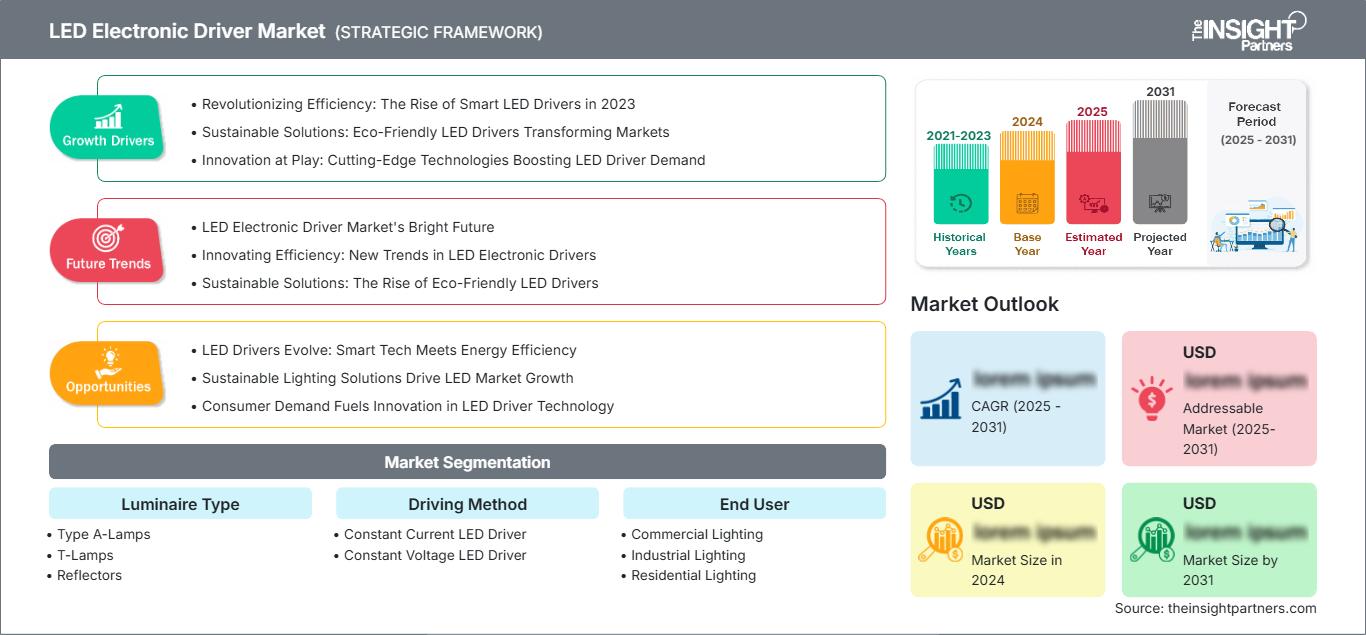
The Led Electronic Driver Market was valued at US$ 13.45 Billion in 2025 and is projected to reach US$ 35.45 Billion by 2034, expanding at a CAGR of 12.34% during 2026–2034. The market encompasses electronic power-management solutions that regulate LED current or voltage across diverse luminaire architectures. Rising LED penetration, increasingly sophisticated dimming requirements, tighter energy-efficiency expectations, and integration of lighting controls are reshaping driver specifications across commercial, industrial, residential, outdoor, and traffic applications.
Demand conditions indicate that Led Electronic Driver Market size expansion will increasingly reflect replacement of legacy drivers, higher-value intelligent luminaires, and greater integration between drivers and building-control platforms. North America is supported by energy codes and retrofit activity, while Europe benefits from efficiency regulation. Asia Pacific remains strategically important because of manufacturing scale, infrastructure investment, and rapid LED deployment across China, Japan, South Korea, and India.
LED Electronic Driver Market Assessment and Insights
- North America: North America represented a modelled 30–34% Led Electronic Driver Market share in 2025, with the market growing at a CAGR of 11.3–12.0% between 2026–2034, supported by commercial retrofits, energy codes, and controls-ready lighting demand.
- US: The US accounted for 84–88% of North America's 2025 value, with a CAGR of 11.2–11.9% through 2034, supported by building-efficiency programs and connected lighting adoption.
- Europe: Europe held a 26–30% share in 2025 and is projected to expand at 12.0–12.7% CAGR, led by Germany, the UK, France, Italy, and Spain as efficient lighting and controls gain specification priority.
- Asia Pacific: Asia Pacific represented 31–35% in 2025 and is expected to record 13.2–14.0% CAGR, with China, Japan, South Korea, and India combining manufacturing depth with infrastructure-led LED adoption.
- Largest Segment: Type A-Lamps held a modelled 34–38% share in 2025 and is expected to grow at 10.8–11.5% CAGR through 2034, supported by broad replacement demand.
- High Growth Segment: Integral LED Modules represented 16–20% in 2025 and is forecast to grow at 14.5–15.3% CAGR, reflecting compact luminaire architectures and integrated electronics.
- Key companies analyzed in detail: ams-OSRAM AG, Harvard Engineering Ltd., Texas Instruments Incorporated, Analog Devices, Inc., Macroblock, Inc., Microchip Technology Inc., Current Lighting Solutions, LLC, Cree Lighting USA LLC, ROHM Co., Ltd., onsemi, Infineon Technologies AG, and Diodes Incorporated.
Source: The Insight Partners' analysis based on proprietary research, government publications, company annual reports, investor presentations, industry databases, and expert interviews.
Advancements in Led Electronic Driver Market have led to driver developments from simple electrical control to efficiency improvements, space saving, dimmability, heat management, and control integration. Constant-current designs continue to be relevant due to the importance of current control to the LED, with digitally adjustable drivers now capable of PWM, analog, and hybrid dimming capability. Current product offerings also include trends toward higher power density, wide input voltage range, and protection circuitry.
Future trends in the Led Electronic Driver Market will see the emphasis being placed on intelligent driver electronics, switching technologies with lower losses, control system interoperability, and sensor integration. Increasing regulation of lighting efficiency is driving the replacement cycle, while developing countries are increasing their adoption of LEDs. According to IEA, lighting accounted for 8% of total global electricity consumption in 2024, with another wave of adoption of LEDs focused around higher performance and intelligence.
LED Electronic Driver Market Report Scope
| Report Attribute | Details |
|---|---|
| Market size in 2025 | US$ 13.45 Billion |
| Market Size by 2034 | US$ 35.45 Billion |
| Global CAGR (2026 - 2034) | 12.34% |
| Historical Data | 2021-2024 |
| Forecast period | 2026-2034 |
LED Electronic Driver Market Analysis
Led Electronic Driver Market is driven by the ongoing transition from traditional lighting to LED lighting architecture and by the growing need for better power management. Since drivers serve as an interface between electrical supply and light-emitting components, the efficiency, thermal properties, dimming capability, and reliability become critical to overall cost-effectiveness of such systems. Commercial retrofit projects require driver-controlled luminaries, whereas industrial and outdoor projects are focused on durability and performance stability.
The Led Electronic Driver Market value chain consists of semiconductor vendors, manufacturers of magnetic and passive components, IC design firms, electronic drivers manufacturers, lighting fixture OEMs, distributors, system integrators, and providers of building control solutions. This means that supply issues depend on the availability of semiconductors, component prices, and qualification process. The most popular type of driver is constant current drivers, although constant voltage drivers can be used in case when LED modules or strips require voltage distribution.
Led Electronic Driver Market competition is shifting towards efficient electrical performance, dimming capabilities, thermal performance, form factor, reliability, and control system compatibility beyond mere functioning of the drivers. ams-OSRAM AG specializes in intelligent lighting and addressable architecture, whereas Texas Instruments Incorporated is specialized in general driver ICs. On the other hand, Analog Devices, Inc., Macroblock, Inc., Microchip Technology Inc., and ROHM Co., Ltd are involved in both control and semiconductors segment, providing various options to luminaire makers.
Investments in the Led Electronic Driver Market are also going towards developing integrated systems, which have less components and make system development simpler. Infineon Technologies AG is making progress in GaN-based power conversion and integrated dimming systems, whereas Diodes Incorporated has developed reference designs for combination of driver and dimming-control functionalities for commercial lighting. All these moves indicate strategy of positioning around low losses, small form factor, deep dimming, and easy compliance with performance of lighting.
● REPORT CUSTOMIZATION
Tailor This Report To Align With Your Specific Business Requirements
This report can be customized to align precisely with your business objectives, scope, and target markets. Customization options include tailored segmentation, geography, competitive analysis, and strategic insights to support informed decision-making.
Customize This Report →WHAT YOU CAN ADJUST
- ● Segmentations
- ● Geography
- ● Competitive Analysis
- ● Language Preferences
LED Electronic Driver Market: Strategic Insights
Regional Insights
North America Led Electronic Driver Market
North America is estimated to account for 30–34% of 2025 global Led Electronic Driver Market, with a regional CAGR of 11.3–12.0% through 2034. The US leads the regional demand based on building renovation, controllable fixtures requirement, performance requirements, and the replacement of fluorescent system. The government directive highlights dimming as a very significant aspect that helps in saving energy, and the need for compatibility with control system is vital.
Canada is involved by commercial efficiency, institutional upgrades, and outdoor infrastructure upgrade. There is a change in the demand of the electronic driver as there is a rising demand for low dimming, stable current, and compatibility with networked lighting controls. The US is the leading regional country due to a huge commercial installation and retrofitting being carried out in the country. The growth is also facilitated by investments in smart building, where the electronic driver is required.
U.S. Led Electronic Driver Market Market
The Led Electronic Driver Market report shows that the US is estimated to represent 84–88% of North America's 2025 value and is projected to expand at 11.2–11.9% CAGR through 2034. The demand for this technology is centered on office spaces, warehouses, healthcare centers, educational establishments, hospitality venues, retail spaces, and outdoor infrastructures. The federal guidelines on lighting provide for driver-control compatibility and name CCR and PWM as among the critical dimming technologies.
The Led Electronic Driver Market forecast shows that emerging trends within the market include increasing interest in control ready fixtures, low-flicker operation, deep dimming, and communication features in luminaires. Manufacturers such as Texas Instruments Incorporated, Current Lighting Solutions, LLC, Cree Lighting USA LLC, and Diodes Incorporated cater to various aspects of the ecosystem design. Retrofits are still relevant as LED retrofits ensure continued use of the current fixture infrastructure while lowering energy consumption.
Europe Led Electronic Driver Market Market
Europe represented an estimated 26–30% share in 2025 and is expected to expand at 12.0–12.7% CAGR through 2034. Germany has emerged as the leading demander, followed by the UK, France, Italy, and Spain. EU policies relating to lighting have been becoming stricter on efficiency criteria, hence facilitating the migration from less efficient lighting products. According to the IEA, EU regulations have already had an impact in shifting to LED lighting.
From the Led Electronic Driver Market trends, it appears that Germany is supported by industrial automation, commercial renovations, and engineering-driven lighting requirements. The UK has benefited from building efficiency requirements and retrofits. On the other hand, France, Italy, and Spain have been benefiting from commercial renovations, hospitality, infrastructure, and outdoor lighting requirements. All these countries require electronic drivers with reliable dimming capability, high power quality, low standby consumption, and compatibility with digital lighting control systems.
APAC Led Electronic Driver Market Market
APAC held an estimated 31–35% share in 2025 and is forecast to register 13.2–14.0% CAGR through 2034. China is the dominant force in this region, owing to the size of its manufacturing sector and its extensive manufacture of LEDs, while Japan and South Korea have highly developed electronics sectors. India is developing as a market through urban infrastructure and LED conversions for commercial use, and Australia focuses on energy efficient buildings and outdoor lighting.
China continues to dominate owing to its electronics manufacturing sector and strong internal demand for lighting. Japan and South Korea focus on reliability, size, and technology in their driver manufacture. India provides high-volume opportunities through infrastructural development and conversion from existing conventional lighting. Australia participates through its efficiency projects.
Middle East & Africa Led Electronic Driver Market Market
Middle East and Africa is expected to expand at 11.8–12.5% CAGR through 2034, supported by infrastructure development, energy-efficiency programs, commercial construction, and replacement of conventional lighting. The biggest demands in the region come from Saudi Arabia and the UAE. In terms of sub-Saharan markets, South Africa presents the most solid market base for structured commercial and industrial lighting applications.
The urban development and infrastructure investments make Saudi Arabia a beneficiary, and the UAE's demands come from the hospitality sector, the commercial projects, as well as the smart city initiatives. In South Africa, the drivers for adoption are municipal and commercial efficiency regulations. Rest of MEA is more fragmented, where adoption depends on the project financing and infrastructure availability.
Segmentation Analysis
Luminaire Type
The Luminaire Type segment is projected to grow at a CAGR of 12.0–12.6% between 2026–2034. Demand is influenced by replacement cycles, luminaire design preferences, LED integration, and the need for drivers optimized around specific optical and electrical architectures. Integral modules are gaining strategic relevance as fixture manufacturers seek compact assemblies and fewer discrete components.
- Type A-Lamps: Type A-Lamps retain broad relevance because they support direct replacement applications and established consumer specifications. Their large installed base creates recurring driver demand across residential and commercial replacement cycles.
- T-Lamps: T-Lamps are important in linear retrofit applications where existing form factors remain valuable. Demand depends on compatibility with legacy fixtures, thermal conditions, dimming requirements, and replacement economics.
- Reflectors: Reflectors serve directional lighting applications requiring controlled optical distribution. Their driver requirements emphasize stable current regulation, thermal reliability, and compatibility with dimming or beam-control systems.
- Decorative Lamps: Decorative Lamps increasingly require compact drivers capable of maintaining visual quality in smaller housings. Hospitality, residential, and architectural applications support demand for low-flicker and smoothly dimmable solutions.
- Integral LED Modules: Integral LED Modules support integrated luminaire architectures by combining light source and electronics within compact assemblies. Their strategic importance is increasing as manufacturers pursue thinner designs and simplified installation.
Driving Method
The Driving Method segment is forecast to expand at 12.6–13.2% CAGR through 2034. Selection depends on LED architecture, output power, wiring configuration, dimming requirements, and application-level control. Constant-current solutions remain fundamental for direct LED control, while constant-voltage architectures retain relevance in module-based systems.
- Constant Current LED Driver: Constant Current LED Driver solutions provide controlled current to LED emitters and support stable brightness and predictable thermal behavior. They remain central to high-performance luminaires and precision lighting systems.
- Constant Voltage LED Driver: Constant Voltage LED Driver architectures remain relevant for LED modules and distributed lighting arrangements requiring regulated voltage rails. Their adoption is linked to modular fixture construction and application-specific electrical layouts.
End User
The End User segment is expected to register 12.2–12.9% CAGR from 2026 to 2034. Commercial projects remain significant because lighting controls, retrofit programs, and building-efficiency requirements create strong demand for sophisticated drivers. Industrial facilities emphasize reliability and thermal management, while residential applications increasingly incorporate dimming and connected functionality.
- Commercial Lighting: Commercial Lighting remains strategically important because offices, retail, hospitality, healthcare, and education increasingly combine LED retrofits with controls. Driver compatibility directly influences system commissioning and energy-management performance.
- Industrial Lighting: Industrial Lighting requires robust drivers capable of operating under heat, dust, vibration, and long duty cycles. Warehouses and manufacturing facilities increasingly use dimming and occupancy controls to reduce unnecessary lighting consumption.
- Residential Lighting: Residential Lighting benefits from replacement of conventional lamps and growing consumer adoption of dimmable and connected fixtures. Compact driver designs are important where luminaire size, acoustics, and aesthetic integration influence purchasing decisions.
- Outdoor and Traffic Lighting: Outdoor and Traffic Lighting requires high reliability, surge tolerance, thermal resilience, and stable operation across variable environmental conditions. Municipal and infrastructure projects increasingly combine LED conversion with adaptive dimming and centralized controls.
Opportunity Snapshot
| End Users | Revenue Contribution (High/Medium/Low) | Trend Tag (MAX 2 words) | Adoption Stage |
| Commercial Lighting | High | Smart Controls | Scaling |
| Industrial Lighting | High | Adaptive Dimming | Scaling |
| Residential Lighting | Medium | Connected Homes | Scaling |
| Outdoor and Traffic Lighting | High | Adaptive Roads | Scaling |
LED Electronic Driver Market Growth Drivers and Impact Analysis
Expansion of Energy-Efficient Lighting Retrofits
LED conversion still stands as a critical driver due to the fact that electronic drivers play a central role in almost all types of LED luminaire designs. According to the IEA, LEDs have made significant advances in energy efficiency, with the average efficiency of LEDs having doubled between 2015 and now, with the most efficient products achieving up to 230 lm/W. Additionally, IEA asserts that lighting makes up around 8% of global electricity demand as at 2024. The situation presents a continuous replacement opportunity in the sense that building owners look to reduce their electricity consumption without replacing their existing lighting systems. Thus, the need for drivers continues not only in the sale of new luminaires but also in retrofits and replacement systems.
Integration of Dimming and Building Controls
The combination of dimming, occupancy sensing, daylight harvesting, and control networking is raising expectations regarding the level of electronic complexity required of the driver. The driver is supposed to provide dimming capability while maintaining stable current output and low flicker, as well as having predictable dimming characteristics and abnormal operation protection capabilities. As per the US federal guidelines, the use of CCR and PWM technologies is emphasized when it comes to dimming, making it necessary to ensure compatibility of the drivers and the control system in use. The result of the above requirement is an increased value proposition in terms of the electronic complexity of the driver.
Advances in Semiconductor Power Conversion
As per the report on LED Electronic Drivers market forecast, it can be seen that there is a development in semiconductors which will increase the efficiency, reduce the size, and add more functions to the electronic drivers. The use of wide band gap devices, power stage integration, better switching techniques, and thermal management helps the makers to reach out to high power densities without having to increase the size of the drivers. Infineon Technologies AG has used GaN as the technique to achieve high speed, higher efficiency, and high power density. Texas Instruments Incorporated also provides buck, boost, and multiple topology drivers with analog and PWM dimming.
LED Electronic Driver Market Future Trends
Driver-Level Intelligence and Embedded Diagnostics
Future driver architectures will feature increased intelligence built into the luminaire itself, thereby minimizing reliance on additional control units. The drivers will be capable of embedded diagnostics, including monitoring of temperature, current, fault detection, and operating conditions, in addition to providing the capacity for predictive maintenance and commissioning. Multiple channels will increasingly be used to integrate tunable white, color control, and dynamic lighting functionality. Such an approach is evident in today’s semiconductor offerings, which include LED control, communications capabilities, diagnostics, and embedded processing in the semiconductor portfolio. The move toward connected lighting could result in driver functionality being distributed throughout the system, as opposed to just power conversion functionality. This opens up additional needs in terms of security and firmware management, and the need for interoperability and component availability in the long run.
Higher Power Density Through Wide-Bandgap Switching
Wide-bandgap semiconductors are expected to influence driver architecture as manufacturers pursue smaller footprints, higher efficiency, and improved thermal performance. GaN-based solutions can enable higher switching frequencies and smaller passive components, supporting compact driver designs. The trend is particularly relevant for premium commercial luminaires, high-output industrial systems, and applications where driver volume or heat dissipation constrains fixture design. Greater power density can also facilitate integration of power conversion, control, and communication functions within smaller enclosures. As component costs and design expertise improve, adoption should extend beyond specialized applications. The resulting driver landscape is likely to emphasize optimized switching, lower losses, reduced magnetic size, thermal derating, and digitally controlled operation. This evolution will strengthen the role of semiconductor selection in overall luminaire performance.
LED Electronic Driver Market Opportunities
Smart Retrofit Driver Platforms
A significant opportunity exists in retrofit-oriented driver platforms that combine LED compatibility with advanced dimming and communication capabilities. Existing commercial and institutional buildings contain large installed populations of luminaires that require modernization without complete fixture replacement. Modular driver solutions can reduce installation disruption while allowing owners to introduce controls, scheduling, occupancy response, and daylight-based dimming. Suppliers can create differentiated platforms around broad input-voltage ranges, multiple control protocols, low-flicker operation, and simplified commissioning. The opportunity is especially relevant in mature lighting markets where LED penetration is already high but first-generation installations are approaching replacement cycles. Such platforms can also support maintenance strategies by allowing electronics to be replaced independently of the complete luminaire, improving asset utilization and potentially reducing lifecycle waste.
Integrated Driver Solutions for Emerging Infrastructure
Emerging markets provide an opportunity for driver suppliers to align compact, efficient electronics with rapidly expanding infrastructure. Urban development in Asia, the Middle East, and parts of Africa is increasing demand for commercial buildings, roads, public spaces, industrial facilities, and transport infrastructure. Integrated drivers can reduce bill-of-material complexity while supporting requirements for power quality, thermal protection, dimming, and long service life. Local manufacturing partnerships and application-specific reference designs can improve deployment efficiency where engineering resources vary between projects. Suppliers can also target outdoor and traffic applications with surge-resistant designs and adaptive control capabilities. The strategic opportunity lies in offering standardized electronic platforms that can be configured for different luminaire power classes and regional electrical environments without requiring entirely new architectures for every project.
Recent Developments
- July 2026: Texas Instruments Incorporated published application guidance for optimizing illumination LED-driver dimming performance using the TPS92205x and TPS92365x families. The material addresses dimming behavior and design considerations for driver architectures, reinforcing the company's focus on high-performance illumination power management and deeper controllability in LED applications.
- May 2026: Infineon Technologies AG highlighted its LITIX Basic LED-driver family for low- to medium-power applications, including constant-current devices with one or three output channels. The portfolio emphasizes stable LED brightness, protection functions, and PWM capability, illustrating continued development of compact regulated-current architectures for lighting applications.
- February 2025: ams-OSRAM AG announced that its AS1163 Stand-Alone Intelligent Driver was selected by Ningbo Fuerda Smartech for dynamic ambient-lighting applications. The solution integrates with the company's Open System Protocol and enables intelligent LED control without requiring a local microcontroller, illustrating the shift toward distributed and network-capable driver electronics.
Frequently Asked Questions

- Comprehensive Market Sizing and Forecast Analysis
- Detailed Segmentation Analysis
- In-Depth Market Dynamics Assessment
- Regional and Country-Level Insights
- Competitive Landscape and Company Benchmarking
- Strategic Business Intelligence
Recent Reports
Testimonials

The Insight Partners provided valuable market intelligence that supported our global go-to-market strategy. Their team was professional, responsive, and attentive to our feedback, providing thoughtful analysis and helpful methodological clarifications throughout the project.
Junmo Kim Chief Financial Officer (CFO), Enertech Co., Ltd.
The Insight Partners' SCADA System Market report is comprehensive, with valuable insights on current trends and future forecasts. The team was highly professional, responsive, and supportive throughout. We are very satisfied and highly recommend their services.
RAN KEDEM Partner, Reali Technologies LTDs
I requested a report on a very specific software market and the team produced the report in a few days. The information was very relevant and well presented. I then requested some changes and additions to the report. The team was again very responsive and I got the final report in less than a week.
JEAN-HERVE JENN Chairman, Future Analytica
We worked with The Insight Partners for an important market study and forecast. They gave us clear insights into opportunities and risks, which helped shape our plans. Their research was easy to use and based on solid data. It helped us make smart, confident decisions. We highly recommend them.
PIYUSH NAGPAL Sr. Vice President, High Beam Global
The Insight Partners delivered insightful, well-structured market research with strong domain expertise. Their team was professional and responsive throughout. The user-friendly website made accessing industry reports seamless. We highly recommend them for reliable, high-quality research services
YUKIHIKO ADACHI CEO, Deep Blue, LLC.
This is the first time I have purchased a market report from The Insight Partners.While I was unsure at first, I visited their web site and felt more comfortable to take the risk and purchase a market report.I am completely satisfied with the quality of the report and customer service. I had several questions and comments with the initial report, but after a couple of dialogs over email with their analyst I believe I have a report that I can use as input to our strategic planning process.Thank you so much for taking the extra time and making this a positive experience.I will definitely recommend your service to others and you will be my first call when we need further market data.
JOHN SUZUKI President and Chief Executive Officer, Board Director, BK Technologies
I wish to appreciate your support and the professionalism you displayed in the course of attending to my request for information regarding to infectious disease IVD market in Nigeria. I appreciate your patience, your guidance, and the fact that you were willing to offer a discount, which eventually made it possible for us to close a deal. I look forward to engaging The Insight Partners in the future, all thanks to the impression you have created in me as a result of this first encounter.
DR CHIJIOKE ONYIA MANAGING DIRECTOR, PineCrest Healthcare Ltd.Reason to Buy
- Informed Decision-Making
- Understanding Market Dynamics
- Competitive Analysis
- Identifying Emerging Markets
- Customer Insights
- Market Forecasts
- Risk Mitigation
- Boosting Operational Efficiency
- Strategic Planning
- Investment Justification
- Tracking Industry Innovations
- Aligning with Regulatory Trends





 Get Free Sample for