
Swarm Robotics Market Share, Growth & Demand by 2034
Swarm Robotics Market Size and Forecasts (2021 - 2034), Global and Regional Share, Trends, and Growth Opportunity Analysis Report Coverage : By Platform (UAV, UGV), Application (Security, Inspection & Monitoring, Mapping & Surveying, Search & Rescue and Disaster Relief, Supply Chain and Warehouse Management), End-Use Industry (Military & Defense, Industrial, Agriculture, Healthcare, Others)
- Status : Data Released
- Report Code : TIPRE00039644
- Category : Electronics and Semiconductor
- No. of Pages : 150
- Available Report Formats :


- Last update date : November 02, 2026


2025 Market Size
US$ 1.35 Bn
Base year value
2034 Forecast
US$ 11.89 Bn
Projected by 2034
CAGR 2026-2034
27.35 %
Growth rate
Addressable Market
US$ 49.10 Bn
(2026-2034)
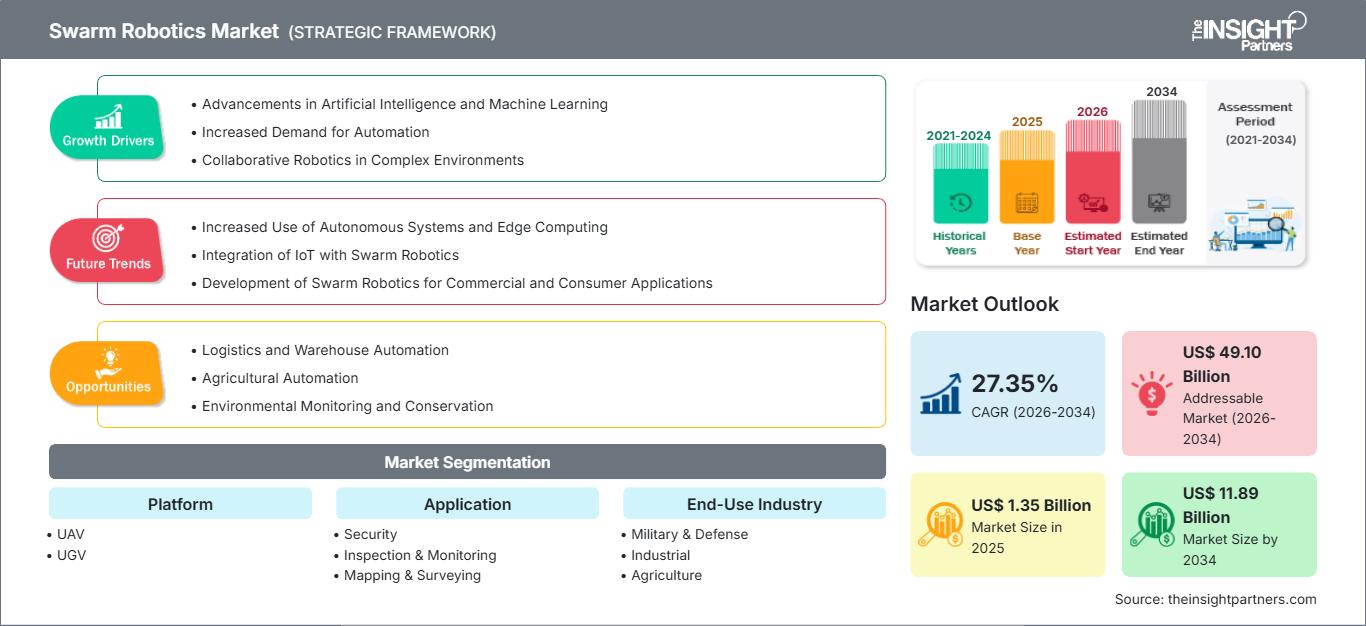
The Swarm Robotics Market size was valued at US$ 1.35 Billion in 2025 and is projected to reach US$ 11.89 Billion by 2034, expanding at a CAGR of 27.35% during 2026–2034. The market covers coordinated fleets of autonomous robotic platforms that share information, distribute tasks, and operate with limited centralized control. Adoption is expanding across defense, industrial inspection, agriculture, logistics, emergency response, and infrastructure monitoring as AI, edge computing, sensing, and wireless connectivity improve multi-robot coordination.
North America is expected to expand at approximately ~27% CAGR through 2034, supported by defense experimentation, warehouse automation, autonomous inspection, and continued development of AI-enabled robotic systems. The region combines established robotics suppliers with government-backed experimentation and commercial deployment environments, allowing swarm architectures to progress from controlled demonstrations toward repeatable operational use.
Swarm Robotics Market Assessment and Insights
Regional Outlook
- North America: ~39% of the global Swarm Robotics Market share in 2025 | ~27% CAGR through 2034. Market position: North America holds the largest regional position, supported by defense autonomy programs, advanced robotics research, warehouse automation, agricultural robotics, and a mature ecosystem of AI, sensing, communications, and autonomous-platform suppliers.
- US: ~68% of North American market revenue in 2025 | ~27% CAGR through 2034. Market position: The US represents the largest country market in North America, with demand spanning defense, security, logistics, inspection, and research applications. Government experimentation and private-sector robotics development support continued commercialization.
- Europe: ~27% of the global market in 2025 | ~25% CAGR through 2034. Market position: Europe has a developed industrial robotics base and expanding autonomous-system activity. Germany represents the leading country in Europe, supported by manufacturing automation, logistics, engineering capabilities, and industrial technology investment.
- Asia Pacific: ~26% of the global market in 2025 | ~30% CAGR through 2034. Market position: Asia Pacific is the fastest-growing region, driven by manufacturing automation, agricultural robotics, labor constraints, smart infrastructure, drone deployment, and increasing investment in AI-enabled autonomous systems. China represents the leading country in Asia Pacific.
Segment Outlook
- Unmanned Ground Vehicles (UGV): ~42% Share in 2025 | ~30% CAGR through 2034. Market position: UGVs lead platform demand because ground-based fleets can support warehouse movement, inspection, security, agriculture, defense logistics, and industrial operations while benefiting from improving navigation, perception, and fleet-management technologies.
- End-Use Industry: ~34% Share in 2025 | ~29% CAGR through 2034. Market position: The end-use industry dimension captures broad deployment across military and defense, industrial, agriculture, and healthcare environments. Industrial and defense requirements provide established demand, while agricultural and healthcare use cases broaden the addressable opportunity.
Competitive Coverage
Hydromea SA, Boston Dynamics, SwarmFarm Robotics, Swarm Technology, Sentien Robotics, Berkeley Marine Robotics, Swisslog Holding AG, FARobot, Inc., KION Group AG, K-Team Corporation
Methodology
The Insight Partners follows Data Collection & Secondary Research, Primary Research, Data Analysis, and Data Triangulation & Final Review to validate market estimates and insights.
Source: The Insight Partners' analysis based on proprietary research, government publications, company annual reports, investor presentations, industry databases, and expert interviews.
The Swarm Robotics Market has advanced from experiments demonstrating collective robot behavior in laboratory settings to commercially viable multi-robot solutions incorporating aspects of sensing, navigation, communication, task assignment, and autonomy. Advances in onboard computing and machine learning have enabled greater autonomy from centralized control, as have cost reductions in sensors and wireless communication technologies that make coordination across a fleet feasible. Manufacturing is also moving toward modularity of platforms such that similar hardware architectures can serve various missions via changes in software, payload, and operating system.
Future investment in the Swarm Robotics Market will probably focus on systems that can function reliably in scenarios where individual robots have issues with coverage, endurance, or accessibility. Experimentation in defense, automation in warehouses, precision farming, inspections at sea, and disaster management represent diverse avenues for commercial application. Progress in regulation of autonomous vehicles and drones, as well as investments in edge AI and industry digitization, will eventually improve the deployment scenario. The role of Asia Pacific is increasing as manufacturing, farming, logistics, and smart city initiatives create larger operational environments for robot fleets.
Swarm Robotics Market Report Scope
| Report Attribute | Details |
|---|---|
| Market size in 2025 | US$ 1.35 Billion |
| Market Size by 2034 | US$ 11.89 Billion |
| Global CAGR (2026 - 2034) | 27.35% |
| Historical Data | 2021-2024 |
| Forecast period | 2026-2034 |
Swarm Robotics Market Analysis
The development of the Swarm Robotics Market is mainly driven by the economic benefit of distributing operations among many relatively small autonomous vehicles instead of using a complicated and expensive system as a whole. Many robots are able to distribute such operations as inspections, mapping, cargo transportation, and surveillance across a larger area and still be operative even when certain robots cannot be used. It means that there is a demand for robot fleet management, communication systems, navigation systems, sensors, batteries, payloads, and maintenance.
The supply in the Swarm Robotics Market is getting more modular in nature. Platform companies compete in the ability of their product to move, carry payload, have high autonomy, good communication abilities, and withstand difficult conditions, whereas software providers compete in their algorithms for coordination, route planning, perception, and management of missions. Hydromea shows the significance of communications and autonomy underwater, while SwarmFarm Robotics represents the agricultural approach where several small autonomous vehicles work together. In logistics, Swisslog and KION Group AG show the connection between robotics and warehouse control systems.
The competitive set includes dedicated swarm developers as well as robotics firms extending existing platforms to work in collaboration with each other. Boston Dynamics adds its capabilities of mobile robot technology that can be used for inspection and autonomous sensing; FARobot, Inc. and K-Team Corporation fall within specialized robotic platforms as well as research applications; Swarm Technology and Sentien Robotics are more targeted solutions to multi-agent autonomy; Berkeley Marine Robotics and Hydromea solve issues in maritime and subsea environment where distributed sensing and coordination of vehicles help eliminate inspection limitations.
More investment in the Swarm Robotics Market is going into autonomy software, perception powered by AI, communications and integration with applications rather than pure hardware. This gives an edge to companies that can deliver repeatable operational economics rather than unique technology demonstrations. Positioning is based on access to application data, fleet management skills, systems integration and customer reach. Companies working in agriculture, warehousing, defense and inspection of infrastructure can employ sector-specific deployment to create recurring demand and increase fleet size and software portion.
● REPORT CUSTOMIZATION
Tailor This Report To Align With Your Specific Business Requirements
This report can be customized to align precisely with your business objectives, scope, and target markets. Customization options include tailored segmentation, geography, competitive analysis, and strategic insights to support informed decision-making.
Customize This Report →WHAT YOU CAN ADJUST
- ● Segmentations
- ● Geography
- ● Competitive Analysis
- ● Language Preferences
Swarm Robotics Market: Strategic Insights
Regional Insights
North America Swarm Robotics Market
North America represents approximately ~39% of the global market in 2025 and is projected to expand at around ~27% CAGR through 2034. Defense autonomy projects, commercial robotics, warehousing automation, agriculture technology, and robust research and development are the factors contributing to the regional positioning. United States serves as the biggest demand source, while Canada supports through robotics research, mining, agriculture, and industrial automation. Moreover, the region has a well-established supply chain for sensors, processing chips, communication solutions, navigation technologies, and cloud-to-edge software.
A military application of robots is one of the most significant avenues for commercialization since multi-robotic systems can be used in reconnaissance missions, perimeter surveillance, mapmaking, logistics, and search-and-rescue missions. Another avenue is a commercial application for automated warehouses, inspection services, and agriculture. Boston Dynamics, Swarm Technology, Sentien Robotics, and Hydromea represent the regional technology portfolio. The experiments conducted by the government with autonomous and swarm systems help create real-world environments in which algorithms, human-robot interface, and communication solutions are tested.
U.S. Swarm Robotics Market
The US accounts for approximately ~68% of North American market revenue in 2025 and is expected to grow at about ~27% CAGR through 2034. Demand is distributed across military and defense, industrial inspection, security, logistics, agriculture, and research. Defense organizations are testing coordinated autonomous platforms for reconnaissance, mapping, security, and other missions that require distributed coverage.
Commercialization is underway in relation to facilities where fleets of robots may coordinate movement and sensing activities. Mobile robot platforms are offered by Boston Dynamics for inspection and monitoring tasks, while dedicated developers cover agriculture, maritime robotics, and coordination of activities. Research done in universities and government programs related to the area of multiagent autonomy also assists in transferring the knowledge in areas such as perception, communication, and mission planning in the United States, which benefits from past experience with unmanned aerial systems.
Europe Swarm Robotics Market
Europe represented approximately ~27% of the global market in 2025 and is expected to expand at around ~25% CAGR through 2034. Germany is the most advanced European country, which is based on the manufacturing sector, industrial automation technology, logistics and robotics engineering knowledge. The United Kingdom plays the role of providing the country with research facilities, defense systems and autonomous technologies. In addition, France supplies applications for defense, industrial automation and infrastructure. In addition, Italy and Spain contribute to demand due to manufacturing, agriculture, logistics and inspection.
The main feature of European robotics is that of autonomous robotics with already existing Industry 4.0 infrastructure in the region. German manufacturing creates demand for robots in production plants and distribution centers. In addition, the UK and France create demand for security, defense and research. As far as Italy and Spain go, they create better chances for agricultural, logistic and infrastructure inspection projects. Such firms as Swisslog Holding AG and KION Group AG link robotics with warehouse automation. Also, Hydromea provides subsea robotics technology. Besides, there are many research programs in Europe, where universities collaborate with manufacturers and technologists. It helps to develop decentralized control, machine perception and resilient communication systems.
APAC Swarm Robotics Market
Asia Pacific represents approximately ~26% of the global market in 2025 and is expected to record around ~30% CAGR through 2034, making it the fastest-growing region. China is the largest nation in Asia Pacific based on manufacturing capability, automation, drones and large eco-system of industrial technology. The Japan and South Korean market offer robotics maturity while Indian and Australian market support robotics through defense, agriculture, mining, logistics and infrastructure applications.
Constraints on labor force, industrial automation, precision agriculture and smart infrastructure are primary drivers of demand. China and Japan offer large manufacturing eco-system, South Korea offers robotics along with electronics capability, India develops autonomous capabilities in defense and industrial sectors while Australia offers an excellent eco-system for agriculture robotics. SwarmFarm Robotics proves the relevance of cooperative autonomous machines in agriculture sector, whereas the investment in AI and unmanned systems in the region form a basis for wider fleet deployments.
Middle East & Africa Swarm Robotics Market
Middle East & Africa is expected to expand at approximately ~28% CAGR through 2034, supported by infrastructure development, security requirements, energy-sector inspection, logistics modernization, and investment in autonomous technologies. Saudi Arabia represents the leading country in the Middle East & Africa market where evidence supports a comparatively strong technology-investment environment. The UAE is also developing robotics and autonomous-system applications.
Energy infrastructure presents opportunities for robots that can undertake inspection of pipelines, facilities, ports, off-shore operations, and hard-to-reach places. The demand side for robots in South Africa comes from its mining industry, as well as industrial inspection, security, and research. For the entire region, the business case becomes stronger where there are coordinated systems to minimize the need to operate in dangerous conditions. Sub-sea robots and distributed inspection may be especially pertinent to off-shore energy projects, while warehouse automation is important for logistics centers.
Segmentation Analysis
Platform
Platform
Platform demand is centered on autonomous fleets that can coordinate navigation, sensing, and task allocation across multiple units. UGVs currently represent the largest platform category because they can operate in warehouses, agricultural fields, industrial facilities, defense environments, and infrastructure sites. UAVs provide complementary value where rapid coverage, aerial mapping, surveillance, or access to difficult terrain is required. The segment is expected to expand at approximately ~30% CAGR through 2034, supported by falling sensor and computing costs and improvements in autonomous navigation.
- UAV: UAV swarms support wide-area mapping, surveillance, inspection, environmental monitoring, and agricultural operations. Their ability to cover large areas quickly makes coordinated aerial deployment particularly relevant where a single aircraft cannot provide sufficient persistence or spatial coverage.
- UGV: UGV fleets provide persistent ground-level movement, inspection, transport, security, and agricultural functions. Their payload flexibility and ability to operate in structured environments make them particularly relevant to warehouses, factories, farms, defense logistics, and infrastructure monitoring.
Application
Application
Application demand is becoming more diversified as swarm capabilities move beyond defense experimentation into commercial operations. Inspection and monitoring benefit from distributed sensing, while mapping and surveying gain from simultaneous coverage of large areas. Search and rescue applications use multiple platforms to explore difficult environments, whereas supply chain and warehouse management uses coordinated fleets for material movement. The segment is expected to grow at approximately ~28% CAGR through 2034, supported by broader use of fleet-management software and autonomous decision-making.
- Security: Coordinated robots can provide distributed perimeter surveillance and reduce the need for continuous human monitoring across large sites, particularly in facilities where persistent coverage and rapid response are operational priorities.
- Inspection & Monitoring: Multi-robot inspection enables simultaneous data collection across infrastructure, industrial facilities, energy assets, and difficult-access environments, increasing coverage and reducing dependence on manual inspection teams.
- Mapping & Surveying: Swarms can divide mapping areas among several platforms, improving spatial coverage and allowing operators to collect information from multiple locations simultaneously.
- Search & Rescue and Disaster Relief: Multiple autonomous platforms can enter hazardous or obstructed environments to locate people, assess conditions, and relay information before human responders enter the affected area.
- Supply Chain and Warehouse Management: Coordinated mobile robots can dynamically distribute transport tasks, reduce congestion, and scale fleet capacity according to throughput requirements and warehouse operating conditions.
End-Use Industry
End-Use Industry
End-use adoption is broadening from defense and research toward industrial, agricultural, and healthcare environments. Military and defense applications remain important because swarm architectures can provide distributed sensing and mission coverage. Industrial users benefit from coordinated inspection and material movement, while agriculture provides a strong setting for small autonomous machines performing repeated field operations. Healthcare remains earlier-stage but offers opportunities in hospital logistics, emergency response, and specialized robotic assistance. The segment is expected to grow at approximately ~29% CAGR through 2034.
- Military & Defense: Defense users employ swarm concepts for surveillance, reconnaissance, mapping, logistics, countermeasure development, and distributed sensing. The strategic value comes from combining multiple lower-cost platforms with centralized mission supervision.
- Industrial: Industrial environments provide structured operating conditions for coordinated inspection, material handling, facility monitoring, and autonomous transportation, supporting repeatable deployments and scalable fleet economics.
- Agriculture: Agricultural swarms enable smaller autonomous machines to conduct crop protection, mowing, monitoring, and other field activities. Their operating flexibility can reduce dependence on large machinery for selected farming tasks.
- Healthcare: Healthcare applications include internal logistics, environmental monitoring, emergency response, and specialized robotic assistance. Adoption remains dependent on safety, reliability, integration, and regulatory requirements.
Opportunity Snapshot
| End-Use Industry | Revenue Contribution | Trend Tag | Adoption Stage |
|---|---|---|---|
| Military & Defense | High | Autonomous Missions | Scaling |
| Industrial | High | Fleet Inspection | Scaling |
| Agriculture | Medium | Precision Farming | Scaling |
| Healthcare | Low | Robotic Assistance | Emerging |
Swarm Robotics Market Growth Drivers and Impact Analysis
Distributed autonomy reduces dependence on single high-value platforms
Key among those factors is the capacity to split sensing, mobility, and actions between a number of autonomous units. Rather than developing a single unit capable of undertaking all actions, many smaller units with complimentary functionality could be used. This design would allow more efficient distribution and increased safety in case one of the units goes out of service. When applied in military context, it helps conduct reconnaissance and surveillance over a greater territory. When applied in the industrial environment, a few smaller robots may inspect various pieces of equipment simultaneously. For agriculture, small units would be able to collaborate together without having all of them being comparable to a big tractor.
AI and edge computing improve real-time coordination
Advances in AI, computer vision, onboard processors, and edge computing are increasing the practical capabilities of multi-robot systems. Swarms require each platform to perceive local conditions while also sharing relevant information with neighboring units or a supervisory system. Greater onboard processing reduces communication dependence and enables robots to respond when connectivity is intermittent. Improved algorithms also support dynamic task allocation, collision avoidance, route optimization, and adaptation to changing environments. These capabilities expand commercial use beyond highly structured environments. The resulting market impact extends across hardware and software suppliers because customers increasingly evaluate the entire autonomy stack rather than the robot alone. Suppliers able to integrate perception, communication, navigation, and fleet-management software can address larger portions of customer projects.
Labor constraints increase the economic case for autonomous fleets
Persistent labor constraints in warehousing, agriculture, inspection, and hazardous industrial operations are strengthening the business case for coordinated robotics. A fleet can distribute repetitive activities among multiple machines and maintain operations across longer periods than conventional manually operated equipment. In warehouses, coordinated mobile robots can support material movement and order fulfillment. In agriculture, smaller autonomous machines can perform selected field tasks with less dependence on large machinery and operators. Inspection applications benefit when robots can access hazardous or confined environments. The market impact is particularly significant where labor availability is uncertain and operating costs are rising. Rather than replacing every existing workflow, swarm robotics can initially automate discrete, repetitive, or hazardous tasks and expand as operational data demonstrates reliability.
Swarm Robotics Market Future Trends
Software-defined swarm orchestration will become a core system layer
The Swarm Robotics Market trends indicate that future deployments are expected to place greater emphasis on software that treats individual robots as configurable nodes within a larger mission architecture. Instead of programming every machine independently, operators will increasingly define objectives, constraints, geographic boundaries, priority tasks, and safety conditions while orchestration software allocates work dynamically. This model can allow fleets to incorporate different robot types, payloads, or capabilities while maintaining a common command layer. Standardized interfaces and improved simulation environments should also reduce deployment time by allowing mission planners to test behavior before physical operations. The trend creates opportunities for vendors that can provide platform-agnostic coordination, digital twins, fleet analytics, cybersecurity, and human-machine interfaces alongside physical robots.
Physical AI will expand autonomous operation in unstructured environments
The Swarm Robotics Market forecast shows that next phase of swarm systems is likely to involve greater integration of physical AI with sensing, computation, and actuation at the edge. Robots will increasingly interpret local conditions and adapt their behavior rather than relying exclusively on predefined routes or centralized instructions. This is particularly relevant to disaster response, agricultural fields, offshore infrastructure, defense environments, and industrial sites where terrain and operating conditions change continuously. Multi-agent systems can use local observations to redistribute tasks and maintain mission continuity when individual robots encounter obstacles or lose connectivity. As these capabilities mature, the distinction between a robotic platform and its autonomy software will become less pronounced. Commercial differentiation will increasingly depend on reliability, data quality, interoperability, and the ability to validate autonomous behavior.
Swarm Robotics Market Opportunities
Fleet-based inspection for energy and critical infrastructure
Energy infrastructure, ports, industrial plants, pipelines, offshore assets, and other critical facilities represent an opportunity for coordinated inspection systems. These environments often contain large areas, difficult-access locations, confined spaces, or hazardous operating conditions that make manual inspection expensive and time-consuming. A fleet can combine different mobility modes, sensors, and payloads to inspect multiple assets while transmitting information to a central monitoring system. Subsea applications are particularly relevant because autonomous underwater platforms can collect data where tethered systems or divers face operational limitations. Suppliers can pursue opportunities by combining robotic hardware with inspection analytics, digital asset models, remote operations, and recurring maintenance services. This creates a service-oriented revenue model rather than relying exclusively on individual robot sales.
Application-specific autonomous agriculture platforms
Agriculture provides an opportunity to develop purpose-built fleets rather than general-purpose robots. Crop protection, weed treatment, mowing, monitoring, and field mapping each require different payloads and operating behaviors, creating scope for modular autonomous machines. Smaller platforms can operate cooperatively across fields and support selective treatment strategies that are difficult to achieve with conventional large equipment. The opportunity extends beyond robot manufacturing into agronomic software, fleet scheduling, machine vision, field analytics, maintenance, and technology-enabled service models. Companies with direct access to farms can improve commercialization by validating robotic workflows under local soil, crop, weather, and operating conditions. Partnerships with agricultural technology providers can further integrate robotic fleets with existing farm-management systems.
Recent Developments
- August 2026: Hydromea SA and SepcoTech A/S entered a commercial partnership covering Scandinavia for Hydromea's EXRAY subsea inspection system. The arrangement initially targets naval, defense, maritime, and offshore applications. EXRAY combines a tethered mothership ROV with a compact wireless vehicle, demonstrating how coordinated robotic elements can extend inspection capabilities in confined and difficult-access environments.
- May 2026: KION Group AG announced a strategic equity investment in ZIKOO Robotics, a China-based provider of pallet-storage robotics. The companies plan to combine KION's industrial-truck and intralogistics capabilities with ZIKOO's high-density pallet storage robotics and software. The development strengthens the role of coordinated autonomous equipment and intelligent software in warehouse automation.
- April 2025: Boston Dynamics and Hyundai Motor Group expanded their collaboration to increase robotics manufacturing capabilities in the US. Hyundai announced plans to purchase tens of thousands of robots over the following years, while Spot was already being used for industrial inspection and predictive maintenance and Atlas was planned for future factory deployment.
Frequently Asked Questions

- Comprehensive Market Sizing and Forecast Analysis
- Detailed Segmentation Analysis
- In-Depth Market Dynamics Assessment
- Regional and Country-Level Insights
- Competitive Landscape and Company Benchmarking
- Strategic Business Intelligence
Recent Reports
Testimonials

The Insight Partners provided valuable market intelligence that supported our global go-to-market strategy. Their team was professional, responsive, and attentive to our feedback, providing thoughtful analysis and helpful methodological clarifications throughout the project.
Junmo Kim Chief Financial Officer (CFO), Enertech Co., Ltd.
The Insight Partners' SCADA System Market report is comprehensive, with valuable insights on current trends and future forecasts. The team was highly professional, responsive, and supportive throughout. We are very satisfied and highly recommend their services.
RAN KEDEM Partner, Reali Technologies LTDs
I requested a report on a very specific software market and the team produced the report in a few days. The information was very relevant and well presented. I then requested some changes and additions to the report. The team was again very responsive and I got the final report in less than a week.
JEAN-HERVE JENN Chairman, Future Analytica
We worked with The Insight Partners for an important market study and forecast. They gave us clear insights into opportunities and risks, which helped shape our plans. Their research was easy to use and based on solid data. It helped us make smart, confident decisions. We highly recommend them.
PIYUSH NAGPAL Sr. Vice President, High Beam Global
The Insight Partners delivered insightful, well-structured market research with strong domain expertise. Their team was professional and responsive throughout. The user-friendly website made accessing industry reports seamless. We highly recommend them for reliable, high-quality research services
YUKIHIKO ADACHI CEO, Deep Blue, LLC.
This is the first time I have purchased a market report from The Insight Partners.While I was unsure at first, I visited their web site and felt more comfortable to take the risk and purchase a market report.I am completely satisfied with the quality of the report and customer service. I had several questions and comments with the initial report, but after a couple of dialogs over email with their analyst I believe I have a report that I can use as input to our strategic planning process.Thank you so much for taking the extra time and making this a positive experience.I will definitely recommend your service to others and you will be my first call when we need further market data.
JOHN SUZUKI President and Chief Executive Officer, Board Director, BK Technologies
I wish to appreciate your support and the professionalism you displayed in the course of attending to my request for information regarding to infectious disease IVD market in Nigeria. I appreciate your patience, your guidance, and the fact that you were willing to offer a discount, which eventually made it possible for us to close a deal. I look forward to engaging The Insight Partners in the future, all thanks to the impression you have created in me as a result of this first encounter.
DR CHIJIOKE ONYIA MANAGING DIRECTOR, PineCrest Healthcare Ltd.Reason to Buy
- Informed Decision-Making
- Understanding Market Dynamics
- Competitive Analysis
- Identifying Emerging Markets
- Customer Insights
- Market Forecasts
- Risk Mitigation
- Boosting Operational Efficiency
- Strategic Planning
- Investment Justification
- Tracking Industry Innovations
- Aligning with Regulatory Trends





 Get Free Sample for