
UV LED Market Size, Share, Trends & Forecast 2034
Coverage: By Technology (UV-A LED, UV-B LED, UV-C LED), Applications (Curing, Medical, Electronic Devices, Water Treatment, Security and Others)
- Status : Data Released
- Report Code : TIPTE100000649
- Category : Electronics and Semiconductor
- No. of Pages : 150
- Available Report Formats :


- Last update date : October 26, 2026


2025 Market Size
US$ 1.17 Bn
Base year value
2034 Forecast
US$ 4.65 Bn
Projected by 2034
CAGR 2026-2034
25.86 %
Growth rate
Addressable Market
US$ 39.43 Bn
(2026-2034)
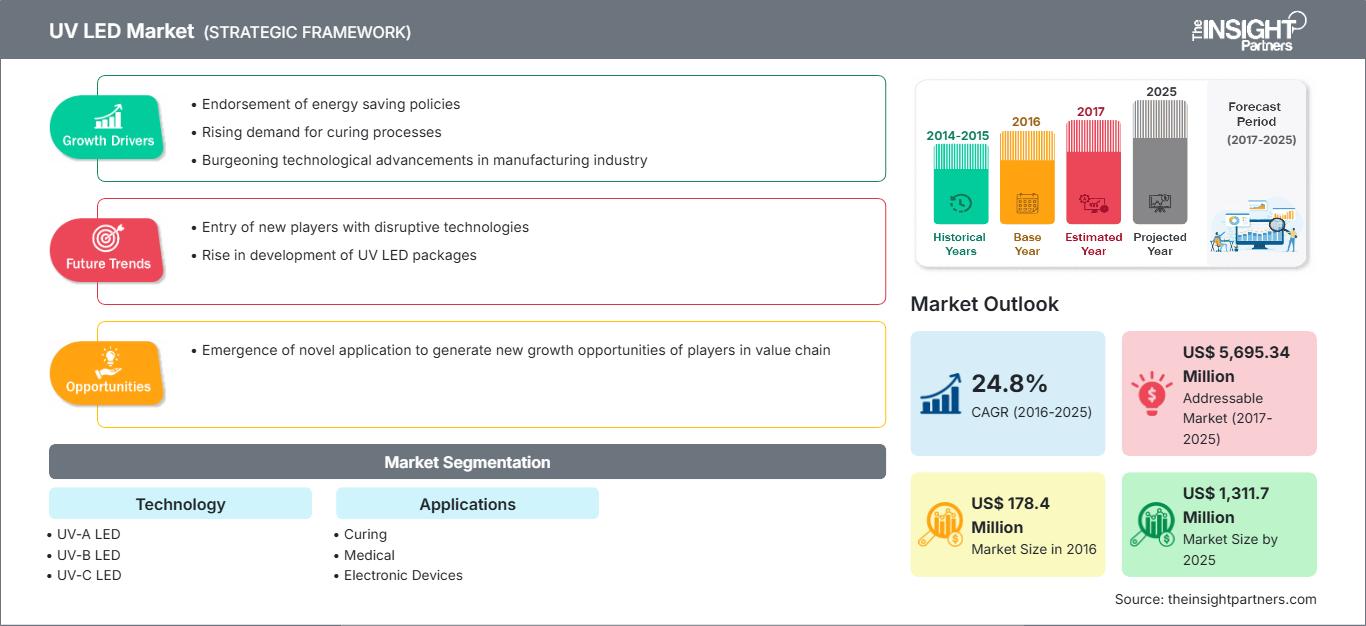
The UV LED market is expanding from US$ 1.17 Billion in 2025 to US$ 4.65 Billion by 2034, registering a CAGR of 25.86% during 2026–2034. Adoption is being shaped by advances in ultraviolet semiconductor efficiency, compact system design, mercury-free operation, and broader deployment across curing, medical, electronic devices, water treatment, and security applications. Increasing wavelength precision and improved thermal management are also widening the addressable application base.
North America is positioned for sustained expansion, with the UV LED market size expected to register a CAGR of approximately 23–27% during 2026–2034. Industrial automation, healthcare modernization, water-quality requirements, and replacement of conventional ultraviolet lamps are supporting investment. Demand is particularly supported by electronics manufacturing, advanced curing systems, and decentralized disinfection equipment requiring compact, controllable ultraviolet sources.
UV LED Market Assessment and Insights
- North America: The region represented approximately 28–32% of the uv led market in 2025 and is projected to grow at a CAGR of 23–27% during 2026–2034, supported by healthcare, electronics, water treatment, and industrial curing adoption.
- US: The US accounted for approximately 67–71% of North America's market in 2025 and is expected to expand at a CAGR of 23–27% during 2026–2034, led by industrial and medical applications.
- Europe: Europe held approximately 22–26% share in 2025 and is projected to grow at a CAGR of 22–26% during 2026–2034. Germany, the UK, France, Italy, and Spain are important demand centers because of advanced manufacturing and environmental requirements.
- Asia Pacific: Asia Pacific represented approximately 37–41% share in 2025 and is expected to expand at a CAGR of 27–31% during 2026–2034. China, Japan, South Korea, and India lead regional manufacturing, electronics, and water-treatment deployment.
- Largest Segment: UV-C LED represented approximately 48–52% market share in 2025 and is projected to grow at a CAGR of 27–31% during 2026–2034, reflecting strong disinfection demand.
- High Growth Segment: Water Treatment represented approximately 16–20% market share in 2025 and is expected to grow at a CAGR of 29–33% during 2026–2034, driven by mercury-free treatment systems.
- Key companies analyzed in detail: Koninklijke Philips N.V., LG Electronics, Inc., Crystal IS, Inc., Nichia Corporation, Phoseon Technology, SemiLEDs Corporation, Seoul Viosys Co., Ltd., Sensor Electronic Technology, Inc., Halma plc, Heraeus Holding GmbH, Nordson Corporation, and Lumileds Holding B.V.
Source: The Insight Partners' analysis based on proprietary research, government publications, company annual reports, investor presentations, industry databases, and expert interviews.
The UV LED market has evolved from niche ultraviolet illumination toward engineered semiconductor light sources capable of precise wavelength control and rapid switching. Improvements in AlGaN-based UV-C emitters, packaging, optical extraction, and thermal pathways have raised usable irradiance while reducing system constraints. Production economics increasingly depend on wafer quality, epitaxial consistency, packaging yield, thermal design, and application-specific optical integration.
Looking ahead, geographic expansion will increasingly follow electronics manufacturing, decentralized water treatment, healthcare infrastructure, and industrial automation. Regulatory pressure to reduce mercury exposure provides an additional transition pathway, while investment in high-efficiency deep-UV devices can improve total operating economics. The commercial outlook therefore, depends not only on LED output but also on system-level efficiency, reliability, lifetime, and compliance with application-specific safety requirements, according to the UV LED Market report.
UV LED Market Report Scope
| Report Attribute | Details |
|---|---|
| Market size in 2025 | US$ 1.17 Billion |
| Market Size by 2034 | US$ 4.65 Billion |
| Global CAGR (2026 - 2034) | 25.86% |
| Historical Data | 2021-2024 |
| Forecast period | 2026-2034 |
UV LED Market Analysis
The market demand is driven by the needs of manufacturers who require small form factor ultraviolet sources that can be controlled instantaneously for curing, testing, sterilization, and specialized processing. The industry involves epitaxial growth on semiconductors, silicon wafer manufacturing and packaging, optoelectronics, control circuits, thermal management, systems integration, and equipment maintenance. UV-A is still vital for curing and sensing applications, whereas UV-C becomes more involved in water and air purification systems. Supply considerations are dependent on semiconductor efficiency, substrate availability, packaging challenges, and thermal performance.
Within the UV LED Market, competitive differentiation increasingly rests on wavelength stability, radiant power, wall-plug efficiency, thermal resistance, and package reliability rather than LED availability alone. Nichia Corporation has advanced deep-UV efficiency, while Seoul Viosys combines UV-C technology with integrated disinfection solutions. Crystal IS, Inc., Sensor Electronic Technology, Inc., and SemiLEDs Corporation strengthen specialist semiconductor capabilities, while Phoseon Technology and Nordson Corporation support industrial curing ecosystems, according to the UV LED Market forecast.
The process of strategic positioning is further impacted by vertical integration and application partnerships. Koninklijke Philips N.V., LG Electronics, Inc., and Lumileds Holding B.V. offer enhanced semiconducting and lighting abilities, while Halma plc and Heraeus Holding GmbH provide application engineering and technology exposure. Funding is being channeled towards high-output UV-C packages, cooling advances, optics improvement, and systems integration. The companies with the ability to prove reduced energy consumption, increased lifespan, and reliable dosing will be able to take advantage of the higher value-added applications.
● REPORT CUSTOMIZATION
Tailor This Report To Align With Your Specific Business Requirements
This report can be customized to align precisely with your business objectives, scope, and target markets. Customization options include tailored segmentation, geography, competitive analysis, and strategic insights to support informed decision-making.
Customize This Report →WHAT YOU CAN ADJUST
- ● Segmentations
- ● Geography
- ● Competitive Analysis
- ● Language Preferences
UV LED Market: Strategic Insights
Regional Insights
North America uv led market
North America accounted for approximately 28–32% of the uv led market in 2025 and is forecast to expand at a CAGR of 23–27% through 2034. The United States continues to be the key region for demand, with electronic products manufacturing, medical equipment manufacturing, industrial curing processes, laboratory systems, and decentralized water treatment being some of the key applications. Another structural catalyst for the market is the replacement of existing ultraviolet lamps.
The increasing focus of buyers from the region on factors such as operating costs, controllability, maintenance needs, and environmental aspects is another trend being seen in the region. Increasing investments in manufacturing and water infrastructure are driving the adoption of miniaturized UV-C systems, and the adoption of UV-A curing systems is being driven by automation in manufacturing operations.
U.S. uv led Market
The U.S. represented approximately 67–71% of North America's UV LED market share in 2025 and is projected to grow at a CAGR of 23–27% through 2034. Demand is largely confined to applications in curing, healthcare, electronics, security, and water treatment. Examples of such companies that form part of the domestic industry are Nordson Corporation, Phoseon Technology, and Lumileds Holding B.V.
Current developments in terms of applications are geared towards the development of digitally controlled systems that deliver precise wavelengths in addition to the capability to rapidly modulate them. Repeatability in curing and inspection is a requirement in electronics and semiconductors, while mercury-free ultraviolet architectures are being evaluated in municipal and commercial water applications. Phototherapy, fluorescence, authentication, and sensing are also among the medical and security applications creating more demand for this segment.
Europe uv led Market
Europe held approximately 22–26% of the UV LED market in 2025 and is expected to grow at a CAGR of 22–26% through 2034. Germany takes the lead with the United Kingdom, France, Italy, and Spain providing through industrial manufacturing, healthcare, electronics, water treatment, and specialized lighting applications.
The UK sustains demand via healthcare technology, research, industrial automation, and security applications. Germany has an edge in the industrial equipment sector, with UV curing, electronics manufacturing, printing, and process engineering. France merges aerospace, healthcare, food processing, and water-treatment applications. Italy and Spain provide through manufacturing, packaging, food processing, hospitality, and distributed water-treatment systems. The European focus on environmental protection and reduction of mercury content in lamps makes for a move towards semiconductor ultraviolet light sources.
APAC uv led Market
Asia Pacific represented approximately 37–41% of the uv led market in 2025 and is projected to grow at a CAGR of 27–31% through 2034. China leads regional demand, followed by Japan, South Korea, India, and Australia. Electronics manufacturing, semiconductor production, water treatment, and industrial curing remain central applications.
"China is combining large-scale manufacturing with expanded water and sanitation infrastructure. Japanese manufacturers emphasize highly efficient parts and precise equipment, whereas Korean manufacturers are benefiting from semiconductor and display manufacturing capabilities. In addition to water treatment and health care applications, there is growing promise in India in terms of electronics and industrial processing and for Australian markets in specialized water and environmental applications."
Middle East & Africa uv led Market
The Middle East & Africa is expected to expand at a CAGR of approximately 20–24% during 2026–2034, supported by water scarcity, desalination, infrastructure modernization, and industrial development. Saudi Arabia and the UAE represent leading regional markets, while South Africa provides a major African demand center, reflecting key UV LED Market trends.
Water treatment is still a key area where the technology of ultraviolet radiation can be combined with water filtration and chemical purification. For Saudi Arabia, infrastructure development is related to both commercial and municipal water treatment. In the UAE, desalination, hospitality, healthcare, and advanced infrastructure all provide the chance for the use of this equipment. Water security, food processing, and sanitation in industry will attract investments from South Africa.
Segmentation Analysis
Technology
The technology segment is structured around UV-A LED, UV-B LED, and UV-C LED architectures serving distinct wavelength requirements. UV-C is the largest technology category, while continued improvements in semiconductor efficiency, thermal management, and packaging are widening applications across disinfection and industrial systems. The segment is projected to grow at a CAGR of 27–31% during 2026–2034.
- UV-A LED: UV-A LEDs remain strategically important for curing, fluorescence, inspection, authentication, and specialty illumination. Their comparatively mature commercial ecosystem supports integration into automated industrial equipment where precise exposure and rapid switching are operational priorities.
- UV-B LED: UV-B LEDs address specialized medical, phototherapy, dermatological, and scientific applications requiring controlled wavelength delivery. Their importance is linked to precise dosing, compact equipment design, and the development of specialized healthcare and research instruments.
- UV-C LED: UV-C LEDs command the largest technology position because germicidal wavelengths support water treatment, air treatment, surface disinfection, and food-related sanitation. Improvements in efficiency and output are expanding their practicality in higher-throughput equipment.
Applications
Applications include Curing, Medical, Electronic Devices, Water Treatment, and Security, with the segment expected to grow at a CAGR of 25–29% during 2026–2034. Demand increasingly reflects application-specific performance requirements, system integration, and replacement of conventional ultraviolet sources.
- Curing: UV LED curing supports adhesives, coatings, inks, and industrial processes requiring instant activation, localized exposure, lower thermal impact, and digitally controlled energy delivery. Its strategic value is strongest where production speed and process repeatability influence manufacturing economics.
- Medical: Medical applications use ultraviolet wavelengths in phototherapy, diagnostics, equipment-related processes, and specialized treatment systems. Demand depends heavily on precise wavelength control, safety engineering, clinical validation, and compact equipment requirements.
- Electronic Devices: Electronics applications use UV LEDs for curing, inspection, bonding, and process control. Semiconductor and electronics manufacturers value rapid switching, localized irradiation, repeatability, and reduced thermal exposure during increasingly automated production.
- Water Treatment: Water treatment is becoming a major application for mercury-free UV-C systems, particularly where compact equipment, rapid response, and chemical-free disinfection are valued. System-level dosage control and flow management remain critical procurement considerations.
- Security: Security applications include counterfeit detection, authentication, fluorescence inspection, and specialized sensing. UV LEDs provide compact, controllable illumination that can be integrated into scanners, verification equipment, and portable inspection systems.
Opportunity Snapshot
| Segment Name | Revenue Contribution (High/Medium/Low) | Trend Tag (MAX 2 words) | Adoption Stage (Emerging/Scaling/Mature) |
| Curing | High | Precision Curing | Mature |
| Medical | Medium | Clinical Phototherapy | Scaling |
| Electronic Devices | High | Process Inspection | Scaling |
| Water Treatment | High | Mercury-Free Disinfection | Scaling |
| Security | Medium | Authentication Lighting | Mature |
UV LED Market Growth Drivers and Impact Analysis
Mercury-free transition across ultraviolet equipment
Issues concerning environmental impact and efficiency of operation are making people look for alternative sources of ultraviolet radiation that don’t use hazardous mercury lamps. UV LEDs don’t use mercury, have a compact design, can be switched instantly, and their output can be controlled electronically. The use of such lamps can make maintenance easier and make it possible for designers to produce small treatment and curing systems. In 2026, Nichia discovered that switching from mercury lamps to LEDs for its manufacturing reduced CO2 emissions from each lamp by 35%. The success of this technology will depend on reaching sufficient irradiance, lifetime, and thermally efficient performance in a cost-efficient manner.
Higher-efficiency deep-UV semiconductor development
Increases in efficiency for deep-UV semiconductors are helping increase the commercial viability of the applications that use UV-C radiation. Nichia recorded an efficiency of 7.4% for its 280 nm NCSU434D product in 2025, compared to 3.1% in 2021, to demonstrate how rapidly efficiency is improving at the device level. Increased efficiency will help cut the amount of electricity needed for the same amount of ultraviolet radiation output, as well as lessen thermal management issues. Improved heat dissipation will give engineers designing systems the chance to increase the output energy without necessarily increasing the package size. Improvements in efficiency will have implications not just in disinfection, but also in other UV LED applications like curing and sensing.
Expansion of decentralized water-treatment architectures
Water purification is one area where UV-C LEDs have significant opportunities due to the fact that semiconductor-based lamps have a smaller size, fast control ability, and can be embedded into decentralized devices. Possible applications of these LEDs include point-of-use solutions, commercial water treatment, and industrial process water. Improvements in both optical performance and thermal management enhance throughput capabilities. The same trend was proven in 2025 by Nichia and MIURA when they increased throughput from 10 cubic meters per hour to about 25 cubic meters per hour due to an innovative UV-C LED lamp structure. Such innovations can make a case for mercury-free water treatment when size, maintenance, and chemical-free disinfection become critical factors.
UV LED Market Future Trends
Integrated wavelength-selective ultraviolet platforms
In the future, the combination of several different ultraviolet wavelengths on programmable platforms is expected, rather than the use of individual emitters. Sources of UV-A, UV-B, and UV-C can be programmed according to application needs, thus allowing the same platform to serve curing, inspecting, sensing, and treatment applications. Driver technology, optics, thermal sensing, and control electronics will allow the tuning of the wavelength to be more precise. Sensors will allow closed-loop operations based on irradiance, temperature, flow, and exposure time. This would potentially transform the purchasing process from buying LEDs into purchasing complete modules, proven by application results. The manufacturers who combine the efficiency of semiconductors with optics and electronics may have more control over their systems.
High-output UV-C systems with advanced thermal architectures
Future developments in the field of UV-C technology will focus on both high-output density and high heat dissipation at the same time. High-power operation can contribute to increased treatment capacity, but heat generation can lower the effectiveness and lifespan of the product if the packaging is not good enough. For that reason, ceramic packages, advanced heat dissipation, optimized optical design, and high-current components are now under development by the manufacturers. The technology presented by Nichia in 2025 was a perfect example of how advancements in packaging can allow both increasing output density and efficient heat dissipation. It can be assumed that the further development of such technology will make larger treatment systems more realistic without making larger light sources.
UV LED Market Opportunities
Application-specific module platforms
A significant commercial opportunity lies in developing application-specific UV LED modules rather than selling components independently. Water treatment, curing, medical equipment, electronics, and security systems require different combinations of wavelength, optical distribution, thermal control, drivers, and monitoring. Integrated modules can shorten equipment-development cycles and provide predictable performance for system manufacturers. Suppliers can strengthen customer retention by offering validated optical designs, thermal solutions, control electronics, and replacement programs alongside emitters. This model is particularly relevant for smaller equipment manufacturers that lack internal ultraviolet engineering expertise. As semiconductor performance improves, module suppliers can capture additional value by tailoring packages to flow rates, curing widths, exposure distances, and clinical or industrial operating requirements.
Mercury-lamp replacement programs in industrial facilities
Industrial facilities with existing mercury ultraviolet equipment provide a practical conversion opportunity because replacement decisions can be linked to maintenance cycles, energy objectives, and environmental programs. Suppliers can assess installed lamp configurations and propose LED modules designed around equivalent or improved exposure characteristics. The strongest opportunity is likely to emerge where systems operate frequently and benefit from instant switching, localized irradiation, or reduced maintenance. Demonstrated reductions in emissions and improved operating control can strengthen investment cases. Service providers can further differentiate through retrofit engineering, installation, validation, and performance monitoring. Such programs can accelerate adoption without requiring customers to redesign complete production lines, making installed-base conversion an important route for expanding ultraviolet semiconductor penetration.
Frequently Asked Questions

- Comprehensive Market Sizing and Forecast Analysis
- Detailed Segmentation Analysis
- In-Depth Market Dynamics Assessment
- Regional and Country-Level Insights
- Competitive Landscape and Company Benchmarking
- Strategic Business Intelligence
Recent Reports
Testimonials

The Insight Partners provided valuable market intelligence that supported our global go-to-market strategy. Their team was professional, responsive, and attentive to our feedback, providing thoughtful analysis and helpful methodological clarifications throughout the project.
Junmo Kim Chief Financial Officer (CFO), Enertech Co., Ltd.
The Insight Partners' SCADA System Market report is comprehensive, with valuable insights on current trends and future forecasts. The team was highly professional, responsive, and supportive throughout. We are very satisfied and highly recommend their services.
RAN KEDEM Partner, Reali Technologies LTDs
I requested a report on a very specific software market and the team produced the report in a few days. The information was very relevant and well presented. I then requested some changes and additions to the report. The team was again very responsive and I got the final report in less than a week.
JEAN-HERVE JENN Chairman, Future Analytica
We worked with The Insight Partners for an important market study and forecast. They gave us clear insights into opportunities and risks, which helped shape our plans. Their research was easy to use and based on solid data. It helped us make smart, confident decisions. We highly recommend them.
PIYUSH NAGPAL Sr. Vice President, High Beam Global
The Insight Partners delivered insightful, well-structured market research with strong domain expertise. Their team was professional and responsive throughout. The user-friendly website made accessing industry reports seamless. We highly recommend them for reliable, high-quality research services
YUKIHIKO ADACHI CEO, Deep Blue, LLC.
This is the first time I have purchased a market report from The Insight Partners.While I was unsure at first, I visited their web site and felt more comfortable to take the risk and purchase a market report.I am completely satisfied with the quality of the report and customer service. I had several questions and comments with the initial report, but after a couple of dialogs over email with their analyst I believe I have a report that I can use as input to our strategic planning process.Thank you so much for taking the extra time and making this a positive experience.I will definitely recommend your service to others and you will be my first call when we need further market data.
JOHN SUZUKI President and Chief Executive Officer, Board Director, BK Technologies
I wish to appreciate your support and the professionalism you displayed in the course of attending to my request for information regarding to infectious disease IVD market in Nigeria. I appreciate your patience, your guidance, and the fact that you were willing to offer a discount, which eventually made it possible for us to close a deal. I look forward to engaging The Insight Partners in the future, all thanks to the impression you have created in me as a result of this first encounter.
DR CHIJIOKE ONYIA MANAGING DIRECTOR, PineCrest Healthcare Ltd.Reason to Buy
- Informed Decision-Making
- Understanding Market Dynamics
- Competitive Analysis
- Identifying Emerging Markets
- Customer Insights
- Market Forecasts
- Risk Mitigation
- Boosting Operational Efficiency
- Strategic Planning
- Investment Justification
- Tracking Industry Innovations
- Aligning with Regulatory Trends






 Get Free Sample for