
Vibration Monitoring Market Trends, Demand & Growth by 2034
Coverage: by Component (Hardware, Software); System Type (Vibration Analyzer, Embedded Systems); Deployment (On-premise, Cloud); End User (Automotive, Chemicals) , and Geography (North America, Europe, Asia Pacific, and South and Central America)
- Status : Data Released
- Report Code : TIPRE00010133
- Category : Electronics and Semiconductor
- No. of Pages : 150
- Available Report Formats :


- Last update date : September 21, 2026


2025 Market Size
US$ 1,868.92 Mn
Base year value
2034 Forecast
US$ 3,334.4 Mn
Projected by 2034
CAGR 2026-2034
6.64 %
Growth rate
Addressable Market
US$ 23,517.99 Mn
(2026-2034)
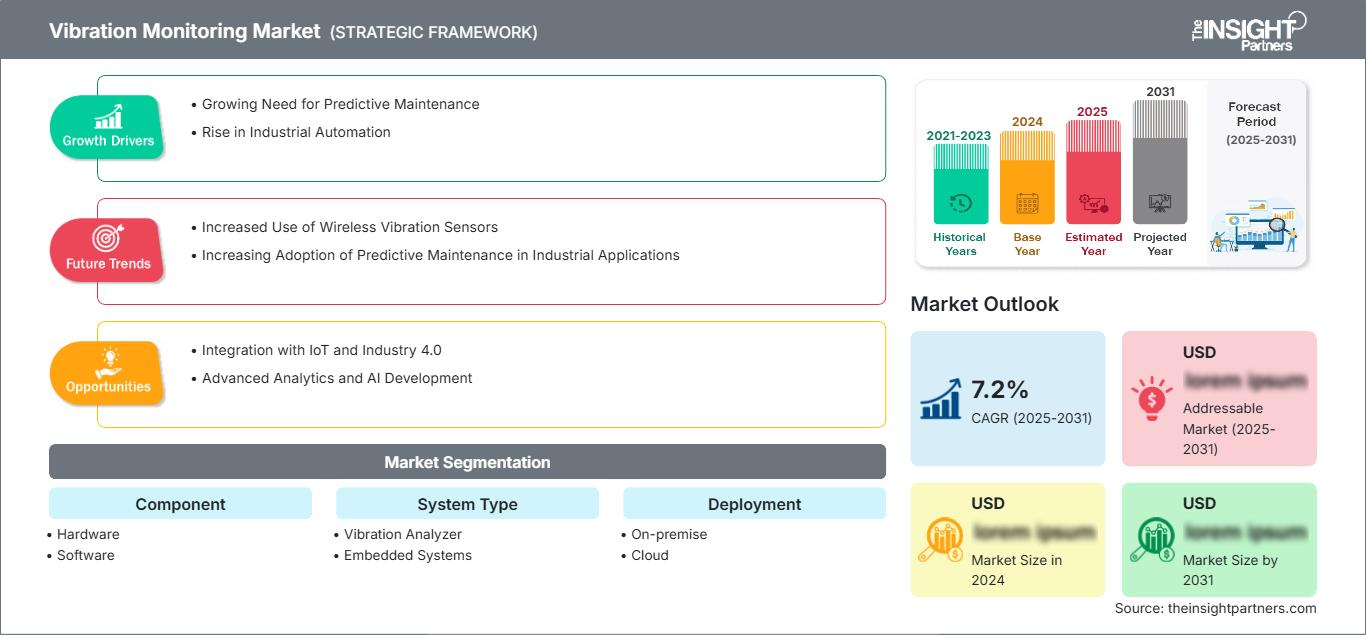
The Vibration monitoring market is valued at US$ 1,868.92 Million in 2025 and is projected to reach US$ 3,334.4 Million by 2034, expanding at a CAGR of 6.64% during 2026–2034. The market reflects increasing adoption of condition-based maintenance across rotating equipment, where continuous measurement of vibration characteristics supports earlier fault detection, maintenance scheduling, and asset performance optimization across industrial operations.
North America is expected to expand at an estimated 6.8–7.4% CAGR through 2034, supported by mature predictive-maintenance programs, industrial automation investments, and broad deployment of connected sensors. The vibration monitoring market size is further supported by manufacturers upgrading legacy maintenance architectures with wireless sensing, edge analytics, and software-enabled condition monitoring for motors, pumps, compressors, fans, and gearboxes.
Vibration Monitoring Market Assessment and Insights
- North America: The region is expected to represent 34–38% share in 2025 and grow at a CAGR of 6.8–7.4% between 2026–2034, supported by advanced manufacturing, installed industrial assets, and predictive maintenance adoption.
- US: The US accounts for 70–74% of North America's 2025 market and is projected to grow at a CAGR of 7.0–7.5%, supported by industrial automation and asset reliability programs.
- Europe: Europe is estimated at 27–31% share in 2025 and is projected to grow at 6.0–6.5% CAGR through 2034, led by Germany, the UK, France, Italy, and Spain, where industrial efficiency and machinery reliability remain priorities.
- Asia Pacific: Asia Pacific represents 25–29% share in 2025 and is expected to expand at 7.2–7.8% CAGR, with China, Japan, South Korea, and India benefiting from factory automation, electronics manufacturing, and infrastructure investment.
Largest Segment: Hardware is estimated to hold 58–62% market share in 2025, growing at a 6.0–6.4% CAGR, reflecting the continuing requirement for sensors, analyzers, gateways, and acquisition equipment.
- High Growth Segment: Cloud deployment is estimated at 24–28% market share in 2025 and is projected to grow at a 9.8–10.6% CAGR as centralized analytics and remote asset visibility gain traction.
- Key companies analyzed in detail: Banner Engineering Corp., ERBESSD INSTRUMENTS, Fluke Corporation, HBM, ifm electronic gmbh, Omni Instruments, SAP SE, STI Vibration Monitoring Inc., VibraVista, and Vibro-Acoustic srl.
Source: The Insight Partners' analysis based on proprietary research, government publications, company annual reports, investor presentations, industry databases, and expert interviews.
The market has advanced from sporadic measurement to continuous sensing systems using accelerometers, wireless technology, edge computing, and analytics. There is an increasing reliance on hardware that can monitor multiple vibration characteristics and software that translates measurement data into useful condition indicators. Production sites are also incorporating vibration data with temperature, current, operating speed, and process variables to perform contextual fault analysis without relying on discrete inspection.
Future-oriented innovation is now focusing on connected assets, low-power sensors, and analytics. New industrial markets are developing their manufacturing capabilities, while existing markets are upgrading their installed base of machinery. The need for operational safety, energy efficiency, and machinery reliability is contributing to condition monitoring investment. The vibration monitoring market share is therefore expected to become more distributed across connected hardware, analytical software, and service-enabled monitoring architectures.
Vibration Monitoring Market Report Scope
| Report Attribute | Details |
|---|---|
| Market size in 2025 | US$ 1,868.92 Million |
| Market Size by 2034 | US$ 3,334.4 Million |
| Global CAGR (2026 - 2034) | 6.64% |
| Historical Data | 2021-2024 |
| Forecast period | 2026-2034 |
Vibration Monitoring Market Analysis
Demand is primarily generated by the need to identify mechanical deterioration before it produces production interruptions or secondary equipment damage. Motors, pumps, compressors, fans, gearboxes, and rotating assemblies are particularly suited to vibration-based assessment because imbalance, misalignment, looseness, and bearing deterioration can produce measurable changes in vibration signatures. The vibration monitoring market growth, therefore, follows industrial asset intensity and the increasing economic value assigned to uptime.
The industry comprises hardware vendors, instrumentation vendors, software vendors, automation vendors, system integration vendors, maintenance personnel, and OEM equipment for the industrial sector. The role of hardware is critical as the quality of signal capture determines the quality of diagnostics, while that of software becomes more important due to the role played by automated baseline, alarms, visualizations, and trending capabilities. Supply trends are also moving towards wireless sensing and smaller sensors.
Competition is characterized by a combination of established instrumentation companies, automation specialists, industrial software providers, and focused condition-monitoring vendors, according to the Vibration Monitoring Market report. Banner Engineering Corp. emphasizes wireless sensing and predictive maintenance, while Fluke Corporation combines portable diagnostic capabilities with broader reliability workflows. Ifm electronic gmbh integrates condition monitoring into industrial automation, whereas SAP SE approaches the market from enterprise asset and maintenance management.
Positioning in a strategic manner relies more and more on the attributes of interoperability, analytics, ease of installation, and lifecycle costing rather than on just the sensor itself. ERBESSD INSTRUMENTS, HBM, Omni Instruments, STI Vibration Monitoring Inc., VibraVista, and Vibro-Acoustic srl meet the needs for specific measurements and monitoring purposes. Large-scale automation systems compete on the basis of the scope of integration. Funding will therefore go towards scalable sensor networks and intelligent cloud-based applications.
● REPORT CUSTOMIZATION
Tailor This Report To Align With Your Specific Business Requirements
This report can be customized to align precisely with your business objectives, scope, and target markets. Customization options include tailored segmentation, geography, competitive analysis, and strategic insights to support informed decision-making.
Customize This Report →WHAT YOU CAN ADJUST
- ● Segmentations
- ● Geography
- ● Competitive Analysis
- ● Language Preferences
Vibration Monitoring Market: Strategic Insights
Regional Insights
North America Vibration Monitoring Market
North America is estimated to command 34–38% of the global Vibration Monitoring market revenue in 2025 and is expected to expand at a 6.8–7.4% CAGR through 2034. Reliability engineering principles, large installations of rotating equipment, and widespread industrial automation contribute to the strength of the market in the region. In the US, there is an increasing trend for manufacturers, power generation firms, chemical companies, and processing industries to integrate condition monitoring information into computer-based maintenance systems. Wireless sensors will be especially useful where installation costs or equipment access make conventional systems less feasible.
Canada's contribution comes from its mining, energy, pulp and paper, and process manufacturing sectors, where the reliability of equipment has an impact on the economics of production. There is an increasing trend in the industry to use vibration in combination with temperature and other operational parameters to differentiate faults. The development of the North American market is helped not only by the implementation of new automation projects but also by upgrading existing facilities.
U.S. Vibration Monitoring Market
The US represents approximately 70–74% of North America's 2025 Vibration Monitoring market and is projected to grow at a 7.0–7.5% CAGR through 2034. Modernization of manufacturing, aerospace production, chemicals, automotive plants, and energy requires repeated need for asset diagnostics. More organizations now look for monitoring tools that not only allow scalability over several sites but also integrate with their automation and maintenance solutions.
Monitoring can include everything from motors and pumps to compressors, conveyors, fans, and production machines. The two vendors with noticeable presence in the space of condition monitoring are Fluke Corporation and Banner Engineering Corp., whereas industrial hardware manufacturers provide integration options within plant control architecture. Labor availability issues contribute to the adoption of automated data collection and remote diagnostics tools. Large-scale plants prefer monitoring, alarms, and processes over measuring capabilities.
Europe Vibration Monitoring Market
Europe is estimated to account for 27–31% share of the Vibration Monitoring market in 2025 and is projected to expand at a 6.0–6.5% CAGR. Germany leads regional demand, supported by machinery manufacturing and automotive production, while the UK, France, Italy, and Spain contribute through process industries, transportation, energy, and industrial automation. Efficiency requirements and aging industrial assets encourage condition-based maintenance investments.
The UK market is based on aerospace, utility, manufacturing, and offshore energy industries. Continuous monitoring is widely used in order to determine the degradation of rotating equipment and decrease the importance of inspections. Germany is still the leading European market due to the necessity of accurate condition monitoring of machines for highly automated manufacturing facilities. Other demand comes from France, Italy, and Spain, where different industries such as chemical, food processing, energy, transport, and general manufacturing can be found.
APAC Vibration Monitoring Market
APAC is estimated to hold 25–29% share of the Vibration Monitoring market in 2025 and is expected to grow at a 7.2–7.8% CAGR. The region is led by China, owing to manufacturing scale, automation, and equipment modernization. Japan and South Korea have high demand owing to precision manufacturing and electronics, while India and Australia bring in demand from manufacturing, mining, energy, and infrastructure applications.
Digitization of industry and manufacturing investment policies will drive the adoption in the region. China continues to be the market leader in the region, while India offers more potential owing to the modernization of maintenance practices in the region’s factories. Japan and South Korea focus on precision and reliability, while Australia has stringent demands in mining and resource processing applications. The opportunity in the region lies in affordable sensor connectivity and scalable monitoring systems.
Middle East & Africa Vibration Monitoring Market
The Middle East and Africa Vibration Monitoring market is estimated to represent 7–9% of global demand and is expected to grow at a 5.5–6.2% CAGR. Saudi Arabia is at the forefront of adoption, fueled by energy infrastructure, petrochemicals, and industrial diversification. The UAE is contributing via utilities, manufacturing, transport, and heavy infrastructure investment, while South Africa helps via mining and process industry applications.
The regional market continues to be very much tied to oil and gas, power generation, water infrastructure, mining, and industrial projects. The industrial growth in Saudi Arabia drives the need for monitoring systems for pumps, compressors, motors, and other rotating equipment. Smart investments in infrastructure in the UAE further open up opportunities for monitoring systems. Other MEA countries are more application-oriented, with reliability economics driving investments.

Segmentation Analysis
Component
The component segment is expected to grow at a 6.6–7.1% CAGR during 2026–2034, according to the Vibration Monitoring market forecast. Hardware remains fundamental because sensors, acquisition units, analyzers, and communication equipment provide the measurement layer required by monitoring systems. Software is gaining strategic importance as users seek automated diagnostics, asset histories, dashboards, and integration with maintenance platforms. The combination of physical sensing and analytical capability is increasingly shaping procurement decisions.
- Hardware: Hardware remains the core deployment layer because sensors and acquisition devices directly determine measurement availability, signal quality, installation coverage, and compatibility with industrial equipment.
- Software: Software adoption is increasing as maintenance teams require automated interpretation, trending, alarm management, visualization, and integration with enterprise asset-management workflows.
System Type
The system type segment is projected to expand at a 6.4–6.9% CAGR from 2026 to 2034, reflecting key Vibration Monitoring market trends. Vibration analyzers remain important for detailed diagnostics and troubleshooting, while embedded systems support continuous monitoring directly within equipment or connected control architectures. The shift toward permanent sensing is expanding the addressable base beyond specialist inspection teams, particularly where machines operate continuously or are difficult to access.
- Vibration Analyzer: Vibration analyzers remain strategically important for commissioning, root-cause investigations, maintenance validation, and detailed spectral diagnosis across complex rotating equipment.
- Embedded Systems: Embedded systems support continuous machine-health assessment and enable OEMs and industrial users to integrate vibration intelligence directly into equipment, controllers, and connected maintenance architectures.
Deployment
The deployment segment is expected to register a 6.8–7.4% CAGR during 2026–2034, reflecting key Vibration Monitoring market trends. On-premise systems remain relevant where data governance, low-latency processing, or legacy control architectures influence procurement. Cloud platforms are gaining momentum because they support centralized dashboards, remote access, fleet-level comparisons, and software updates. Hybrid architectures are also emerging where operational data must remain locally controlled while selected analytics are shared centrally.
- On-premise: On-premise systems remain preferred in sensitive industrial environments requiring local processing, established control-system integration, predictable data access, or strict operational governance.
- Cloud: Cloud deployment is increasingly selected for remote monitoring, multi-site asset management, centralized analytics, and scalable data storage across geographically distributed industrial operations.
End User
The end-user segment is forecast to grow at a 6.5–7.0% CAGR through 2034, reflecting growth in the Vibration Monitoring market. Automotive facilities require reliable monitoring across highly automated production lines, while chemical plants prioritize continuous operation and equipment integrity. These sectors increasingly connect vibration information with broader maintenance workflows, enabling maintenance teams to prioritize assets according to severity, operating context, and production consequences rather than relying solely on fixed inspection intervals.
- Automotive: Automotive manufacturers use vibration monitoring across motors, conveyors, pumps, robotic equipment, machining systems, and other production assets where unplanned stoppages can disrupt tightly synchronized operations.
- Chemicals: Chemical producers prioritize monitoring for rotating process equipment because equipment degradation can affect throughput, safety, maintenance planning, and continuity of critical production processes.
Opportunity Snapshot
| End User | Revenue Contribution | Trend Tag | Adoption Stage |
| Automotive | High | Smart Factories | Scaling |
| Chemicals | High | Process Reliability | Mature |
Vibration Monitoring Market Growth Drivers and Impact Analysis
Expansion of Predictive Maintenance Across Asset-Intensive Industries
Predictive maintenance will emerge as one of the most important strategies for maintaining high levels of reliability without increasing preventive efforts that prove unnecessary. Vibration can be used as an efficient condition indicator for rotational machinery since any variations will provide information about emerging malfunctions in the machine before actual failure occurs. The benefits of this approach are not limited only to the field of maintenance; increased equipment availability will allow the company to better schedule production, spare parts, staffing, and even energy needs. Constant measurement will allow the plant to create baselines for each machine individually, instead of using common standards. The increase in connected devices in the industry will enable the company to monitor not only the most critical machines but also the whole population of fans, pumps, and gearboxes.
Industrial Digitization Is Increasing the Value of Machine-Level Data
Digital transformation in industry is transforming the vibration measurement process from being an isolated piece of maintenance information into machine health data, which may be used in making decisions outside the maintenance domain. Connected sensors can send out information about the status of equipment to the control system, edge computing, or enterprise platforms, making it possible to evaluate how the equipment behaves over time in different production settings. It is valuable to correlate the vibration measurements with the operating speed, load, temperature, process environment, and maintenance history. This can help to minimize alarms generated due to changes in operating conditions and avoid unnecessary action based on them. The importance of this development is especially strong for manufacturing companies that operate from multiple sites since standardization of practices is possible using central visibility.
Wireless Sensing Is Lowering Barriers to Monitoring Wider Asset Populations
Wireless vibration sensors alleviate the installation challenge of conventional wired condition monitoring setups. The use of such sensors allows for installing them where wiring would be costly, complex, or disruptive to manufacturing processes, thus enabling monitoring even of secondary equipment that would otherwise undergo periodic inspections manually. Furthermore, wireless sensors with batteries enable flexible installation of monitoring units at geographically scattered equipment. From a commercial perspective, the result might be an increase in the number of monitored devices at each plant, but issues with battery life, reliability of connection, mounting, security of information, and data handling will still play an important role in purchase decisions. Wireless monitoring is particularly useful for pumps, fans, motors, conveyor belts, and remote equipment.
Vibration Monitoring Market Future Trends
Edge Intelligence Will Move More Diagnostic Processing Toward Sensors
Future systems will increasingly process vibration information closer to the asset rather than transmitting every raw waveform to centralized platforms. Edge intelligence can reduce communication requirements, improve response time, and allow devices to generate condition indicators locally. This architecture is particularly valuable for battery-powered sensors and geographically distributed machinery where bandwidth or power is constrained. Embedded models can identify recurring patterns, distinguish normal operating states, and trigger targeted data transmission when unusual behavior occurs. Over time, edge processing is likely to coexist with cloud analytics, with local devices handling immediate classification while centralized platforms manage fleet-level learning and historical comparison. This distributed approach can improve scalability while preserving access to detailed data when expert diagnosis is required.
Multimodal Monitoring Will Strengthen Contextual Fault Diagnosis
The next generation of monitoring architectures will increasingly combine vibration with temperature, electrical current, acoustic signals, speed, pressure, and process variables. Multimodal sensing can help distinguish between faults that produce similar vibration signatures but occur under different operating conditions. The resulting models can evaluate asset health using a broader physical context rather than a single measurement channel. This is particularly valuable in complex production environments where changes in load, speed, or process state can influence vibration independently of mechanical deterioration. Integration with maintenance history can further improve interpretation by linking condition changes with previous repairs and component replacements. As sensor costs decline and industrial communication becomes more standardized, multimodal monitoring is likely to become increasingly practical for high-value and continuously operating equipment.
Vibration Monitoring Market Opportunities
Scalable Monitoring for Mid-Tier and Distributed Industrial Assets
A significant opportunity exists in extending continuous condition monitoring beyond large critical assets to mid-tier equipment populations. Many facilities operate hundreds or thousands of motors, pumps, fans, and conveyors where traditional wired monitoring is economically selective. Compact wireless sensors, simplified installation, and automated analytics can reduce the cost per monitored asset and make broader deployment practical. Vendors can capture this opportunity by designing modular systems that begin with a small group of critical machines and expand as users demonstrate operational value. Subscription-based software, device-health services, and remote diagnostics can further lower adoption barriers. The strongest propositions will combine straightforward installation with reliable alarm interpretation, because maintenance teams need actionable information rather than large volumes of unfiltered vibration data.
Integrated Asset Reliability Platforms for Multi-Site Operations
Multi-site industrial organizations present another opportunity for platforms that combine vibration monitoring with broader asset-management workflows. Centralized systems can provide common dashboards, asset-health scores, maintenance prioritization, and standardized reporting across plants with different equipment configurations. Integration with enterprise maintenance systems can connect detected conditions with work orders, spare parts requirements, technician scheduling, and historical interventions. This creates an opportunity for technology providers to move beyond point solutions toward recurring software and service relationships. Industrial operators can also use cross-site data to identify recurring equipment problems, compare maintenance practices, and refine alarm strategies. Vendors capable of supporting diverse sensor protocols and existing automation environments will be better positioned to serve organizations seeking a unified reliability architecture without replacing every legacy monitoring component.
Frequently Asked Questions

- Comprehensive Market Sizing and Forecast Analysis
- Detailed Segmentation Analysis
- In-Depth Market Dynamics Assessment
- Regional and Country-Level Insights
- Competitive Landscape and Company Benchmarking
- Strategic Business Intelligence
Recent Reports
Testimonials

The Insight Partners provided valuable market intelligence that supported our global go-to-market strategy. Their team was professional, responsive, and attentive to our feedback, providing thoughtful analysis and helpful methodological clarifications throughout the project.
Junmo Kim Chief Financial Officer (CFO), Enertech Co., Ltd.
The Insight Partners' SCADA System Market report is comprehensive, with valuable insights on current trends and future forecasts. The team was highly professional, responsive, and supportive throughout. We are very satisfied and highly recommend their services.
RAN KEDEM Partner, Reali Technologies LTDs
I requested a report on a very specific software market and the team produced the report in a few days. The information was very relevant and well presented. I then requested some changes and additions to the report. The team was again very responsive and I got the final report in less than a week.
JEAN-HERVE JENN Chairman, Future Analytica
We worked with The Insight Partners for an important market study and forecast. They gave us clear insights into opportunities and risks, which helped shape our plans. Their research was easy to use and based on solid data. It helped us make smart, confident decisions. We highly recommend them.
PIYUSH NAGPAL Sr. Vice President, High Beam Global
The Insight Partners delivered insightful, well-structured market research with strong domain expertise. Their team was professional and responsive throughout. The user-friendly website made accessing industry reports seamless. We highly recommend them for reliable, high-quality research services
YUKIHIKO ADACHI CEO, Deep Blue, LLC.
This is the first time I have purchased a market report from The Insight Partners.While I was unsure at first, I visited their web site and felt more comfortable to take the risk and purchase a market report.I am completely satisfied with the quality of the report and customer service. I had several questions and comments with the initial report, but after a couple of dialogs over email with their analyst I believe I have a report that I can use as input to our strategic planning process.Thank you so much for taking the extra time and making this a positive experience.I will definitely recommend your service to others and you will be my first call when we need further market data.
JOHN SUZUKI President and Chief Executive Officer, Board Director, BK Technologies
I wish to appreciate your support and the professionalism you displayed in the course of attending to my request for information regarding to infectious disease IVD market in Nigeria. I appreciate your patience, your guidance, and the fact that you were willing to offer a discount, which eventually made it possible for us to close a deal. I look forward to engaging The Insight Partners in the future, all thanks to the impression you have created in me as a result of this first encounter.
DR CHIJIOKE ONYIA MANAGING DIRECTOR, PineCrest Healthcare Ltd.Reason to Buy
- Informed Decision-Making
- Understanding Market Dynamics
- Competitive Analysis
- Identifying Emerging Markets
- Customer Insights
- Market Forecasts
- Risk Mitigation
- Boosting Operational Efficiency
- Strategic Planning
- Investment Justification
- Tracking Industry Innovations
- Aligning with Regulatory Trends





 Get Free Sample for