
Refrigerated Display Cabinets Market Size, Share & Growth by 2034
Coverage: by Product (Frozen, Chilled); Type (Plug In Refrigerated Display, Semi Plug-in Refrigerated Display, Remote Refrigerated Display); Application (Beverages, Food, Medicine, Others); and Geography (North America, Europe, Asia Pacific, and South and Central America)
- Status : Data Released
- Report Code : TIPTE100000298
- Category : Electronics and Semiconductor
- No. of Pages : 150
- Available Report Formats :


- Last update date : September 16, 2026


2025 Market Size
US$ 13.71 Bn
Base year value
2034 Forecast
US$ 23.17 Bn
Projected by 2034
CAGR 2026-2034
6.00 %
Growth rate
Addressable Market
US$ 167.00 Bn
(2026-2034)
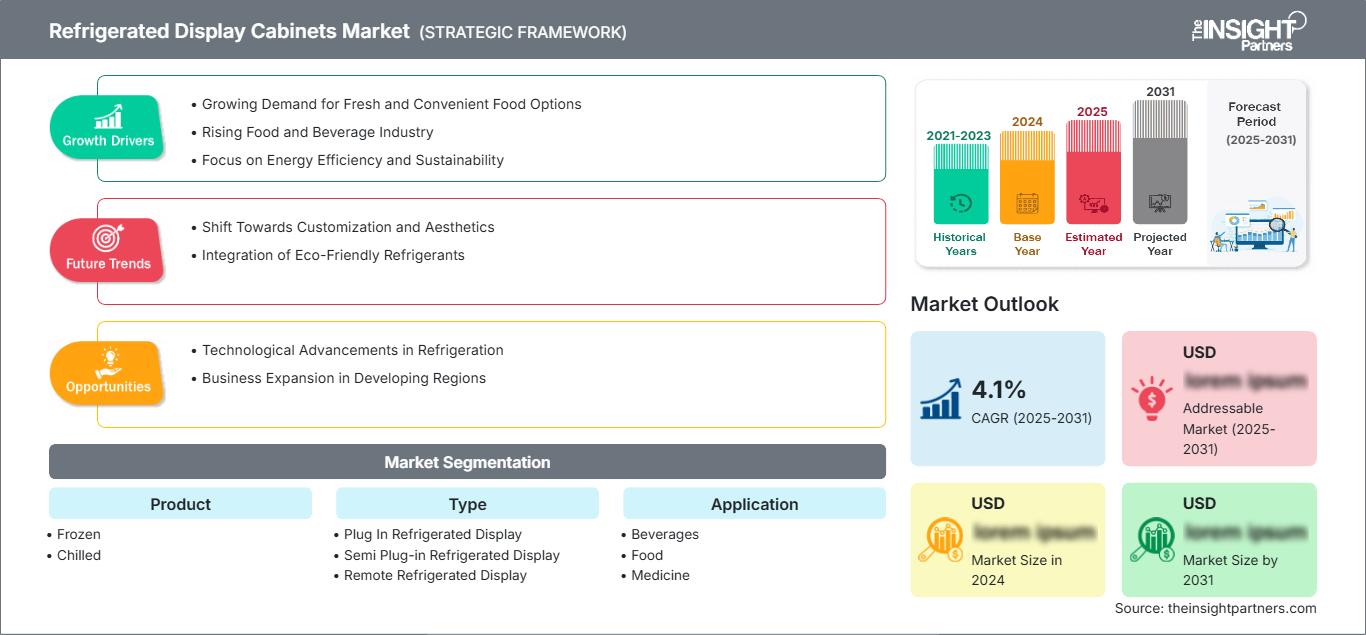
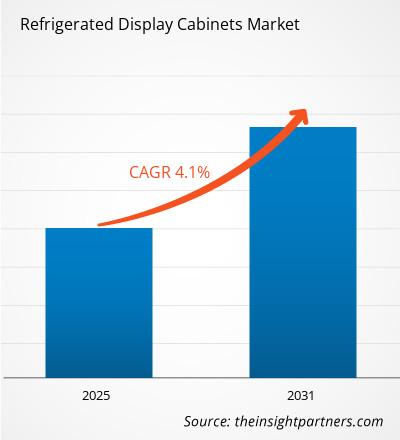
The refrigerated display cabinets market is expanding as food retail, convenience stores, foodservice operators, and pharmaceutical outlets invest in temperature-controlled merchandising. The market is valued at US$ 13.71 Billion in 2025 and is projected to reach US$ 23.17 Billion by 2034, registering a CAGR of 6.00% during 2026–2034. Product innovation increasingly combines energy efficiency, merchandising visibility, natural refrigerants, and digital monitoring with requirements for reliable temperature control.
North American demand is supported by supermarket modernization, convenience-store expansion, replacement of aging refrigeration assets, and tighter energy-efficiency requirements in the Refrigerated Display Cabinets Market Size. The regional market is estimated to expand at a 5.4–6.1% CAGR during 2026–2034, with growth strengthened by investments in low-GWP refrigeration, self-contained cases, glass-door systems, and integrated food-retail infrastructure.
Refrigerated Display Cabinets Market Assessment and Insights
- North America: North America represented a 29–33% share in 2025 and is expected to grow at a 5.4–6.1% CAGR between 2026–2034, supported by supermarket refurbishment, convenience retail expansion, energy-efficient replacements, and demand for natural-refrigerant systems.
- US: The US accounted for 84–88% of North American demand in 2025 and is projected to grow at a 5.3–6.0% CAGR between 2026–2034, led by food retail modernization and replacement cycles.
- Europe: Europe held a 35–40% share in 2025 and is forecast to expand at a 5.7–6.4% CAGR between 2026–2034, with Germany, the UK, France, Italy, and Spain benefiting from supermarket upgrades and refrigerant transition requirements.
- Asia Pacific: Asia Pacific captured a 20–24% share in 2025 and is projected to grow at a 7.0–8.0% CAGR between 2026–2034, led by China, Japan, India, South Korea, and Australia as organized food retail and cold-chain infrastructure deepen.
- Largest Segment: Frozen products represented a 55–60% market share in 2025, with a 5.8–6.4% CAGR from 2026–2034, reflecting sustained freezer-case requirements across modern grocery formats.
- High Growth Segment: Plug In Refrigerated Display represented a 34–39% market share in 2025, with a 6.5–7.2% CAGR from 2026–2034, supported by flexible installation and convenience retail.
- Key companies analyzed in detail: Carrier Corporation, AHT Cooling Systems GmbH, Metalfrio Solutions S.A., Dover Corporation, Lennox International Inc., Frigoglass S.A.I.C., Hoshizaki Corporation, Epta S.p.A., Hussmann Corporation, Illinois Tool Works Inc.
Source: The Insight Partners' analysis based on proprietary research, government publications, company annual reports, investor presentations, industry databases, and expert interviews.
The refrigerated display cabinets market is evolving from conventional mechanical refrigeration toward energy-optimized cabinets using natural refrigerants, electronically controlled components, improved insulation, LED illumination, and connected monitoring. Production trends are focusing on modular platforms that can be modified to hold both cold and frozen goods. Producers are also integrating the appearance of the cabinets with their cooling capabilities, especially in cases where open-front display, clear doors, and visibility of the goods being sold play an important part in purchasing decisions made by retailers.
Future growth will be dictated more and more by new grocery retailing models, convenience stores, restaurant chains, and drugstore operations. Environmental pressure on the use of HFCs with high GWP is making producers interested in developing products based on carbon dioxide and natural refrigerants, as well as taking into account lifetime energy consumption costs instead of purchase price.
Refrigerated Display Cabinets Market Report Scope
| Report Attribute | Details |
|---|---|
| Market size in 2025 | US$ 13.71 Billion |
| Market Size by 2034 | US$ 23.17 Billion |
| Global CAGR (2026 - 2034) | 6.00% |
| Historical Data | 2021-2024 |
| Forecast period | 2026-2034 |
Refrigerated Display Cabinets Market Analysis
Demand for refrigerated display cabinets is closely linked to food retail floor space, packaged-food penetration, frozen-food consumption, and replacement of inefficient equipment. Consequently, the refrigerated display cabinets market growth depends on retailers seeking higher product visibility without compromising temperature stability. The value chain involves compressors, heat exchangers, controllers, insulation, glazing systems, lighting, refrigerants, cabinet manufacturing, systems integration, installation, and post-sales service.
Supply conditions are influenced by the cost of steel, copper, aluminum, glass, electronics, and components in refrigeration systems. Increasingly, manufacturers are choosing to localize manufacturing activities in order to minimize logistics risk and accelerate the installation process. Whereas plug-and-play designs facilitate installation for small shops, centralized systems continue to be necessary for large supermarkets that need a centralized refrigeration system design.
The refrigerated display cabinets market analysis indicates competition is increasingly based on energy performance, natural-refrigerant compatibility, cabinet configuration, service capability, and customization. The Carrier Corporation and the Hussmann Corporation provide good portfolios of commercial refrigeration, while the Dover Corporation merges the Hillphoenix refrigeration technology with its merchandiser products. The epta s.p.a. stresses retail integration, while AHT cooling systems gmbh excels in plug-in refrigeration.
The strategic positioning is being affected by acquisitions, optimization of production and investments in new technologies. The metalfrio solutions s.a. and frigoglass s.a.i.c. possess the valuable abilities in producing beverages and food displays, while the Hoshizaki Corporation has expanded its portfolio of display cases. Lennox International Inc. and Illinois Tool Works Inc., along with other specialist companies, offer refrigeration equipment and food service technology.
● REPORT CUSTOMIZATION
Tailor This Report To Align With Your Specific Business Requirements
This report can be customized to align precisely with your business objectives, scope, and target markets. Customization options include tailored segmentation, geography, competitive analysis, and strategic insights to support informed decision-making.
Customize This Report →WHAT YOU CAN ADJUST
- ● Segmentations
- ● Geography
- ● Competitive Analysis
- ● Language Preferences
Refrigerated Display Cabinets Market: Strategic Insights
Regional Insights
North America refrigerated display cabinets market
North America accounted for a 29–33% of the refrigerated display cabinets market share in 2025 and is expected to register a 5.4–6.1% CAGR through 2034. The US leads regional demand because of its large supermarket and convenience store chain networks, higher replacement needs, and investment in refrigerated displays. The contribution of Canada is in the form of modern grocery stores and cold chain facilities, whereas that of Mexico is growing demand coming from organized retail.
Today, retailers consider cabinets based on their total cost of ownership, energy usage, ease of maintenance, and product visibility. Natural refrigerants, electronically commutated motors, LED lighting, better door systems, and remote monitoring are now being considered. The regional manufacturers are also coming up with plug-and-play configurations to cater to small stores and specialty food stores.
U.S. refrigerated display cabinets Market
The US represented 84–88% of North American refrigerated display cabinets market demand in 2025 and is projected to grow at a 5.3–6.0% CAGR through 2034. The size is indicative of well-developed infrastructures of supermarkets, convenience stores, warehouse clubs, food services, and specialty retailers. Carrier Corporation, Dover Corporation, Hussmann Corporation, Hoshizaki Corporation, and Illinois Tool Works Inc. have competencies related to refrigeration and food equipment ecosystems.
Applications increasingly involve frozen food, beverages, prepared foods, fresh produce, and pharmaceuticals. Retailers are upgrading old cabinets with efficient equipment; new stores are increasingly using modular designs and self-contained systems. Issues associated with changing refrigerants and cost control associated with utilities make a good case for efficient compressors, insulated units, electronically operated fans, and high-quality doors.
Europe refrigerated display cabinets Market
Europe held a 35–40% share in 2025 and is forecast to expand at a 5.7–6.4% CAGR through 2034, making it the leading regional market in the Refrigerated Display Cabinets Market Trends. Germany is a principal demand center, followed by the UK, France, Italy, and Spain. EU refrigerant regulation and supermarket modernization are major structural influences on replacement investment.
The UK and Germany remain important because established grocery networks require continuous equipment renewal. Germany benefits from strong supermarket penetration and engineering capabilities, while the UK has substantial convenience and grocery refrigeration requirements. France, Italy, and Spain contribute through supermarket refurbishment, foodservice development, and tourism-related retail demand. Epta S.p.A., Carrier Corporation, AHT Cooling Systems GmbH, and other European suppliers support regional production and installation ecosystems.
APAC refrigerated display cabinets market
APAC represented a 20–24% share in 2025 and is projected to grow at a 7.0–8.0% CAGR through 2034, making it the fastest-growing major region. China leads regional demand, followed by Japan, South Korea, India, and Australia. Organized retail expansion and cold-chain investment support equipment deployment.
China benefits from expanding modern grocery and foodservice infrastructure, while Japan and South Korea emphasize energy-efficient replacements. India is developing organized retail and cold-chain capacity, and Australia maintains demand through established supermarkets and convenience formats. Industrial policy, urbanization, food-safety requirements, and rising frozen-food penetration create a broad installation base.
Middle East & Africa refrigerated display cabinets Market
The Middle East and Africa demand is supported by supermarket development, hospitality investment, food-import dependence, and expanding temperature-controlled logistics. Saudi Arabia and the UAE represent leading markets, while South Africa provides an important southern African base. Regional growth is estimated at 5.8–6.7% CAGR through 2034, supported by retail infrastructure investment.
High ambient temperatures increase refrigeration loads, encouraging better insulation, efficient compressors, and reliable temperature management. Saudi Arabia benefits from retail and food-infrastructure projects, while the UAE combines hospitality and premium grocery demand. South Africa supports supermarket replacement activity, with the rest of MEA offering longer-term opportunities as modern retail penetration and cold-chain infrastructure improve.
Segmentation Analysis
Product
The Product segment is differentiated between Frozen and Chilled cabinets, with purchasing decisions influenced by required temperature ranges, merchandise category, energy consumption, store configuration, and door or open-display requirements. The segment is estimated to expand at a 5.7–6.3% CAGR during 2026–2034. Frozen applications retain strong structural demand because temperature stability is essential for long-duration product preservation.
- Frozen: Frozen cabinets remain central to supermarkets, convenience stores, and foodservice outlets because frozen meals, meat, seafood, ice cream, and packaged foods require consistent low-temperature preservation and highly visible merchandising.
- Chilled: Chilled cabinets serve dairy, fresh foods, beverages, prepared meals, and deli products. Demand is shaped by shorter shelf lives, frequent replenishment, visibility requirements, and precise temperature management.
Type
The Type segment includes Plug In Refrigerated Display, Semi Plug-in Refrigerated Display, and Remote Refrigerated Display. It is projected to register a 5.9–6.5% CAGR during 2026–2034. Selection depends on store size, installation flexibility, heat rejection considerations, energy architecture, maintenance practices, and centralized refrigeration requirements.
- Plug In Refrigerated Display: Plug-in units integrate refrigeration components into individual cabinets, enabling rapid installation, flexible positioning, and straightforward deployment across convenience stores, specialty retailers, and foodservice locations.
- Semi Plug-in Refrigerated Display: Semi plug-in systems balance cabinet-level flexibility with broader refrigeration integration, making them useful where retailers seek modular installation while managing heat rejection and operating efficiency.
- Remote Refrigerated Display: Remote systems connect cabinets to centralized refrigeration equipment and remain strategically important in larger supermarkets where coordinated temperature control, energy management, maintenance access, and system integration are priorities.
Application
The Application segment covers Beverages, Food, Medicine, and Others and is expected to expand at a 6.1–6.8% CAGR during 2026–2034. The refrigerated display cabinets market scope is broadening as retailers combine merchandising, preservation, energy management, and product-access requirements within increasingly standardized store formats.
- Beverages: Beverage merchandising relies heavily on transparent doors, high product visibility, rapid access, and stable temperatures, particularly across convenience stores, fuel stations, supermarkets, restaurants, and branded beverage channels.
- Food: Food applications represent the core installed base, spanning fresh, chilled, frozen, prepared, dairy, meat, seafood, bakery, and packaged categories requiring differentiated temperature and merchandising configurations.
- Medicine: Medicine applications prioritize temperature stability, monitoring, access control, and dependable operation. Pharmacies, hospitals, clinics, and healthcare retailers use specialized refrigeration where product integrity and compliance are critical.
Opportunity Snapshot
| Application | Revenue Contribution | Trend Tag | Adoption Stage |
| Beverages | High | Beverage Merchandising | Mature |
| Food | High | Frozen Foods | Mature |
| Medicine | Medium | Pharma Cooling | Scaling |
| Others | Low | Specialty Retail | Emerging |
Refrigerated Display Cabinets Market Growth Drivers and Impact Analysis
Energy-efficiency requirements and refrigerant transition
The cost of energy used to power up is one of the highest operational costs in food retailing, which is why cabinet efficiency has become a crucial consideration in equipment procurement. With regulations prohibiting the use of refrigerants that have a high global warming potential, manufacturers have begun designing cabinets using other types of refrigerants, like hydrocarbons and carbon dioxide. This affects not only the compressors but also requires other aspects of the cabinet, such as the insulation, fan motors, control systems, lighting, heat exchangers, and doors to work as a system. In equipment purchasing, retailers are now evaluating equipment on lifecycle cost and not just the cost of acquisition. This will favor suppliers who can quantify energy savings, support the conversion to alternative refrigerants, and provide service infrastructure.
Expansion of organized food retail and convenience formats
The expansion of organized forms of grocery retail, convenience retail, foodservice retail, and specialty retail requires a greater number of refrigerated merchandising applications. New retail locations will demand equipment capable of handling varied product mixes but able to be installed quickly and offering flexible floor layouts. Plug-in cabinets work particularly well for convenience retail locations where individual plug-in cabinets can be deployed in a variety of ways relative to beverage, snack, frozen food, or impulse merchandising needs without having significant central refrigeration equipment. Supermarket operations will tend to require more varieties of chilled, frozen, remote, and semi-plug-in equipment. This diversity of applications makes it desirable for equipment manufacturers to have wide product lines rather than depend on a single cabinet design.
Cold-chain investment and stricter food-quality requirements
With more money being invested in cold chain infrastructure, there is a growing need for reliable temperature control equipment at the retail level. The problem of food wastage, food safety regulations, pharmaceutical industry needs, and the demands of consumers for the freshness of products make the business implications of temperature control issues more evident. More advanced sensors, alarms, electronic controls, and even remote monitoring technology are becoming a part of cabinet design. These features will help retailers detect any unusual temperatures, servicing needs, or changes in performance of their refrigeration equipment before any losses are incurred. The business significance of all this becomes especially apparent for retailers with many stores having large installed bases of refrigerators.
Refrigerated Display Cabinets Market Future Trends
Connected cabinets and predictive refrigeration management
Connected refrigerators will evolve from mere temperature tracking to predictive management of their functionality. The sensors will be able to monitor temperatures, the behavior of compressors, the operation of doors, energy usage, and faults, thus allowing operators to detect any abnormalities in the functioning of their cabinets before a problem impacts the products within them. Connecting to store management software will enable the systems to generate alerts for maintenance and benchmark performance. Ultimately, machine learning algorithms can detect the difference between normal seasonal changes and actual problems with the equipment. Hence, suppliers will incorporate connectivity into the standard cabinet designs instead of considering it as an accessory.
Modular natural-refrigerant architectures
Cabinet manufacturers are expected to increase the use of modular architectures designed around lower-impact refrigerants and simplified service procedures. Modularization can reduce the number of unique components required across product families, supporting manufacturing efficiency and spare-parts rationalization. Natural refrigerants such as R290 and CO₂ are likely to remain important where regulatory requirements, operating conditions, and equipment configuration support their adoption. The engineering challenge will be balancing refrigerant charge, safety, thermal performance, cabinet dimensions, and installation requirements. Standardized modules can allow manufacturers to adapt cabinets across different store formats without redesigning complete systems. This approach should also make equipment upgrades easier as controls, sensors, lighting, and refrigeration components evolve.
Refrigerated Display Cabinets Market Opportunities
Localized production for emerging retail markets
Manufacturers can pursue localized production and assembly in high-growth markets where imported refrigeration equipment faces transportation costs, long lead times, currency exposure, and service constraints. India, Southeast Asia, China, Latin America, and selected Middle Eastern markets offer opportunities to establish regional manufacturing or supplier networks aligned with local store formats. Localization can also support adaptation to ambient temperatures, electrical standards, refrigerant preferences, and retailer-specific merchandising requirements. Strategic partnerships with refrigeration contractors and retail-equipment distributors could accelerate installation capacity without requiring manufacturers to duplicate every service function. The refrigerated display cabinets market Forecasts indicate that suppliers able to combine standardized global engineering with locally configured products can improve competitiveness while reducing delivery risk and responding more rapidly to supermarket, convenience-store, foodservice, and specialty-retail expansion.
Lifecycle service and retrofit platforms
A significant opportunity exists in servicing the installed base rather than focusing exclusively on new cabinet sales. Retailers operating thousands of units require replacement glass, doors, lighting, controls, motors, sensors, electronic components, and refrigeration assemblies throughout equipment lifecycles. Suppliers can create retrofit programs that improve energy performance without requiring complete cabinet replacement, particularly where cabinet structures remain serviceable. Digital diagnostics can identify inefficient assets and prioritize refurbishment based on operating cost and failure risk. Such programs also create recurring revenue through maintenance contracts, component replacement, monitoring, and energy optimization. Companies with established field-service networks can use installed-base data to identify upgrade opportunities and support customers through phased modernization programs, helping retailers spread capital expenditure while improving refrigeration performance.
Frequently Asked Questions

- Comprehensive Market Sizing and Forecast Analysis
- Detailed Segmentation Analysis
- In-Depth Market Dynamics Assessment
- Regional and Country-Level Insights
- Competitive Landscape and Company Benchmarking
- Strategic Business Intelligence
Recent Reports
Testimonials

The Insight Partners provided valuable market intelligence that supported our global go-to-market strategy. Their team was professional, responsive, and attentive to our feedback, providing thoughtful analysis and helpful methodological clarifications throughout the project.
Junmo Kim Chief Financial Officer (CFO), Enertech Co., Ltd.
The Insight Partners' SCADA System Market report is comprehensive, with valuable insights on current trends and future forecasts. The team was highly professional, responsive, and supportive throughout. We are very satisfied and highly recommend their services.
RAN KEDEM Partner, Reali Technologies LTDs
I requested a report on a very specific software market and the team produced the report in a few days. The information was very relevant and well presented. I then requested some changes and additions to the report. The team was again very responsive and I got the final report in less than a week.
JEAN-HERVE JENN Chairman, Future Analytica
We worked with The Insight Partners for an important market study and forecast. They gave us clear insights into opportunities and risks, which helped shape our plans. Their research was easy to use and based on solid data. It helped us make smart, confident decisions. We highly recommend them.
PIYUSH NAGPAL Sr. Vice President, High Beam Global
The Insight Partners delivered insightful, well-structured market research with strong domain expertise. Their team was professional and responsive throughout. The user-friendly website made accessing industry reports seamless. We highly recommend them for reliable, high-quality research services
YUKIHIKO ADACHI CEO, Deep Blue, LLC.
This is the first time I have purchased a market report from The Insight Partners.While I was unsure at first, I visited their web site and felt more comfortable to take the risk and purchase a market report.I am completely satisfied with the quality of the report and customer service. I had several questions and comments with the initial report, but after a couple of dialogs over email with their analyst I believe I have a report that I can use as input to our strategic planning process.Thank you so much for taking the extra time and making this a positive experience.I will definitely recommend your service to others and you will be my first call when we need further market data.
JOHN SUZUKI President and Chief Executive Officer, Board Director, BK Technologies
I wish to appreciate your support and the professionalism you displayed in the course of attending to my request for information regarding to infectious disease IVD market in Nigeria. I appreciate your patience, your guidance, and the fact that you were willing to offer a discount, which eventually made it possible for us to close a deal. I look forward to engaging The Insight Partners in the future, all thanks to the impression you have created in me as a result of this first encounter.
DR CHIJIOKE ONYIA MANAGING DIRECTOR, PineCrest Healthcare Ltd.Reason to Buy
- Informed Decision-Making
- Understanding Market Dynamics
- Competitive Analysis
- Identifying Emerging Markets
- Customer Insights
- Market Forecasts
- Risk Mitigation
- Boosting Operational Efficiency
- Strategic Planning
- Investment Justification
- Tracking Industry Innovations
- Aligning with Regulatory Trends





 Get Free Sample for