
Smart Water Monitoring Market Trends, Size & Forecast by 2034
Coverage: By Components (Ultrasonic Sensor, Temperature Sensor, PH Sensor, Flow Sensor, Communication Network, Others); Application (Water Tank Level Monitoring, Water Quality Monitoring, Water Pipe Leakage Detection); End-user (Water Utilities, Industry, Commercial and Residential) , and Geography (North America, Europe, Asia Pacific, and South and Central America)
- Status : Data Released
- Report Code : TIPTE100000293
- Category : Electronics and Semiconductor
- No. of Pages : 150
- Available Report Formats :


- Last update date : September 01, 2026


2025 Market Size
US$ 20.62 Bn
Base year value
2034 Forecast
US$ 61.43 Bn
Projected by 2034
CAGR 2026-2034
12.90 %
Growth rate
Addressable Market
US$ 357.36 Bn
(2026-2034)
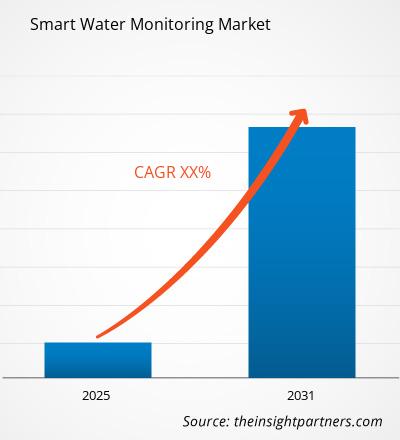
The Smart Water Monitoring Market is expanding as utilities, industries, and property operators adopt connected sensing and analytics to improve visibility across water assets. The market is valued at US$ 20.62 Billion in 2025 and is projected to reach US$ 61.43 Billion by 2034, registering a CAGR of 12.90% from 2026 to 2034. Growth reflects increasing requirements for continuous measurement, leakage detection, quality assurance, and digitally enabled infrastructure management.
North America remains a structurally advanced adoption environment, supported by aging distribution networks, established utility digitization programs, and stronger deployment of connected monitoring infrastructure. The Smart Water Monitoring Market size in the region is supported by replacement of legacy instrumentation, pressure to reduce non-revenue water, and integration of sensor data with cloud analytics, SCADA environments, and predictive maintenance workflows.
Smart Water Monitoring Market Assessment and Insights
- North America: The region is expected to hold a 42–46% Smart Water Monitoring Market share in 2025 and grow at a 12.4–13.2% CAGR between 2026–2034, supported by utility modernization, connected infrastructure replacement, and established digital monitoring ecosystems.
- US: The US represents 68–72% of North America's 2025 share, with growth of 12.1–12.9% CAGR between 2026–2034, driven by municipal upgrades and industrial water-efficiency programs.
- Europe: Europe accounts for a 23–27% share in 2025 and is projected to grow at 11.5–12.4% CAGR between 2026–2034, with Germany, the UK, France, Italy, and Spain supporting adoption through infrastructure renewal and environmental compliance.
- Asia Pacific: Asia Pacific holds an estimated 18–22% share in 2025 and is expected to record 14.0–15.0% CAGR between 2026–2034, led by China, Japan, South Korea, India, and Australia as utilities digitize expanding networks.
- Largest Segment: Components represent an estimated 34–38% market share in 2025, expanding at 12.6–13.4% CAGR from 2026–2034, reflecting broad sensor deployment across monitoring architectures.
- High Growth Segment: Application is projected at 32–36% market share in 2025, with 13.8–14.8% CAGR from 2026–2034, as quality and leakage applications gain analytical sophistication.
- Key companies analyzed in detail: ABB Ltd.; Aclara Technologies LLC; Badger Meter, Inc.; Diehl Stiftung & Co. KG; Elster Group GmbH; General Electric Company; Schneider Electric SE; Sensus USA Inc.; Siemens AG; TaKaDu Ltd.
Source: The Insight Partners' analysis based on proprietary research, government publications, company annual reports, investor presentations, industry databases, and expert interviews.
The Smart Water Monitoring market has developed into a networked sensing framework integrating ultrasonic sensors, flow sensors, pH sensors, temperature sensors, and communications components. Manufacturers have been focusing on power saving, remote diagnostics, compatibility, and field robustness in the production of sensors. At the same time, utilities have been networking their instrumentation systems with supervisory systems and analytics frameworks, which has caused purchases to be made not just of individual sensors but complete monitoring environments.
The Smart Water Monitoring Market report shows that there is potential for investments in smart water monitoring systems to spread to urban networks, industrial water systems, and commercially operated digital property. Water quality, infrastructure strength, and resource efficiency issues will ensure continued interest in traceable measurements and automated notifications. Advances in wireless communications and edge computing could ease the challenges associated with managing scattered assets, and infrastructure development projects will offer opportunities to vendors that offer monitoring systems alongside other modernizations.
Smart Water Monitoring Market Report Scope
| Report Attribute | Details |
|---|---|
| Market size in 2025 | US$ 20.62 Billion |
| Market Size by 2034 | US$ 61.43 Billion |
| Global CAGR (2026 - 2034) | 12.90% |
| Historical Data | 2021-2024 |
| Forecast period | 2026-2034 |
Smart Water Monitoring Market Analysis
The demand is increasingly driven by the requirement to transform scattered field measurements into useful operational intelligence. Consequently, the expansion in the Smart Water Monitoring Market is associated with the availability of connectivity in sensors, coverage of network infrastructure, analytics capabilities, and the economics of loss prevention or disruption avoidance. The procurement process within utilities is a tiered one that involves the purchase of the sensors from the manufacturers, communication services from network providers, system integration from engineering firms, and software from application providers.
The supply side of the market is biased towards the ability to combine accurate measurement with reliable communications and software. The suppliers of component parts have to cater to the different installation environments such as underground pipelines, reservoirs, treatment plants, industrial facilities, and buildings. The evaluation of procurement now includes issues of battery life, cybersecurity measures, calibration needs, interoperability, and support over the lifecycle of equipment.
The competitive landscape in the Smart Water Monitoring Market has been found to be highly fragmented, with automation firms competing against firms specialized in metering and analytics. Some of the leading automation firms include ABB Ltd., Schneider Electric SE, and Siemens AG, whereas Aclara Technologies LLC, Badger Meter, Inc., Diehl Stiftung & Co. KG, and Sensus USA Inc. offer advanced metering and measurement solutions. In addition, TaKaDu Ltd. specializes in network analytics, while General Electric Company and Elster Group GmbH have comprehensive offerings in the industrial and utility technology sectors.
The Smart Water Monitoring Market forecast indicates that positioning within the market requires an ability to link sensing hardware with software. For example, ABB Ltd. offers solutions based on measurement and process technology; Schneider Electric SE integrates monitoring with automation systems; Siemens AG offers digital water applications combined with industrial control. In addition, a specialized firm can distinguish itself in the market by offering accurate metering, network analytics, or specific sensors. Thus, the investments are being made in interoperable systems, predictive analytics, cybersecurity, and low-power field devices.
● REPORT CUSTOMIZATION
Tailor This Report To Align With Your Specific Business Requirements
This report can be customized to align precisely with your business objectives, scope, and target markets. Customization options include tailored segmentation, geography, competitive analysis, and strategic insights to support informed decision-making.
Customize This Report →WHAT YOU CAN ADJUST
- ● Segmentations
- ● Geography
- ● Competitive Analysis
- ● Language Preferences
Smart Water Monitoring Market: Strategic Insights

Regional Insights
North America Smart Water Monitoring Market
North America held a 42–46% share in 2025, with regional growth estimated at a 12.4–13.2% CAGR through 2034. Digitization maturity, meter base infrastructure, and high demands to monitor old assets are among key factors that contribute to market development in the USA and Canada. In the replacement market segment, integration of field devices and analytics/operational platforms becomes increasingly common.
In this region, municipalities are dominant buyers, but industrial sites and large commercial buildings expand the addressable market. The presence of communication infrastructure and experience in remote monitoring are important prerequisites for adoption. Demand for flow measurement, leakage detection, pressure monitoring, and water quality detection technologies is particularly high. Integration into existing utility control environments becomes increasingly popular.
U.S. Smart Water Monitoring Market
The US represented 68–72% of North America's 2025 share and is projected to grow at a 12.1–12.9% CAGR through 2034. Utility modernization, infrastructure replacement, and operational pressure to identify losses support deployment across municipal distribution systems, treatment plants, industrial sites, and large buildings.
The major vendors of this type include Badger Meter, Inc., Aclara Technologies LLC, Sensus USA Inc., and General Electric Company. The need to integrate remote meter reading with anomaly detection and operational dashboards is increasing. The growing need for scalable architecture to support distributed devices is seen in large utilities, while process reliability, compliance, and water efficiency are critical needs for industrial customers.
Europe Smart Water Monitoring Market
Europe accounted for a 23–27% share in 2025 and is expected to expand at an 11.5–12.4% CAGR, with Germany emerging as a leading country. The UK and Germany have strong utility modernization activity, while France, Italy, and Spain increasingly emphasize leakage reduction, digital infrastructure, and water resilience.
In the UK market, there is the need for utility performance requirements, aging infrastructure, and the need to cut down on water leakage. In Germany, there is a combination of industrial water management and efficient municipal infrastructures. There is also France with the emphasis on efficiency of the network as well as the treatment process, and in Italy and Spain, the water stress situation in the regions makes it necessary to monitor the operations.
APAC Smart Water Monitoring Market
APAC represented 18–22% share in 2025 and is forecast to grow at a 14.0–15.0% CAGR, with China leading regional adoption. Japan and South Korea emphasize advanced infrastructure, while India and Australia address urban expansion, industrial consumption, and water-security pressures.
China benefits from large-scale infrastructure investment, while India is accelerating digital water projects alongside urban development. Japan prioritizes reliability and asset optimization, South Korea emphasizes smart infrastructure, and Australia focuses on drought resilience. Industrial facilities across the region are also adopting monitoring to manage process water and wastewater. Policy-led modernization, expanding communications networks, and rising demand for measurable resource efficiency strengthen the regional investment case.
Middle East & Africa Smart Water Monitoring Market
The Middle East and Africa market is expected to grow at a 10.5–11.5% CAGR, with Saudi Arabia representing a leading market. Saudi Arabia and the UAE emphasize water-security infrastructure and advanced utilities, while South Africa addresses network efficiency and infrastructure constraints.
The Rest of MEA presents a more uneven adoption profile, reflecting differences in financing, infrastructure maturity, and connectivity. Desalination, energy-intensive water production, leakage reduction, and remote asset monitoring are important use cases across the region. Utilities increasingly seek technologies that provide visibility across dispersed infrastructure and support efficient pumping and treatment. Demand should remain concentrated in projects where monitoring delivers measurable operational benefits alongside broader water-security investment.
Segmentation Analysis
Components
Components form the largest main segment, expanding at a 12.6–13.4% CAGR from 2026–2034. Adoption is supported by broad deployment requirements across utilities, industrial plants, buildings, reservoirs, and pipelines. The Smart Water Monitoring Market scope increasingly encompasses integrated sensing packages rather than individual measurement points, encouraging suppliers to improve interoperability, durability, communications efficiency, and remote diagnostics.
- Ultrasonic Sensor: Ultrasonic sensors support non-contact measurement and reliable monitoring where mechanical wear is a concern. Their integration into connected systems strengthens asset visibility and enables automated measurement across utility and industrial environments.
- Temperature Sensor: Temperature sensors provide supporting process information for water quality and equipment monitoring. Demand is strongest where thermal changes influence treatment performance, process stability, equipment condition, or environmental compliance.
- PH Sensor: pH sensors are strategically important for treatment and industrial applications requiring continuous chemical-condition visibility. Connected deployment reduces dependence on periodic sampling and supports faster response to deviations.
- Flow Sensor: Flow sensors remain central to distribution and process monitoring because accurate movement measurement underpins leakage identification, consumption analysis, pumping optimization, and operational balancing across water networks.
- Communication Network: Communication networks connect dispersed sensors with operational platforms. Their strategic role increases as utilities require remote visibility, scalable deployments, reliable alerts, and integration with cloud or control environments.
Application
Application is the high-growth main segment, projected to expand at a 13.8–14.8% CAGR from 2026–2034. Demand is shifting toward outcome-oriented monitoring, where sensing technologies are selected according to leakage, storage, or quality objectives. The Smart Water Monitoring Market growth within applications benefits from stronger analytical capabilities and expanding deployment beyond conventional utility metering.
- Water Tank Level Monitoring: Tank-level monitoring supports supply continuity, pump scheduling, overflow prevention, and inventory visibility. Adoption is relevant across utilities, commercial facilities, residential complexes, and industrial sites with distributed storage.
- Water Quality Monitoring: Quality monitoring addresses increasingly stringent operational requirements by providing timely visibility into changing water conditions. It is strategically important for treatment facilities, distribution systems, industrial users, and sensitive applications.
- Water Pipe Leakage Detection: Leakage detection converts flow and pressure anomalies into actionable maintenance signals. Utilities increasingly prioritize these systems because early identification can reduce water losses, infrastructure damage, emergency repairs, and service interruptions.
End-user
End-user demand is expected to expand at a 12.2–13.0% CAGR from 2026–2034 as monitoring becomes embedded in operational and sustainability programs. Utilities remain foundational customers, while industrial, commercial, and residential users broaden adoption through connected buildings, process optimization, and water-efficiency initiatives.
- Water Utilities: Utilities represent a core customer group because monitoring supports distribution visibility, leakage management, quality assurance, and infrastructure planning. Procurement increasingly emphasizes scalable platforms capable of integrating existing field assets.
- Industry: Industrial users deploy monitoring to control process-water consumption, identify abnormal conditions, and strengthen wastewater oversight. Demand is strongest where water availability, treatment cost, and production continuity directly affect operating economics.
- Commercial and Residential: Commercial and residential adoption is expanding through connected buildings, property management systems, and localized leakage detection. Ease of installation, remote alerts, and lower maintenance requirements influence purchasing decisions.
Opportunity Snapshot
| Application | Revenue Contribution (High/Medium/Low) | Trend Tag | Adoption Stage |
|---|---|---|---|
| Water Tank Level Monitoring | Medium | Tank Automation | Scaling |
| Water Quality Monitoring | High | Quality Analytics | Scaling |
| Water Pipe Leakage Detection | High | Leak Analytics | Scaling |
Smart Water Monitoring Market Growth Drivers and Impact Analysis
Aging Water Infrastructure and Non-Revenue Water Reduction
The aged state of the pipeline network, valves, pumps, storage capacity, and treatment infrastructure makes it necessary to have constant condition awareness. Monitoring systems can detect abnormal flows, pressures, temperatures, or qualities before they lead to a failure of large scale. The market effect will be greatest in utilities with higher maintenance needs and few field employees, since the connected sensors can help the operators to prioritize intervention by assessing the existing condition of the network. Similarly, an industrial site will profit if failures in the water system will hinder their manufacturing process or raise their treatment costs. With the extended replacement cycle of the infrastructure over several budget cycles, the monitoring becomes a midway solution of modernization that improves condition awareness without having to rebuild the network.
Stronger Water Quality and Resource-Efficiency Requirements
Water quality standards are growing increasingly data-driven, as the water utility industry is looking for earlier indication of water contamination, process anomalies, and inefficiencies in the treatment process. Continual measurements of pH, temperature, flow, and other variables create a better picture than periodic sampling alone. The implication on the market, however, is not limited by compliance alone, as high-frequency data collection gives plant managers the ability to fine-tune their treatment processes, conduct anomaly investigations, and increase efficiency. Industrial users are increasingly seeing the link between water monitoring and reporting and resource efficiency, which raises demands for sensors that produce reliable readings in difficult environments, and software that makes sense of raw data into meaningful alerts.
Expansion of Connected Utility and Industrial Infrastructure
Connected infrastructure is making it easier to monitor distributed water systems because wireless communication, cloud technology, edge computing, and more interoperable control systems make it possible to consolidate information coming in from dispersed sites. This alters the purchase criteria because buyers are able to consider the overall lifetime value of a monitoring system, not just its capabilities. Integration with operational technology could be useful for improved maintenance scheduling, alarm handling, history tracking, and reduced data input. Industrial facilities can take advantage of the same strategy in connecting water readings with manufacturing and energy consumption data. With the growing development of digital infrastructure, monitoring becomes a part of an operational technology strategy instead of being just an environmental strategy.
Smart Water Monitoring Market Future Trends
AI-Enabled Water Network Intelligence
AI-based monitoring is likely to move from experimental analytics toward operational decision support as utilities accumulate larger sensor datasets. The Smart Water Monitoring Market trends increasingly favor systems that identify unusual patterns, distinguish genuine anomalies from normal demand variation, and recommend maintenance priorities. Future platforms may combine hydraulic models, historical consumption, weather information, asset age, and real-time measurements to improve predictions. Edge analytics can reduce dependence on continuous cloud connectivity for time-sensitive alarms, while centralized systems can support longer-term optimization. Vendors will increasingly compete on model transparency, data quality, cybersecurity, and integration with existing operational technology. Successful deployments will likely emphasize measurable reductions in response time, maintenance costs, and avoidable losses rather than AI functionality alone. This shift can improve the commercial case for advanced monitoring across complex networks.
Digital Twins and Closed-Loop Water Operations
Digital twins are expected to become more practical as sensor density and communications reliability improve. A virtual representation of a water network can combine live measurements with hydraulic, process, and asset information, allowing operators to test scenarios before changing physical conditions. Future deployments may use these models to evaluate pressure adjustments, maintenance sequencing, treatment settings, and capacity constraints. The technology can also support workforce training by reproducing operational situations without disrupting live infrastructure. Integration with predictive analytics should further improve asset planning and capital allocation. Rather than functioning as isolated visualization tools, digital twins are likely to become operational layers connecting field instrumentation with engineering and control systems. Their adoption will depend on data consistency, model maintenance, cybersecurity, and demonstrable financial value across utility and industrial environments.
Smart Water Monitoring Market Opportunities
Monitoring-as-a-Service for Smaller Utilities
Smaller utilities often face constrained capital budgets, limited technical staffing, and heterogeneous legacy infrastructure. A monitoring-as-a-service model can address these barriers by combining sensors, connectivity, analytics, maintenance, and technical support under recurring commercial arrangements. This approach reduces the need for large upfront technology investments while giving operators access to continuously updated software and remote expertise. Vendors can target regional utility clusters, municipal partnerships, and managed infrastructure programs where standardized deployments are practical. Service models can also create recurring revenue from device management, data analytics, cybersecurity, calibration, and system upgrades. Smart Water Monitoring Market Forecasts are particularly relevant to these models because adoption can broaden beyond large utilities when purchasing shifts from equipment ownership toward measurable operational outcomes. Successful providers will need transparent service-level commitments and interoperable architectures.
Industrial Water Intelligence and Sustainability Platforms
Industrial sites represent an attractive investment opportunity because water consumption is directly connected with production economics, environmental performance, and operational resilience. Vendors can develop integrated platforms combining water measurements with energy, production, wastewater, and sustainability information. Such systems allow plant managers to identify process losses, compare water intensity across production lines, and prioritize reuse or recycling projects. High-value opportunities are likely in food processing, chemicals, pharmaceuticals, mining, pulp and paper, and semiconductor manufacturing, where water quality and continuity can materially affect production. Suppliers should focus on modular deployment, secure integration with industrial control systems, and analytics that translate measurements into operational decisions. Partnerships with engineering firms and automation integrators can accelerate market access while reducing the complexity of deploying monitoring technologies within established industrial environments.
Recent Developments
- June 2026: Schneider Electric has launched EcoStruxure Water Advisor, a cloud-based intelligence platform that enables utilities to see what is happening in their infrastructure in real time. It brings together data from multiple systems and shows it in one place, so teams can quickly identify issues and decide how to respond. By providing a clear, live view of the entire water network, the system helps utilities reduce water loss, lower operating costs, and maintain a reliable supply for customers.
- June 2026: Itron, Inc. which is innovating new ways for utilities and cities to manage energy and water, is working together with Watercare Services, New Zealand’s largest water and wastewater utility, to modernize their water network by upgrading its existing mechanical meters with 100,000 Itron Intelis wSource digital water meters, as part of Watercare’s plan to connect almost half a million smart meters in total across the Auckland region. This deployment represents one of the largest smart water metering upgrades in New Zealand and will give Watercare Services greater visibility into its network to accelerate leak detection and improve billing accuracy.
- May 2026: Siemens expands its digital portfolio for water, wastewater and waste management. Rising environmental standards, growing cost pressures, and a shortage of skilled workers: the demands on operators of municipal and industrial infrastructure continue to increase, making data-driven operations more critical than ever. At IFAT 2026, the leading trade fair for environmental technologies, Siemens showcase how digital solutions help manage water quality, wastewater treatment and material flows in waste management more efficiently.
Frequently Asked Questions

- Comprehensive Market Sizing and Forecast Analysis
- Detailed Segmentation Analysis
- In-Depth Market Dynamics Assessment
- Regional and Country-Level Insights
- Competitive Landscape and Company Benchmarking
- Strategic Business Intelligence
Recent Reports
Testimonials

The Insight Partners' SCADA System Market report is comprehensive, with valuable insights on current trends and future forecasts. The team was highly professional, responsive, and supportive throughout. We are very satisfied and highly recommend their services.
RAN KEDEM Partner, Reali Technologies LTDs
I requested a report on a very specific software market and the team produced the report in a few days. The information was very relevant and well presented. I then requested some changes and additions to the report. The team was again very responsive and I got the final report in less than a week.
JEAN-HERVE JENN Chairman, Future Analytica
We worked with The Insight Partners for an important market study and forecast. They gave us clear insights into opportunities and risks, which helped shape our plans. Their research was easy to use and based on solid data. It helped us make smart, confident decisions. We highly recommend them.
PIYUSH NAGPAL Sr. Vice President, High Beam Global
The Insight Partners delivered insightful, well-structured market research with strong domain expertise. Their team was professional and responsive throughout. The user-friendly website made accessing industry reports seamless. We highly recommend them for reliable, high-quality research services
YUKIHIKO ADACHI CEO, Deep Blue, LLC.
This is the first time I have purchased a market report from The Insight Partners.While I was unsure at first, I visited their web site and felt more comfortable to take the risk and purchase a market report.I am completely satisfied with the quality of the report and customer service. I had several questions and comments with the initial report, but after a couple of dialogs over email with their analyst I believe I have a report that I can use as input to our strategic planning process.Thank you so much for taking the extra time and making this a positive experience.I will definitely recommend your service to others and you will be my first call when we need further market data.
JOHN SUZUKI President and Chief Executive Officer, Board Director, BK Technologies
I wish to appreciate your support and the professionalism you displayed in the course of attending to my request for information regarding to infectious disease IVD market in Nigeria. I appreciate your patience, your guidance, and the fact that you were willing to offer a discount, which eventually made it possible for us to close a deal. I look forward to engaging The Insight Partners in the future, all thanks to the impression you have created in me as a result of this first encounter.
DR CHIJIOKE ONYIA MANAGING DIRECTOR, PineCrest Healthcare Ltd.Reason to Buy
- Informed Decision-Making
- Understanding Market Dynamics
- Competitive Analysis
- Identifying Emerging Markets
- Customer Insights
- Market Forecasts
- Risk Mitigation
- Boosting Operational Efficiency
- Strategic Planning
- Investment Justification
- Tracking Industry Innovations
- Aligning with Regulatory Trends





 Get Free Sample for