Dry eye disease has evolved from being viewed as a minor ocular discomfort to a chronic eye condition that significantly affects quality of life, workplace productivity, and long term eye health. Increasing screen exposure, aging populations, environmental pollution, autoimmune disorders, hormonal changes, and contact lens usage have contributed to a steady rise in dry eye disease cases worldwide. As healthcare systems place greater emphasis on early diagnosis and personalized care, innovative technologies are reshaping how clinicians identify, monitor, and treat this condition.
Artificial intelligence (AI), precision medicine, advanced drug delivery systems, and digital healthcare platforms are leading this transformation. These advancements are improving diagnostic accuracy while enabling ophthalmologists to deliver individualized therapies that address the underlying causes of the disease rather than simply relieving symptoms.
According to The Insight Partners, the Dry Eye Disease Market was valued at US$ 6.84 billion in 2025 and is projected to reach US$ 11.29 billion by 2034, registering a CAGR of 6.46% during 2026 to 2034. Market growth is supported by increasing awareness, continuous pharmaceutical innovation, expanding ophthalmology infrastructure, and the growing adoption of digital healthcare technologies.
AI is Revolutionizing Dry Eye Disease Diagnosis
Traditional diagnosis of dry eye disease often involves a combination of patient questionnaires, tear production tests, ocular surface examinations, and clinical observation. While effective, these approaches may vary depending on physician experience and patient symptoms.
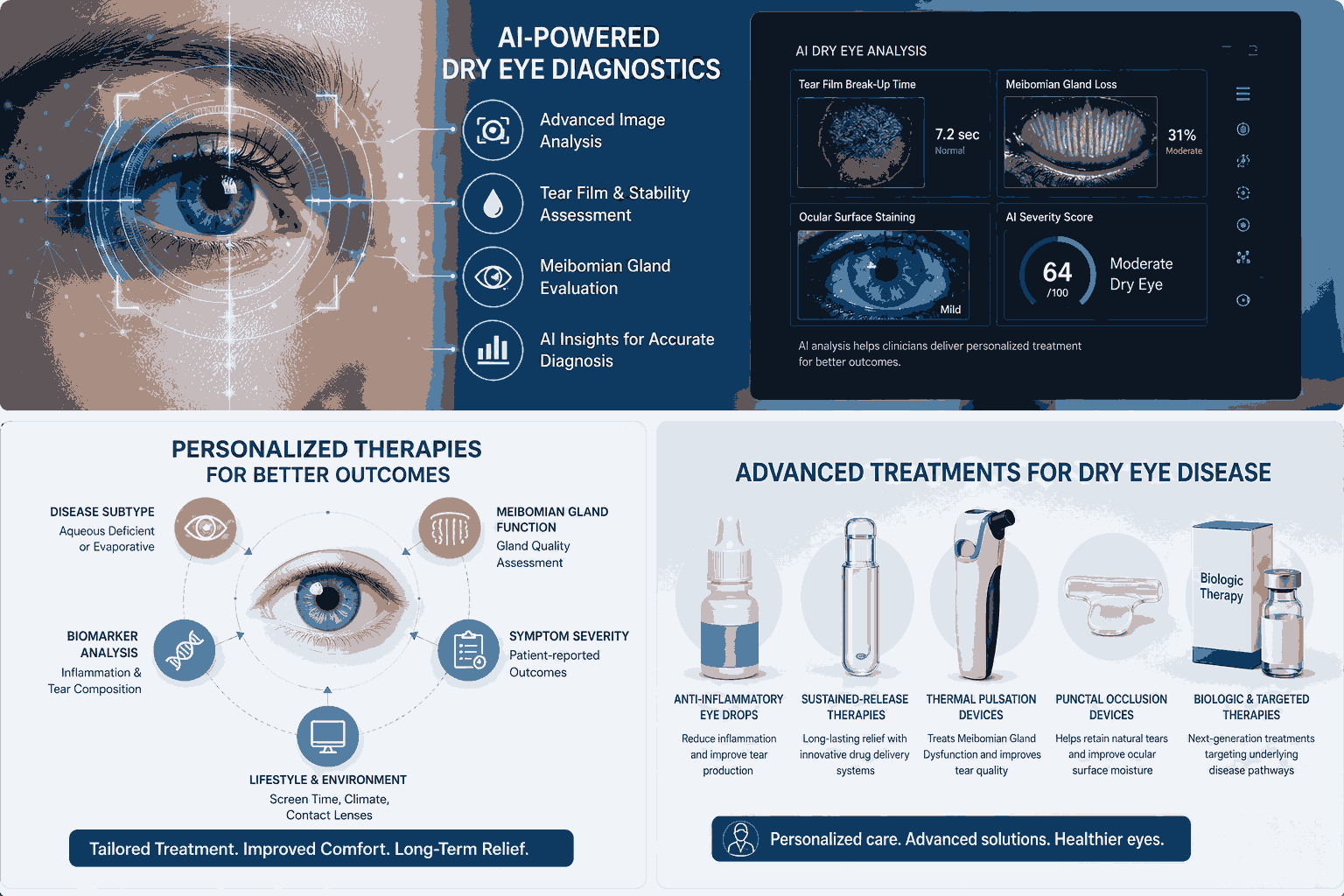
Artificial intelligence is introducing greater consistency and precision into clinical practice. AI powered diagnostic systems can analyze high resolution ocular images, evaluate tear film stability, detect meibomian gland abnormalities, and identify subtle inflammatory changes that may otherwise be difficult to recognize.
Machine learning algorithms are also helping ophthalmologists classify patients according to disease severity and subtype, enabling faster clinical decision making. This is particularly valuable because dry eye disease is not a single condition but a collection of disorders with different underlying mechanisms.
As AI continues to integrate into ophthalmology workflows, healthcare providers can deliver earlier diagnosis, reduce unnecessary treatment delays, and improve long term patient outcomes.
Personalized Therapies Are Changing Treatment Strategies
One of the most significant developments in dry eye disease management is the transition from standardized treatment protocols toward personalized therapies.
Rather than prescribing identical medications for every patient, ophthalmologists increasingly evaluate factors such as:
- Disease subtype
- Tear film composition
- Inflammatory biomarkers
- Meibomian gland function
- Patient lifestyle
- Severity of symptoms
This personalized approach allows physicians to select therapies that directly address each patient's underlying condition.
Patients with aqueous deficient dry eye disease may benefit from treatments that improve tear production and reduce ocular inflammation, while individuals with evaporative dry eye disease often require therapies targeting meibomian gland dysfunction and tear film stabilization.
Precision medicine is expected to become a major differentiator across ophthalmology, supported by advances in molecular diagnostics, biomarker research, and AI assisted clinical decision support.
Pharmaceutical Innovation Continues to Accelerate
The pharmaceutical industry continues investing heavily in next generation dry eye disease therapies.
Modern treatment development is increasingly focused on:
- Preservative free formulations
- Targeted anti inflammatory therapies
- Immunomodulatory medications
- Sustained release drug delivery systems
- Biologic therapies
- Extended duration ophthalmic formulations
Unlike conventional artificial tears that primarily provide temporary symptom relief, many newer prescription therapies target inflammatory pathways responsible for chronic disease progression.
Recent product approvals and ongoing clinical trials demonstrate the industry's commitment to improving both treatment effectiveness and patient adherence.
Long acting drug delivery technologies are also reducing dosing frequency, helping patients maintain consistent treatment while improving overall clinical outcomes.
AI and Digital Health Are Supporting Long Term Disease Management
Digital healthcare has become an important component of chronic disease management, including ophthalmology.
Teleophthalmology platforms, AI enabled patient monitoring, electronic prescriptions, and virtual consultations are making specialized eye care more accessible than ever before.
Patients can now receive:
- Remote follow up consultations
- Medication reminders
- Digital symptom tracking
- Treatment adherence monitoring
- AI assisted risk assessments
These technologies improve communication between physicians and patients while reducing unnecessary hospital visits.
Digital healthcare also supports early intervention by encouraging patients to seek medical attention before symptoms become severe.
As connected healthcare infrastructure expands globally, digital platforms will play an increasingly important role in improving treatment accessibility and patient engagement.
Advanced Drug Delivery Technologies Are Improving Patient Experience
Drug delivery innovation has become one of the fastest evolving areas within ophthalmology.
Researchers are developing technologies that provide longer lasting therapeutic effects while improving patient comfort.
Examples include:
- Sustained release implants
- Bioabsorbable drug delivery platforms
- Long acting ophthalmic solutions
- Combination therapies
- Innovative ocular inserts
These technologies reduce the need for frequent eye drop administration while maintaining therapeutic drug concentrations over extended periods.
Improved convenience directly contributes to better medication adherence, which remains one of the biggest challenges in chronic dry eye disease management.
Regional Markets Continue to Expand
North America continues to lead the global dry eye disease market due to advanced healthcare infrastructure, strong reimbursement systems, extensive ophthalmology services, and high diagnosis rates.
The United States remains the largest contributor within the region, supported by pharmaceutical innovation, clinical research, and widespread availability of advanced prescription therapies.
Europe also maintains strong market growth, driven by increasing awareness, specialist eye care services, and continuous healthcare investment across Germany, the United Kingdom, France, Italy, and Spain.
Meanwhile, Asia Pacific is expected to register the fastest growth through 2034. Countries including China, Japan, India, and South Korea are investing significantly in ophthalmology infrastructure while expanding access to specialized healthcare services. Rising digital device usage and increasing patient awareness continue supporting regional demand.
Online Pharmacies Are Expanding Patient Access
Distribution channels are also evolving alongside treatment innovation.
While hospitals, specialty eye clinics, and retail pharmacies continue serving as primary treatment providers, online pharmacies are becoming one of the fastest growing distribution channels.
Digital pharmaceutical platforms offer several advantages, including:
- Convenient prescription refills
- Home delivery services
- Competitive pricing
- Improved treatment accessibility
- Better support for chronic disease management
Growing consumer confidence in digital healthcare is expected to further strengthen this segment throughout the forecast period.
Competitive Landscape Focuses on Innovation
Competition within the dry eye disease market remains strong as pharmaceutical companies continue investing in research, product development, and strategic collaborations.
Leading companies are expanding their ophthalmology portfolios through innovative therapeutics, targeted anti inflammatory treatments, biologics, sustained release drug delivery technologies, and personalized treatment solutions.
Manufacturers are also partnering with research institutions and specialty ophthalmology centers to accelerate clinical development, regulatory approvals, and commercialization of advanced therapies.
These investments are strengthening the industry's ability to address increasing global demand while maintaining competitive differentiation.
Looking Ahead
The future of dry eye disease management extends far beyond symptom relief. AI powered diagnostics, precision medicine, digital healthcare integration, and advanced ophthalmic therapeutics are transforming every stage of patient care, from early diagnosis to personalized long term treatment.
As healthcare providers increasingly adopt intelligent diagnostic tools and individualized treatment strategies, patients can expect faster diagnosis, more effective therapies, and improved quality of life.
Supported by continuous pharmaceutical innovation, expanding specialty eye care infrastructure, and growing adoption of digital health technologies, the Dry Eye Disease Industry is well positioned for sustained growth through 2034. Organizations that continue investing in AI driven ophthalmology, biomarker based therapies, and patient centric care models are expected to shape the next generation of innovation in global eye healthcare.