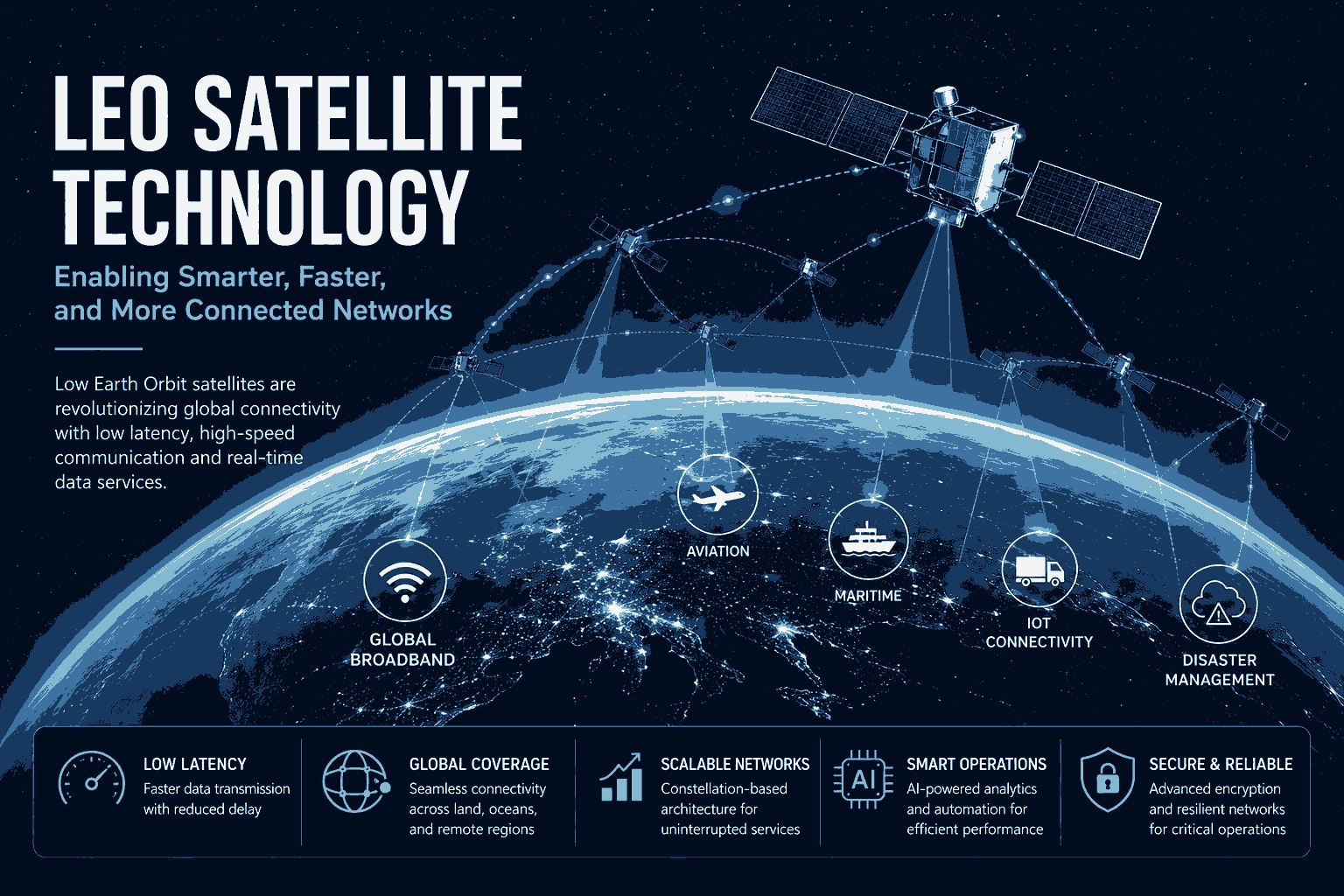
Low Earth Orbit (LEO) satellites are redefining the future of global connectivity by delivering high speed, low latency communication services that were once impossible through traditional satellite systems. Positioned between approximately 160 km and 2,000 km above Earth, LEO satellites enable faster data transmission, making them ideal for broadband internet, Earth observation, defense, navigation, disaster response, and Internet of Things (IoT) applications.
As governments and private organizations continue investing in satellite constellations, reusable launch vehicles, and advanced onboard technologies, the LEO satellite ecosystem is expanding rapidly. According to The Insight Partners, the LEO Satellite Market is projected to grow from US$ 12.25 billion in 2025 to US$ 35.44 billion by 2034, registering a CAGR of 11.67% during the forecast period. This remarkable growth reflects increasing demand for global connectivity, technological innovation, and expanding commercial applications across multiple industries.
Exploring LEO Satellite Technology
Unlike traditional geostationary satellites that orbit approximately 36,000 km above Earth, LEO satellites operate much closer to the planet. This significantly reduces signal travel time, resulting in lower latency and improved communication performance.
Modern LEO satellite constellations consist of hundreds or even thousands of interconnected satellites working together to provide continuous global coverage. These networks are capable of delivering broadband internet, real time monitoring, secure communications, and advanced imaging services across both urban and remote regions.
The latest generation of LEO satellites integrates:
- Artificial Intelligence for onboard data processing
- Laser inter satellite communication links
- Software defined payloads
- Advanced propulsion systems
- High resolution imaging sensors
- Cloud enabled ground station integration
These technologies are making satellite communication smarter, more efficient, and highly scalable.
Why LEO Satellites Are Becoming Essential
The world is generating more digital data than ever before. Connected devices, autonomous systems, smart cities, industrial automation, and global supply chains all require reliable connectivity regardless of geographic location.
LEO satellites help bridge communication gaps by providing internet access where terrestrial infrastructure is unavailable or economically impractical.
Major benefits include:
Low Latency Communication
Because signals travel much shorter distances, LEO satellites can reduce latency dramatically compared to traditional satellites. This makes applications such as video conferencing, cloud computing, online gaming, financial transactions, and remote healthcare significantly more responsive.
Global Broadband Access
Millions of people still lack reliable internet connectivity. Large LEO satellite constellations can extend broadband services to rural communities, islands, maritime vessels, aircraft, mining operations, and disaster affected regions.
Rapid Deployment
Compared to large geostationary satellites, smaller LEO satellites can be manufactured and launched more quickly. Advances in reusable rockets have further reduced launch costs, accelerating deployment schedules.
Flexible Network Architecture
Software defined satellites allow operators to modify communication capabilities through software updates rather than hardware replacements. This flexibility supports changing customer demands and evolving communication standards.
Key Technologies Driving the LEO Satellite Revolution
Miniaturization of Satellites
Modern manufacturing techniques have enabled highly capable satellites weighing only a few hundred kilograms. These compact platforms offer lower production costs while maintaining excellent performance.
Miniaturization also allows operators to launch multiple satellites simultaneously, improving deployment efficiency.
Reusable Launch Vehicles
Reusable rockets have transformed satellite economics by significantly reducing launch expenses.
Lower launch costs allow organizations to deploy larger satellite constellations while replacing aging satellites more frequently, improving overall network reliability.
Artificial Intelligence Integration
AI is becoming increasingly important within satellite operations.
Artificial intelligence enables:
- Automated satellite health monitoring
- Intelligent bandwidth allocation
- Image recognition
- Predictive maintenance
- Autonomous collision avoidance
- Real time anomaly detection
These capabilities improve operational efficiency while reducing dependence on ground control teams.
Laser Communication Systems
Laser based optical communication links allow satellites to exchange data at extremely high speeds without routing information through Earth based stations.
This technology reduces transmission delays while improving network resilience and global coverage.
Expanding Applications Across Industries
Communication Services
Communication remains the largest application for LEO satellites. Broadband internet providers are deploying massive constellations to deliver reliable high speed connectivity across underserved regions.
Businesses operating in remote environments such as oil and gas, mining, shipping, aviation, and construction increasingly rely on satellite based communication for uninterrupted operations.
Earth Observation
High resolution Earth observation satellites support numerous industries through continuous monitoring and imaging.
Applications include:
- Precision agriculture
- Environmental monitoring
- Climate research
- Forest management
- Urban planning
- Infrastructure development
- Disaster assessment
The combination of AI powered image analysis and real time satellite data is improving decision making across both public and private sectors.
Navigation and Location Services
LEO satellites are expected to complement existing navigation systems by improving positioning accuracy and reducing signal interruptions.
Industries including logistics, autonomous vehicles, aviation, and maritime transportation stand to benefit from enhanced navigation capabilities.
Defense and National Security
Military organizations are investing heavily in LEO satellite networks for secure communications, intelligence gathering, surveillance, reconnaissance, and tactical operations.
Large distributed constellations provide greater resilience than single satellite systems because network functionality continues even if individual satellites fail.
Commercial Opportunities Continue Expanding
The commercialization of space has opened new business models beyond satellite communications.
Emerging revenue opportunities include:
- Satellite based IoT connectivity
- Climate intelligence platforms
- Insurance risk assessment
- Infrastructure monitoring
- Smart agriculture services
- Asset tracking
- Maritime logistics
- Aviation connectivity
- Environmental compliance monitoring
- Space based cybersecurity solutions
As organizations increasingly depend on real time data, satellite generated information is becoming a valuable commercial asset.
Market Segmentation Highlights
The LEO Satellite Market serves diverse customer requirements across several segments.
By Payload Capacity
- Below 1000 Kg
- 1000 to 5000 Kg
- Above 5000 Kg
Smaller satellites dominate constellation deployments due to lower manufacturing and launch costs, while larger satellites continue supporting specialized missions requiring higher payload capabilities.
By Application
- Communication
- Earth Observation
- Navigation
- Space Science
- Others
Communication applications currently account for a significant share of market demand, while Earth observation continues experiencing rapid expansion.
By End User
Commercial Sector
Commercial operators continue investing aggressively in broadband internet, IoT services, environmental monitoring, transportation, and enterprise communication solutions.
Military Sector
Defense organizations utilize LEO satellites for surveillance, intelligence, secure communication, border monitoring, and mission critical operations.
Regional Growth Outlook
North America
North America remains the largest regional market, led by the United States. Strong government investment, private sector innovation, expanding satellite launches, and advanced aerospace capabilities continue driving regional leadership.
Europe
European countries are strengthening satellite infrastructure to improve digital sovereignty, environmental monitoring, and secure communications while supporting collaborative space initiatives.
Asia Pacific
Asia Pacific is witnessing substantial growth due to increasing investments in national space programs, telecommunications infrastructure, smart cities, and commercial satellite manufacturing.
Countries including China, India, Japan, and Australia continue expanding satellite capabilities across commercial and defense applications.
Middle East and Africa
Governments are increasingly adopting satellite technologies to improve digital inclusion, environmental monitoring, and infrastructure development across geographically challenging regions.
South and Central America
Satellite connectivity is helping improve internet access, agricultural productivity, environmental monitoring, and disaster response capabilities throughout the region.
Challenges That Require Industry Attention
Despite significant growth potential, the LEO satellite industry faces several challenges.
Space Debris Management
The rapid increase in satellite launches raises concerns regarding orbital congestion and collision risks. Responsible satellite disposal strategies and active debris management will become increasingly important.
Spectrum Coordination
As more operators deploy satellite constellations, efficient spectrum allocation and international regulatory coordination will be essential for avoiding communication interference.
Cybersecurity
Growing reliance on satellite infrastructure increases the importance of protecting networks from cyber threats through advanced encryption, secure communication protocols, and continuous monitoring.
Capital Investment
Although launch costs have declined, building and maintaining global satellite constellations still requires substantial long term investment and operational expertise.
Future Outlook Through 2034
The future of LEO satellite technology extends well beyond broadband connectivity. Integration with 5G and future 6G networks, artificial intelligence, autonomous transportation, edge computing, and billions of connected IoT devices will transform satellites into essential components of the global digital infrastructure.
Increasing collaboration between commercial operators, governments, telecommunications providers, cloud service companies, and defense organizations will accelerate innovation and create entirely new business opportunities.
Advancements in reusable launch systems, satellite miniaturization, onboard intelligence, and high speed optical communications will continue reducing operational costs while expanding service capabilities. As industries become increasingly data driven, LEO satellites will play a central role in delivering secure, reliable, and real time connectivity worldwide.
LEO satellite technology is transforming how the world communicates, gathers data, and delivers digital services. From enabling high speed broadband in remote communities to supporting intelligent transportation, precision agriculture, disaster management, defense operations, and environmental monitoring, these satellite networks are becoming foundational to the connected economy.
With rapid technological advancements, expanding commercial investment, and increasing demand for reliable global connectivity, the LEO Satellite Market is positioned for sustained growth through 2034. Organizations that invest in scalable satellite infrastructure, AI driven analytics, and next generation communication technologies will be well positioned to capitalize on the immense opportunities emerging across this dynamic sector.