Water infrastructure is undergoing a major transformation as governments, utilities, and industries invest in smarter, more resilient, and sustainable pipeline networks. Aging water distribution systems, increasing urbanization, rising concerns over water scarcity, and the need to reduce leakage are driving demand for advanced piping solutions that offer durability, efficiency, and long operational life. As a result, polyolefin pipes have become an essential component of modern infrastructure projects worldwide.
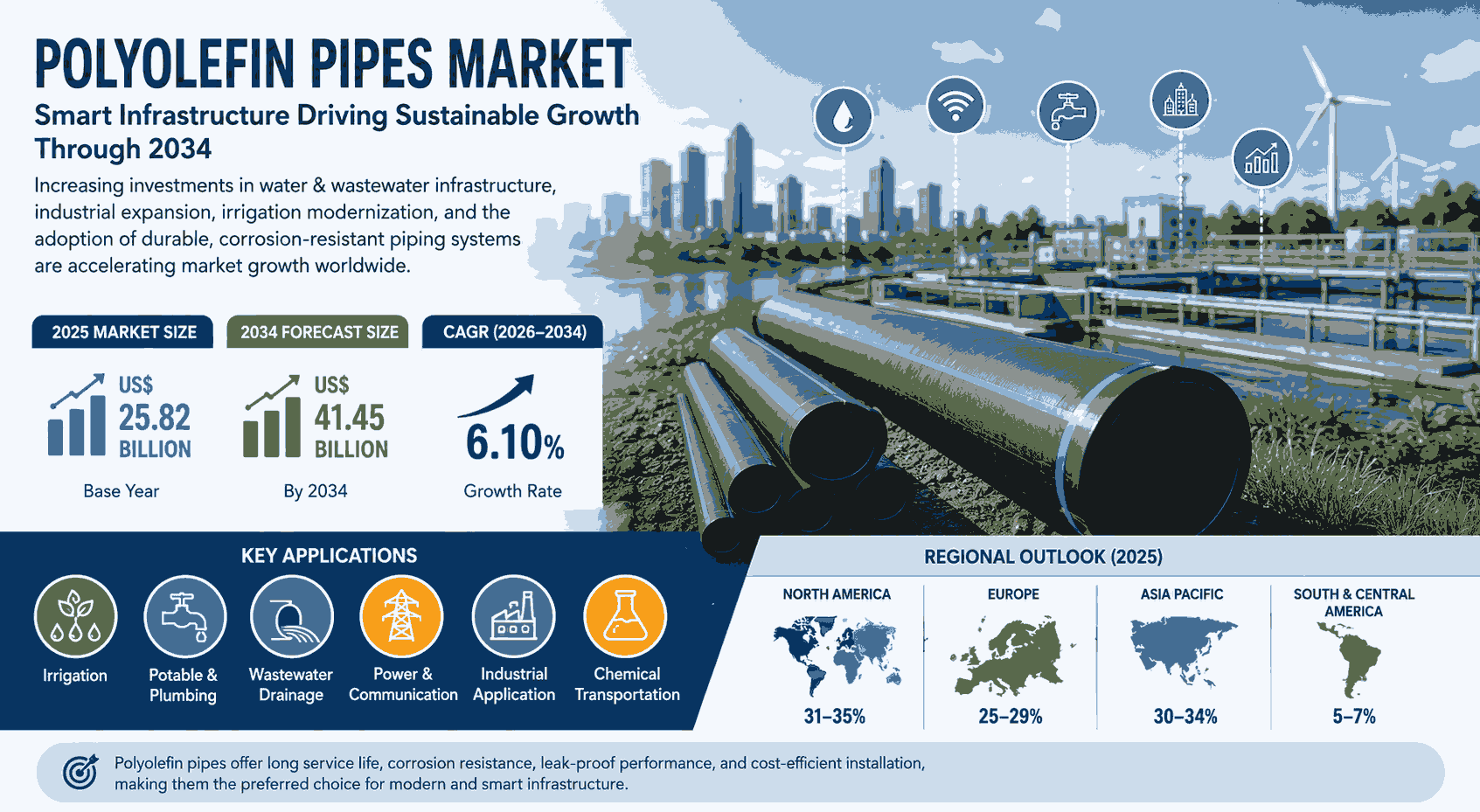
According to The Insight Partners, the Polyolefin Pipes Market was valued at US$ 25.82 billion in 2025 and is projected to reach US$ 41.45 billion by 2034, expanding at a CAGR of 6.10% during 2026-2034. Market growth is fueled by increasing investments in water and wastewater infrastructure, replacement of aging pipeline systems, industrial expansion, and the adoption of corrosion-resistant piping materials across multiple applications.
Why Polyolefin Pipes Are Becoming the Preferred Infrastructure Material
Traditional metal and concrete pipes have served utility networks for decades, but they often suffer from corrosion, leakage, high maintenance costs, and shorter service lives. In contrast, polyolefin pipes offer an attractive combination of mechanical strength, flexibility, lightweight construction, and exceptional chemical resistance.
Manufactured primarily from polyethylene (PE), polypropylene (PP), and plastomer materials, these pipes are designed to withstand harsh environmental conditions while maintaining excellent hydraulic performance. Their ability to resist corrosion and chemical degradation significantly reduces maintenance requirements and extends pipeline life, making them ideal for long-term infrastructure investments.
As municipalities seek solutions that minimize lifecycle costs while improving water distribution efficiency, polyolefin piping systems continue replacing conventional materials across municipal, industrial, and agricultural applications.
Smart Water Infrastructure Is Driving Global Demand
One of the strongest growth drivers for the polyolefin pipes market is the global transition toward smart water infrastructure.
Modern water networks increasingly integrate sensors, automated monitoring systems, digital leak detection technologies, and predictive maintenance platforms. These smart systems require highly reliable pipeline materials capable of supporting decades of uninterrupted service with minimal maintenance.
Polyolefin pipes provide the structural reliability necessary for these intelligent networks. Their leak-resistant joints, flexibility, and pressure tolerance help utilities reduce non-revenue water losses while improving overall system efficiency.
Governments across developed and emerging economies are allocating substantial budgets toward upgrading water transmission and wastewater collection networks. These modernization initiatives create significant opportunities for manufacturers of advanced polyethylene and polypropylene pipe systems.
Infrastructure Modernization Continues to Fuel Market Growth
Many countries are facing the challenge of replacing decades-old underground pipeline infrastructure.
Water leakage, corrosion, pipeline failures, and increasing maintenance expenses have prompted governments to accelerate infrastructure rehabilitation programs. Instead of repairing outdated metallic systems repeatedly, municipalities are increasingly installing high-performance polymer piping networks.
Polyolefin pipes offer numerous advantages during infrastructure replacement projects, including:
- Lower installation costs
- Reduced transportation expenses
- Faster project completion
- Excellent corrosion resistance
- Long operational lifespan
- Minimal maintenance requirements
Their compatibility with trenchless installation methods also minimizes disruption in densely populated urban environments, making them highly suitable for modern city redevelopment projects.
Agricultural Irrigation Is Creating Significant Opportunities
Agriculture remains one of the largest consumers of water worldwide, making efficient irrigation systems increasingly important.
Governments are promoting precision farming and water conservation initiatives that rely on reliable pipeline networks capable of reducing water losses. Polyethylene pipes have become the preferred choice for irrigation because they are lightweight, flexible, and resistant to environmental stress.
Modern irrigation systems require piping that performs efficiently under varying pressure conditions while remaining durable under prolonged outdoor exposure.
As investments in agricultural modernization continue across Asia Pacific, Latin America, and Africa, irrigation applications are expected to remain one of the largest contributors to market demand.
Industrial Applications Continue Expanding
Industrial facilities increasingly require piping systems capable of transporting chemicals, wastewater, slurry, and process fluids safely.
Polyolefin pipes are gaining widespread acceptance across industries because they offer:
- Superior chemical resistance
- High pressure performance
- Excellent abrasion resistance
- Lower maintenance costs
- Longer operational life
Chemical processing plants, mining operations, food processing facilities, manufacturing industries, and energy projects continue adopting polypropylene and polyethylene piping systems to improve operational reliability while reducing downtime.
Among all applications, chemical transportation is projected to register one of the fastest growth rates through 2034 due to expanding investments in industrial manufacturing and specialty chemical production.
Polyethylene Remains the Dominant Material
Among the various product types, polyethylene (PE) continues to dominate the global market.
Its exceptional flexibility, high impact strength, corrosion resistance, and long service life make it suitable for numerous pressure piping applications.
PE pipes are extensively used in:
- Municipal water supply
- Gas distribution
- Wastewater drainage
- Agricultural irrigation
- Industrial fluid transportation
Meanwhile, polypropylene pipes continue gaining popularity in high-temperature industrial applications where greater mechanical strength is required. Plastomer-based pipes are also emerging for specialized engineering applications requiring enhanced flexibility and impact resistance.
Regional Outlook
North America
North America continues to represent one of the largest regional markets due to ongoing investments in water infrastructure rehabilitation, municipal utility modernization, and oil and gas pipeline development.
The United States remains the dominant market within the region, supported by federal infrastructure funding and increasing replacement of aging underground utility systems.
Europe
European countries continue investing heavily in sustainable infrastructure and water conservation projects.
Germany, France, and the United Kingdom are modernizing municipal water networks while promoting environmentally sustainable pipeline materials that reduce maintenance costs and improve operational efficiency.
Asia Pacific
Asia Pacific is expected to record the fastest market growth through 2034.
Rapid urbanization, industrial expansion, smart city initiatives, and increasing investments in irrigation and wastewater management continue driving demand across China, India, Japan, and Southeast Asia.
Growing manufacturing capacity within the region also strengthens the global supply chain for polyolefin pipe production.
Sustainability Is Reshaping Product Development
Environmental sustainability has become a central focus across the construction and infrastructure industries.
Pipe manufacturers are increasingly investing in recycled polymer technologies and circular economy initiatives while maintaining strict quality standards.
Advancements in polymer processing now allow manufacturers to incorporate recycled materials into selected applications without compromising performance.
Companies are also investing in:
- Energy-efficient manufacturing
- Lower carbon production methods
- Sustainable resin technologies
- Waste reduction programs
- Material traceability systems
These initiatives support global sustainability goals while strengthening long-term competitiveness.
Digital Manufacturing Is Improving Product Quality
Automation is transforming polyolefin pipe manufacturing.
Modern production facilities utilize intelligent extrusion systems, real-time quality monitoring, automated inspection equipment, and predictive maintenance technologies.
Digital manufacturing enables:
- Higher production efficiency
- Improved dimensional accuracy
- Reduced material waste
- Faster product development
- Better supply chain responsiveness
These innovations allow manufacturers to meet increasingly demanding infrastructure specifications while improving overall operational efficiency.
Competitive Landscape
The global market remains highly competitive, with leading manufacturers focusing on innovation, capacity expansion, and sustainable product development.
Major companies continue strengthening their market positions through advanced piping technologies, strategic partnerships, production automation, and regional manufacturing expansion.
Key industry participants include:
- AGRU Kunststofftechnik GmbH
- Georg Fischer AG (GF Piping Systems)
- Advanced Drainage Systems, Inc.
- Chevron Phillips Chemical Company LLC
- JM Eagle, Inc.
- Aliaxis SA
- Radius Systems Ltd.
- Prinsco, Inc.
- Polyplastic Group
- Nan Ya Plastics Corporation
Recent investments in XXL HDPE manufacturing facilities, updated product portfolios, leadership expansion, and engineering innovations demonstrate the industry's commitment to meeting growing global infrastructure demand.
Looking Ahead
The future of the polyolefin pipes market is closely linked to the modernization of global infrastructure. As governments prioritize resilient water systems, utilities adopt smart pipeline technologies, and industries seek durable, corrosion-resistant materials, demand for advanced polyolefin piping solutions will continue to rise.
With smart water infrastructure, precision irrigation, sustainable construction, digital manufacturing, and industrial expansion shaping market dynamics, polyolefin pipes are expected to play a critical role in supporting future infrastructure development.
Backed by continuous material innovation, expanding manufacturing capabilities, and increasing investments in resilient utility networks, the global polyolefin pipes market is well positioned for sustained growth through 2034, creating significant opportunities for manufacturers, infrastructure developers, and technology providers alike.