Industrial painting is undergoing a significant transformation as manufacturers increasingly move beyond conventional spray-painting processes toward automated, connected, energy-efficient, and environmentally responsible finishing systems. Paint booths, once viewed primarily as controlled spaces for containing overspray and managing ventilation, are becoming sophisticated production assets equipped with advanced airflow systems, digital controls, robotics, sensors, and intelligent monitoring technologies.
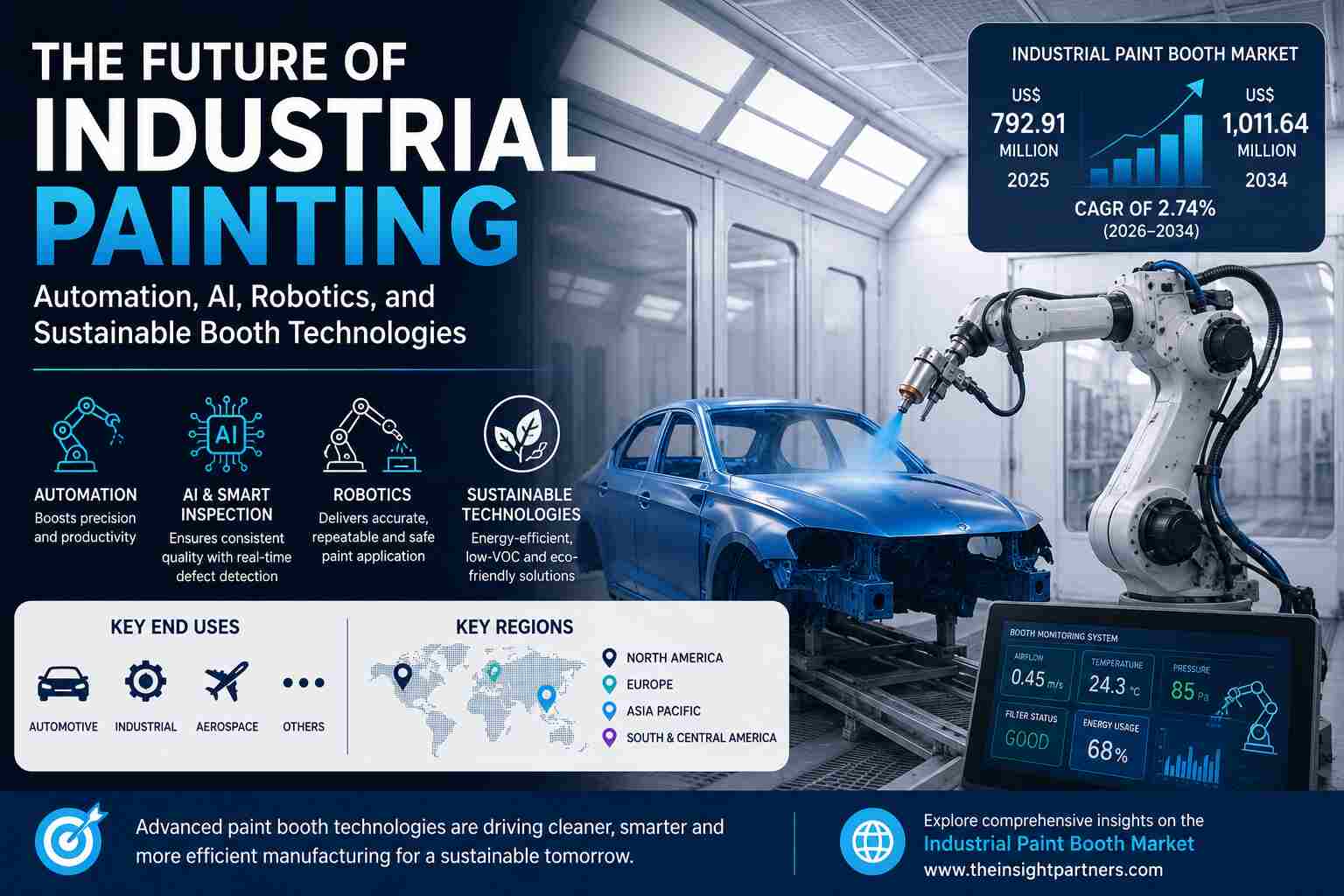
According to The Insight Partners, the Industrial Paint Booth Market was valued at US$ 792.91 million in 2025 and is projected to reach US$ 1,011.64 million by 2034, expanding at a CAGR of 2.74% during 2026–2034. The market's growth is supported by increasing demand for controlled coating environments across automotive, industrial, and aerospace applications, where consistent finishes, worker safety, overspray management, and regulatory compliance are critical.
Automation Is Redefining Industrial Painting
Automation is emerging as one of the most important forces shaping the future of industrial painting. Manufacturers are increasingly deploying automated spray systems, programmable controls, robotic arms, and automated material-handling systems to improve consistency and production efficiency.
Traditional manual painting processes can produce variations in coating thickness, spray patterns, and application speed. Automated systems can follow predefined application paths and repeat the same process across multiple workpieces. This helps manufacturers achieve more consistent coating quality while reducing material waste and minimizing dependence on manual intervention.
The increasing adoption of automation is particularly relevant to automotive manufacturing, where high production volumes require repeatable and reliable finishing processes. The automotive segment currently represents the largest end-use category in the Industrial Paint Booth Market, accounting for a modeled 52–56% share in 2025.
Automation is also becoming important for industrial manufacturers handling large or complex components. Machinery, agricultural equipment, rail vehicles, construction equipment, and fabricated metal products can require different coating processes and booth configurations. Modular and customizable automated systems can help manufacturers accommodate these varying production requirements.
Robotics Brings Precision to Paint Application
Robotic painting systems are expected to play an increasingly important role in next-generation industrial paint booths. Robots can deliver highly controlled movements, consistent spray distances, and repeatable application patterns, making them particularly useful for high-volume and precision-oriented manufacturing.
Robotic systems can also operate in environments where prolonged exposure to paint vapors or overspray may create occupational concerns. By performing repetitive spraying operations, robots can reduce the amount of direct human exposure to hazardous substances while allowing operators to focus on supervision, quality control, maintenance, and process optimization.
The combination of robotic arms with advanced paint booths can create highly integrated finishing cells. These systems can incorporate programmed spray recipes, controlled airflow, automated curing cycles, and digital monitoring. Such integration can improve throughput while reducing process variability.
Aerospace represents an especially promising application area. Although smaller than automotive in overall market contribution, aerospace is identified as a high-growth segment, with a modeled 3.4–3.8% CAGR during 2026–2034. Aircraft and aerospace components require high levels of contamination control, precise environmental management, and consistent finishing, making advanced booth technologies particularly valuable.
AI Is Making Paint Booths Smarter
Artificial intelligence is expected to extend automation beyond simple programmed operations. AI-enabled systems can analyze production data, identify variations, and support predictive decision-making.
For example, AI-based quality inspection systems can potentially detect coating defects, uneven coverage, color inconsistencies, or surface imperfections using cameras and machine-vision technologies. Instead of relying exclusively on manual inspection after painting, manufacturers can increasingly integrate real-time inspection into the production process.
AI can also support predictive maintenance. Paint booths contain several critical components, including fans, motors, burners, filters, control systems, and ventilation equipment. Monitoring operating parameters can help manufacturers identify abnormal performance before equipment failure causes significant downtime.
The Insight Partners identifies automation and AI as key future trends transforming paint application processes, alongside smart paint booths incorporating IoT-based real-time monitoring.
IoT Connectivity Enables Real-Time Monitoring
The future industrial paint booth is likely to be increasingly connected. IoT-enabled systems can collect information from sensors monitoring airflow, temperature, pressure, filter conditions, energy consumption, and other operating parameters.
Remote monitoring can provide production managers with visibility into booth performance without requiring constant physical inspection. This is especially useful for manufacturers operating multiple production facilities or large finishing lines.
Connected systems can also help manufacturers identify opportunities for energy optimization. Variable-frequency drives, programmed operating cycles, efficient motors, LED lighting, and intelligent controls can help reduce unnecessary energy consumption.
The market report highlights smart paint booths with IoT integration for real-time monitoring as an important market opportunity.
Sustainability Is Becoming a Core Design Priority
Environmental sustainability is another major factor influencing the evolution of industrial paint booths. Manufacturers face increasing pressure to reduce emissions, improve energy efficiency, minimize material waste, and adopt cleaner coating technologies.
Waterborne coatings and other environmentally preferable coating technologies are encouraging manufacturers to reconsider booth design and ventilation requirements. Advanced booths can be engineered to support these coating systems while maintaining appropriate airflow and filtration.
Energy efficiency is equally important. Conventional paint booths can consume significant amounts of energy because of ventilation, heating, lighting, and curing requirements. Technologies such as variable-frequency drives, heat recovery, energy-efficient motors, LED lighting, and optimized airflow can help reduce operating costs.
Europe is particularly important in this area. The region's industrial paint booth market is expected to grow at a modeled 2.1–2.5% CAGR through 2034, with energy costs and emissions requirements encouraging investments in heat recovery, efficient motors, recycling, and improved maintenance practices.
Modular and Flexible Booths Will Support Changing Production Needs
Another emerging direction is the development of modular and customizable paint booth solutions. Manufacturers increasingly need systems that can accommodate changing product sizes, production volumes, coating technologies, and facility constraints.
Crossdraft booths remain attractive because their horizontal airflow configuration can simplify installation and reduce civil-work requirements. Semi downdraft booths offer a balance between improved contamination control and installation requirements, while side draft booths can provide flexibility for large or irregular workpieces.
Modular designs can allow manufacturers to expand or modify finishing capacity without completely rebuilding their production infrastructure. This flexibility is particularly valuable for industrial facilities undergoing modernization or transitioning toward new product categories.
Asia Pacific Emerges as a Key Growth Engine
Geographically, Asia Pacific is positioned as an important growth region for industrial paint booth technologies. The region accounted for a modeled 30–32% market share in 2025 and is forecast to register a 3.3–3.7% CAGR during 2026–2034, making it the fastest-growing regional market in the report's assessment.
China's manufacturing scale, together with expanding automotive, machinery, and aerospace activities, supports demand for advanced coating infrastructure. Japan and South Korea contribute through their strong automation and manufacturing capabilities, while India is seeing demand from automotive, rail, defense, and broader industrial production.
As manufacturers across Asia Pacific modernize production facilities, opportunities are expected to increase for suppliers offering automated, energy-efficient, connected, and customizable paint booth solutions.
What the Future Holds for Industrial Paint Booths
The industrial paint booth is evolving from a basic ventilation enclosure into an intelligent component of the smart factory. Automation, robotics, AI, IoT connectivity, advanced filtration, energy management, and sustainable coating technologies are converging to create more productive and environmentally responsible finishing environments.
As manufacturers prioritize production consistency, worker safety, regulatory compliance, energy efficiency, and digital manufacturing, technology providers that can combine booth engineering with automation, monitoring, installation, and lifecycle maintenance are likely to gain a competitive advantage.
Ultimately, the future of industrial painting will not be defined by the paint booth alone. It will be shaped by the integration of automation, AI, robotics, intelligent airflow management, connected monitoring, and sustainable technologies into a unified finishing ecosystem. This transformation can help manufacturers achieve higher-quality finishes while controlling operating costs, improving productivity, and moving closer to the goals of smarter and more sustainable manufacturing.