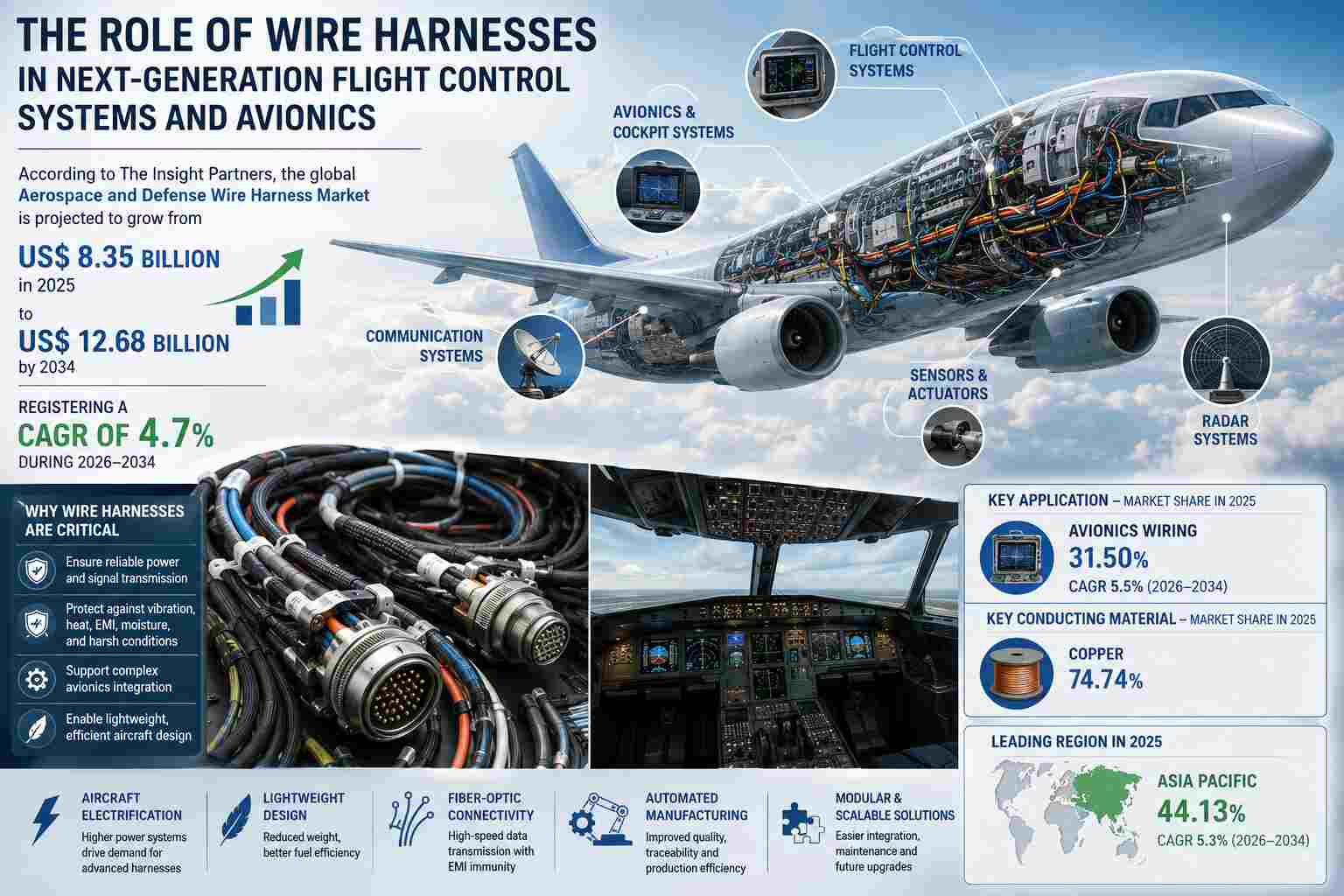
Modern aircraft are becoming increasingly connected, automated, and electrically intensive. From digital flight controls and advanced cockpit displays to radar, sensors, communication systems, and mission electronics, aircraft increasingly depend on sophisticated electrical and electronic architectures. At the center of these architectures are wire harnesses, which provide organized pathways for transmitting electrical power and signals between critical systems.
According to The Insight Partners, the global Aerospace and Defense Wire Harness Market is projected to grow from US$ 8.35 billion in 2025 to US$ 12.68 billion by 2034, registering a CAGR of 4.7% during 2026–2034. The market is being supported by aircraft electrification, avionics integration, fleet modernization, defense electronics upgrades, and the increasing deployment of electronic systems across commercial and military platforms.
Wire Harnesses: The Connectivity Backbone of Modern Aircraft
Aerospace wire harnesses are engineered assemblies comprising wires, cables, terminals, connectors, insulation, shielding, and other components. Their primary role is to distribute electrical power and transmit signals between aircraft systems while protecting connections against vibration, heat, electromagnetic interference (EMI), moisture, chemicals, and other demanding operating conditions.
In next-generation aircraft, the importance of these assemblies extends well beyond basic electrical connectivity. Flight computers, sensors, actuators, navigation systems, cockpit displays, communication equipment, and other avionics must exchange information continuously and reliably. A properly designed harness ensures that these systems receive the required power and maintain dependable signal transmission throughout the aircraft's operational life.
As aircraft electrical architectures become more complex, manufacturers are moving toward modular harness sets capable of carrying power, signal, radio-frequency, and fiber-optic transmission. This shift is increasing demand for lightweight designs, compact connectors, improved insulation, shielding, and highly traceable manufacturing processes.
Supporting Next-Generation Flight Control Systems
Flight control systems are among the most safety-critical applications for aerospace wire harnesses. Modern aircraft increasingly use electronic flight control architectures in which pilot commands are converted into electrical signals and processed by flight computers before actuators respond.
In these systems, harnesses connect flight-control computers, sensors, actuators, feedback mechanisms, and related electronic components. Any failure in a critical connection can affect system performance, which makes reliability, redundancy, shielding, connector quality, and manufacturing precision essential.
The Insight Partners identifies Flight Control Systems as one of the important application areas within the aerospace and defense wire harness market. Harnesses used in these systems must withstand vibration and temperature variations while maintaining electrical integrity over extended operating periods.
Next-generation aircraft are also integrating increasingly sophisticated control architectures. As the number of sensors and electronic control units increases, wiring networks can become heavier and more complicated. Consequently, aerospace manufacturers and harness suppliers are focusing on optimized routing, modular designs, lightweight conductors, and compact connections to improve overall aircraft efficiency.
Avionics Wiring Remains a Major Market Application
Avionics wiring represents the largest application segment in the Aerospace and Defense Wire Harness Market, accounting for 31.50% of the market in 2025 and expected to grow at a 5.5% CAGR between 2026 and 2034.
Modern avionics systems encompass navigation, communication, cockpit displays, flight computers, sensors, monitoring systems, and other electronic equipment. These systems require extensive wiring infrastructure to transmit power and data.
The growing digitalization of aircraft is increasing the density of avionics equipment. Advanced aircraft may integrate multiple sensors and computing systems that must communicate with one another in real time. This creates demand for harnesses capable of supporting higher data rates while minimizing weight and maintaining electromagnetic compatibility.
For harness manufacturers, this means that conventional wiring approaches are increasingly being supplemented by advanced connectivity solutions. Fiber-optic technologies can provide high-speed data transmission and immunity to electromagnetic interference, making optical fiber an increasingly relevant conducting material for selected aerospace applications.
Lightweighting Is Reshaping Aerospace Harness Design
Weight reduction remains one of the most important priorities in aircraft design. Every additional kilogram can influence fuel consumption, range, payload capacity, and overall operating efficiency. As a result, aerospace manufacturers are looking for opportunities to reduce the weight of electrical systems without compromising reliability or safety.
Wire harnesses can represent a significant portion of an aircraft's electrical infrastructure. Consequently, manufacturers are exploring lightweight conductors, thinner and more efficient insulation systems, compact connectors, optimized routing, and modular harness architectures.
Copper remains the dominant conducting material, accounting for 74.74% of the market in 2025, according to The Insight Partners. However, aluminum is attractive in applications where weight reduction is particularly important, while optical fiber is gaining relevance for high-speed data transmission and EMI-sensitive systems.
This balance between conductivity, weight, durability, cost, and manufacturability is expected to remain a key consideration as aircraft electrical systems evolve.
Advanced Insulation for Demanding Flight Environments
The insulation surrounding aerospace wires performs a critical protective function. Aircraft wiring may be exposed to high temperatures, vibration, abrasion, chemicals, fluids, moisture, and mechanical stress. Insulation must therefore provide reliable dielectric performance while meeting stringent safety and environmental requirements.
The Aerospace and Defense Wire Harness Market covers insulation materials including Polyvinyl Chloride (PVC), Cross-linked Polyethylene (XLPE), Polyethylene (PE), Polypropylene (PP), Polyurethane (PU), and Thermoplastic Elastomer (TPE).
Material selection depends on factors such as operating temperature, voltage, flexibility, abrasion resistance, weight, chemical exposure, and installation environment. As aircraft become more electrically intensive, the demand for materials capable of providing reliable performance in compact and high-density wiring environments is expected to increase.
Wiring for Radar and Military Communication Systems
The role of wire harnesses extends beyond commercial aviation. Modern military aircraft require sophisticated radar, electronic systems, sensors, secure communications, and mission equipment. These systems demand ruggedized wiring capable of functioning under challenging environmental and electromagnetic conditions.
Radar systems, for example, require high-integrity connections and effective shielding to maintain signal stability and electromagnetic compatibility. Military communication systems similarly depend on reliable wiring pathways to support data transmission and connectivity across airborne defense platforms.
Defense modernization programs are therefore creating additional opportunities for aerospace wire harness manufacturers. As military platforms receive upgraded avionics and mission systems, existing wiring architectures may need to be replaced, modified, or expanded.
Aircraft Electrification Creates New Wiring Requirements
Aircraft electrification is another important factor influencing the future of aerospace wire harnesses. More-electric aircraft architectures are increasing the amount of electrical power generated, distributed, and consumed onboard.
This trend creates demand for harnesses capable of handling higher electrical loads while maintaining thermal management, insulation performance, shielding, and reliability. The market report identifies low-, medium-, and high-voltage harnesses, with high-voltage systems becoming increasingly relevant to electrification, propulsion-adjacent systems, and high-power electronics.
The emergence of hybrid-electric and electric aviation could further accelerate this transition. Future aircraft architectures may require new approaches to power distribution, electrical protection, thermal management, and harness routing.
Automation and Traceability Are Transforming Manufacturing
As aerospace wire harnesses become more complex, manufacturers are also investing in automated production and digital manufacturing processes. Automated wire cutting, stripping, crimping, labeling, testing, and inspection can improve consistency while reducing manufacturing errors.
Traceability is particularly important in aerospace because harnesses used in flight-critical systems must meet stringent quality and certification requirements. Digital manufacturing systems can help suppliers track individual components, production parameters, testing results, and quality records.
The shift toward modular harnesses and digitally supported manufacturing is therefore likely to become an important competitive factor for aerospace suppliers.
Regional Growth Creates New Opportunities
The global aerospace and defense wire harness market is expanding across established aerospace manufacturing centers as well as emerging production hubs. Asia Pacific accounted for 44.13% of the market in 2025 and is projected to grow at a 5.3% CAGR through 2034, supported by demand from China, Japan, South Korea, India, and Australia. North America held a 23.43% share in 2025, while Europe accounted for 22.78%.
The increasing localization of aerospace manufacturing, defense production, maintenance, repair, and overhaul (MRO) activities is creating opportunities for regional wire harness suppliers. Markets such as India, South Korea, Gulf countries, and parts of Eastern Europe are expected to become increasingly important as domestic aerospace capabilities and defense manufacturing expand.
The Future of Aerospace Wire Harnesses
The future of aerospace wire harnesses will be closely connected to the evolution of aircraft electrical and electronic architectures. As aircraft become more electric, connected, autonomous, and software-defined, their wiring systems will need to deliver higher performance within increasingly constrained spaces.
Future developments are likely to focus on lightweight conductors, compact connectors, advanced insulation, fiber-optic connectivity, higher-voltage architectures, modular harnesses, automated manufacturing, and enhanced testing and traceability.
For flight control systems and avionics, reliability will remain the most important requirement. However, aerospace manufacturers will increasingly seek harness solutions that simultaneously reduce weight, support higher data rates, simplify maintenance, improve electromagnetic compatibility, and accommodate increasingly complex aircraft architectures.
With the Aerospace and Defense Wire Harness Market expected to witness significant growth through 2034, wire harnesses are positioned to remain a fundamental enabling technology for the next generation of commercial aircraft, military platforms, unmanned systems, and advanced aviation architectures.