
Flow Meter Market Size, Growth & Demand by 2034
Coverage: by Product (Differential Pressure, Positive Displacement, Magnetic, Ultrasonic, Others); Power Type (Electric, Solar, Battery Powered); Application (Water and Wastewater, Oil and Gas, Chemicals, Power Generation, Pulp and Paper, Food and Beverage, Others); and Geography (North America, Europe, Asia Pacific, and South and Central America)
- Status : Data Released
- Report Code : TIPRE00004803
- Category : Electronics and Semiconductor
- No. of Pages : 150
- Available Report Formats :


- Last update date : September 10, 2026


2025 Market Size
US$ 9.35 Bn
Base year value
2034 Forecast
US$ 14.72 Bn
Projected by 2034
CAGR 2026-2034
5.17 %
Growth rate
Addressable Market
US$ 109.19 Bn
(2026-2034)
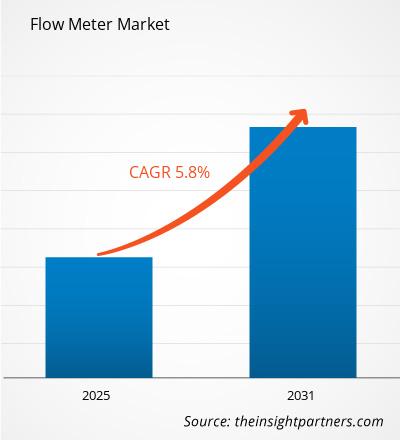
The global Flow Meter market was valued at US$ 9.35 billion in 2025 and is expected to reach US$ 14.72 billion by 2034; it is estimated to record a CAGR of 5.17% during 2026-2034.
Flow Meter Market Assessment and Insights
- North America: North America is expected to represent a 26–30% share in 2025, growing at a 5.7–6.1% CAGR between 2026–2034, supported by process automation, water infrastructure upgrades, energy production, and replacement of aging instrumentation.
- US: The US is estimated to account for 68–72% of North America's 2025 share, advancing at a 5.6–6.0% CAGR between 2026–2034, led by industrial modernization and utilities.
- Europe: Europe is estimated at a 24–28% share in 2025, with a 5.0–5.4% CAGR between 2026–2034. Germany, the UK, France, Italy, and Spain remain important markets because of process industries, environmental compliance, and energy efficiency programs.
- Asia Pacific: Asia Pacific is projected at a 31–35% share in 2025, expanding at a 6.2–6.7% CAGR between 2026–2034. China, Japan, South Korea, and India lead demand through manufacturing investment, utilities development, and industrial automation.
- Largest Segment: Magnetic products are estimated to hold a 28–32% market share in 2025, with a 5.8–6.4% CAGR from 2026–2034, reflecting strong suitability for conductive liquids, water networks, and process applications.
- High Growth Segment: Solar-powered meters represent an estimated 8–12% share in 2025, with a 7.0–7.8% CAGR from 2026–2034, supported by remote infrastructure and low-power monitoring requirements.
- Key companies analyzed in detail: ABB Ltd, Emerson Electric Co., Endress+Hauser Management AG, General Electric Company (GE), Honeywell International Inc., Höntzsch GmbH, KROHNE Messtechnik GmbH, Siemens AG, Tokyo Keiso Co., Ltd., Yokogawa Electric Corporation.
Source: The Insight Partners' analysis based on proprietary research, government publications, company annual reports, investor presentations, industry databases, and expert interviews.
The technological change is driving the shift in the measurement technology from stand-alone measuring instruments to more advanced instruments that will be able to perform diagnostics, verifications, and reconfiguration of the device remotely. The differential pressure plays an important role in the existing plants, whereas the magnetic, ultrasonic, and Coriolis measurements provide increased accuracy and lower maintenance as well as specific measurement capabilities.
During the forecasted period, the investments in the technology are expected to go into the water management, energy efficiency, process electrification, and instruments upgrade in the emerging industrial economies. This will be driven by the regulatory requirements for resource efficiency and environmental monitoring that are likely to drive the replacement of less advanced measuring systems. The manufacturers with wide range of applications, local calibration services, and digital services infrastructure are ready to meet such needs.
Flow Meter Market Report Scope
| Report Attribute | Details |
|---|---|
| Market size in 2025 | US$ 9.35 Billion |
| Market Size by 2034 | US$ 14.72 Billion |
| Global CAGR (2026 - 2034) | 5.17% |
| Historical Data | 2021-2024 |
| Forecast period | 2026-2034 |
Flow Meter Market Analysis
The demand in this industry is increasingly driven by the Growth of the Flow Meter Market due to automation in industries, utilities, process safety and resource optimization. The application of flow meters is vital wherever there is the need for controlling the rate of throughput, energy use, chemical addition, product quality and custody transfer. In terms of the value chain, the players range from sensor makers, electronics companies, systems integrators, distributors, calibrators and finally automation of industries.
Supply is influenced by the diverse sensing technology and applications. Magnetic flow meters are suitable for measuring conductive liquids while ultrasonic sensors facilitate non-intrusive flow measurement. Coriolis flow meters measure directly mass flow. Companies are developing software diagnostics and digital interface capabilities to generate revenue from service contracts. Availability of components, capability for calibration and manufacturing in various regions are key considerations in terms of delivery and project execution.
In Flow Meter Market Report, competitive positioning is now more based on technological diversity, application engineering, support for the installed base, and system integration with automation systems. Competing across multiple process technologies in the Market include ABB Ltd., Emerson Electric Co., Endress+Hauser Management AG, Honeywell International Inc., and Siemens AG. Companies like Yokogawa Electric Corporation, KROHNE Messtechnik GmbH, Tokyo Keiso Co., Ltd., and Höntzsch GmbH are bringing in additional expertise, while GE sustains its presence in measurement within the industrial and energy segment.
The investment is now moving towards networking, diagnostics, and low maintenance architecture. The entry by Emerson into the realm of non-intrusive ultrasonic technology indicates the importance of measurement technology that does not disrupt the process. Endress+Hauser can rely on its global manufacturing and calibration network, whereas Yokogawa is building on its digital technology within the existing magnetic and vortex meters. Competitive differentiation is becoming increasingly dependent on accuracy in difficult operating conditions, cybersecurity, communication compatibility, lifecycle services, and retrofit capability.
● REPORT CUSTOMIZATION
Tailor This Report To Align With Your Specific Business Requirements
This report can be customized to align precisely with your business objectives, scope, and target markets. Customization options include tailored segmentation, geography, competitive analysis, and strategic insights to support informed decision-making.
Customize This Report →WHAT YOU CAN ADJUST
- ● Segmentations
- ● Geography
- ● Competitive Analysis
- ● Language Preferences
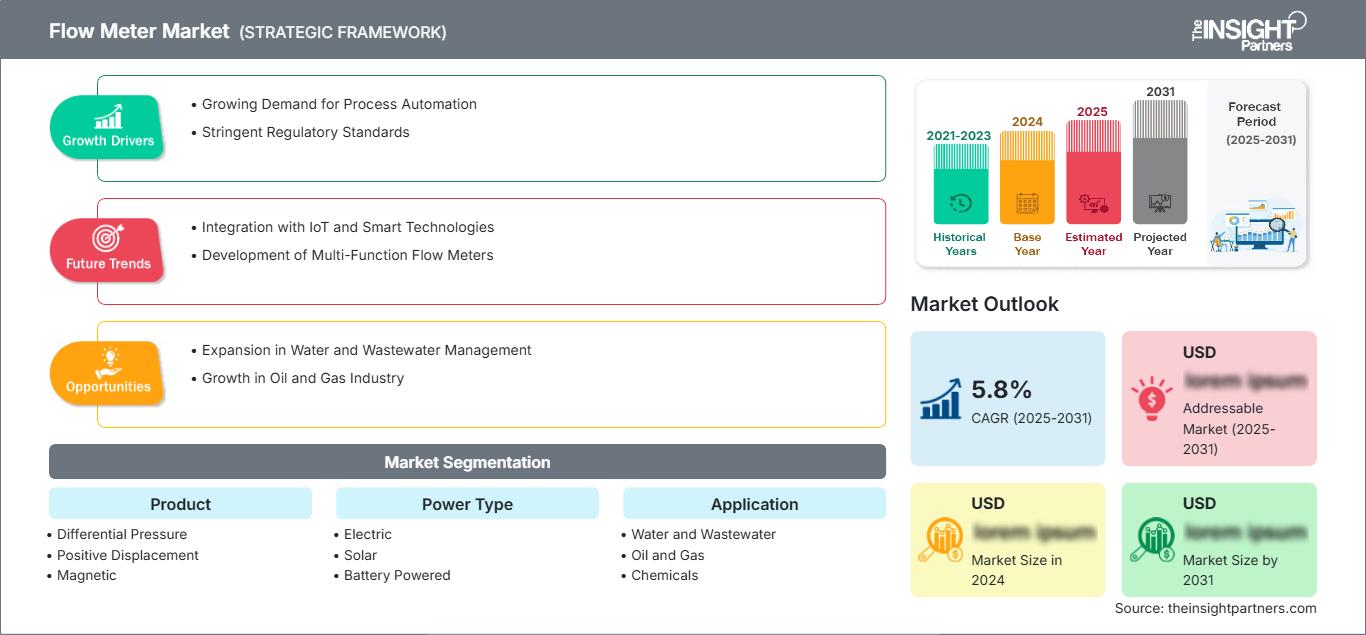
Flow Meter Market: Strategic Insights
Regional Insights
North America Flow Meter Market
North America is expected to maintain a 26–30% Flow Meter Market share in 2025 and expand at a 5.7–6.1% CAGR through 2034. The United States dominates regional demand, supported by oil and gas infrastructure, chemical processing, power generation, food manufacturing, and municipal water systems. Replacement of aging instrumentation remains an important source of recurring demand.
Canada’s participation in the market can be seen via energy, mining, water treatment, and industrial processes, while Mexico’s contributions include manufacturing and utilities applications. Customers will place more emphasis on remote monitoring, validation, communication compatibility, and lower maintenance needs. Non-invasive ultrasonic meters can prove advantageous when considering retrofit applications when shutdown or pipe modification is not desirable. Regional adoption will also gain from existing automation systems and well-developed distribution channels. For the North American Flow Meter Market, life cycle costing will become a factor as customers look to increase measurement reliability without disrupting processes.
U.S. Flow Meter Market
The US constitutes around 68-72% of North America’s share for 2025 and is projected to grow at a 5.6-6.0% CAGR over 2034. Demand is highly concentrated within oil and gas, chemicals, utilities, food processing, pharmaceuticals, and power generation. Leading vendors have extensive sales and services operations in the region.
Applications are moving towards smart meters which can measure, verify remotely and manage assets. There is an increasing need for reliable metering in water utilities and retrofits in industries to ensure minimal downtime. Leading players such as Emerson, Honeywell International Inc., ABB Ltd, Siemens AG, and Yokogawa Electric Corporation have significant technology footprint within the applications. In the US, there are replacement cycles for existing instrumentation and the gradual adoption of industrial Ethernet and digital field communications.
Europe Flow Meter Market
Europe is projected to have a market size of 24-28% in 2025, and grow at a CAGR of 5.0-5.4% to 2034. Germany continues to be the largest national market because of the presence of advanced process manufacturing, chemical, machinery, and energy systems. The market share of the Flow Meter Market in Europe is shaped by efficiency and modernization objectives.
There are demands in the UK for flow meters in the areas of water utilities, chemicals, energy, and food processing, with an emphasis on remote monitoring and asset management. Germany benefits from a strong industrial sector, and good instrumentation engineering expertise for the use of magnetic, ultrasonic, Coriolis, and differential-pressure flow meters. France, Italy, and Spain make contributions to the market through water infrastructure, food production, chemicals, electricity generation, and industrial automation. European consumers increasingly value energy efficiency, environmental monitoring, equipment validation, and compatibility with digital plant structures.
APAC Flow Meter Market
The APAC region will hold the leading regional market position with its 31–35% share and a 6.2–6.7% CAGR growth in 2025. In the region, China is the leading country in terms of demand, followed by Japan, South Korea, India, and Australia. The drivers include industrial automation and water infrastructure development.
In China, investments in the manufacturing sector and utilities industry help drive the volume of instrumentation demand; precision manufacturing and process optimization are the key drivers for Japan and South Korea, India offers its industrial development and water infrastructure projects, and Australia offers mining and energy applications and municipal uses. Greenfield projects and replacements of conventional instruments with connected devices shape the Flow Meter Market in the APAC region.
Middle East & Africa Flow Meter Market
The Middle East and Africa will see growth in demand at a rate of 5.4-5.9% CAGR, with Saudi Arabia being the major market in the region. Demand from the UAE comes from utilities, energy, and infrastructure applications, whereas South Africa's demand includes mining, water, chemical, and energy applications.
Investments in energy and industrial diversification in Saudi Arabia drive instrument investments, while the UAE's development of utilities and infrastructure supports demand for reliable measuring equipment. South Africa requires flow measurement in the mining industry and municipalities. The rest of the MEA region is dominated by project work in the oil and gas, desalination, and industrial infrastructure sector.
Segmentation Analysis
Product
The Product segment in the Flow Meter Market is projected to grow at a 5.5–6.1% CAGR from 2026–2034. Technology selection depends on fluid characteristics, accuracy requirements, pressure conditions, installation constraints, and maintenance priorities. Magnetic and ultrasonic solutions should gain relative importance where operators prioritize low maintenance and retrofit flexibility.
- Differential Pressure: Differential pressure meters remain strategically important in established steam, gas, and liquid installations. Their extensive installed base, engineering familiarity, and compatibility with legacy process systems sustain replacement and modernization demand.
- Positive Displacement: Positive displacement meters retain relevance where volumetric accuracy is important, particularly in controlled liquid applications. Their mechanical operating principle supports dependable measurement but can increase maintenance considerations compared with solid-state alternatives.
- Magnetic: Magnetic meters benefit from strong suitability for conductive liquids, including water, wastewater, chemicals, and slurries. Their absence of moving parts supports reliability and makes them attractive for continuous industrial and municipal applications.
- Ultrasonic: Ultrasonic meters are increasingly selected for non-intrusive measurement, large pipelines, retrofit projects, and applications where shutdowns are costly. Their flexibility supports adoption across water, energy, industrial, and utility installations.
- Others: Other technologies address specialized measurement conditions where conventional magnetic, differential pressure, or ultrasonic solutions may not provide the required combination of accuracy, fluid compatibility, or installation flexibility.
Power Type
The Power Type segment in the Flow Meter Market is expected to expand at a 5.8–6.8% CAGR from 2026–2034 as industrial users seek reliable operation across fixed and remote locations. Selection increasingly reflects availability of electrical infrastructure, maintenance access, energy efficiency requirements, and connectivity needs. Solar and battery architectures are particularly relevant to dispersed assets.
- Electric: Electric meters remain the dominant configuration across process plants and utility facilities because continuous power availability supports advanced electronics, communications, diagnostics, and integration with centralized control systems.
- Solar: Solar-powered meters address remote pipelines, water networks, irrigation systems, and dispersed infrastructure where grid connection is expensive. Their strategic value increases when autonomous operation and lower field maintenance are priorities.
- Battery Powered: Battery-powered meters support installations where cabling is difficult or power availability is intermittent. They are relevant to temporary monitoring, remote utilities, and decentralized networks requiring dependable operation with limited infrastructure.
Application
The Application segment in the Flow Meter Market is projected to advance at a 5.7–6.3% CAGR from 2026–2034. Demand is distributed across utilities and process industries, with measurement requirements varying according to fluid properties, safety conditions, production economics, and regulatory obligations. Water, oil and gas, chemicals, and power remain significant demand centers.
- Water and Wastewater: Water and wastewater applications require dependable measurement across treatment, distribution, leakage monitoring, and process control. Magnetic and ultrasonic technologies are particularly relevant because of their suitability for conductive fluids and large pipelines.
- Oil and Gas: Oil and gas operators use flow measurement for production optimization, allocation, custody transfer, pipeline monitoring, and process control. Accuracy, hazardous-area certification, pressure tolerance, and verification capabilities strongly influence procurement.
- Chemicals: Chemical facilities require measurement across corrosive, viscous, hazardous, and variable-composition fluids. Instrument selection therefore emphasizes material compatibility, accuracy, diagnostics, and reliable operation under demanding process conditions.
- Power Generation: Power plants use flow meters across steam, cooling water, fuel, feedwater, and auxiliary systems. Reliable measurement supports efficiency management, equipment protection, plant balancing, and operational troubleshooting.
- Pulp and Paper: Pulp and paper facilities require robust measurement for water, chemicals, stock preparation, and process fluids. Resistance to slurry conditions, deposits, and variable conductivity supports technology selection.
- Food and Beverage: Food and beverage applications prioritize hygienic construction, cleanability, repeatability, and accurate batch measurement. Coriolis, magnetic, and specialized sanitary technologies address different liquid and process requirements.
- Others: Other applications include mining, pharmaceuticals, marine operations, metals, and general manufacturing. These users create specialized demand where difficult fluids, harsh environments, compact installation, or high verification requirements influence equipment selection.
Opportunity Snapshot
| Application | Revenue Contribution (High/Medium/Low) | Trend Tag | Adoption Stage |
|---|---|---|---|
| Water and Wastewater | High | Smart Water | Scaling |
| Oil and Gas | High | Custody Transfer | Mature |
| Chemicals | High | Process Safety | Mature |
| Power Generation | Medium | Plant Efficiency | Mature |
| Pulp and Paper | Medium | Slurry Control | Scaling |
| Food and Beverage | Medium | Hygienic Flow | Scaling |
| Others | Low | Remote Monitoring | Emerging |
Flow Meter Market Growth Drivers and Impact Analysis
Water Infrastructure Modernization and Loss Reduction
The municipal water networks are emerging as an area of growing importance in terms of instrument demand due to the need for increased insight regarding production, delivery, consumption, and leakage rates. Flow meters are the basis for measurements used in district metering, pressure management, billing, optimization of treatment plants, and network balancing. Old infrastructure creates an increasing incentive for retrofit instruments that can be installed without extensive disruptions. In addition, solar- and battery-operated instruments make it possible to expand monitoring to remote parts of the network that do not have access to the electricity grid. The effect on the industry will not be limited to replacement but rather will result from the evaluation of meters in relation to monitoring systems.
Industrial Automation and Digital Process Control
The use of measurement data in terms of process optimization, maintenance and energy management is growing at industrial plants. Flow meters are changing from standalone devices to networked field devices that are capable of diagnostics, verification and communicating with control systems. This leads to an increased demand for devices that offer more than just flow readings, especially in the chemicals, power, food processing and energy industries. Digitization helps cut down on troubleshooting time since abnormal behavior of measurements can be detected prior to the decline in process performance. It adds value to the existing instrumentation since past data can be used in the analysis of production and maintenance needs.
Energy Efficiency and Process Optimization Requirements
Efficiency improvements and production reliability are required from energy-intensive manufacturing operations. Flow measurement enables operators to optimize steam, compressed air, cooling water, fuel, chemical, and process fluid flow rates, thereby helping them to find losses and maximize the usage of equipment. The issue of measuring accuracy becomes relevant when energy costs form a significant part of operational expenses. Besides, advanced metering equipment may be able to offer information about whether the fluctuations are caused by processes or by the deterioration of the measurement equipment itself. This leads to condition-based maintenance and eliminates unnecessary intervention. The justification for investment now often involves operational cost reductions as well as reliability factors in addition to measurement accuracy compliance alone. It creates opportunities for suppliers to demonstrate their added value throughout the lifecycle.
Flow Meter Market Future Trends
Connected Meters With Embedded Verification and Diagnostics
Future instrumentation will increasingly combine sensing, diagnostics, verification, communication, and asset-management functionality in a single device. The Flow Meter Market trends indicate a shift toward instruments capable of continuously assessing measurement health rather than relying exclusively on scheduled field calibration. Embedded diagnostics can identify abnormal process conditions, sensor deterioration, or installation issues and communicate relevant information to centralized systems. This architecture supports condition-based maintenance and can reduce unnecessary service visits. Digital interfaces will also become more important as plants adopt industrial Ethernet and connected asset platforms. Manufacturers are likely to differentiate products through software functionality, cybersecurity, remote configuration, and data quality rather than sensing hardware alone. The resulting market structure should favor suppliers able to combine measurement expertise with industrial digitalization capabilities.
Non-Intrusive Measurement for Retrofit and Asset Flexibility
Non-intrusive measurement is likely to gain broader acceptance where production continuity and installation flexibility are major priorities in the Flow Meter Market. Clamp-on ultrasonic technology can measure flow without cutting into pipework, reducing installation complexity and avoiding some shutdown requirements. This creates opportunities in operating plants where replacement of conventional meters would otherwise require isolation, draining, or process interruption. Large pipelines, hazardous fluids, temporary measurement studies, and verification projects are particularly relevant use cases. Future products should increasingly integrate improved signal processing, automated configuration, diagnostics, and portable connectivity. As industrial operators focus on maximizing asset availability, non-intrusive technologies can become a practical complement to permanently installed meters. The commercial opportunity extends beyond new equipment because retrofit applications can broaden the addressable installed base.
Flow Meter Market Opportunities
Localized Manufacturing and Service Ecosystems in Asia
Manufacturers can strengthen their position by expanding production, calibration, engineering, and service capabilities in high-growth Asian economies. China, India, South Korea, and Southeast Asia combine industrial investment with increasing demand for locally supported instrumentation. Localized capabilities can shorten delivery cycles, improve application engineering, and reduce service-response constraints for utilities and process plants. India is particularly relevant because industrial expansion and water infrastructure projects create demand across multiple application groups. Strategic investment should focus not only on assembly but also calibration laboratories, technical training, digital support, and regional spare-parts inventories. Partnerships with system integrators can further improve market access. The Flow Meter Market Forecasts therefore point toward a broader competitive role for regional manufacturing and service networks alongside traditional global production models.
Smart Water and Remote Asset Monitoring Platforms
Water utilities represent an attractive investment area because flow measurement can serve as a foundation for broader digital monitoring platforms. Suppliers can combine meters with communications, leakage analytics, remote diagnostics, and asset-management software to create solutions addressing network efficiency rather than individual measurement points. Solar and battery-powered devices can extend monitoring to remote pipelines and decentralized infrastructure without extensive electrical construction. Commercial strategies should prioritize interoperability because utilities frequently operate equipment from multiple generations and manufacturers. Pilot projects can establish measurable benefits before larger network deployment, reducing procurement risk. The opportunity is strongest where water scarcity, infrastructure losses, and modernization programs create pressure for better operational visibility. Vendors capable of integrating measurement hardware with practical analytics can therefore access recurring service opportunities beyond initial equipment sales.
Recent Developments
- April 2025: Emerson Electric Co. introduced the Flexim FLUXUS / PIOX 731 series of non-intrusive ultrasonic flow meters. The nine-model range supports volumetric and mass-flow measurement for gases and liquids, with modular hardware intended to reduce assembly time. The portfolio also includes disturbance correction, meter verification, wet-gas correction, and dynamic gas measurement functions for demanding industrial applications.
- July 2025: Yokogawa Electric Corporation. announced the first delivery of its next-generation AXG magnetic flowmeters in Maharashtra, India, through its wholly owned subsidiary Adept Fluidyne. The delivery expanded local availability of advanced magnetic measurement technology and followed Yokogawa's integration of Adept's established flowmeter capabilities, supporting applications across water, wastewater, and industrial processes.
- March 2025: ABB Ltd. continued expanding its digital flow-measurement portfolio, including Coriolis, magnetic, vortex, swirl, and thermal mass technologies with Ethernet-APL and digital verification capabilities. Its offering addresses water, oil and gas, chemicals, power, pulp and paper, and other industrial applications, reinforcing the shift toward connected measurement and lifecycle service functionality.
Frequently Asked Questions

- Comprehensive Market Sizing and Forecast Analysis
- Detailed Segmentation Analysis
- In-Depth Market Dynamics Assessment
- Regional and Country-Level Insights
- Competitive Landscape and Company Benchmarking
- Strategic Business Intelligence
Recent Reports
Testimonials

The Insight Partners' SCADA System Market report is comprehensive, with valuable insights on current trends and future forecasts. The team was highly professional, responsive, and supportive throughout. We are very satisfied and highly recommend their services.
RAN KEDEM Partner, Reali Technologies LTDs
I requested a report on a very specific software market and the team produced the report in a few days. The information was very relevant and well presented. I then requested some changes and additions to the report. The team was again very responsive and I got the final report in less than a week.
JEAN-HERVE JENN Chairman, Future Analytica
We worked with The Insight Partners for an important market study and forecast. They gave us clear insights into opportunities and risks, which helped shape our plans. Their research was easy to use and based on solid data. It helped us make smart, confident decisions. We highly recommend them.
PIYUSH NAGPAL Sr. Vice President, High Beam Global
The Insight Partners delivered insightful, well-structured market research with strong domain expertise. Their team was professional and responsive throughout. The user-friendly website made accessing industry reports seamless. We highly recommend them for reliable, high-quality research services
YUKIHIKO ADACHI CEO, Deep Blue, LLC.
This is the first time I have purchased a market report from The Insight Partners.While I was unsure at first, I visited their web site and felt more comfortable to take the risk and purchase a market report.I am completely satisfied with the quality of the report and customer service. I had several questions and comments with the initial report, but after a couple of dialogs over email with their analyst I believe I have a report that I can use as input to our strategic planning process.Thank you so much for taking the extra time and making this a positive experience.I will definitely recommend your service to others and you will be my first call when we need further market data.
JOHN SUZUKI President and Chief Executive Officer, Board Director, BK Technologies
I wish to appreciate your support and the professionalism you displayed in the course of attending to my request for information regarding to infectious disease IVD market in Nigeria. I appreciate your patience, your guidance, and the fact that you were willing to offer a discount, which eventually made it possible for us to close a deal. I look forward to engaging The Insight Partners in the future, all thanks to the impression you have created in me as a result of this first encounter.
DR CHIJIOKE ONYIA MANAGING DIRECTOR, PineCrest Healthcare Ltd.Reason to Buy
- Informed Decision-Making
- Understanding Market Dynamics
- Competitive Analysis
- Identifying Emerging Markets
- Customer Insights
- Market Forecasts
- Risk Mitigation
- Boosting Operational Efficiency
- Strategic Planning
- Investment Justification
- Tracking Industry Innovations
- Aligning with Regulatory Trends





 Get Free Sample for