
Corrosion Under Insulation Monitoring Market Key Players and Opportunities by 2034
Coverage: By Component (Hardware, Software, and Services) and End User (Oil & Gas, Marine, Chemical & Petrochemical, Energy & Power, Food Processing Industries, and Others) and Geography.
- Status : Data Released
- Report Code : TIPRE00029532
- Category : Electronics and Semiconductor
- No. of Pages : 150
- Available Report Formats :


- Last update date : October 26, 2026


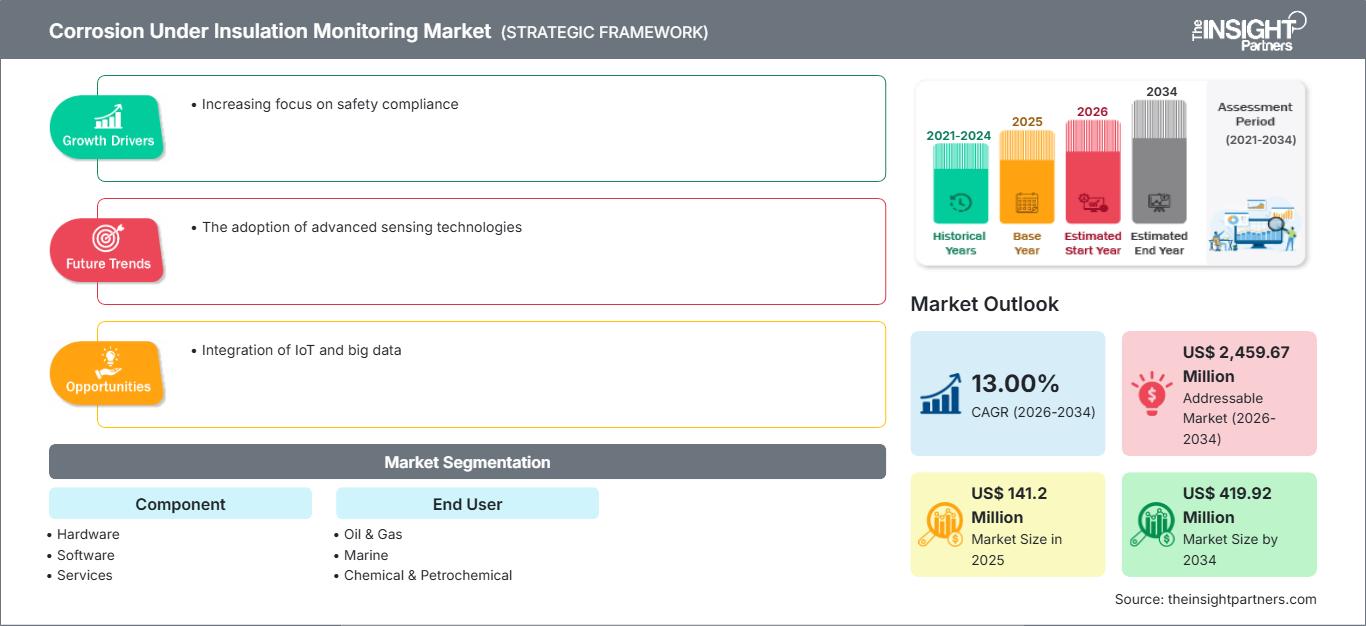
2025 Market Size
US$ 141.2 Mn
Base year value
2034 Forecast
US$ 419.92 Mn
Projected by 2034
CAGR 2026-2034
13.00 %
Growth rate
Addressable Market
US$ 2,459.67 Mn
(2026-2034)
The Corrosion Under Insulation Monitoring Market value stands at US$ 141.2 Million in 2025 and is expected to reach US$ 419.92 Million by 2034 with a CAGR of 13% during 2026 to 2034. The demand will be driven by the need for equipment, tools and software used for detecting moisture infiltration, wall loss and localized corrosion below the insulation within the industries of oil & gas, marine, chemical & petrochemical, energy & power and food processing.
In North America, Corrosion Under Insulation Monitoring Market size will be boosted by the CAGR of 12.1%-13.2% due to the increase in risk-based inspection at the refineries, LNG terminals, petrochemical plants, and power stations. The growth in the market is attributed to the aging of the insulated piping system, insurance company's focus on leak prevention and continuous monitoring guidance such as CUI RP 101.
Corrosion Under Insulation Monitoring Market Assessment and Insights
- North America: North America held a 32–35% share in 2025 and is growing at a 12.1–13.2% CAGR between 2026–2034, supported by refinery integrity mandates, LNG investments, and aging insulated pipework.
- US: The US represented 76–80% of North America in 2025 and is growing at a 12.3–13.4% CAGR between 2026–2034, led by downstream energy and petrochemical retrofits.
- Europe: Europe accounted for a 24–27% share in 2025 and is growing at an 11.4–12.6% CAGR between 2026–2034, with the UK, Germany, France, Italy, and Spain leading regulated inspection adoption.
- Asia Pacific: Asia Pacific held a 28–31% share in 2025 and is growing at a 14.0–15.2% CAGR between 2026–2034, driven by China, Japan, South Korea, India, and Australia industrial expansion.
- Largest Segment: Hardware led with a 46–49% market share in 2025 and a 12.0–13.1% CAGR between 2026–2034, reflecting sensor, probe, radiography, and ultrasonic equipment demand.
- High Growth Segment: Services held a 29–32% market share in 2025 and is growing at a 14.2–15.6% CAGR between 2026–2034 due to outsourced inspection programs.
- Key companies analyzed in detail: 3-Sci Limited, Alabama Specialty Products Inc., Eddyfi Technologies, iSensPro, KAEFER SE & Co. KG, MAXWELL NDT, MISTRAS Group, Inc., TesTex Incorporated, QSA Global, Inc., Rohrback Cosasco Systems, Inc., CorrosionRADAR Ltd., and Applied Technical Services, LLC.
Source: The Insight Partners' analysis based on proprietary research, government publications, company annual reports, investor presentations, industry databases, and expert interviews.
Technological development is driving the shift of CUI management from occasional insulation removal to continuous condition intelligence. The CUI Monitoring Market depends on moisture sensors, electrical resistance sensors, pulsed eddy current, guided wave ultrasonics, digital radiography, and technology that correlates invisible signs of corrosion with the schedule of inspections. Production requirements are shifting towards robust probes, intrinsically safe electronics, wireless gateways, cloud dashboards, and subscription-based services that allow operators to prioritize maintenance for critical insulated assets.
Future demand trends are likely to be driven by refinery turnarounds, liquefied natural gas expansion, increased capacity for chemicals, retrofits for decarbonization, and heightened asset integrity standards. New markets are embracing CUI monitoring as their industrial facilities mature and operating conditions lead to condensation underneath insulation due to temperature. Process safety programs and industry recommendations for continuous CUI monitoring will provide regulatory push behind investible data, risk prioritization, and predictive maintenance workflows.
Corrosion Under Insulation Monitoring Market Report Scope
| Report Attribute | Details |
|---|---|
| Market size in 2025 | US$ 141.2 Million |
| Market Size by 2034 | US$ 419.92 Million |
| Global CAGR (2026 - 2034) | 13.00% |
| Historical Data | 2021-2024 |
| Forecast period | 2026-2034 |
Corrosion Under Insulation Monitoring Market Analysis
Market drivers include the reduction of unexpected shutdowns, prevention of leaks, and focusing on inspection budgeting. Insulation stripping is being replaced by monitoring, which detects corrosion, moisture, and wall loss before any visible signs become visible. The market value chain includes sensor manufacturers, NDT equipment providers, radiography providers, software, inspection companies, insulation providers, and plant maintenance teams.
Supply factors are biased toward providers who can provide proven hardware with validation information and integrate them in RBI systems. Availability of hardware, hazardous area certificates, skill set of technicians, and reliability of the data generated will be some of the factors impacting supply. CUI RP 101 and AMPP training materials validate the need for continuous monitoring, while corrosion costs of over US$ 2.5 trillion per year make the case with executives.
The Corrosion Under Insulation Monitoring Market analysis reveals a competitive environment defined by accuracy of measurements, installation, scope of service, and readiness for analytics. MISTRAS Group, Inc., Eddyfi Technologies, TesTex Incorporated, QSA Global, Inc., and MAXWELL NDT participate via inspection equipment and field services. 3-Sci Limited, Alabama Specialty Products Inc., iSensPro, CorrosionRADAR Ltd., and Rohrback Cosasco Systems, Inc. offer solutions related to sensors for monitoring and measurement of corrosion.
Trends in investments include wireless communication capabilities, analytics tools, integration with digital twin, intrinsic safety, and service contracts linked to integrity of the plant. KAEFER SE & Co. KG is a newcomer with insulation and asset management services, while Applied Technical Services, LLC increases test capacity. Strategic positioning requires evidence of detection, reduction of lifecycle costs, availability of the installed base, and capability to turn sensor data into maintenance priorities.
● REPORT CUSTOMIZATION
Tailor This Report To Align With Your Specific Business Requirements
This report can be customized to align precisely with your business objectives, scope, and target markets. Customization options include tailored segmentation, geography, competitive analysis, and strategic insights to support informed decision-making.
Customize This Report →WHAT YOU CAN ADJUST
- ● Segmentations
- ● Geography
- ● Competitive Analysis
- ● Language Preferences
Corrosion Under Insulation Monitoring Market: Strategic Insights
Regional Insights
North America Corrosion Under Insulation Monitoring Market
The North American market share stood at 32–35% in 2025 and is projected to grow at a 12.1–13.2% CAGR from 2026 to 2034. The major structural factors driving corrosion under insulation monitoring market share include modernization of refineries, LNG export facilities, chemical processing facilities, and the presence of a lot of insulated pipes in aged facilities.
Operators monitor corrosion under insulation in order to minimize the cost associated with stripping off insulation, turnaround planning, and process safety exposure. The key driving forces behind corrosion under insulation monitoring include OSHA process safety management, insurance companies' expectations, exposure to severe weather conditions, and costly downtime in continuous-process industries. North America consists of the US and Canada, where the former drives demand whereas the latter drives demand via its oil sands, refining, and petrochemical operations.
U.S. Corrosion Under Insulation Monitoring Market
The United States constitutes 76–80% of North America in 2025 and is witnessing a CAGR of 12.3–13.4% during 2026–2034. The demand is driven by huge downstream refineries, petrochemical, LNG and power plants having insulated lines in conditions leading to condensation. Monitoring aids in risk-based inspection, scope of turnaround, leak detection and scheduling of high consequence circuits.
Players operating in the market include MISTRAS Group, Inc., TesTex Incorporated, QSA Global, Inc., Alabama Specialty Products Inc., Rohrback Cosasco Systems, Inc. and Applied Technical Services, LLC. Trends in applications are toward oil and gas plants with high temperature insulation and chemical plants dealing with corrosive service.
Europe Corrosion Under Insulation Monitoring Market
Europe was estimated to account for a market share of 24–27% in 2025 and has a projected compound annual growth rate (CAGR) of 11.4–12.6% from 2026 to 2034. United Kingdom is the leader in adoption via North Sea assets, refineries, and chemical hubs with risk-based inspection technology. Germany is next via petrochemicals, specialty chemicals, and energy assets where insulation technology must be efficient and sustainable.
France, Italy, and Spain add via refineries, LNG, maritime, and power assets that operate in humid coastal climates. Industrial safety rules, energy transition refurbishments, and maintenance optimization fuel adoption in Europe. Key companies active in the region include Eddyfi Technologies, KAEFER SE & Co. KG, iSensPro, 3-Sci Limited, and CorrosionRADAR Ltd.
APAC Corrosion Under Insulation Monitoring Market
The APAC segment accounted for a share of 28–31% in 2025 and is expected to grow at a CAGR of 14.0–15.2% from 2026 to 2034. China dominates due to petrochemical complexes, refinery expansions, and power projects. Japan and South Korea utilize monitoring for critical industrial equipment and offshore plants.
India and Australia are ramping up their adoption owing to refineries, liquefied natural gas, mining-related processing, and energy projects. The factors that drive adoption in the policy arena include industrial safety, energy security, and intolerance of outages. Competition among suppliers takes place using local servicing partnerships, portable NDT instrumentation, and continuous monitoring systems for hot, coastal, and humid conditions.
Middle East & Africa Corrosion Under Insulation Monitoring Market
Middle East & Africa is expected to grow at an 11.8–12.9% CAGR during 2026–2034. Saudi Arabia leads through refining, petrochemicals, gas processing, and desalination-linked infrastructure, while the UAE supports demand through LNG, storage terminals, and industrial free-zone assets.
South Africa and Rest of MEA demand is linked to power, mining, chemicals, and port infrastructure. High ambient temperatures, coastal salinity, and large insulated pipe networks increase CUI risk. Monitoring is adopted where leak avoidance, maintenance prioritization, and shutdown efficiency justify investment in sensors, radiography, and service-led inspection programs.
Segmentation Analysis
Component
The Component segment is forecast to grow at a 12.8–13.9% CAGR during 2026–2034. Corrosion Under Insulation Monitoring Market scope by component reflects a transition from equipment-led inspection to integrated integrity programs. Hardware remains the largest revenue base because probes, sensors, pulsed eddy current devices, and radiography systems are essential for detection, while software and services convert readings into inspection priorities.
- Hardware: Hardware holds the strongest position because operators require durable sensors, ultrasonic instruments, radiography equipment, coupons, and probes that can withstand insulated, high-temperature, and hazardous industrial environments.
- Software: Software demand is rising as asset owners need dashboards, corrosion-rate analytics, alarm management, data historians, and integration with risk-based inspection and maintenance management platforms.
- Services: Services are strategically important because many plants rely on external specialists for installation, calibration, validation, NDT execution, reporting, and interpretation of CUI risk across large asset portfolios.
End User
The End User segment is projected to grow at a 13.1–14.3% CAGR during 2026–2034. Demand is concentrated where insulated equipment failure can cause safety, environmental, or production losses. Oil and gas leads adoption because pipelines, vessels, and process units have high CUI exposure, while chemical, marine, power, and food processing facilities expand monitoring to reduce maintenance uncertainty.
- Oil & Gas: Oil and gas remains the core end user because refineries, LNG terminals, offshore assets, and gas plants contain extensive insulated piping with high safety and downtime consequences.
- Marine: Marine demand is supported by offshore platforms, vessels, terminals, and coastal infrastructure where salt exposure, vibration, and inaccessible insulated surfaces increase the need for non-invasive inspection.
- Chemical & Petrochemical: Chemical and petrochemical plants adopt monitoring to protect reactors, transfer lines, tanks, and utilities exposed to corrosive service, cyclic temperatures, and strict process safety obligations.
- Energy & Power: Energy and power facilities use monitoring for steam lines, boilers, turbines, heat recovery systems, and insulated piping where downtime, thermal efficiency, and safety are closely linked.
- Food Processing Industries: Food processing plants deploy monitoring selectively on insulated steam, chilled-water, and process lines where hygiene, temperature control, and uninterrupted production require reliable asset condition evidence.
Opportunity Snapshot
| End User | Revenue Contribution | Trend Tag | Adoption Stage |
| Oil & Gas | High | Asset Integrity | Mature |
| Marine | Medium | Offshore Risk | Scaling |
| Chemical & Petrochemical | High | Process Safety | Scaling |
| Energy & Power | Medium | Thermal Assets | Scaling |
| Food Processing Industries | Low | Hygiene Lines | Emerging |
Corrosion Under Insulation Monitoring Market Growth Drivers and Impact Analysis
Risk-Based Inspection Programs Shift Toward Continuous Evidence
There is mounting pressure on asset owners to demonstrate that the inspection intervals are based on actual equipment risk and not past records. Constant monitoring for CUI can help in identifying wet insulation, corrosion, and wall-loss detection outside of turnaround cycles, thus minimizing the chances of overlooking the degradation process. Procurement is affected by this driver as potential customers consider sensor reliability, qualification of sensors and systems, and compatibility of the system with computerized maintenance management systems. As far as practical implications, more targeted insulation stripping, less wasteful inspection, and timely action on critical circuits are seen.
Aging Industrial Assets Raise the Cost of Hidden Corrosion
There are old refineries, chemical processing plants, power plants, and marine facilities that have insulated assets dating decades back. The problem of CUI in these aged facilities can go unnoticed due to a combination of thermal cycles, damage to insulation jackets, moisture, and coating deterioration. Monitoring technology helps solve this challenge through the transformation of unobservable equipment to quantifiable condition information. The market potential is highest wherever a leak results in process downtime, repairs, pollution reports, or employee exposures. The operators now base their decisions for purchasing on the saved outage hours and uncertainty minimized in repairs.
Digital Maintenance Platforms Increase Demand for Connected Sensors
Industrial maintenance crews are moving towards digital tools that bring together past inspection records, sensor readings, work orders, and risk scores. The measurement of CUI falls in line with such a trend in that it provides time-stamped data on assets which were previously inspected manually at intermittent periods. Sensors connected wirelessly and analytics tools provide an ability to prioritize circuits based on their varying moisture levels and corrosion data. This driver increases the scope of activity for suppliers beyond being equipment providers to become data providers. The practical implications here are improved turnaround scoping, lower exposure in the field, and quick reaction to any changes in corrosion rates.
Corrosion Under Insulation Monitoring Market Future Trends
Predictive Analytics Become Central to CUI Decision-Making
Corrosion Under Insulation Monitoring Market trends show that there is going to be a move towards analyzing moisture levels, temperature, coating integrity, operating history, and inspection results in order to determine likelihood of corrosion. Future systems would not only be able to inform users about unusual data, but also prioritize the circuits based on maintenance requirements. This way, plants will be able to change their approach from general sampling to data-driven prioritization among thousands of insulated items. The implementation will be based on proven models, understandable outcomes, and cyber security measures.
Hybrid NDT and Permanent Monitoring Models Gain Scale
Future implementations are likely to rely on fixed sensors coupled with periodic pulsed eddy current testing, ultrasonics, and radiography. This hybrid solution will permit technicians to implement continuous monitoring of critical assets while using NDT in a portable fashion for verification and increased coverage during turnaround periods. Economies will be made through not having to instrument every insulated pipe. Suppliers will vie with each other in their ability to interface with the technology, train technicians, and report findings. With the refinement of best practices, hybrids will become easier to sell to the owner, insurers, and regulatory bodies.
Corrosion Under Insulation Monitoring Market Opportunities
Managed CUI Integrity Programs for Energy and Chemical Operators
Corrosion Under Insulation Monitoring Market Forecasts indicate an opportunity for suppliers to offer managed integrity programs that combine sensors, periodic NDT, software, and expert interpretation under multi-year contracts. Energy and chemical operators often lack enough specialized personnel to install, validate, and interpret monitoring systems across complex plants. Vendors can create recurring revenue by packaging asset selection, baseline inspection, data review, alarm triage, and turnaround recommendations. This opportunity is action-oriented because it shifts spending from one-time equipment purchases to outcome-linked service models. Providers should build standardized playbooks, technician networks, and reporting formats aligned with plant risk-based inspection procedures.
Brownfield Retrofit Packages for Aging Insulated Assets
Brownfield facilities represent a major opportunity because many high-risk insulated circuits were built before continuous monitoring became practical. Suppliers can develop retrofit packages that minimize insulation removal, use wireless communication, and fit hazardous-area requirements. The investment case is strongest for refineries, LNG terminals, petrochemical plants, and power stations preparing turnaround scopes. Vendors should prioritize modular kits, fast installation methods, and economic justification tools that compare monitoring cost with avoided downtime, scaffolding, and emergency repair. Strong execution can help operators extend asset life while meeting safety expectations without replacing large sections of existing pipework.
Recent Developments
- June 2026: IEV Group and CorrosionRADAR entered into a strategic partnership to expand continuous corrosion under insulation (CUI) monitoring capabilities across Southeast Asia, including Malaysia, Indonesia, India, Brunei, Vietnam, and Thailand. The collaboration combines CorrosionRADAR’s electromagnetic guided radar (EMGR)-based remote monitoring technology with IEV Group’s regional engineering and asset integrity services, enabling condition-based inspection planning, optimized maintenance, and enhanced long-term asset integrity management for insulated industrial infrastructure.
- May 2026: CorrosionRADAR partnered with Soluções Usiminas to expand continuous corrosion under insulation (CUI) monitoring across Brazil’s industrial sector. The collaboration combines CorrosionRADAR’s electromagnetic guided radar (EMGR)-based remote monitoring technology with Soluções Usiminas’ industrial maintenance and inspection expertise, enabling real-time asset integrity monitoring, predictive maintenance, reduced inspection costs, and improved operational reliability for critical infrastructure in the oil, gas, mining, and energy industries.
- July 2026: A joint industry project led by SIRRIS brought together energy companies, coating manufacturers, and research organizations to develop new approaches for reducing corrosion under insulation (CUI) in oil, gas, and petrochemical assets. The first phase evaluated advanced coating test methods, moisture monitoring technologies, and electrochemical impedance spectroscopy (EIS) techniques to improve early detection, understand coating degradation, and strengthen asset integrity management. The initiative aims to support predictive maintenance strategies, reduce CUI-related failures, and establish improved industry standards for long-term corrosion prevention.
Frequently Asked Questions

- Comprehensive Market Sizing and Forecast Analysis
- Detailed Segmentation Analysis
- In-Depth Market Dynamics Assessment
- Regional and Country-Level Insights
- Competitive Landscape and Company Benchmarking
- Strategic Business Intelligence
Recent Reports
Testimonials

The Insight Partners provided valuable market intelligence that supported our global go-to-market strategy. Their team was professional, responsive, and attentive to our feedback, providing thoughtful analysis and helpful methodological clarifications throughout the project.
Junmo Kim Chief Financial Officer (CFO), Enertech Co., Ltd.
The Insight Partners' SCADA System Market report is comprehensive, with valuable insights on current trends and future forecasts. The team was highly professional, responsive, and supportive throughout. We are very satisfied and highly recommend their services.
RAN KEDEM Partner, Reali Technologies LTDs
I requested a report on a very specific software market and the team produced the report in a few days. The information was very relevant and well presented. I then requested some changes and additions to the report. The team was again very responsive and I got the final report in less than a week.
JEAN-HERVE JENN Chairman, Future Analytica
We worked with The Insight Partners for an important market study and forecast. They gave us clear insights into opportunities and risks, which helped shape our plans. Their research was easy to use and based on solid data. It helped us make smart, confident decisions. We highly recommend them.
PIYUSH NAGPAL Sr. Vice President, High Beam Global
The Insight Partners delivered insightful, well-structured market research with strong domain expertise. Their team was professional and responsive throughout. The user-friendly website made accessing industry reports seamless. We highly recommend them for reliable, high-quality research services
YUKIHIKO ADACHI CEO, Deep Blue, LLC.
This is the first time I have purchased a market report from The Insight Partners.While I was unsure at first, I visited their web site and felt more comfortable to take the risk and purchase a market report.I am completely satisfied with the quality of the report and customer service. I had several questions and comments with the initial report, but after a couple of dialogs over email with their analyst I believe I have a report that I can use as input to our strategic planning process.Thank you so much for taking the extra time and making this a positive experience.I will definitely recommend your service to others and you will be my first call when we need further market data.
JOHN SUZUKI President and Chief Executive Officer, Board Director, BK Technologies
I wish to appreciate your support and the professionalism you displayed in the course of attending to my request for information regarding to infectious disease IVD market in Nigeria. I appreciate your patience, your guidance, and the fact that you were willing to offer a discount, which eventually made it possible for us to close a deal. I look forward to engaging The Insight Partners in the future, all thanks to the impression you have created in me as a result of this first encounter.
DR CHIJIOKE ONYIA MANAGING DIRECTOR, PineCrest Healthcare Ltd.Reason to Buy
- Informed Decision-Making
- Understanding Market Dynamics
- Competitive Analysis
- Identifying Emerging Markets
- Customer Insights
- Market Forecasts
- Risk Mitigation
- Boosting Operational Efficiency
- Strategic Planning
- Investment Justification
- Tracking Industry Innovations
- Aligning with Regulatory Trends






 Get Free Sample for