
Air Quality Control Systems Market Growth, Size & Forecast by 2034
Coverage: By Type (Electrostatic Precipitators (ESP), Flue Gas Desulfurization (FGD), Selective Catalytic Reduction (SCR), Others); Industry Vertical (Energy and Power, Oil and Gas, Manufacturing, Others) , and Geography (North America, Europe, Asia Pacific, and South and Central America)
- Status : Data Released
- Report Code : TIPRE00006146
- Category : Electronics and Semiconductor
- No. of Pages : 150
- Available Report Formats :


- Last update date : July 17, 2026


2025 Market Size
US$ 123.42 Bn
Base year value
2034 Forecast
US$ 220.97 Bn
Projected by 2034
CAGR 2026-2034
6.69 %
Growth rate
Addressable Market
US$ 1,557.04 Bn
(2026-2034)
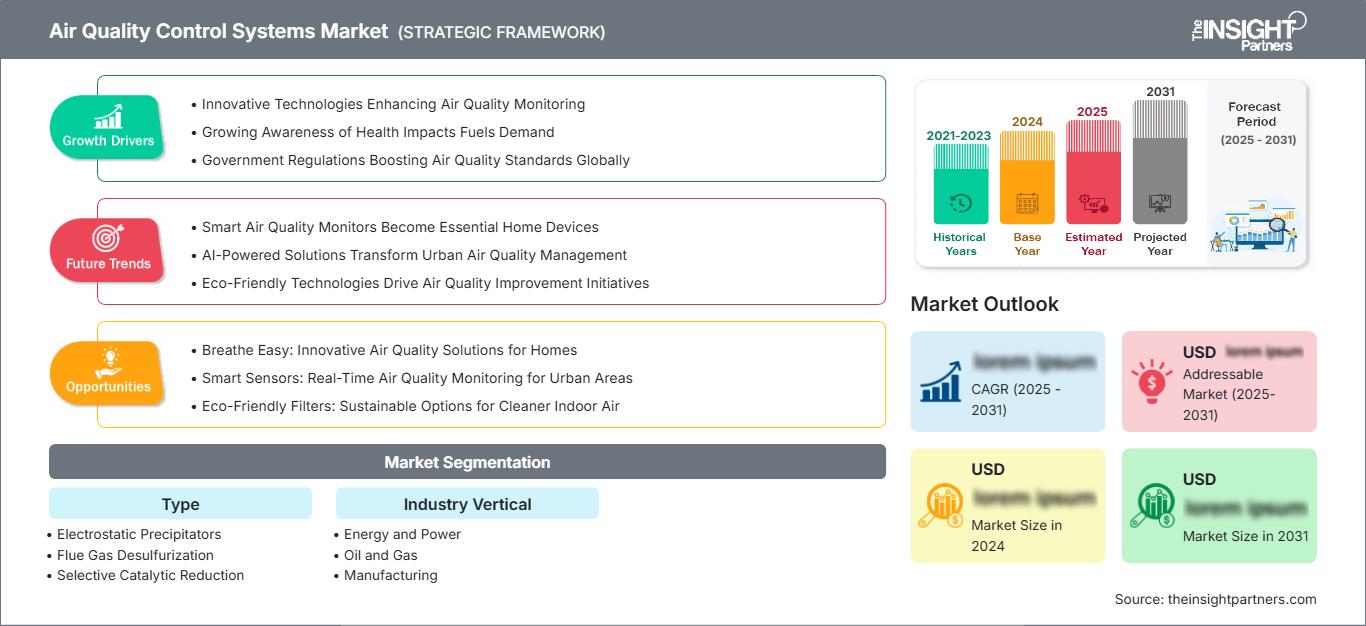
The global Air Quality Control Systems market size is expected to grow from US$ 123.42 billion in 2025 to US$ 220.97 billion in 2034; the market is expected to witness a CAGR of 6.69% during the forecast period from 2026 to 2034. The demand will be driven by more stringent emissions regulations in industries, aged thermal assets, and requirements to decrease particulate emissions, sulfur oxides, nitrogen oxides, mercury emissions, and acid gases.
In North America, the market is fueled by a CAGR growth range of 5.9–6.4%. This is driven by power generation plant cycle for retrofits along with replacement of older particulate and gas control equipment. Power generation companies in the United States still consider modularity in scrubbers, electrostatic precipitators, and selective catalytic reduction as primary factors.
Air Quality Control Systems Market Assessment and Insights
- North America accounted for 26–29% share in 2025 and is growing at a CAGR range of 5.9–6.4% during 2026–2034, led by coal fleet compliance upgrades, refinery controls, and industrial permitting pressure.
- US represented 78–82% of North America in 2025 and is growing at a CAGR range of 5.8–6.3% during 2026–2034, supported by retrofit spending.
- Europe held 20–23% share in 2025 and is growing at a CAGR range of 5.4–5.9% during 2026–2034, with Germany, the UK, France, Italy, and Spain leading industrial abatement investments.
- Asia Pacific captured 34–37% share in 2025 and is growing at a CAGR range of 7.4–7.9% during 2026–2034, led by China, India, Japan, South Korea, and Australia.
- Largest Segment Flue Gas Desulfurization held 38–42% market share in 2025, growing at a CAGR range of 6.4–6.9% during 2026–2034 because sulfur control remains capital intensive.
- High Growth Segment Selective Catalytic Reduction held 26–30% market share in 2025, growing at a CAGR range of 7.1–7.6% during 2026–2034 as NOx limits tighten.
- Key companies analyzed in detail: Babcock and Wilcox Enterprises, Inc., Ducon Technologies Inc., Fujian Longking Co., Ltd., GEA Group Aktiengesellschaft, General Electric Company, Hamon Corporation, Mitsubishi Heavy Industries, Ltd., Thermax Limited, Tri-Mer Corporation, and Wood PLC.
Source: The Insight Partners' analysis based on proprietary research, government publications, company annual reports, investor presentations, industry databases, and expert interviews.
From an adoption perspective, the shift has gone from singular pollutant control to a train design including particulate control, desulfurization, denitrification, sorbent injection, and ongoing air quality monitoring. EPA standards indicate that electrostatic precipitators have the capability of achieving efficiencies above 99%, while according to WHO statistics, 99% of the world population is breathing air contaminated beyond standard guidelines. Such situations ensure that the market remains dynamic in terms of installations where industrial activity meets environment requirements.
Future expectations reveal that new areas will contribute significantly to project assignments due to an increasing demand for coal, cement, refining, and metal capacity, all in more stringent conditions. According to reports by the International Energy Agency, there seems to be no increase in power sector emissions; however, fossil fueled plants will still have a significant presence in China, India, Southeast Asia, and some Middle Eastern countries.
Air Quality Control Systems Market Report Scope
| Report Attribute | Details |
|---|---|
| Market size in 2025 | US$ 123.42 Billion |
| Market Size by 2034 | US$ 220.97 Billion |
| Global CAGR (2026 - 2034) | 6.69% |
| Historical Data | 2021-2024 |
| Forecast period | 2026-2034 |
Air Quality Control Systems Market Analysis
Decarbonizing industry does not make pollutant abatement obsolete, but rather shifts focus from one area to another. Drivers of growth in Air Quality Control Systems Market are reliability improvement, dust reduction, reagents optimization, and compliance of assets which are still functioning through energy transition. Power plants demand SOx, NOx and particulates control, while refineries and manufacturing facilities need systems with flexible fuel qualities and load handling capabilities.
The ecosystem consists of engineering contractors, catalyst suppliers, absorbers manufacturers, sensors providers and service firms. Factors affecting the supply side include steel prices, specialty metals prices, catalysts supply and local fabrication. The buyers tend to evaluate their projects in terms of lifetime costs rather than initial price of equipment, thus creating advantage for vendors capable of combining engineering, installation, digital monitoring, reagents supply and maintenance into one package.
According to the Air Quality Control Systems Market report, there is competition within the market involving global engineering companies and specialty pollution control equipment manufacturers based on installed base, retrofit capabilities, and process expertise. Babcock & Wilcox Enterprises, Inc., Mitsubishi Heavy Industries, Ltd., Thermax Limited, and GEA Group Aktiengesellschaft have a competitive edge in complex projects, whereas Ducon Technologies Inc., Tri-Mer Corporation, and Fujian Longking Co., Ltd. will continue to enhance their niches.
Investment is focusing on modules for retrofits, low water desulfurization technology, particulate collection technology, and catalysts capable of handling fluctuating boiler loads. General Electric Company, Wood PLC, and Hamon Corporation will continue to be relevant via engineering, services, and project execution capabilities. The current strategic positioning requires compliance assurance, rapid installation, diagnostics, and system compatibility for carbon capture pre-treatment needs.
● REPORT CUSTOMIZATION
Tailor This Report To Align With Your Specific Business Requirements
This report can be customized to align precisely with your business objectives, scope, and target markets. Customization options include tailored segmentation, geography, competitive analysis, and strategic insights to support informed decision-making.
Customize This Report →WHAT YOU CAN ADJUST
- ● Segmentations
- ● Geography
- ● Competitive Analysis
- ● Language Preferences
Air Quality Control Systems Market: Strategic Insights
Regional Insights
North America Air Quality Control Systems Market
North America accounted for 26–29% share in 2025, with an estimated 5.9–6.4% CAGR during 2026–2034. The Air Quality Control Systems Market share is supported by U.S. coal and gas generation, refinery emission controls, cement kilns, and chemical processing plants that require documented performance under federal and state air programs. Canada adds demand through oil sands, metals, and industrial boiler applications.
Regional purchasing favors retrofit-friendly equipment, predictable outage schedules, and service contracts that reduce compliance risk. EPA program data identify flue gas desulfurization as a principal SO2 control route for coal-fired electricity units, reinforcing the installed-base service opportunity. Vendors with U.S. fabrication, catalyst support, and field engineering capacity remain well positioned as operators extend asset lives while lowering emissions intensity.
U.S. Air Quality Control Systems Market
The US accounted for 78–82% of North America in 2025, and is expected to grow at a CAGR of 5.8–6.3% during 2026-2034. The key application drivers include coal-fired power generation, petrochemical production, oil and gas processing plants, steel mills, cement manufacturing plants, and waste-to-energy applications. Babcock and Wilcox Enterprises, Inc. and General Electric Company have service advantages, while other manufacturers provide wet scrubbers and particulate control equipment.
Trends in application include retrofits of old electrostatic precipitator internals, replacement of SCR catalyst layers, dry sorbent injection systems, and installation of continuous emissions monitoring systems with predictive maintenance. Increased demand for electricity from data centers and industrial reshoring results in increased demand for reliable electricity generation which could help to finance the retrofits. Compliance planning is linked to outage planning, reagent logistics, and emission margin management.
Europe Air Quality Control Systems Market
The European market share stood at 20–23% in 2025, and a CAGR of 5.4–5.9% is forecast for 2026-2034. Germany leads due to the fact that power plants, chemical industry, cement production, and waste incineration operations must comply with the emission regulation requirements continuously. In the UK, waste-to-energy, biomass, and industrial boilers abatement drives growth by generating the need for miniaturization and services.
France, Italy, and Spain benefit from cement, refinery, glass, and metal industries where nitrogen oxide and particulate regulation impact the buying decision. Buyers in Europe pay close attention to energy savings, reagent consumption, water use, and circular materials management in scrubber residuals. Competitors such as GEA Group Aktiengesellschaft, Mitsubishi Heavy Industries, Ltd., Wood PLC, and Hamon Corporation operate through engineering expertise and local delivery chains.
APAC Air Quality Control Systems Market
The APAC region secured 34–37% market share in 2025 and is projected to register a CAGR of 7.4–7.9% from 2026 to 2034. The dominance of China in the region can be attributed to large-scale industries, power plants, and local manufacturers like Fujian Longking Co., Ltd. India follows China owing to its addition of thermal power capacities, expansion of refineries, and delayed flue gas desulfurization projects.
In Japan and South Korea, efficient SCR technology, particulates removal, and small-sized retrofits dominate. In Australia, the mining sector, metal industry, and power applications have been identified. Pressure by policy makers against SO2, NOx, and PM2.5 emissions, along with industrial production growth, make APAC the largest and most rapidly growing region for the market.
Middle East & Africa Air Quality Control Systems Market
Middle East and Africa is projected to grow at a 6.2–6.7% CAGR during 2026–2034, with Saudi Arabia leading regional demand. Oil refining, petrochemicals, power generation, and metals projects require emission control packages that can operate under high-temperature, high-dust, and corrosive gas conditions.
The UAE supports demand through industrial zones and waste-to-energy projects, while South Africa depends on coal power and mining-linked processing. Rest of MEA opportunities are tied to infrastructure expansion and tighter environmental permitting. Suppliers with corrosion-resistant designs, local service partners, and financing support are better placed to convert project pipelines.
Segmentation Analysis
Type
Type is expected to grow at a 6.5–7.0% CAGR during 2026–2034 as buyers select technology according to pollutant profile, fuel chemistry, boiler configuration, water availability, and retrofit space. The Air Quality Control Systems Market scope across type categories reflects a shift toward integrated packages that combine sulfur, nitrogen, and particulate reduction while preserving plant availability.
- Electrostatic Precipitators remain essential for high-volume particulate control in power, cement, metals, and pulp applications because they handle large flue gas streams with low pressure drop and long operating life.
- Flue Gas Desulfurization maintains the largest segment position because sulfur control often requires absorber vessels, reagent systems, oxidation, dewatering, and wastewater handling across coal, refining, and heavy industry.
- Selective Catalytic Reduction gains strategic importance as NOx limits tighten and operators seek higher removal efficiency under variable load conditions, especially in power generation, process heating, and industrial boilers.
Industry Vertical
Industry Vertical is projected to grow at a 6.6–7.1% CAGR during 2026–2034, led by applications where continuous production and regulatory compliance intersect. Energy and power remains the anchor, but oil and gas and manufacturing facilities are adopting tailored systems to control sulfur oxides, nitrogen oxides, acid gases, particulate matter, and hazardous air pollutants.
- Energy and Power generates high revenue contribution because thermal plants, biomass units, and waste-to-energy assets require robust systems that maintain emission margins across changing load profiles.
- Oil and Gas demand is shaped by refinery heaters, sulfur recovery units, FCC units, and petrochemical complexes that need corrosion-resistant scrubbers, oxidizers, and gas treatment systems.
- Manufacturing covers cement, steel, chemicals, glass, pulp, and food processing facilities where localized permits, dust handling, and operational continuity determine technology selection.
Opportunity Snapshot
| Industry Vertical | Revenue Contribution | Trend Tag | Adoption Stage |
| Energy and Power | High | Coal Retrofit | Mature |
| Oil and Gas | Medium | Refinery Controls | Scaling |
| Manufacturing | Medium | Kiln Abatement | Scaling |
Air Quality Control Systems Market Growth Drivers and Impact Analysis
Tightening Industrial Emission Standards
Regulatory pressure remains the strongest demand catalyst because emission limits increasingly apply to multiple pollutants rather than single pollutants. Facilities must document lower SO2, NOx, PM, mercury, and acid gas levels while avoiding production interruptions. This pushes buyers toward integrated systems with monitoring, reagent control, and guaranteed performance. The commercial impact is visible in longer service contracts, higher retrofit content, and greater demand for engineering studies before capital approval. Vendors that can quantify removal efficiency, pressure drop, water use, and lifecycle cost gain an advantage in competitive tenders.
Aging Thermal and Industrial Installed Base
Many power, refining, cement, and metals assets were designed before current emission limits, making retrofit spending a practical alternative to full replacement. Operators are replacing collection plates, absorber internals, mist eliminators, catalyst layers, ductwork, and control systems to extend asset life. This driver supports steady aftermarket revenue and creates entry points for modular solutions that minimize outage time. The Air Quality Control Systems Market benefits when older facilities remain economically necessary but must operate with improved environmental performance and documented compliance margins.
Industrial Expansion in High-Emission Sectors
Capacity additions in cement, chemicals, petrochemicals, refining, steel, and thermal power sustain equipment demand in regions where industrial output is still rising. New plants increasingly include emission control packages at the design stage to secure permits and financing. This improves project visibility for suppliers and raises the importance of local manufacturing partnerships. The impact extends beyond original equipment, because installed systems require reagents, catalyst replacement, inspections, spares, and performance optimization throughout the operating life of the facility.
Air Quality Control Systems Market Future Trends
Digital Optimization of Emission Control Assets
Air Quality Control Systems Market trends point toward sensor-led optimization that adjusts reagent dosing, catalyst use, voltage settings, and pressure drop in real time. Digital layers will become more important as plants operate under variable fuel quality and flexible load conditions. Predictive maintenance can identify fouling, catalyst deactivation, corrosion, and dust re-entrainment before compliance risk rises. Vendors offering analytics with equipment warranties can convert one-time capital sales into recurring service relationships, improving customer retention and operating performance.
Low-Water and Hybrid Abatement Designs
Water constraints and wastewater rules are moving procurement toward semi-dry scrubbers, dry sorbent injection, hybrid particulate systems, and designs that reduce purge streams. These solutions will gain relevance in arid regions, mining areas, and industrial zones with limited water allocation. Hybrid packages can balance removal efficiency, capital cost, and environmental footprint by combining dry and wet stages. This trend also supports modular construction, faster installation, and simpler permitting where large wet systems face space or water limitations.
Air Quality Control Systems Market Opportunities
Retrofit Programs for Emerging Power Fleets
Air Quality Control Systems Market Forecasts indicate that retrofit programs in India, Southeast Asia, and selected Middle Eastern markets will create attractive project pipelines. Many thermal and industrial boilers need staged upgrades rather than immediate retirement, particularly where electricity demand and industrial employment remain policy priorities. Suppliers can target engineered packages combining FGD, SCR, ESP upgrades, and monitoring. Financing partnerships, local fabrication, and phased installation schedules will be decisive because utilities and industrial operators often manage capital limits while meeting tighter emission deadlines.
Carbon Capture Pre-Treatment Integration
Carbon capture projects require cleaner flue gas streams because particulates, SOx, NOx, and acid gases can degrade solvents and raise operating costs. This creates an adjacent opportunity for air quality control vendors to supply pre-treatment systems, polishing stages, and performance monitoring before capture units. The opportunity is strongest in power, cement, refining, and waste-to-energy facilities evaluating capture readiness. Vendors that align pollutant control engineering with carbon capture developers can participate earlier in feasibility studies and secure higher-value integrated contracts.
Recent Developments
- August 2025: Emerson has announced the new PACSystems RX3i CPS400 Safety Controller, designed to enable Safety Integrity Level 2 (SIL2) strategies for infrastructure, fire and gas, burner management systems, and other emergency shutdown systems. The PACSystems Safety Controller is a compact, high-performance solution with robust security measures and a scalable architecture with 2,000 available I/O points, ideal for complex projects with evolving requirements.
- June 2026: Cummins in India, a leading integrated power solutions provider marked another milestone in the evolution of the Cleaner Air Better Life (CABL) initiative, with the launch of an advanced Decision Support System (DSS) for air quality management in Pune and Pimpri Chinchwad. Conceptualized by Cummins in India, CII and NITI Aayog, CABL has evolved into a national multi-stakeholder platform bringing together government, industry, academia, civil society and communities to address air pollution through four focused task forces on clean transport, clean fuel, clean industry and biomass management.
- May 2026: IQAir North America announced today the launch of its new US trade-in program, designed to give customers a more flexible and cost-effective way to upgrade their air quality monitors and purifier systems as their needs and environments change over time. Through the program, eligible customers can return qualifying previously purchased IQAir air purifiers and air quality monitors in exchange for IQAir Credit toward the purchase of a new IQAir model.
Frequently Asked Questions

- Comprehensive Market Sizing and Forecast Analysis
- Detailed Segmentation Analysis
- In-Depth Market Dynamics Assessment
- Regional and Country-Level Insights
- Competitive Landscape and Company Benchmarking
- Strategic Business Intelligence
Recent Reports
Testimonials

The Insight Partners provided valuable market intelligence that supported our global go-to-market strategy. Their team was professional, responsive, and attentive to our feedback, providing thoughtful analysis and helpful methodological clarifications throughout the project.
Junmo Kim Chief Financial Officer (CFO), Enertech Co., Ltd.
The Insight Partners' SCADA System Market report is comprehensive, with valuable insights on current trends and future forecasts. The team was highly professional, responsive, and supportive throughout. We are very satisfied and highly recommend their services.
RAN KEDEM Partner, Reali Technologies LTDs
I requested a report on a very specific software market and the team produced the report in a few days. The information was very relevant and well presented. I then requested some changes and additions to the report. The team was again very responsive and I got the final report in less than a week.
JEAN-HERVE JENN Chairman, Future Analytica
We worked with The Insight Partners for an important market study and forecast. They gave us clear insights into opportunities and risks, which helped shape our plans. Their research was easy to use and based on solid data. It helped us make smart, confident decisions. We highly recommend them.
PIYUSH NAGPAL Sr. Vice President, High Beam Global
The Insight Partners delivered insightful, well-structured market research with strong domain expertise. Their team was professional and responsive throughout. The user-friendly website made accessing industry reports seamless. We highly recommend them for reliable, high-quality research services
YUKIHIKO ADACHI CEO, Deep Blue, LLC.
This is the first time I have purchased a market report from The Insight Partners.While I was unsure at first, I visited their web site and felt more comfortable to take the risk and purchase a market report.I am completely satisfied with the quality of the report and customer service. I had several questions and comments with the initial report, but after a couple of dialogs over email with their analyst I believe I have a report that I can use as input to our strategic planning process.Thank you so much for taking the extra time and making this a positive experience.I will definitely recommend your service to others and you will be my first call when we need further market data.
JOHN SUZUKI President and Chief Executive Officer, Board Director, BK Technologies
I wish to appreciate your support and the professionalism you displayed in the course of attending to my request for information regarding to infectious disease IVD market in Nigeria. I appreciate your patience, your guidance, and the fact that you were willing to offer a discount, which eventually made it possible for us to close a deal. I look forward to engaging The Insight Partners in the future, all thanks to the impression you have created in me as a result of this first encounter.
DR CHIJIOKE ONYIA MANAGING DIRECTOR, PineCrest Healthcare Ltd.Reason to Buy
- Informed Decision-Making
- Understanding Market Dynamics
- Competitive Analysis
- Identifying Emerging Markets
- Customer Insights
- Market Forecasts
- Risk Mitigation
- Boosting Operational Efficiency
- Strategic Planning
- Investment Justification
- Tracking Industry Innovations
- Aligning with Regulatory Trends





 Get Free Sample for