
Alternator Market Share, Size & Demand by 2034
Coverage: By; Range (Low Voltage (0V-1000V), Medium Voltage (1001v-4160V) and High Voltage (4161V-15000V)); Component (Stator and Rotor); and Vertical (Oil & Gas, Marine, Mining, Power Plant, Automotive and Others) , and Geography (North America, Europe, Asia Pacific, and South and Central America)
- Status : Data Released
- Report Code : TIPTE100000896
- Category : Electronics and Semiconductor
- No. of Pages : 150
- Available Report Formats :


- Last update date : July 14, 2026


2025 Market Size
US$ 30.52 Bn
Base year value
2034 Forecast
US$ 46.56 Bn
Projected by 2034
CAGR 2026-2034
4.80 %
Growth rate
Addressable Market
US$ 349.79 Bn
(2026-2034)
The Alternator Market was valued at US$ 30.52 Billion in 2025 and is projected to reach US$ 46.56 Billion by 2034; it is expected to register a CAGR of 4.80% during 2026–2034. The Alternator Market supports automotive charging, industrial generator excitation, marine auxiliaries, mining machinery, oilfield equipment, and power plant systems where electrical continuity, voltage stability, and uptime remain core procurement criteria.
North America alternator market is anticipated to grow at a CAGR of 4.1% - 4.5%, driven by replacement demand from the heavy-duty fleet, generator set applications, oil & gas operations, and robust power infrastructure investments. The expansive maintenance infrastructure in North America facilitates the implementation of premium alternators due to shorter installation times and better idle performance in challenging conditions.
Alternator Market Assessment and Insights
- North America accounted for 20–24% of the alternator market share in 2025 and is projected to expand at a CAGR of 4.1–4.5% during 2026–2034. Demand is supported by investments in standby power systems, commercial vehicle modernization, industrial automation, and replacement demand from mature power infrastructure across the United States and Canada.
- U.S. represented 78–82% of the North American alternator market size in 2025 and is anticipated to grow at a CAGR of 4.2–4.6% during 2026–2034, supported by manufacturing expansion, data center investments, and increasing deployment of backup power solutions.
- Europe alternator market captured 22–26% share in 2025 and is expected to register a CAGR of 4.3–4.7% during 2026–2034. Germany, the United Kingdom, France, Italy, and Spain continue to lead regional demand owing to advanced automotive production, industrial machinery manufacturing, and stringent efficiency standards.
- Asia Pacific held the 44–48% market share in 2025 and is forecast to grow at a CAGR of 5.3–5.7% during 2026–2034. China, India, Japan, and South Korea remain the principal manufacturing and consumption centers, supported by expanding industrial output and vehicle production.
- Largest Segment: Three-phase alternators accounted for a market share of 54–58% in 2025 and are expected to record a CAGR of 5.0–5.4% during 2026–2034, reflecting their extensive use across industrial facilities, utilities, mining operations, and large commercial applications.
- High Growth Segment: Brushless Alternators represented 40–44% market share in 2025 and are projected to expand at a CAGR of 5.6–6.0% during 2026–2034, supported by lower maintenance requirements, higher operating efficiency, and adoption in demanding industrial environments.
- Key companies analyzed in detail: Cummins Inc., DENSO CORPORATION, FORVIA HELLA GmbH & Co. KGaA, Hitachi Astemo, Ltd., Mitsubishi Electric Corporation, Prestolite Electric Incorporated, Valeo SE, Bosch Limited, WEG S.A., and Iskra Mehanizmi d.o.o.
Source: The Insight Partners' analysis based on proprietary research, government publications, company annual reports, investor presentations, industry databases, and expert interviews.
The alternator market report has evolved from rotating electric devices to power management devices because of greater auxiliary loads, compact designs, and greater duty cycle stresses. Supplier competitive advantage involves brushless alternators, small high-efficiency products, dual fan cooling, anti-corrosion features, and application-based testing. New developments can be identified in manufacturing because of copper cost management, electronics, and the aftermarket considerations in component selection.
New demand in the forecast period will come from the industrialization of APAC, energy needs of the Middle East, fleet upgradation of North America, and premium replacement markets of Europe. Priorities of energy security of the IEA and logistics infrastructure based on the IATA require reliable electrical power systems, whether stationary or portable. Fuel economy and uptime economic considerations will favor greater efficiency of thermal performance and integration with other system architecture.
Alternator Market Report Scope
| Report Attribute | Details |
|---|---|
| Market size in 2025 | US$ 30.52 Billion |
| Market Size by 2034 | US$ 46.56 Billion |
| Global CAGR (2026 - 2034) | 4.80% |
| Historical Data | 2021-2024 |
| Forecast period | 2026-2034 |
Alternator Market Analysis
Demand for alternators is rising due to increased use of sensors, HVAC, control systems, light systems, safety electronics, telematics, and other loads in vehicles, generators, marine systems, and industrial machinery. Factors determining the size of the alternator market include production volume, replacement requirements, severity of applications, and willingness to pay for steady power generation at low speeds and continuous duty.
The value chain consists of materials, windings, rotors, stators, regulators, rectifiers, bearings, housing, electronics, test & validation, and servicing & distribution. Manufacturers with capabilities to cope with changing material prices and broad fitment are in a good position in terms of supply. Also, the alternator market features industrial generator packages in which voltage stability and longevity are important factors next to the component cost.
The industry is fragmented with many mobility, rotating electric machinery, and industrial power equipment manufacturers. DENSO CORPORATION and Valeo SE specialize in automotive and aftermarket segments. Cummins Inc. and WEG S.A. have their alternators tied to the generator and power systems. Prestolite Electric Incorporated and Iskra Mehanizmi, d.o.o. serve industrial and heavy-duty markets.
Investment trends indicate a shift toward higher-efficiency rotating electrics, better aftermarket availability, and platform-specific engineering instead of simple capacity expansion. Gains in market share are likely for suppliers that combine application data, original equipment validation, installer support, and strong regional distribution. Companies are increasingly focusing on uptime, energy reliability, and less frequent service intervention.
● REPORT CUSTOMIZATION
Tailor This Report To Align With Your Specific Business Requirements
This report can be customized to align precisely with your business objectives, scope, and target markets. Customization options include tailored segmentation, geography, competitive analysis, and strategic insights to support informed decision-making.
Customize This Report →WHAT YOU CAN ADJUST
- ● Segmentations
- ● Geography
- ● Competitive Analysis
- ● Language Preferences
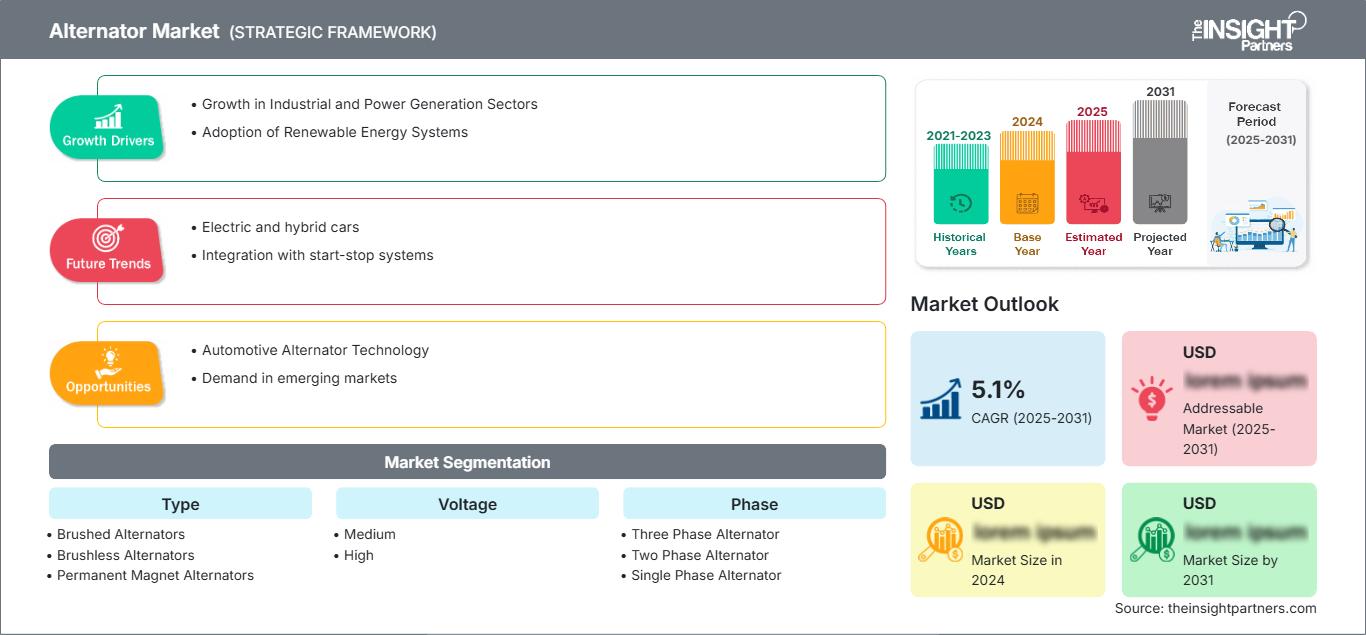
Alternator Market: Strategic Insights
Regional Insights
North America Alternator Market
North America accounted for 20–24% of the global alternator market in 2025 and is projected to expand at a CAGR of 4.1–4.5% during 2026–2034. Stable industrial activity, replacement demand for aging power infrastructure, and sustained investments in standby power systems continue to underpin regional growth. The widespread use of alternators across commercial vehicles, oil and gas operations, construction equipment, and utility applications also supports consistent procurement.
The region benefits from a mature manufacturing ecosystem, advanced engineering capabilities, and stringent equipment reliability standards. Increasing investments in data centers, healthcare facilities, and industrial automation are creating additional demand for dependable backup power solutions. Furthermore, modernization of transportation fleets and expanding renewable energy integration are encouraging the adoption of efficient alternator technologies that offer improved durability, voltage regulation, and lifecycle performance.
U.S. Alternator Market
The United States represented 78–82% of the North American market in 2025 and is anticipated to grow at a CAGR of 4.2–4.6% during 2026–2034. High demand from commercial vehicles, industrial machinery, mining equipment, and standby generator installations continues to sustain market expansion. The country also benefits from the presence of major manufacturers, extensive aftermarket networks, and significant investments in advanced manufacturing technologies.
Companies including Cummins Inc., Prestolite Electric Incorporated, and Bosch Limited maintain strong operational footprints through manufacturing, engineering, and distribution activities serving OEM and aftermarket customers. Growing deployment of intelligent power management systems, increasing construction of hyperscale data centers, and replacement of aging industrial equipment are expected to reinforce domestic demand for high-efficiency alternators throughout the forecast period.
Europe Alternator Market
Europe captured 22–26% of the global alternator market in 2025 and is expected to register a CAGR of 4.3–4.7% during 2026–2034. Germany remains the leading regional market owing to its strong automotive manufacturing base, industrial machinery production, and engineering expertise. Continuous investments in factory automation and energy-efficient equipment support sustained demand for advanced alternator systems.
The United Kingdom continues to experience stable market expansion through investments in infrastructure modernization, distributed energy systems, and commercial vehicle fleet upgrades. Industrial electrification initiatives and increasing adoption of efficient backup power technologies are contributing to broader deployment across manufacturing, transportation, and utility applications.
France, Italy, and Spain collectively contribute significant regional demand through diversified industrial manufacturing, marine equipment production, renewable energy projects, and commercial transportation sectors. Increasing emphasis on energy efficiency, equipment reliability, and industrial modernization is expected to strengthen alternator adoption across these markets while supporting long-term regional competitiveness.
APAC Alternator Market
Asia Pacific held 44–48% of the global alternator market in 2025 and is forecast to expand at a CAGR of 5.3–5.7% during 2026–2034. China leads the regional market due to its large-scale industrial production, extensive automotive manufacturing, and expanding electrical equipment sector.
Japan and South Korea continue to drive technological innovation through advanced automotive engineering, industrial automation, and precision manufacturing. High-quality production capabilities support both domestic demand and export-oriented manufacturing activities.
India and Australia are witnessing increasing investments in mining, power generation, transportation infrastructure, and industrial manufacturing. Government-led infrastructure initiatives and expanding manufacturing capacity are expected to sustain long-term regional growth, making Asia Pacific the fastest-growing regional market.
Middle East & Africa Alternator Market
The Middle East & Africa market is projected to grow at a CAGR of 4.8–5.2% during 2026–2034. Saudi Arabia remains the leading market, supported by investments in industrial diversification, power generation, and large-scale infrastructure developments.
The United Arab Emirates continues to expand demand through commercial construction, logistics infrastructure, and data center investments. Increasing deployment of standby power equipment further supports alternator adoption across critical facilities.
South Africa and the Rest of MEA are benefiting from mining activities, utility modernization, and transportation infrastructure projects. Rising investments in industrial development and reliable electricity supply are expected to create new opportunities for alternator manufacturers serving both public and private sector projects.
Segmentation Analysis
Type
The Type segment is projected to grow at a CAGR of 5.1–5.5% during 2026–2034. Product selection is increasingly influenced by operational efficiency, maintenance requirements, lifecycle cost, and application-specific performance. Growing adoption of advanced electrical systems across industrial equipment, commercial vehicles, marine applications, and power generation facilities is encouraging manufacturers to expand their portfolios with high-efficiency alternator technologies.
- Brushed Alternators: Brushed alternators retain relevance in cost-sensitive systems and legacy equipment platforms where ease of maintenance, broad service familiarity, and compatibility with conventional electrical architectures remain more important than advanced efficiency gains.
- Brushless Alternators: Brushless alternators are gaining strategic preference in industrial, marine, and heavy-duty use cases because they reduce wear-prone contact points, improve durability, and support longer service intervals under harsh thermal and vibration conditions.
- Permanent Magnet Alternators: Permanent Magnet Alternators are increasingly attractive in specialized applications requiring compact design, high efficiency, and dependable low-speed output, particularly where energy conversion performance and lightweight architecture influence equipment selection.
Voltage
The Voltage segment is anticipated to register a CAGR of 4.6–5.0% during 2026–2034. Demand is shaped by expanding industrial automation, power distribution modernization, and increasing deployment of electrical equipment requiring dependable voltage regulation.
- Medium: Medium voltage configurations account for substantial demand across mainstream vehicle, equipment, and generator-linked uses where balanced power output, manageable system complexity, and broad compatibility make them commercially practical.
- High: High voltage alternators serve more specialized roles in energy-intensive systems, larger industrial installations, and advanced electrical architectures where stronger output capability and load-handling performance justify higher technical requirements.
Phase
The Phase segment is projected to expand at a CAGR of 5.0–5.4% during 2026–2034. Increasing industrial electrification, expanding manufacturing capacity, and rising investment in reliable power generation systems continue to support demand across different phase configurations.
- Three Phase Alternator: Three Phase Alternator products represent the most commercially important phase category because they deliver smoother power flow, higher efficiency, and better suitability for industrial, generator, and heavy-duty applications.
- Two Phase Alternator: Two Phase Alternator demand is comparatively niche, with use concentrated in specific legacy or specialized systems where existing design requirements still favor intermediate phase arrangements over broader three-phase adoption.
- Single Phase Alternator: Single Phase Alternator products remain relevant in smaller-scale equipment and selective backup applications where system simplicity, lower power needs, and cost discipline outweigh the benefits of more complex phase configurations.
Vertical
The Vertical segment is expected to grow at a CAGR of 5.2–5.6% during 2026–2034. Expansion of industrial infrastructure, transportation networks, mining operations, and power generation capacity continues to diversify end-user demand. Increasing emphasis on equipment reliability, operational efficiency, and uninterrupted electricity supply supports sustained adoption across multiple industries.
- Oil & Gas: Oil & Gas generates robust demand for durable alternators because drilling, pumping, field vehicles, and remote operations require reliable power support in high-temperature, high-vibration, and maintenance-constrained environments.
- Marine: Marine applications favor corrosion-resistant, load-stable alternators capable of supporting navigation, safety, auxiliary systems, and onboard electrical equipment under continuous operating and moisture-exposed conditions.
- Mining: Mining drives demand for heavy-duty alternators in haulage, excavation, and site-support machinery where dust, shock loading, and long operating cycles place a premium on rugged performance and reduced downtime.
- Power Plant: Power Plant demand is linked to generator systems, standby support, and critical auxiliary functions, making efficiency, voltage stability, and operational reliability central purchase criteria for this vertical.
- Automotive and Others: Automotive and Others is the largest revenue-contributing vertical due to the scale of passenger, commercial, and off-highway vehicle applications that continuously require charging-system replacement, upgrade, and OE-aligned supply.
Opportunity Snapshot
| Segment Name | Revenue Contribution | Trend Tag | Adoption Stage |
| Oil & Gas | Medium | Field Power | Mature |
| Marine | Medium | Vessel Electrification | Scaling |
| Mining | Medium | Equipment Uptime | Mature |
| Power Plant | High | Backup Reliability | Mature |
| Automotive and Others | High | Electrical Load | Scaling |
Alternator Market Growth Drivers and Impact Analysis
Rising electrical load across vehicles and mobile equipment
Increased growth of the alternator market is associated with the constant increase in electrical consumption in passenger cars, commercial fleets, agricultural machinery, and off-road equipment. At the same time, despite the rapid development of the technologies of fully electric vehicles, there is still an immense number of internal combustion engines, hybrid technologies, and their mix that require alternators. These alternators help provide energy for lighting, heating and air conditioning, control systems, telematics, safety electronics, entertainment systems, etc. At this moment, this problem is especially important in the industrial sphere when performance during idle time and efficiency of charging processes influence operating time more significantly than the price of the components. Due to the growing complexity of electrical systems, operators prefer alternators with high output and higher thermal ratings to operate under varied conditions without breakdowns. That tendency is seen in the increasing demand for premium products, application-specific solutions, and willingness of the OE manufacturers and fleets to purchase alternators that are easier to install and more durable in operation.
Industrial backup power expansion across critical operations
Another key element is the rising requirement for dependable power infrastructure for those industries that cannot tolerate any disruption. These sectors include power stations, oil and gas facilities, mining companies, marine, and logistics-oriented locations. Alternators play an integral part in generator sets as well as auxiliary power units where reliability and consistent operation become vital for remote or difficult operating conditions. This becomes all the more critical in regions experiencing grid instability, increasing infrastructure activities, or crucial energy operations. The suppliers serving such requirements are witnessing rising interest in robust synchronous and industrial-grade alternators providing consistent performance in backup, prime, and continuous applications. In commercial parlance, this results in the appreciation of industrial-grade product lines, new opportunities through services, and advantages for suppliers who can relate alternator products to overall power infrastructure solutions rather than isolated components.
Aftermarket modernization and fleet uptime priorities
Aftermarket is not limited to simple replacement cycles anymore. Aftermarket is affected by factors such as labor productivity, quality of service, availability of uptime metrics, and reduction in recurrent failure rates. New introductions of alternators aim to provide easy installation, optimal performance, and compatibility with advanced heavy-duty and mixed-application fleets. Such a trend changes the strategy behind the replacement channel. In mature countries, distribution channels and workshops tend to favor solutions that have little need for rewiring, wide platform compatibility, and stable performance in harsh conditions. Such factors make a business case for expensive alternators possible, particularly for applications such as trucks, buses, commercial and work vehicles, and industrial engines, where maintenance takes place along with actual use of the equipment. The market moves gradually from universal replacement products toward engineered rotating electrical portfolio solutions.
Alternator Market Future Trends
Application-specific alternator platforms to outpace generic designs
There is an ongoing trend toward developing more specialized products catering to different duty cycles, surroundings, and mounting configurations in the alternator market rather than using a single product that suits all needs. These alternator market trends have already been observed in the heavy-duty plug-in alternator line of products. Similarly, there are rotating electricals catering to agricultural and industrial use along with industrial synchronous products developed specially for specific power range requirements. In addition, customers are demanding low maintenance and better equipment matching. Consequently, manufacturers will become increasingly inclined toward categorizing their products on the basis of usage intensity, mounting configuration, voltage requirements, corrosion resistance, and cooling behavior. Such changes will mean that product development and business success will become dependent on application engineering more than large-scale production. Eventually, such developments will prove to be profitable for the suppliers who have specialized technical products to offer while making it difficult for other competing companies due to the inability to offer detailed fittings and end-use customization.
Integration within broader energy management portfolios
The other crucial trend for the future relates to the recasting of alternators in the context of energy management and rotating electric systems. The leading vendors are becoming more oriented toward the themes of electrification, power availability, thermal management, and efficiency. Such an evolution is going to reshape the way alternators are sold and purchased. Rather than just being mechanical charging devices, alternators are becoming associated with uptime optimization, electrical systems enhancement, and performance improvement. In such a way, the trend is expected to increase cross-selling between starters, regulators, batteries, charging systems, and generators. For customers, the value of the trend lies in the solution-oriented procurement process. For vendors, the upside is the deeper penetration into accounts and increased relevance in OEM and aftermarket segments.
Alternator Market Opportunities
High-durability solutions for harsh industrial environments
A significant opportunity exists in creating alternator portfolios for tough sectors like mining, oil and gas, marine, and remote infrastructure support. These applications face challenges such as heat, vibration, dust, moisture, and long hours of operation. Reliability becomes crucial, not just low acquisition costs. Suppliers that prioritize durable housings, effective cooling, corrosion protection, and low-maintenance designs can gain more market share in situations where equipment failure causes serious operational problems. This alternator market forecast opportunity is appealing because customers in these sectors often value lifecycle costs and service continuity over basic part prices. This allows manufacturers and distributors to sell premium products supported by field service, technical validation, and longer replacement intervals. Companies that can turn alternator sales into broader uptime contracts or power-system support packages are particularly well positioned to create lasting and reliable revenue streams in this area.
Premium aftermarket expansion in commercial and mixed fleets
The aftermarket offers a clear opportunity, particularly for medium and heavy-duty vehicles, buses, agricultural machines, and mixed fleets that need high-output alternators that are easy to service. Product launches that cut down on harness changes, speed up installation, and meet OEM expectations show that buyers appreciate both convenience and reliability. This creates opportunities for suppliers to expand premium replacement lines, build relationships with distributors, and connect with workshops rather than just competing on price. Companies should improve catalog coverage, vehicle mapping, installer training, and inventory planning for high-usage fleet categories. Suppliers who excel in these areas can benefit from steady demand, better profit margins, and increased brand preference in markets where minimizing downtime is more important than the initial cost of components.
Recent Developments
- March 2026: DENSO CORPORATION — PowerEdge, a DENSO Products and Services Americas, Inc. brand, launched the 28PE plug-in alternator series for commercial vehicles and medium- and heavy-duty trucks. The 12-volt unit delivers 160 amps at road speed and uses a plug-in connection that eliminates cutting and rewiring for faster fleet service.
- March 2026: DENSO Aftermarket Europe — DENSO added 17 rotating electrics part numbers, including two alternators for John Deere agricultural equipment and Yanmar engines. The update expanded heavy-duty coverage for sprayers, tractors, industrial engines, and marine-related platforms, reinforcing aftermarket demand beyond passenger vehicles.
- October 2025: WEG S.A. — WEG strengthens its presence in the Argentinian market with the strategic supply of 112 pancake alternators for Sumar Servicios Industriales S.R.L.'s lighting towers. The project marks the successful integration of the alternator line from Marathon, a company acquired by WEG in 2024, expanding the offering of high-efficiency solutions for power generation.
Frequently Asked Questions

- Comprehensive Market Sizing and Forecast Analysis
- Detailed Segmentation Analysis
- In-Depth Market Dynamics Assessment
- Regional and Country-Level Insights
- Competitive Landscape and Company Benchmarking
- Strategic Business Intelligence
Recent Reports
Testimonials

The Insight Partners' SCADA System Market report is comprehensive, with valuable insights on current trends and future forecasts. The team was highly professional, responsive, and supportive throughout. We are very satisfied and highly recommend their services.
RAN KEDEM Partner, Reali Technologies LTDs
I requested a report on a very specific software market and the team produced the report in a few days. The information was very relevant and well presented. I then requested some changes and additions to the report. The team was again very responsive and I got the final report in less than a week.
JEAN-HERVE JENN Chairman, Future Analytica
We worked with The Insight Partners for an important market study and forecast. They gave us clear insights into opportunities and risks, which helped shape our plans. Their research was easy to use and based on solid data. It helped us make smart, confident decisions. We highly recommend them.
PIYUSH NAGPAL Sr. Vice President, High Beam Global
The Insight Partners delivered insightful, well-structured market research with strong domain expertise. Their team was professional and responsive throughout. The user-friendly website made accessing industry reports seamless. We highly recommend them for reliable, high-quality research services
YUKIHIKO ADACHI CEO, Deep Blue, LLC.
This is the first time I have purchased a market report from The Insight Partners.While I was unsure at first, I visited their web site and felt more comfortable to take the risk and purchase a market report.I am completely satisfied with the quality of the report and customer service. I had several questions and comments with the initial report, but after a couple of dialogs over email with their analyst I believe I have a report that I can use as input to our strategic planning process.Thank you so much for taking the extra time and making this a positive experience.I will definitely recommend your service to others and you will be my first call when we need further market data.
JOHN SUZUKI President and Chief Executive Officer, Board Director, BK Technologies
I wish to appreciate your support and the professionalism you displayed in the course of attending to my request for information regarding to infectious disease IVD market in Nigeria. I appreciate your patience, your guidance, and the fact that you were willing to offer a discount, which eventually made it possible for us to close a deal. I look forward to engaging The Insight Partners in the future, all thanks to the impression you have created in me as a result of this first encounter.
DR CHIJIOKE ONYIA MANAGING DIRECTOR, PineCrest Healthcare Ltd.Reason to Buy
- Informed Decision-Making
- Understanding Market Dynamics
- Competitive Analysis
- Identifying Emerging Markets
- Customer Insights
- Market Forecasts
- Risk Mitigation
- Boosting Operational Efficiency
- Strategic Planning
- Investment Justification
- Tracking Industry Innovations
- Aligning with Regulatory Trends





 Get Free Sample for