
Ambient Assisted Living and Smart Home Market Size, Trends & Demand by 2034
Ambient Assisted Living and Smart Home Market Size and Forecasts (2021 - 2034), Global and Regional Share, Trends, and Growth Opportunity Analysis Report Coverage : By System (Safety & Security System, Communication System, Medical Assistance System, Power Management System, Entertainment, Transportation and Communication Systems and Others), Sensors (Temperature Sensor, Occupancy Sensor, and Others), Service (Customization & Renovation, Installation & Repair)
- Status : Data Released
- Report Code : TIPRE00039721
- Category : Electronics and Semiconductor
- No. of Pages : 150
- Available Report Formats :


- Last update date : July 20, 2026


2025 Market Size
US$ 181.11 Bn
Base year value
2034 Forecast
US$ 1,902.43 Bn
Projected by 2034
CAGR 2026-2034
29.86 %
Growth rate
Addressable Market
US$ 7,484.28 Bn
(2026-2034)
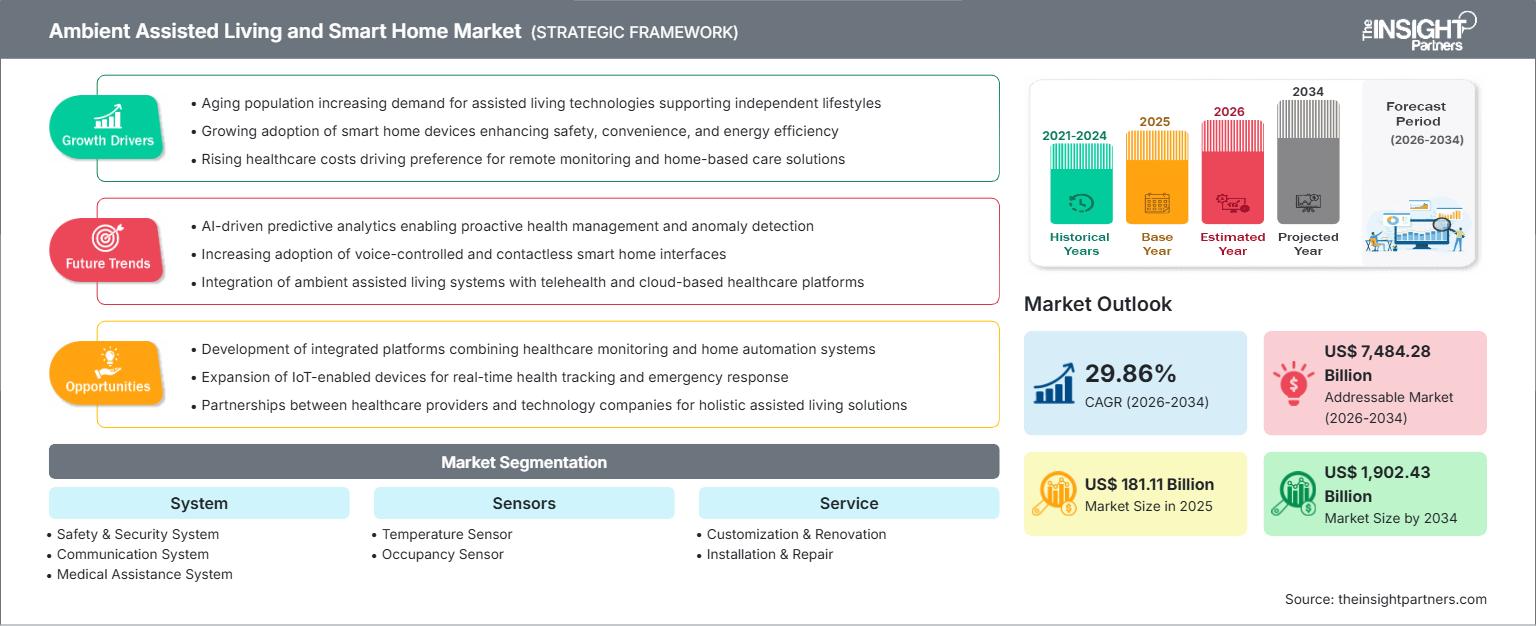
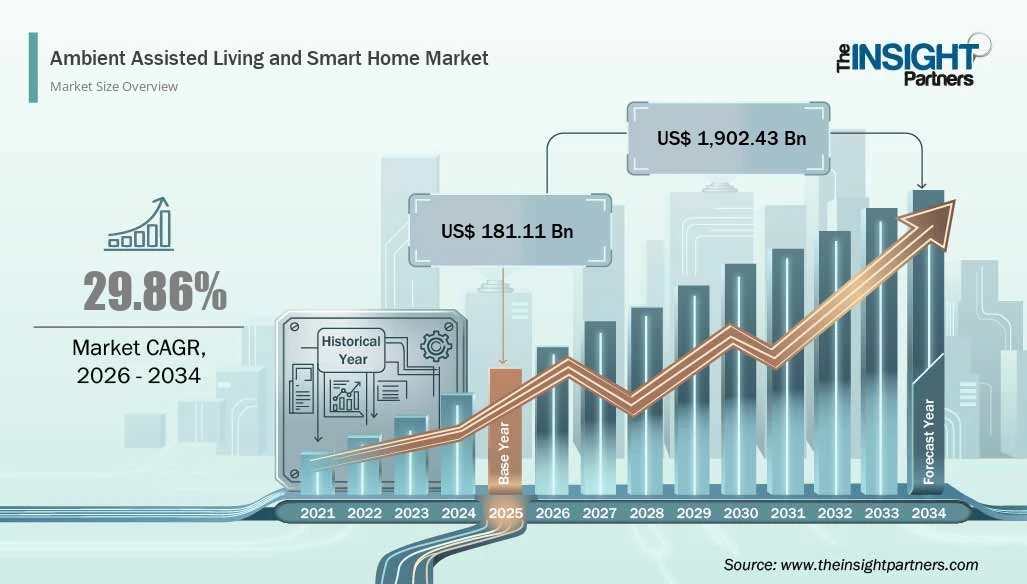
The Ambient Assisted Living and Smart Home Market is expected to rise from US$ 181.11 Billion in 2025 to US$ 1,902.43 Billion in 2034, recording a CAGR of 29.86% during 2026 to 2034. The market is indicative of the overlap of smart home automation, remote patient monitoring, safety systems, communication systems, and residential services meant for independent living, lessening caregiver load, and greater responsiveness in a home care setting.
North America continues to be a revenue cluster of importance, where the Ambient Assisted Living and Smart Home Market size is driven by advanced broadband connectivity, higher ownership of connected devices, and payers’ interest in home monitoring. The growth rate in the region is forecast to be 27%-31% during 2026 to 2034, addressing issues such as aging in place requirements, hospital overload, and overall need for safety, security, and medical assistance within homes.
Ambient Assisted Living and Smart Home Market Assessment and Insights
- North America: The region held 32–36% share in 2025 and is projected to grow at 27–31% CAGR between 2026–2034, supported by digital health reimbursement, smart housing upgrades, and aging-in-place demand.
- US: The country represented 72–76% of North America in 2025 and is expected to expand at 28–32% CAGR between 2026–2034, driven by remote care adoption and platform investment.
- Europe: Europe accounted for 27–31% share in 2025 and is forecast to grow at 26–30% CAGR between 2026–2034, led by Germany, the UK, France, Italy, and Spain.
- Asia Pacific: Asia Pacific captured 23–27% share in 2025 and is expected to grow at 31–35% CAGR between 2026–2034, with China, Japan, South Korea, and India accelerating adoption.
- Largest Segment: System led with 52–56% market share in 2025 and 28–32% CAGR between 2026–2034 as integrated safety, communication, medical, and energy functions dominated deployments.
- High Growth Segment: Sensors held 18–22% market share in 2025 and are expected to register 32–36% CAGR between 2026–2034 as occupancy and environmental monitoring expand.
- Key companies analyzed in detail: Johnson Controls International plc, Heila Technologies Inc., Medic4all Group, GETEMED Medizin- und Informationstechnik AG, House Intelligence GmbH, Televic Group, Telbios S.p.A., Loxone Electronics GmbH, EnOcean Alliance Inc., CareTech Holdings PLC, Amazon.com, Inc., Google LLC.
Source: The Insight Partners' analysis based on proprietary research, government publications, company annual reports, investor presentations, industry databases, and expert interviews.
Migration in technology has transformed the market into an ecosystem of devices with sensors, analytics, a communication gateway, and services that are capable of interacting with each other. The production is shifting from a device-centric model of selling products to a platform model of production, where the quality of hardware, cloud connection, cybersecurity, and installation skills of the vendor will determine the competency of vendors. Edge computing and wireless technology have made it easy to integrate technology into old buildings.
Looking ahead, there will be good forward demand as a result of rising demand in new geographies for smart home, telehealthcare facilities, and infrastructure for the aging population. As per the WHO, the global population above 60 years will cross 2 billion in 2050. Also, the OECD is working on sustainable long-term care solutions.
Ambient Assisted Living and Smart Home Market Report Scope
| Report Attribute | Details |
|---|---|
| Market size in 2025 | US$ 181.11 Billion |
| Market Size by 2034 | US$ 1,902.43 Billion |
| Global CAGR (2026 - 2034) | 29.86% |
| Historical Data | 2021-2024 |
| Forecast period | 2026-2034 |
Ambient Assisted Living and Smart Home Market Analysis
Factors that stimulate growth of the market include longer life expectancies, greater need for chronic condition monitoring services, and a strong preference for aging in place. Needs evolve from mere convenience automation towards security verification, medication management, remote monitoring, and caregiver communications. Value chain involves sensor makers, control platform developers, installation companies, healthcare providers, telecoms, and residential developers, all impacting price, ease of use, and scale of deployment.
The market supply is evolving positively as wireless connectivity, presence detection, temperature monitoring, and cloud technology become more standardized. Nevertheless, the procurement process becomes more complex due to considerations of cybersecurity, after-sales service, interoperability, and proof of impact on care delivery. Market analysis demonstrates that consumers want integrated ecosystems that solve fragmentation in the management of different devices and provide opportunities for upgrading depending on budget and clinical needs.
Competition will become greater because of the advancements made in building control by Johnson Controls International plc, smart automation by Loxone Electronics GmbH, interoperability of energy harvesting by EnOcean Alliance Inc., and care communications and monitoring by Medic4all Group, Telbios S.p.A., Televic Group, GETEMED Medizin- und Informationstechnik AG, and House Intelligence GmbH. Amazon.com, Inc. and Google LLC are setting the bar for voice control and ecosystems of smart homes.
Greater investments will be expected in AI-powered monitoring, secure data analytics, openness and collaboration and a pay-as-you-go business model. The CareTech Holdings PLC is one way that service providers can affect requirements for the deployment of technology. Heila Technologies Inc. provides one example of resilient distributed energy control technology. It is essential to integrate residential automation with healthcare solutions, not just make another smart home appliance.
● REPORT CUSTOMIZATION
Tailor This Report To Align With Your Specific Business Requirements
This report can be customized to align precisely with your business objectives, scope, and target markets. Customization options include tailored segmentation, geography, competitive analysis, and strategic insights to support informed decision-making.
Customize This Report →WHAT YOU CAN ADJUST
- ● Segmentations
- ● Geography
- ● Competitive Analysis
- ● Language Preferences
Ambient Assisted Living and Smart Home Market: Strategic Insights
Regional Insights
North America Ambient Assisted Living and Smart Home Market
North America held 32–36% share in 2025 and is expected to grow at 27–31% CAGR during 2026–2034. The region benefits from strong broadband access, advanced healthcare digitization, and consumer familiarity with connected devices. The Ambient Assisted Living and Smart Home Market share is reinforced by payer interest in remote monitoring and providers seeking lower-cost care settings.
Adoption is concentrated in safety and security systems, medical assistance systems, and sensor-enabled home monitoring. The US leads regional demand, while Canada supports deployment through provincial aging and virtual care initiatives. Vendors prioritize retrofit compatibility, cybersecurity assurance, and caregiver-facing dashboards because households and care operators require reliable alerts, low maintenance, and integration with existing residential infrastructure.
U.S. Ambient Assisted Living and Smart Home Market
The US accounted for 72–76% of North American market in 2025 and is forecast to grow at 28–32% CAGR during 2026–2034. Demand is supported by large senior populations, private-sector digital health investment, and broader acceptance of home-based care. Smart speakers, security hubs, and connected sensors create a familiar entry point for assisted living functions.
Company presence is strongest across building automation, cloud platforms, and consumer interfaces. Johnson Controls International plc supports connected building infrastructure, while Amazon.com, Inc. and Google LLC influence voice control and smart-home behavior. Application trends include fall-risk detection, emergency communication, medication reminders, energy management, and caregiver notifications for households seeking practical, scalable support.
Europe Ambient Assisted Living and Smart Home Market
Europe represented 27–31% share in 2025 and is projected to register 26–30% CAGR during 2026–2034. Germany is the leading country because of automation expertise, connected building standards, and a strong elderly care infrastructure. The UK benefits from digital health pilots, while France, Italy, and Spain increasingly use connected home technologies to manage aging demographics.
Germany emphasizes medical-grade monitoring, emergency response integration, and energy-efficient housing. The UK focuses on remote care pathways and local authority technology-enabled care. France supports telecare and connected housing modernization, while Italy and Spain show demand from family-care settings and retrofit apartments. European adoption is shaped by privacy regulation, interoperability, and public procurement discipline.
APAC Ambient Assisted Living and Smart Home Market
APAC held 23–27% share in 2025 and is projected to grow at 31–35% CAGR during 2026–2034. China is the leading country, supported by smart city investment, connected infrastructure, and domestic electronics capacity. Japan and South Korea prioritize elderly care technologies, while India and Australia expand telehealth, safety automation, and residential energy management.
Industrial policy, urbanization, and broadband rollout are accelerating adoption across both new apartments and retrofit homes. Regional buyers remain price-sensitive, making modular systems strategically important. Local manufacturing and app-based service models are likely to improve affordability, while government aging policies create long-term demand for monitoring, communication, and environmental control solutions.
Middle East & Africa Ambient Assisted Living and Smart Home Market
Middle East & Africa is expected to expand at 24–28% CAGR during 2026–2034. Saudi Arabia is the leading country in smart city programs, premium residential projects, and healthcare modernization, supporting connected living. The UAE follows through with intelligent building investment, while South Africa and the rest of MEA adopt solutions more gradually.
Energy management is especially relevant because connected homes can reduce consumption while supporting safety and comfort. Infrastructure upgrades, private healthcare investment, and digital government programs are improving readiness. Adoption remains uneven, so vendors need localized service networks, resilient connectivity, and practical pricing models to reach assisted living communities and urban households.
Segmentation Analysis
System
System is expected to grow at 28–32% CAGR during 2026–2034, remaining the largest value pool. The Ambient Assisted Living and Smart Home Market scope within this segment covers safety, communication, medical assistance, energy, entertainment, and mobility-linked functions. Buyers favor integrated platforms because they reduce installation complexity and provide consistent monitoring across daily living activities.
- Safety & Security System solutions hold a central position because emergency alerts, access control, surveillance, and fall-risk detection create immediate value for households, caregivers, and assisted living operators.
- Communication System demand is rising as residents, caregivers, clinicians, and service providers require reliable voice, video, and notification channels for coordinated support and faster response.
- Medical Assistance System platforms are strategically important because they connect remote monitoring, medication reminders, wellness checks, and escalation workflows into home-based care delivery models.
- Power Management System adoption is supported by energy-efficiency goals, automated controls, and demand for uninterrupted operation of safety, medical, and communication devices.
- Entertainment, transportation, and Communication Systems improve quality of life by integrating lifestyle content, mobility coordination, social connection, and digital interfaces into assisted residential environments.
Sensors
Sensors are projected to grow at 32–36% CAGR during 2026–2034 as ambient intelligence depends on accurate, low-power data capture. Temperature and occupancy sensing enable automated comfort, activity recognition, energy optimization, and abnormal pattern detection. The segment benefits from miniaturization, lower connectivity costs, and broader AI analytics adoption across residential monitoring applications.
- Temperature Sensor devices support comfort, climate safety, and power efficiency by helping systems adjust indoor conditions automatically for older adults and medically vulnerable users.
- Occupancy Sensor technologies are increasingly important for activity detection, security automation, lighting control, and caregiver alerts when movement patterns indicate potential risk.
Service
Service is expected to grow at 26–30% CAGR during 2026–2034 because successful adoption depends on site assessment, personalization, installation quality, and ongoing repair. Service providers help bridge the gap between consumer-grade devices and dependable care environments. Demand is strongest where households need retrofit support, accessibility upgrades, and technical assistance.
- Customization & Renovation services help adapt homes for accessibility, monitoring coverage, device placement, and user-specific routines, improving practical adoption and long-term satisfaction.
- Installation & Repair services remain essential because reliable system performance, troubleshooting, calibration, and upgrades directly affect user trust and caregiver confidence.
Opportunity Snapshot
| Application | Revenue Contribution | Trend Tag | Adoption Stage |
| Safety & Security System | High | Emergency Alerts | Mature |
| Communication System | Medium | Care Links | Scaling |
| Medical Assistance System | High | Remote Care | Scaling |
| Power Management System | Medium | Energy Control | Scaling |
| Entertainment, Transportation, and Communication Systems | Medium | Social Access | Emerging |
| Temperature Sensor | Medium | Climate Safety | Mature |
| Occupancy Sensor | Medium | Activity Sensing | Scaling |
| Customization & Renovation | Medium | Adaptive Homes | Scaling |
| Installation & Repair | Medium | Service Uptime | Mature |
Ambient Assisted Living and Smart Home Market Growth Drivers and Impact Analysis
Aging-in-Place Demand and Long-Term Care Pressure
The demographic trends in aging have brought up the structural necessity for developing technologies that would ensure the safety and provision of continuous care when older people continue living independently. According to the WHO, the number of people who are 60 years old and older will amount to 2 billion by 2050. In addition, according to OECD, care delivery is being reconsidered due to the fact that aging brings up the increased demand for assistance in daily routines. All these factors positively influence the Ambient Assisted Living and Smart Home Market.
Connected Health Integration with Residential Infrastructure
Healthcare provision is becoming more about prevention and remote care, which turns residential facilities into elements of a care environment. Sensors, communication and medical assistance platforms may notice changes in daily activity levels, facilitate the workflow of telemedicine and raise alarms to caregivers prior to further development of any condition. It affects the most when smart home technologies are safely integrated into clinical and care management platforms. The discussed driver favors cooperation between the manufacturers of automation products, healthcare providers, telecom operators and service firms.
Falling Connectivity Costs and Platform Interoperability
The use of affordable wireless modules, enhanced broadband connectivity, and greater acceptance of open protocols for smart homes is making adoption easier. Interoperability is a key consideration because families use a wide range of products from different manufacturers, including security devices, thermostats, voice assistance, healthcare monitors, and caregiving services. With better interoperability, installers can offer modular systems that can evolve from simple monitoring to complex health care management solutions. The result will be increased demand, reduced risks of product replacement, and vendor competition on performance and security.
Ambient Assisted Living and Smart Home Market Future Trends
Predictive AI for Personalized Home Support
Prediction will drive the Ambient Assisted Living and Smart Home Market, as devices learn based on occupancy levels, temperatures, usage of appliances, interaction rate, and health indicators. The next generation is forecasted to shift from alerting based on predefined rules to baselines that track small deviations in daily activities for each individual user. It will allow caregivers to prioritize their efforts and prevent unnecessary alarms. The vendors who will focus on explainability, edge computing, consent handling, and clinically meaningful dashboards will gain an advantage among the buyers.
Open Ecosystems for Multi-Vendor Assisted Living
Future success will be determined by the extent to which these devices, applications, and caregiving services can interact seamlessly without complicated configurations. Open systems will allow individuals to incorporate sensors, security devices, communication systems, and medical care functionalities incrementally. This development will benefit firms that advocate for standards-based interoperability, open data management policies, and reliable installation services. Additionally, it will provide an opportunity for firms to handle heterogeneous technology environments, thus assisting consumers to avoid being tied up with vendors while still maintaining consistent operations.
Ambient Assisted Living and Smart Home Market Opportunities
Retrofitting Existing Homes for Connected Care
Older people reside mostly in already built homes, which means a vast number of retrofitting possibilities for vendors of smart home systems. Safety modules, occupancy monitoring, emergency communications, and energy management may be provided even if no full-scale renovation is undertaken. The most viable approach will be a bundle of services including evaluation, installation, education, and maintenance. Firms that can standardize the retrofit process and adjust the user interface according to person’s capability will be able to extend their reach to families, organizations, communities, and municipalities.
Integrated Care Platforms for Providers and Payers
Providers and payers need tools that link home-based signals with care decisions, creating opportunities for secure platforms that combine monitoring, triage, communication, and reporting. Ambient Assisted Living and Smart Home Market Forecasts indicate that scalable value will come from recurring services rather than one-time device sales. Vendors can target care organizations with dashboards, compliance controls, installation partnerships, and outcome reporting. This approach supports lower avoidable admissions, faster intervention, and differentiated service models for aging populations.
Recent Developments
- October 2025: National health and social care provider Agincare Holdings Ltd has acquired the majority of business operated by Ambient Support Ltd and its subsidiaries. The deal sees the continued operation of 80 homes and services across the UK, preserving more than 800 jobs and protecting around 700 peoples’ care and support provision.
- December 2024: Ambient has been honored with the 2024 MHN Excellence Gold Award for Best Technology. Multi-Housing News (MHN) recognized Ambient for our groundbreaking innovation in smart apartment technology, specifically our revolutionary, reliable connectivity architecture.
Frequently Asked Questions

- Comprehensive Market Sizing and Forecast Analysis
- Detailed Segmentation Analysis
- In-Depth Market Dynamics Assessment
- Regional and Country-Level Insights
- Competitive Landscape and Company Benchmarking
- Strategic Business Intelligence
Recent Reports
Testimonials

The Insight Partners' SCADA System Market report is comprehensive, with valuable insights on current trends and future forecasts. The team was highly professional, responsive, and supportive throughout. We are very satisfied and highly recommend their services.
RAN KEDEM Partner, Reali Technologies LTDs
I requested a report on a very specific software market and the team produced the report in a few days. The information was very relevant and well presented. I then requested some changes and additions to the report. The team was again very responsive and I got the final report in less than a week.
JEAN-HERVE JENN Chairman, Future Analytica
We worked with The Insight Partners for an important market study and forecast. They gave us clear insights into opportunities and risks, which helped shape our plans. Their research was easy to use and based on solid data. It helped us make smart, confident decisions. We highly recommend them.
PIYUSH NAGPAL Sr. Vice President, High Beam Global
The Insight Partners delivered insightful, well-structured market research with strong domain expertise. Their team was professional and responsive throughout. The user-friendly website made accessing industry reports seamless. We highly recommend them for reliable, high-quality research services
YUKIHIKO ADACHI CEO, Deep Blue, LLC.
This is the first time I have purchased a market report from The Insight Partners.While I was unsure at first, I visited their web site and felt more comfortable to take the risk and purchase a market report.I am completely satisfied with the quality of the report and customer service. I had several questions and comments with the initial report, but after a couple of dialogs over email with their analyst I believe I have a report that I can use as input to our strategic planning process.Thank you so much for taking the extra time and making this a positive experience.I will definitely recommend your service to others and you will be my first call when we need further market data.
JOHN SUZUKI President and Chief Executive Officer, Board Director, BK Technologies
I wish to appreciate your support and the professionalism you displayed in the course of attending to my request for information regarding to infectious disease IVD market in Nigeria. I appreciate your patience, your guidance, and the fact that you were willing to offer a discount, which eventually made it possible for us to close a deal. I look forward to engaging The Insight Partners in the future, all thanks to the impression you have created in me as a result of this first encounter.
DR CHIJIOKE ONYIA MANAGING DIRECTOR, PineCrest Healthcare Ltd.Reason to Buy
- Informed Decision-Making
- Understanding Market Dynamics
- Competitive Analysis
- Identifying Emerging Markets
- Customer Insights
- Market Forecasts
- Risk Mitigation
- Boosting Operational Efficiency
- Strategic Planning
- Investment Justification
- Tracking Industry Innovations
- Aligning with Regulatory Trends





 Get Free Sample for