
Animal Probiotics Market Size, Growth & Demand by 2034
Coverage: By Source (Bacteria, Yeast, Fungi); Form (Dry, Liquid); Livestock (Swine, Poultry, Ruminants, Aquaculture, Others), and Geography (North America, Europe, Asia Pacific, and South and Central America)
- Status : Data Released
- Report Code : TIPRE00018464
- Category : Food and Beverages
- No. of Pages : 150
- Available Report Formats :


- Last update date : August 25, 2026


2025 Market Size
US$ 8.59 Bn
Base year value
2034 Forecast
US$ 18.95 Bn
Projected by 2034
CAGR 2026-2034
9.19 %
Growth rate
Addressable Market
US$ 123.11 Bn
(2026-2034)
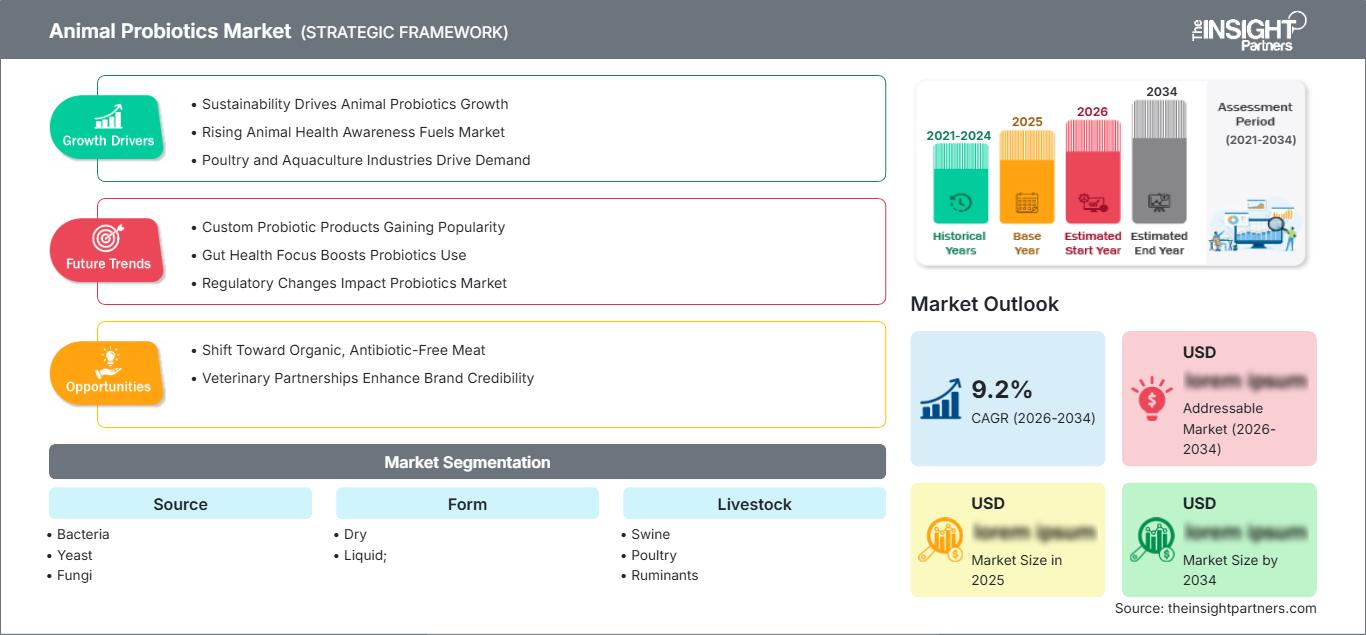
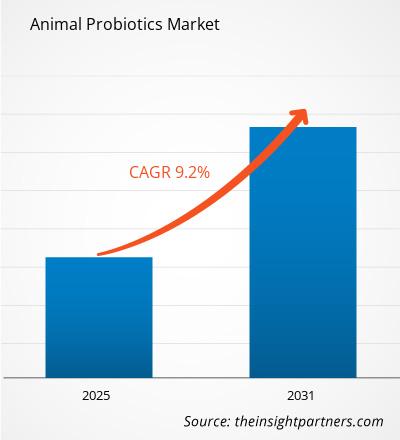
The animal probiotics market was valued at US$ 8.59 Billion in 2025 and is projected to reach US$ 18.95 Billion by 2034, expanding at a CAGR of 9.19% during 2026–2034. Growth is being supported by the increasing shift toward antibiotic-free livestock production, wider adoption of functional feed additives, and rising demand for productivity-enhancing nutritional solutions across poultry, swine, ruminant, and aquaculture operations. Industry developments continue to emphasize gut-health optimization and feed conversion efficiency as key performance priorities.
Across North America, regulatory encouragement for reduced antibiotic usage, advanced commercial livestock farming, and strong adoption of precision nutrition are supporting steady expansion. The animal probiotics market size in the region benefits from high penetration of scientifically validated microbial feed additives, particularly in poultry and swine systems. Regional growth is expected to remain within a high-single-digit to low-double-digit range as producers focus on animal welfare, feed efficiency, and production sustainability.
Animal Probiotics Market Assessment and Insights
- North America: Share in 2025 estimated at 31–35%, supported by advanced feed technologies and commercial-scale livestock operations. CAGR between 2026–2034: 8.5–9.5%.
- US: Represents 68–72% of North American demand in 2025, driven by poultry and swine nutrition programs. CAGR between 2026–2034: 8.8–9.8%.
- Europe: Share in 2025 estimated at 26–30%. Germany, France, the UK, Spain, and Italy lead adoption due to strict antibiotic-reduction policies. CAGR between 2026–2034: 8.0–9.0%.
- Asia Pacific: Share in 2025 estimated at 30–34%, led by China, India, Japan, and Australia. CAGR between 2026–2034: 10.0–11.0%.
- Largest Segment: Bacteria source segment accounted for approximately 64–68% market share in 2025 and is expected to grow at 8.8–9.8% CAGR.
- High Growth Segment: Aquaculture livestock segment represented 11–15% share in 2025 and is projected to register 10.5–11.5% CAGR.
- Key companies analyzed in detail: Adisseo, Calpis Co., Ltd., Chr. Hansen Holding A/S, DSM-Firmenich AG, DuPont de Nemours, Inc., Evonik Industries AG, Kerry Group plc, Lallemand Inc., Lesaffre Group, Novonesis A/S.
Source: The Insight Partners' analysis based on proprietary research, government publications, company annual reports, investor presentations, industry databases, and expert interviews.
Microbial-based products are becoming increasingly common in the formulation of feed as livestock farmers look for ways to reduce the need for antibiotics in livestock production. The development of techniques in strain stability, encapsulation, and formulation according to particular species has made probiotics a commercially attractive alternative in intensive agriculture.
In terms of future developments, it is likely that there will be increased investments in the Asian Pacific region, the Latin American region, and the Middle Eastern livestock industry. This is due to the increasing regulatory push for sustainable production practices and growing demands for animal protein, which makes it profitable for companies to invest in the region.
Animal Probiotics Market Report Scope
| Report Attribute | Details |
|---|---|
| Market size in 2025 | US$ 8.59 Billion |
| Market Size by 2034 | US$ 18.95 Billion |
| Global CAGR (2026 - 2034) | 9.19% |
| Historical Data | 2021-2024 |
| Forecast period | 2026-2034 |
Animal Probiotics Market Analysis
Market growth is directly correlated with international initiatives geared towards enhancing the health of animals and decreasing the dependence on antibiotics for growth promoters. Probiotics are being used more often to ensure the stability of gut bacteria, improve the rate of absorption and enhance animal performance. There is high demand in the poultry and swine segments since intensive production systems need efficiency in performance and in feed conversion. Suppliers are moving into niche markets with the development of optimized strains, scalability, quality management systems and advanced fermentation technologies.
Moreover, growing demand is fueled by higher consumption of animal proteins as well as increasing pressure on producers to meet sustainable goals. Feed manufacturers, microbial technologies companies, distributors, livestock integration firms and veterinarians make up an ecosystem that continues pushing the sales of probiotics. Higher scientific validation has increased the trust of commercial producers in the products and has resulted in higher demand in both developed and emerging livestock markets. Also, positive regulatory trends in a number of regions are facilitating the penetration of probiotics into the feed markets.
Market analysis suggests that the competition level still stands at a medium to high level as leading companies specialize in a strain portfolio, application support, and geographical growth. Such companies as DSM-Firmenich AG, Novonesis A/S, Chr. Hansen Holding A/S, Evonik Industries AG, and Lallemand Inc. still develop their capabilities in the sphere of feed health by engaging in innovations and alliances. Investments made by companies more and more often target research alliances, product differentiation, and technical services to customers.
The industry investments tend to target research into microbiome, precision nutrition, and formulation tailored specifically for the needs of certain types of livestock. The companies Adisseo, Kerry Group plc, Lesaffre Group, Calpis Co., Ltd., and DuPont de Nemours, Inc. have gained a competitive advantage due to their activity in product development and distribution. Competitive differentiation is based not only on price, but also on the basis of efficiency data and technical service capabilities. In addition, further developments in microbiology and livestock management technologies are anticipated to provide opportunities for customized probiotics' usage.
● REPORT CUSTOMIZATION
Tailor This Report To Align With Your Specific Business Requirements
This report can be customized to align precisely with your business objectives, scope, and target markets. Customization options include tailored segmentation, geography, competitive analysis, and strategic insights to support informed decision-making.
Customize This Report →WHAT YOU CAN ADJUST
- ● Segmentations
- ● Geography
- ● Competitive Analysis
- ● Language Preferences
Animal Probiotics Market: Strategic Insights
Regional Insights
North America Animal Probiotics Market
North America accounted for approximately 31–35% animal probiotics market share in 2025 and is projected to expand at a CAGR of 8.5–9.5% through 2034. Strong livestock productivity targets, high commercial farming penetration, and regulatory preference for antibiotic alternatives continue to support adoption. Poultry and swine applications generate the largest consumption volumes.
The region benefits from established feed manufacturing infrastructure and a strong presence of global suppliers. Ongoing investments in livestock health management, combined with demand for premium meat and dairy products, are helping drive adoption. Research institutions, feed companies, and technology providers continue collaborating on advanced microbial solutions that improve feed efficiency and animal welfare outcomes.
U.S. Animal Probiotics Market
The United States represented approximately 68–72% of North American demand in 2025 and is expected to grow at 8.8–9.8% CAGR through 2034. Large-scale poultry, dairy, and swine production systems support high usage of scientifically validated probiotic formulations designed to improve productivity and animal health.
Leading industry participants maintain significant operating footprints across the country, enabling extensive product availability. Commercial livestock producers increasingly deploy probiotics to improve production consistency, support gastrointestinal health, and align with evolving consumer expectations regarding reduced antibiotic usage. Adoption is also supported by ongoing microbial science research and advanced feed formulation capabilities.
Europe Animal Probiotics Market
Europe held an estimated 26–30% share in 2025 and is projected to register 8.0–9.0% CAGR through 2034. Regulatory emphasis on reducing antibiotic dependence remains a key growth factor. Germany is the leading national market due to advanced livestock operations and strong feed additive adoption.
The United Kingdom continues to support demand through poultry and dairy productivity initiatives. France, Italy, and Spain maintain significant opportunities owing to large livestock sectors and increasing focus on functional nutrition. Across the region, manufacturers are emphasizing strain efficacy, compliance standards, and species-specific formulations to strengthen market positions and address changing producer requirements.
APAC Animal Probiotics Market
Asia Pacific accounted for approximately 30–34% share in 2025 and is expected to be the fastest-growing regional market, expanding at 10.0–11.0% CAGR through 2034. China remains the leading country because of its large livestock sector and rising animal protein consumption.
India, Japan, South Korea, and Australia continue to strengthen adoption through investments in feed efficiency and sustainable farming. Government support for modern animal nutrition practices and increasing awareness regarding antibiotic alternatives are contributing to market expansion.
Middle East & Africa Animal Probiotics Market
The Middle East and Africa market is projected to grow at 8.7–9.7% CAGR during 2026–2034. Saudi Arabia and the UAE remain important livestock nutrition markets driven by food-security initiatives and investment in commercial farming operations.
South Africa leads regional adoption owing to its relatively developed feed industry. Growing demand for productivity-enhancing nutritional solutions and modernization of livestock production systems are expected to support long-term market development across the broader region.
Segmentation Analysis
Source
The source segment is expected to expand at a CAGR of 8.9–9.9% through 2034. The market scope is strongly influenced by ongoing advancements in microbial strain identification and commercial production technologies. Bacteria-based formulations dominate, while yeast and fungi derivatives continue gaining traction in specific livestock applications because of their digestive and immunity-supporting characteristics.
- Bacteria: Largest category owing to broad validation across poultry, swine, and ruminant production systems and strong compatibility with commercial feed formulations.
- Yeast: Widely adopted in ruminant nutrition due to digestive support benefits and improving feed utilization efficiency in intensive farming systems.
- Fungi: Emerging niche segment with growing importance in specialized nutritional formulations and advanced livestock health programs.
Form
The form segment is projected to grow at a CAGR of 8.7–9.7% through 2034. Product stability, logistics efficiency, and application flexibility continue shaping demand patterns. Feed manufacturers increasingly evaluate formulation format based on production infrastructure and livestock management practices.
- Dry: Dominant format owing to ease of storage, transportation, and integration into industrial feed manufacturing processes.
- Liquid: Gains traction where water-based administration and flexible dosing strategies are preferred for livestock management.
Livestock
The livestock segment is forecast to expand at a CAGR of 9.3–10.3% through 2034. Rising demand for protein production efficiency, animal welfare improvements, and disease-management support is driving adoption across species categories.
- Swine: Important demand center where gut health and feed conversion performance remain critical operational priorities.
- Poultry: Represents the largest application base because of large-scale global production and sensitivity to digestive performance metrics.
- Ruminants: Supported by increasing focus on dairy productivity and feed optimization programs.
- Aquaculture: Fastest-growing application due to biosecurity requirements and sustainable aquaculture development initiatives.
Opportunity Snapshot
| Segment Name | Revenue Contribution | Trend Tag | Adoption Stage |
| Swine | High | Feed Efficiency | Mature |
| Poultry | High | Gut Health | Mature |
| Ruminants | Medium | Dairy Yield | Scaling |
| Aquaculture | Medium | Water Health | Scaling |
| Others | Low | Companion Feed | Emerging |
Animal Probiotics Market Growth Drivers and Impact Analysis
Antibiotic Replacement Initiatives Across Livestock Production
Growing global worry about antimicrobial resistance has increased the demand for scientific and evidence-based products that serve as replacements for antibiotic growth promoters. Growing regulatory pressure on the judicious use of antibiotics in developed countries has fostered an environment conducive to adopting probiotics. Farmers want a product that will enhance their production efficiency in terms of meeting food safety standards. Consequently, the adoption of probiotics is increasing in livestock production systems. Improved health status of animals results in better economic returns for farmers.
Expansion of Commercial Animal Protein Production
The factors of population increase, urbanization, and shifts in diet are expected to continue fueling the trend towards increased consumption of meat, dairy products, and fish from aquaculture farms. For efficient supply, the use of nutritional technology is increasing as producers strive to increase efficiency while minimizing input levels. The use of probiotics aids in achieving these goals through improved digestion and nutrition. Through the use of probiotics in feeding operations, meat producers can achieve efficiency without having to rely too much on pharmaceuticals.
Advances in Microbiome Research and Strain Development
There has been considerable advancement in scientific knowledge about gut microbiota in animals within the last ten years. Better screening approaches, advances in genomics, and fermentation technology have made it possible for producers to create products that address the needs of a particular species and production environment. This will ensure that the product is dependable and will be adopted readily in the commercial sector. There has been considerable emphasis on the positioning of evidence-based products through field trials and performance tests.
Animal Probiotics Market Future Trends
Precision Livestock Nutrition Platforms
Among the most significant animal probiotics market trends is the integration of probiotics into precision nutrition programs. Producers are increasingly combining microbial solutions with digital monitoring platforms to optimize feed utilization and health outcomes. Future product development is expected to emphasize species-specific and farm-specific formulations supported by performance analytics. This shift could enhance return on investment while enabling more efficient livestock management strategies across commercial operations worldwide.
Multi-Strain and Functional Formulation Development
There is currently an advancement from single strain products into formulations incorporating different microbes. Future products will be aimed at enhancing immunity, tolerance to stress, digestion, and productivity at once. The future will also favor products that focus on formulation stability, flexibility in their use, and validated effectiveness. Such development may provide more differentiation possibilities.
Animal Probiotics Market Opportunities
Expansion in High-Growth Aquaculture Systems
Aquaculture remains one of the most attractive investment areas within the sector. Rising seafood demand, sustainability concerns, and disease-management challenges are encouraging the adoption of microbial feed solutions. Animal probiotics market Forecasts indicate increasing emphasis on water-quality management, feed efficiency, and animal health across commercial aquaculture operations. Suppliers capable of developing targeted solutions for shrimp and fish farming environments may benefit from accelerating demand and expanding international production networks.
Localized Manufacturing and Distribution Partnerships
Growth opportunities are emerging in markets where livestock modernization is progressing rapidly, but local production capacity remains limited. Establishing regional manufacturing facilities and partnerships with feed compounders can improve supply reliability and reduce logistics costs. Companies that combine technical support services with localized distribution strategies are expected to strengthen market access, particularly across the Asia Pacific, the Middle East, and selected African economies.
Frequently Asked Questions

- Comprehensive Market Sizing and Forecast Analysis
- Detailed Segmentation Analysis
- In-Depth Market Dynamics Assessment
- Regional and Country-Level Insights
- Competitive Landscape and Company Benchmarking
- Strategic Business Intelligence
Recent Reports
Testimonials

The Insight Partners provided valuable market intelligence that supported our global go-to-market strategy. Their team was professional, responsive, and attentive to our feedback, providing thoughtful analysis and helpful methodological clarifications throughout the project.
Junmo Kim Chief Financial Officer (CFO), Enertech Co., Ltd.
The Insight Partners' SCADA System Market report is comprehensive, with valuable insights on current trends and future forecasts. The team was highly professional, responsive, and supportive throughout. We are very satisfied and highly recommend their services.
RAN KEDEM Partner, Reali Technologies LTDs
I requested a report on a very specific software market and the team produced the report in a few days. The information was very relevant and well presented. I then requested some changes and additions to the report. The team was again very responsive and I got the final report in less than a week.
JEAN-HERVE JENN Chairman, Future Analytica
We worked with The Insight Partners for an important market study and forecast. They gave us clear insights into opportunities and risks, which helped shape our plans. Their research was easy to use and based on solid data. It helped us make smart, confident decisions. We highly recommend them.
PIYUSH NAGPAL Sr. Vice President, High Beam Global
The Insight Partners delivered insightful, well-structured market research with strong domain expertise. Their team was professional and responsive throughout. The user-friendly website made accessing industry reports seamless. We highly recommend them for reliable, high-quality research services
YUKIHIKO ADACHI CEO, Deep Blue, LLC.
This is the first time I have purchased a market report from The Insight Partners.While I was unsure at first, I visited their web site and felt more comfortable to take the risk and purchase a market report.I am completely satisfied with the quality of the report and customer service. I had several questions and comments with the initial report, but after a couple of dialogs over email with their analyst I believe I have a report that I can use as input to our strategic planning process.Thank you so much for taking the extra time and making this a positive experience.I will definitely recommend your service to others and you will be my first call when we need further market data.
JOHN SUZUKI President and Chief Executive Officer, Board Director, BK Technologies
I wish to appreciate your support and the professionalism you displayed in the course of attending to my request for information regarding to infectious disease IVD market in Nigeria. I appreciate your patience, your guidance, and the fact that you were willing to offer a discount, which eventually made it possible for us to close a deal. I look forward to engaging The Insight Partners in the future, all thanks to the impression you have created in me as a result of this first encounter.
DR CHIJIOKE ONYIA MANAGING DIRECTOR, PineCrest Healthcare Ltd.Reason to Buy
- Informed Decision-Making
- Understanding Market Dynamics
- Competitive Analysis
- Identifying Emerging Markets
- Customer Insights
- Market Forecasts
- Risk Mitigation
- Boosting Operational Efficiency
- Strategic Planning
- Investment Justification
- Tracking Industry Innovations
- Aligning with Regulatory Trends





 Get Free Sample for