
Application Delivery Network Market Growth, Size & Forecast by 2034
Coverage: By Deployment (Cloud, On-premise), Size of Enterprises (Small and Medium Enterprises (SMEs), Large Enterprises), End User ( BFSI, IT and Telecommunications, Healthcare, Government, Media & Entertainment), and Geography (North America, Europe, Asia Pacific, and South and Central America)
- Status : Data Released
- Report Code : TIPTE100000355
- Category : Technology, Media and Telecommunications
- No. of Pages : 150
- Available Report Formats :


- Last update date : August 26, 2026


2025 Market Size
US$ 15.80 Bn
Base year value
2034 Forecast
US$ 31.73 Bn
Projected by 2034
CAGR 2026-2034
8.06 %
Growth rate
Addressable Market
US$ 213.74 Bn
(2026-2034)
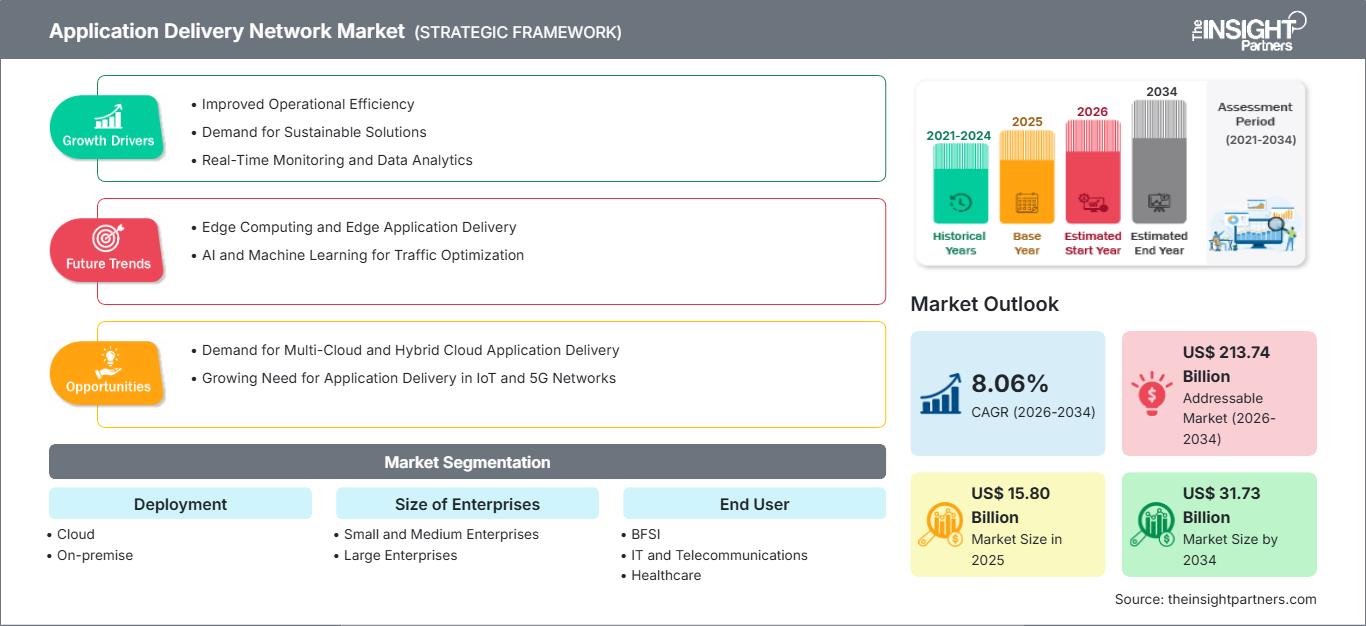
The application delivery network market is projected to grow from US$ 15.80 Billion in 2025 to US$ 31.73 Billion by 2034, expanding at a CAGR of 8.06% during 2026–2034. Adoption is being shaped by enterprise migration to hybrid cloud, growing dependence on latency-sensitive digital services, and the need to secure distributed applications without compromising performance.
North America remains a core demand center as banks, healthcare networks, media platforms, and federal agencies modernize application infrastructure. The application delivery network market size in the region is supported by cloud-native traffic management, high SaaS penetration, and advanced cybersecurity spending, with regional growth expected to remain within a 7.4–8.2% CAGR range through 2034.
Application Delivery Network Market Assessment and Insights
- North America accounted for an estimated 36–39% share in 2025 and is projected to grow at a CAGR of 7.4–8.2% during 2026–2034, led by enterprise cloud adoption and integrated application security.
- US represented nearly 78–82% of North America in 2025 and is expected to expand at a 7.2–8.0% CAGR as large enterprises modernize traffic routing and edge security.
- Europe held an estimated 24–27% share in 2025 and is forecast to grow at a 7.0–7.8% CAGR, with Germany, the UK, and France leading regulated cloud and data sovereignty deployments.
- Asia Pacific accounted for 22–25% share in 2025 and is expected to grow at an 8.8–9.8% CAGR, led by China, India, Japan, South Korea, and Australia.
- Largest Segment: Cloud deployment held around 58–62% market share in 2025 and is projected to grow at an 8.7–9.5% CAGR as enterprises favor scalable service-based delivery models.
- High Growth Segment: Small and Medium Enterprises held 34–38% share in 2025 and are expected to expand at a 9.2–10.1% CAGR due to managed cloud delivery adoption.
- Key companies analyzed in detail: Akamai Technologies, Inc.; Cloudflare, Inc.; Google LLC; Microsoft Corporation; Array Networks, Inc.; Cisco Systems, Inc.; Broadcom Inc.; VIAVI Solutions Inc.; G-Core Labs S.A.; and Juniper Networks, Inc.
Source: The Insight Partners' analysis based on proprietary research, government publications, company annual reports, investor presentations, industry databases, and expert interviews.
Application delivery has moved from appliance-centric traffic management to software-defined, cloud-integrated control. Enterprises now require load balancing, web application firewall functions, SSL offload, API protection, and observability within a unified operating layer. This evolution is widening the application delivery network market growth opportunity as digital channels support banking transactions, telehealth workflows, media streaming, public services, and enterprise collaboration.
Forward investment is shifting toward edge-enabled architectures, AI-assisted routing, and application-aware security. Asia Pacific and the Middle East are building new demand through cloud regions, digital government programs, and mobile-first platforms. The application delivery network market analysis indicates that vendors combining global reach, automation, and security policy orchestration will gain stronger enterprise relevance.
Application Delivery Network Market Report Scope
| Report Attribute | Details |
|---|---|
| Market size in 2025 | US$ 15.80 Billion |
| Market Size by 2034 | US$ 31.73 Billion |
| Global CAGR (2026 - 2034) | 8.06% |
| Historical Data | 2021-2024 |
| Forecast period | 2026-2034 |
Application Delivery Network Market Analysis
The demand has increased since the performance of the application has been linked to the retention of customers, transactional conversions, and employee productivity. Organizations are using the public cloud, private cloud, and the edge for deploying their workload; this has created a need for consistent policy implementation and traffic management. The value chain involves application delivery controllers, CDN platforms, security gateways, monitoring tools, managed services, and cloud native orchestration.
The supply side has shifted from hardware-centric to platform-centric due to vendors adding DDoS protection, bot management, zero-trust security features, and API protection in delivery platforms. Examples of the suppliers include Akamai Technologies, Cloudflare, Google, Microsoft, Cisco, Broadcom, Array Networks, VIAVI Solutions, Gcore, and Juniper Networks.
Competitive intensity reflects the convergence of CDN, ADC, edge security, and cloud networking. Hyperscalers benefit from deep integration with enterprise cloud environments, while specialized providers differentiate through visibility, traffic intelligence, and application acceleration. The application delivery network market analysis suggests that buyers increasingly compare platforms on operational simplicity, global performance, and bundled cybersecurity capability.
Funds are being directed to AI-based routing, programmable edge computing, and managed security services. Companies prefer integrated environments instead of discrete solutions and need the ability to route multi-cloud traffic, generate compliance reports, and deal with incidents in real time. This change provides new chances for vendors able to address both enterprises and SMEs.
● REPORT CUSTOMIZATION
Tailor This Report To Align With Your Specific Business Requirements
This report can be customized to align precisely with your business objectives, scope, and target markets. Customization options include tailored segmentation, geography, competitive analysis, and strategic insights to support informed decision-making.
Customize This Report →WHAT YOU CAN ADJUST
- ● Segmentations
- ● Geography
- ● Competitive Analysis
- ● Language Preferences
Application Delivery Network Market: Strategic Insights
Regional Insights
North America application delivery network market
North America remains the largest regional base with an estimated 36–39% application delivery network market share in 2025. Mature cloud adoption, high digital payment volumes, and strong spending on web security support sustained procurement across BFSI, healthcare, government, and media platforms.
The region is expected to grow at a 7.4–8.2% CAGR through 2034. Enterprises are moving toward integrated CDN, ADC, and zero-trust delivery services to reduce latency and simplify policy management across distributed applications.
U.S. application delivery network Market
The U.S. accounted for about 78–82% of North America in 2025, supported by hyperscale cloud concentration, SaaS density, and large digital transaction volumes. Financial institutions and healthcare systems remain major buyers because application reliability directly affects compliance, access continuity, and service quality.
U.S. demand is forecast to expand at a 7.2–8.0% CAGR. Akamai Technologies, Cloudflare, Google, Microsoft, Cisco, Broadcom, and Juniper Networks maintain a strong commercial presence, while enterprises increasingly prioritize API protection, real-time observability, and automated traffic balancing.
Europe application delivery network Market
Europe represented an estimated 24–27% share in 2025 and is projected to grow at a 7.0–7.8% CAGR. Germany, the UK, and France lead adoption through cloud modernization, data protection requirements, and rising enterprise demand for secure application acceleration.
The UK shows strong demand from financial services and media platforms, while Germany emphasizes regulated industrial cloud and secure connectivity. France, Italy, and Spain are expanding deployments as public services, telecom operators, and healthcare providers adopt resilient digital infrastructure.
APAC application delivery network Market
Asia Pacific held an estimated 22–25% share in 2025 and is expected to record an 8.8–9.8% CAGR. China, India, Japan, South Korea, and Australia lead adoption as cloud regions, digital payments, telehealth, and streaming ecosystems expand.
Growth is supported by mobile-first application use, enterprise cloud migration, and government-backed digital infrastructure. The region also benefits from rising demand for low-latency access, multilingual content delivery, and secure cross-border application performance.
Middle East & Africa application delivery network Market
The Middle East & Africa is expected to grow at a 7.6–8.6% CAGR through 2034. Saudi Arabia, the UAE, and South Africa are significant players, aided by the intelligent cities initiatives, cloud deployments, media consumption online, and e-government services.
The energy, government, telecom, and financial sectors are deploying application delivery platforms that will enhance service availability and secure customer-facing portals. The regional demand is lower than that in North America and Europe, but is increasingly becoming strategically significant for vendors.
Segmentation Analysis
Deployment
Deployment is projected to grow at a 7.8–8.7% CAGR during 2026–2034. The application delivery network market scope across deployment models is expanding as enterprises combine cloud-native services with retained on-premise controls for sensitive workloads.
- Cloud dominates adoption as enterprises require elastic scaling, managed security, and faster rollout across distributed users, making it the preferred model for digital-first and multi-cloud operations.
- On-premise remains relevant where regulatory control, internal traffic inspection, or legacy application dependencies require dedicated infrastructure within enterprise data centers or private networks.
Size of Enterprises
According to the Application Delivery Network Market report, the Size of Enterprises segment is expected to grow at a CAGR of 8.1–9.0% during the forecast period. Large enterprises continue to account for the majority of spending due to extensive application environments, complex traffic management requirements, and ongoing digital transformation initiatives. Meanwhile, SMEs are increasingly procuring managed delivery services to access resilient traffic routing, performance optimization, and integrated security capabilities without requiring deep in-house network engineering resources.
- Small and Medium Enterprises are adopting cloud-managed platforms for website acceleration, basic application security, and predictable operating expenditure amid growing digital commerce and SaaS reliance.
- Large Enterprises require advanced governance, high availability, multi-cloud consistency, and integrated threat protection across complex application estates and geographically dispersed business units.
End User
According to the Application Delivery Network Market forecast, the End User segment is projected to grow at a CAGR of 7.9–8.8% during the forecast period. BFSI and IT & Telecommunications remain the leading adopters due to their need for high application availability, secure connectivity, and efficient traffic management. Meanwhile, healthcare, government, and media organizations are increasingly relying on application delivery solutions to support secure digital access, optimize user experiences, and ensure reliable performance across critical online services and platforms.
- BFSI uses application delivery networks to support online banking, digital payments, fraud-sensitive traffic, and customer portals where latency and uptime directly affect trust.
- IT and Telecommunications deploy platforms for multi-cloud connectivity, traffic visibility, managed service delivery, and high-volume enterprise application performance.
- Healthcare adoption is growing as providers secure patient portals, telehealth traffic, electronic records access, and cloud-based clinical applications.
- Government users prioritize secure access, citizen service continuity, and resilient delivery for public portals, identity systems, and regulated data workflows.
- Media & Entertainment depends on low-latency content access, traffic surge handling, and secure delivery for streaming, gaming, and live digital events.
Opportunity Snapshot
| End User | Revenue Contribution | Trend Tag | Adoption Stage |
| BFSI | High | Secure Banking | Mature |
| IT and Telecommunications | High | Cloud Routing | Scaling |
| Healthcare | Medium | Telehealth Access | Scaling |
| Government | Medium | Citizen Portals | Scaling |
| Media & Entertainment | High | Live Streaming | Mature |
Application Delivery Network Market Growth Drivers and Impact Analysis
Hybrid Cloud Workloads Increase Delivery Complexity
Application deployment in public cloud, private cloud and edge architectures makes traffic management difficult. Application Delivery Platforms can ensure consistent performance, policy enforcement and inspection of security. This will be most evident in BFSI, healthcare and government, where availability, latency and compliance have to be managed simultaneously. This is the driver for continuous investment in cloud-based ADC, CDN and security services. Multi-cloud deployment and working from remote locations is making networks complex, thus encouraging companies to adopt application delivery solutions that offer visibility, automation and workload management capabilities.
Rising Cybersecurity Requirements Reshape Procurement
Nowadays, application delivery comes with built-in defenses against DDoS attacks, bot mitigation, web application firewalls, and API security. Organizations are cutting down on independent tool stacks due to the potential issues associated with scattered security, which may lead to blind spots and inefficiency. Integration of the platform provides robustness through filtering of any malicious traffic that tries to access the applications. This is especially true for consumer-facing portals, payment gateways, and heavy media websites, which face surges in traffic and continuous attack attempts.
Digital Experience Becomes a Business Performance Metric
Slow-performing applications have negative impacts on the conversion process, customer satisfaction levels and workforce productivity. Delivery performance is now a matter of concern for the boards. Companies are spending a lot on traffic management, caching, load balancing and visibility solutions in order to safeguard the end user experience. This change is very evident in the e-commerce sector, streaming services, access to health care and financial services. With digital media taking a central stage as the main point of contact for the services, application delivery has now become an essential revenue protection infrastructure.
Application Delivery Network Market Future Trends
AI-Assisted Traffic Optimization
Application delivery network market trends point toward AI-assisted routing that can analyze traffic conditions, application behavior, and threat signals in real time. Instead of fixed rules, platforms will increasingly recommend or automate routing paths, caching decisions, and anomaly responses. This can reduce operational workload for network teams while improving resilience during traffic surges. Vendors that combine machine learning with explainable controls are likely to gain enterprise trust. AI-driven analytics will also enhance predictive capacity planning, helping organizations identify potential bottlenecks before they impact application availability, performance, or user experience across distributed environments.
Convergence of Edge Delivery and Security
Edge architectures in the future will include a combination of content acceleration, application delivery, API security, and zero-trust access from edge locations. The enterprises will favor converged platforms to minimize the distance between their users, security, and application workloads. Such platforms will enable low-latency services like video conferencing, digital banking, gaming, and SaaS enterprise applications. It will also provide competitive differentiation for vendors that have many points of presence and sophisticated policy orchestration capabilities. The demand for real-time applications and remote access is also going to fuel such investments.
Application Delivery Network Market Opportunities
Managed Delivery Services for SMEs
Small and medium enterprises are an excellent opportunity in the market because, despite the absence of specialists in network management, they still need reliable and quick digital services. According to the forecasts of cloud-managed application delivery networks, there is room for subscription-based products that offer acceleration, WAF, DDoS protection, and analytics. It is possible to target this segment by providing easy onboarding, transparent pricing, and industry-focused templates. These solutions will be particularly useful for digital commerce, healthcare clinics, media producers, and local financial services providers. With the increasing popularity of digitalization, there is also potential for recurring revenues.
Regulated Sector Modernization
Regulated sectors are modernizing applications while maintaining strict requirements for availability, auditability, and data protection. Vendors can target banks, public agencies, hospitals, and telecom operators with platforms that combine application performance, compliance reporting, and advanced security controls. These buyers value reliability and governance over basic bandwidth savings. The opportunity is reinforced by cloud migration, citizen-service digitization, and growing dependence on APIs for secure service integration. Increasing regulatory oversight and the need for continuous service availability are encouraging organizations to invest in modern application delivery platforms with integrated governance capabilities.
Frequently Asked Questions

- Comprehensive Market Sizing and Forecast Analysis
- Detailed Segmentation Analysis
- In-Depth Market Dynamics Assessment
- Regional and Country-Level Insights
- Competitive Landscape and Company Benchmarking
- Strategic Business Intelligence
Recent Reports
Testimonials

The Insight Partners' SCADA System Market report is comprehensive, with valuable insights on current trends and future forecasts. The team was highly professional, responsive, and supportive throughout. We are very satisfied and highly recommend their services.
RAN KEDEM Partner, Reali Technologies LTDs
I requested a report on a very specific software market and the team produced the report in a few days. The information was very relevant and well presented. I then requested some changes and additions to the report. The team was again very responsive and I got the final report in less than a week.
JEAN-HERVE JENN Chairman, Future Analytica
We worked with The Insight Partners for an important market study and forecast. They gave us clear insights into opportunities and risks, which helped shape our plans. Their research was easy to use and based on solid data. It helped us make smart, confident decisions. We highly recommend them.
PIYUSH NAGPAL Sr. Vice President, High Beam Global
The Insight Partners delivered insightful, well-structured market research with strong domain expertise. Their team was professional and responsive throughout. The user-friendly website made accessing industry reports seamless. We highly recommend them for reliable, high-quality research services
YUKIHIKO ADACHI CEO, Deep Blue, LLC.
This is the first time I have purchased a market report from The Insight Partners.While I was unsure at first, I visited their web site and felt more comfortable to take the risk and purchase a market report.I am completely satisfied with the quality of the report and customer service. I had several questions and comments with the initial report, but after a couple of dialogs over email with their analyst I believe I have a report that I can use as input to our strategic planning process.Thank you so much for taking the extra time and making this a positive experience.I will definitely recommend your service to others and you will be my first call when we need further market data.
JOHN SUZUKI President and Chief Executive Officer, Board Director, BK Technologies
I wish to appreciate your support and the professionalism you displayed in the course of attending to my request for information regarding to infectious disease IVD market in Nigeria. I appreciate your patience, your guidance, and the fact that you were willing to offer a discount, which eventually made it possible for us to close a deal. I look forward to engaging The Insight Partners in the future, all thanks to the impression you have created in me as a result of this first encounter.
DR CHIJIOKE ONYIA MANAGING DIRECTOR, PineCrest Healthcare Ltd.Reason to Buy
- Informed Decision-Making
- Understanding Market Dynamics
- Competitive Analysis
- Identifying Emerging Markets
- Customer Insights
- Market Forecasts
- Risk Mitigation
- Boosting Operational Efficiency
- Strategic Planning
- Investment Justification
- Tracking Industry Innovations
- Aligning with Regulatory Trends





 Get Free Sample for