
Application Programming Interface (API) Security Market Growth, Trends & Forecast by 2034
Application Programming Interface (API) Security Market Size and Forecasts (2021–2034), Global and Regional Share, Trends, and Growth Opportunity Analysis Report Coverage : By Offering (Platform and Solutions, Services), Deployment Mode (On-Premises, Cloud, Hybrid), Organization Size (SMEs, Large Enterprise), Vertical (BFSI, IT and Telecom, Government, Manufacturing, Healthcare, Retail and eCommerce, Media and Entertainment, Energy and Utilities, Others)
- Status : Data Released
- Report Code : TIPRE00039724
- Category : Technology, Media and Telecommunications
- No. of Pages : 150
- Available Report Formats :


- Last update date : August 26, 2026


2025 Market Size
US$ 2.79 Bn
Base year value
2034 Forecast
US$ 24.64 Bn
Projected by 2034
CAGR 2026-2034
31.30 %
Growth rate
Addressable Market
US$ 124.04 Bn
(2026-2034)
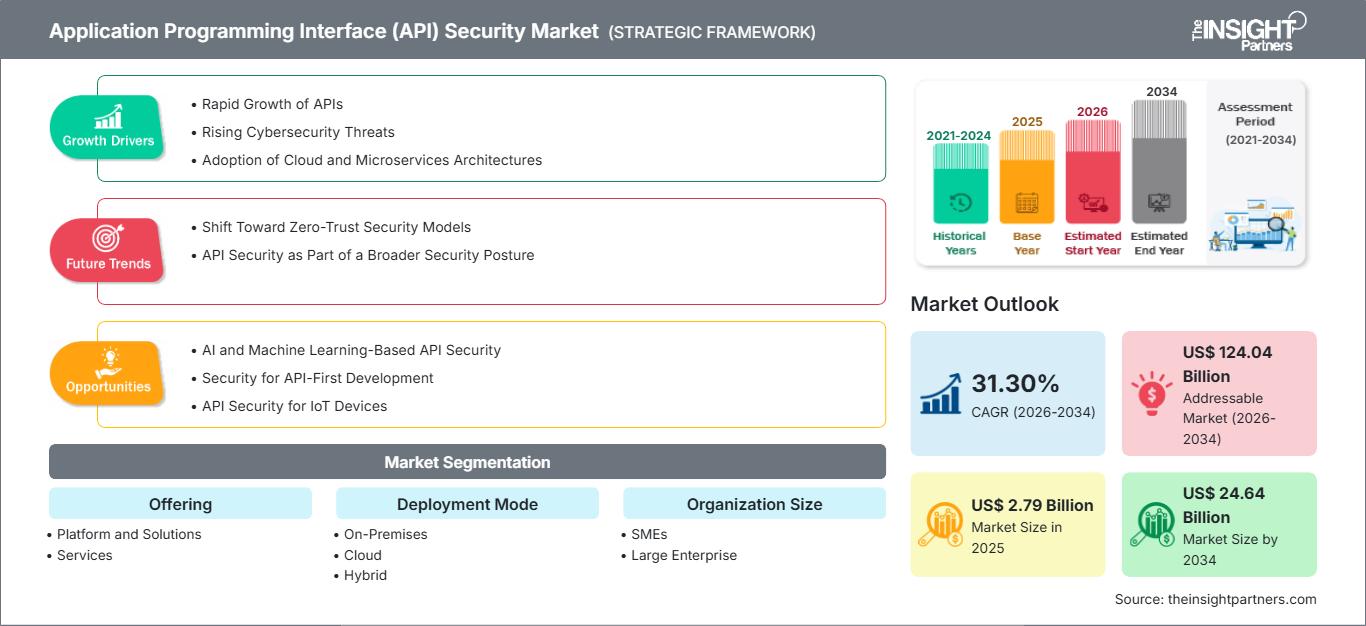
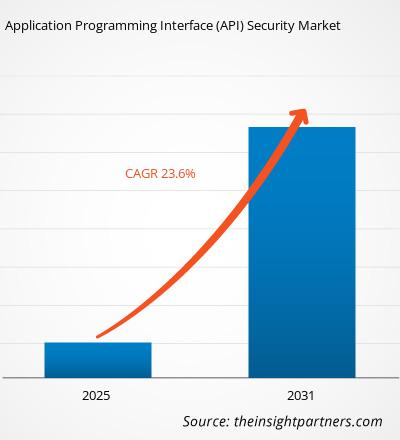
The application programming interface security market was valued at US$ 2.79 Billion in 2025 and is projected to reach US$ 24.64 Billion by 2034, registering a CAGR of 31.30% during 2026–2034. The expansion reflects higher enterprise dependence on APIs for digital banking, cloud workloads, mobile commerce, healthcare exchange, and AI-enabled automation, where exposed interfaces increasingly create direct paths to sensitive data, transaction systems, and business logic.
North America remains the most mature adoption center as enterprises shift from web application firewalls toward API discovery, posture management, and runtime protection. The application programming interface security market size in the region is supported by cloud-native modernization, financial services regulation, and early adoption of zero-trust architectures. Regional CAGR is estimated at 30–32% through 2034, with procurement led by large enterprises, managed security providers, and compliance-heavy sectors.
Application Programming Interface (API) Security Market Assessment and Insights
- North America accounted for 38–41% share in 2025 and is expected to grow at a CAGR of 30–32% during 2026–2034, supported by cloud-native application estates, board-level cyber risk governance, and high API exposure across BFSI, healthcare, and software platforms.
- US represented 78–82% of North America in 2025 and is projected to expand at a CAGR of 29–31% during 2026–2034, driven by mature DevSecOps, federal cyber mandates, and AI workload security.
- Europe held 24–27% share in 2025 and is likely to grow at a CAGR of 29–31% during 2026–2034, led by the UK, Germany, and France, where GDPR, NIS2, and financial-sector resilience programs strengthen demand.
- Asia Pacific captured 22–25% share in 2025 and is forecast to grow at a CAGR of 34–36% during 2026–2034, with China, India, Japan, South Korea, and Australia scaling API controls across digital finance and telecom.
- Largest Segment: Platform and Solutions held 64–68% market share in 2025 and is expected to grow at a CAGR of 30–32% during 2026–2034 as buyers prioritize discovery, threat analytics, and automated enforcement.
- High Growth Segment: Cloud deployment held 45–49% market share in 2025 and is projected to grow at a CAGR of 33–35% during 2026–2034 as SaaS, microservices, and AI APIs expand external attack surfaces.
- Key companies analyzed in detail: Google LLC, Salt Security Inc., Noname Security, Akamai Technologies, Inc., Data Theorem, Inc., Axway Software SA, Imperva, Inc., Traceable Inc., Palo Alto Networks, Inc., Fortinet, Inc., Red Hat, Inc., Ergon Informatik AG, Perforce Software, Inc., WSO2 LLC.
Source: The Insight Partners' analysis based on proprietary research, government publications, company annual reports, investor presentations, industry databases, and expert interviews.
API defense has moved from gateway-centric access control toward continuous discovery, schema validation, behavioral analytics, and protection of business logic. Production dynamics are changing because APIs are now built by distributed developers, exposed through cloud gateways, and consumed by partners, mobile apps, AI agents, and internal services. The application programming interface security market is therefore shifting toward platforms that combine inventory, risk scoring, runtime blocking, and compliance evidence across hybrid estates.
During the forecasted period, new geographies will spend more as open banking, national digital identity, e-commerce, and smart infrastructure initiatives will expand API exposure. The positive regulatory wind behind NIS2, PCI DSS 4.0, DORA, HIPAA-aligned controls, and cybersecurity frameworks for governments will boost baseline requirements. Spending will focus on companies that embed API security into CNAPP, WAAP, SIEM, SOAR, SASE, and DevOps workflows without hampering software delivery speed.
Application Programming Interface (API) Security Market Report Scope
| Report Attribute | Details |
|---|---|
| Market size in 2025 | US$ 2.79 Billion |
| Market Size by 2034 | US$ 24.64 Billion |
| Global CAGR (2026 - 2034) | 31.30% |
| Historical Data | 2021-2024 |
| Forecast period | 2026-2034 |
Application Programming Interface (API) Security Market Analysis
Enterprise demand is accelerating because APIs now carry authentication tokens, payment data, patient records, and operational workflows. Application programming interface security market growth is strongest where API sprawl, shadow endpoints, and third-party integrations exceed manual governance capacity. Security buyers increasingly evaluate real-time traffic analysis, sensitive-data detection, BOLA protection, and anomaly scoring as core controls rather than optional add-ons.
Value chain coverage includes API design, testing, gateways, monitoring, incident response, and compliance reporting. Supply economics favor those providers that have widespread telemetry visibility, machine learning based on production traffic, and support for cloud native platforms. Managed services have become relevant as well since mid-market companies do not always have API security experts.
Competitive intensity is high as cloud providers, WAAP vendors, CNAPP platforms, and API lifecycle specialists converge. Application programming interface security market analysis shows Akamai Technologies, Inc., Imperva, Inc., Google LLC, Palo Alto Networks, Inc., Fortinet, Inc., Salt Security Inc., Traceable Inc., and Data Theorem, Inc. positioning around discovery depth, automated mitigation, and AI-related API governance.
Investments in strategic directions will be made in favor of agents for AI protection, code-to-runtime visibility, and consolidated application security consoles. Companies such as Axway Software SA, Perforce Software, Inc., WSO2 LLC, Red Hat, Inc., Ergon Informatik AG, and Noname Security contribute to the ecosystem with their API management, integration, and security expertise.
● REPORT CUSTOMIZATION
Tailor This Report To Align With Your Specific Business Requirements
This report can be customized to align precisely with your business objectives, scope, and target markets. Customization options include tailored segmentation, geography, competitive analysis, and strategic insights to support informed decision-making.
Customize This Report →WHAT YOU CAN ADJUST
- ● Segmentations
- ● Geography
- ● Competitive Analysis
- ● Language Preferences
Application Programming Interface (API) Security Market: Strategic Insights
Regional Insights
North America application programming interface security market
North America represented 38–41% share in 2025 and is expected to grow at a CAGR of 30–32% during 2026–2034. The region benefits from heavy API usage across banking, SaaS, healthcare platforms, retail marketplaces, and public cloud environments. The application programming interface security market share is reinforced by early adoption of zero trust, SBOM-linked governance, and API inventory mandates across regulated enterprises.
Demand will also be driven by expectations for breach disclosures, PCI DSS 4.0 compliance, and increased attention from the government towards secure software. The market will see buyers integrating their API detection capabilities, WAAP, bot mitigation, and runtime protection into a smaller number of platforms. There will be an increase in managed detection as organizations cope with machine-speed attacks.
U.S. application programming interface security Market
The U.S. accounted for 78–82% of the North America application programming interface security Market in 2025 and is projected to grow at a CAGR of 29–31% during 2026–2034. Large-scale cloud estate, open banking APIs, health data exchange, and digital government initiatives generate a widespread requirement for constant management of APIs and their runtime enforcement. The vendor strength is high with vendors such as Google LLC, Akamai Technologies, Inc., Salt Security Inc., Traceable Inc., and Palo Alto Networks, Inc.
The application areas are focused on fraud detection, AI API governance, payment security, and developer pipeline integration. Fraud prevention is important for financial services organizations in relation to BOLA, whereas PHI exposure monitoring is vital for healthcare customers. U.S. companies are deploying policy as code and automated remediation capabilities for API vulnerabilities.
Europe application programming interface security Market
Europe held 24–27% share of the application programming interface security Market in 2025 and is expected to grow at a CAGR of 29–31% during 2026–2034. Leading the pack is the UK because of mature open banking, fintech API ecosystems, and operational resilience regulation. Large banks, insurance companies, telecom providers, and governments are making runtime visibility, third-party API governance, and better audit evidence their top priorities.
In Germany, the need stems from industrial software, manufacturing automation, connected mobility, and data sovereignty worries. France, Italy, and Spain are increasing their adoption of digital public services, retail modernization, and cybersecurity budgets. In this region, the General Data Protection Regulation (GDPR) and the Network and Information Systems (NIS2) Directive are fueling the need to classify API data.
APAC application programming interface security Market
APAC captured 22–25% share of the application programming interface security Market in 2025 and is projected to grow at a CAGR of 34–36% during 2026–2034. China leads on a regional scale through platform commerce, digital payments, and industrial cloud adoption, while India expands rapidly through UPI-linked ecosystems, fintech APIs, and government digital infrastructure.
Japan, South Korea, and Australia contribute demand through telecom modernization, connected manufacturing, and stricter cyber resilience expectations. Policy drivers include national data protection laws, critical infrastructure programs, and financial-sector technology risk frameworks. Buyers increasingly seek cloud-first deployment and automated API cataloging.
Middle East & Africa application programming interface security Market
The Middle East & Africa application programming interface security Market is expected to grow at a CAGR of 27–29% during 2026–2034, with Saudi Arabia and the UAE leading adoption. Energy, smart city platforms, digital banking, and government service modernization are expanding API exposure across hybrid cloud and critical infrastructure environments.
South Africa shows steady demand from financial services, telecom, and retail e-commerce, while the Rest of MEA remains project-led. Regional buyers prioritize managed services, sovereign hosting options, and protection for partner-facing APIs used in payments, identity, logistics, utilities, and citizen-service platforms.
Segmentation Analysis
Offering
Offering is expected to grow at a CAGR of 30–32% during 2026–2034. The application programming interface security market scope across this segment includes platforms for API discovery, posture assessment, sensitive-data mapping, threat detection, and managed response services. Adoption is shaped by the need to secure distributed development environments while preserving API performance, developer productivity, and compliance reporting.
- Platform and Solutions dominate spending as enterprises require automated inventories, risk scoring, schema enforcement, anomaly detection, and inline mitigation across public, private, partner, and internal APIs.
- Services are gaining strategic value as organizations seek implementation support, managed monitoring, incident triage, API penetration testing, and governance advisory for compliance-heavy digital transformation programs.
Deployment Mode
Deployment Mode is projected to grow at a CAGR of 32–34% during 2026–2034. Deployment decisions depend on data residency, latency, cloud strategy, and the maturity of existing gateways. Cloud deployments lead new buying cycles, while on-premises and hybrid models remain important for banking, government, healthcare, telecom, and industrial organizations with sensitive workloads.
- On-Premise continues to play a role for those needing strict data control, existing gateway infrastructure, sovereign hosting, or OT integration with local policy inspection.
- Cloud offers the fastest-scaling approach since SaaS deployments, microservices, serverless functions, and AI processing are demanding elastic discovery and security at run-time.
- Hybrid tackles complex ecosystems, allowing organizations to have consistent API governance across on-premise data centers, public cloud regions, edge environments, and partners' networks.
Organization Size
Organization Size is expected to grow at a CAGR of 30–32% during 2026–2034. Large enterprises account for the majority of current spending because they operate extensive API portfolios and face higher audit scrutiny. SMEs are becoming more active in cloud-native development, e-commerce integration, and managed security offerings, which reduce implementation barriers and improve affordability.
- SMEs increasingly adopt API security through cloud-native tools, bundled WAAP platforms, and managed services that reduce analyst workload and simplify compliance.
- Large Enterprise buyers emphasize platform consolidation, global visibility, executive risk reporting, automated enforcement, and integration with SOC, DevSecOps, and identity systems.
Vertical
Vertical is projected to grow at a CAGR of 31–33% during 2026–2034. BFSI leads adoption due to open banking, payment APIs, and fraud exposure, while IT and telecom buyers secure high-volume service interfaces. Healthcare, retail, government, manufacturing, media, energy, and utilities are moving from reactive API testing toward continuous runtime governance.
- BFSI prioritizes account protection, transaction integrity, open banking compliance, fraud detection, and business logic defense across payment, onboarding, lending, and partner APIs.
- IT and Telecom require scalable API visibility for developer platforms, subscriber services, OSS/BSS modernization, partner networks, and AI-enabled service orchestration.
- Government demand is shaped by digital identity, citizen portals, defense modernization, and critical service availability across national and local public-sector platforms.
- Manufacturing adoption rises with connected products, industrial IoT, supply-chain APIs, and secure integration between enterprise software and operational systems.
- Healthcare is centered on patient data transfer, payer provider integrations, telehealth, connected devices, and security controls for sensitive clinical and insurance APIs.
- Retail and eCommerce organizations protect themselves against bots, payment fraud, loyalty abuse, scraping, account takeovers, and seasonal heavy API traffic.
- Media and Entertainment leverage API security solutions for secure streaming, subscriptions, DRM workflows, distribution, and personalization.
- Energy and Utilities need to secure their smart grids, customer portals, field service operations, trading systems, and critical infrastructure data exchanges.
Opportunity Snapshot
| Vertical | Revenue Contribution (High/Medium/Low) | Trend Tag (MAX 2 words, specific) | Adoption Stage (Emerging/Scaling/Mature) |
| BFSI | High | Open Banking | Mature |
| IT and Telecom | High | Service APIs | Scaling |
| Government | Medium | Digital Identity | Scaling |
| Manufacturing | Medium | Industrial IoT | Scaling |
| Healthcare | High | Patient Exchange | Scaling |
| Retail and eCommerce | High | Fraud Defense | Mature |
| Media and Entertainment | Medium | Streaming Access | Scaling |
| Energy and Utilities | Medium | Grid APIs | Emerging |
Application Programming Interface (API) Security Market Growth Drivers and Impact Analysis
API Sprawl Across Cloud-Native Enterprises
Inventories of APIs are increasing faster than the manual process of governance can keep up with, especially for those companies using microservices, containers, serverless functions, and multi-cloud integration. The existence of shadow APIs, undocumented endpoints, and inconsistent identity can create vulnerabilities that are not detected by periphery tools. This driver affects the market directly since consumers are reallocating resources spent on periodic testing of their APIs to continuous discovery and run-time posturing management. The application programming interface security market benefits as CISOs seek a measurable reduction in exposed endpoints, faster risk prioritization, and continuous evidence for regulatory audits.
Business Logic Attacks and Automated Abuse
Attackers are beginning to leverage what looks like legitimate API requests for the purpose of exploiting authorization vulnerabilities, data scraping, automation, loyalty program manipulation, or manipulation of checkout processes. Such an attack pattern can be hard to stop using signatures since the traffic follows a protocol-based and legitimate behavior at the network level. The effect is a growing need for behavioral baseline analysis, object-level authorization, session intelligence, and bot protection capabilities within the API landscape. Enterprises have become concerned with solutions that comprehend application behavior rather than just invalid requests.
Regulatory Pressure on Sensitive Data Exchange
There is greater regulatory focus on digital resilience, payment security, health data protection, and critical infrastructure continuity. There are changes in API controls that now affect compliance with the PCI DSS 4.0, GDPR, DORA, NIS2, HIPAA programs, and industry-specific technology risks. The business implications can be seen in procurement requests for API inventory, sensitive data identification, authentication controls, logging, and evidence of incident response. Companies are embracing API security because of audit friction and control maturity for board and regulator satisfaction. Companies providing reporting and policy mapping as well as data privacy capabilities, are well positioned in winning enterprise deals in highly regulated industries.
Application Programming Interface (API) Security Market Future Trends
Agentic AI API Governance
application programming interface security market trends will be reshaped by autonomous agents that call APIs, chain workflows, and access enterprise data at machine speed. Going forward, platforms will have to identify traffic generated from humans, services, bots, and agents while employing least privilege principles for dynamic access control. There is going to be a need for security teams to gain visibility into model-to-tool APIs, MCPs, AI plug-ins, and the APIs that are generated automatically through development. In the next wave of solutions, there is going to be integration of API discovery, prompt-based controls, identity context, and anomalies in real time.
Shift Toward Code-to-Runtime Security
API Security will move to prior to the production phase as companies will integrate their source code repositories, specification files, CI/CD tools, gateways, and run-time telemetry. In this way, companies will be able to find problematic endpoints, the absence of authentication, poor schemas, and leakage of sensitive data at an early stage of development. The commercial aspect of such an approach includes high demand for those solutions that can be integrated into developers' workflow but will continue enforcing security in the run-time environment.
Application Programming Interface (API) Security Market Opportunities
Managed API Security for Mid-Market Buyers
Mid-sized organizations face rising API exposure but often lack dedicated AppSec specialists, mature SIEM operations, or round-the-clock incident response. This creates a clear opportunity for vendors and MSSPs to package API discovery, risk assessment, threat monitoring, and remediation guidance as managed services. Application Programming Interface Security Market Forecasts indicate that service-led adoption can unlock demand from SMEs in e-commerce, healthcare, fintech, logistics, and SaaS. Successful offerings will combine rapid onboarding, predefined compliance reports, analyst escalation, and transparent pricing. Providers that reduce operational complexity while preserving measurable security outcomes can capture a broader customer base.
Verticalized Protection for High-Risk Workflows
Vendors can differentiate their revenue streams by customizing API controls according to business processes like open banking payments, healthcare interoperability, telecom subscriber management, retail loyalty systems, and smart utilities. Generic anomaly detection is good, but specialized policies make it more relevant by tying risk scores with transaction characteristics, fraud signals, and regulatory requirements. Vendors need to invest in preconfigured playbooks, specialized dashboards, and integrations with sector platforms. This plays well into the hands of BFSI, healthcare, retail, and energy customers, where an API breach leads to financial, regulatory, and operational problems within short windows of time.
Frequently Asked Questions

- Comprehensive Market Sizing and Forecast Analysis
- Detailed Segmentation Analysis
- In-Depth Market Dynamics Assessment
- Regional and Country-Level Insights
- Competitive Landscape and Company Benchmarking
- Strategic Business Intelligence
Recent Reports
Testimonials

The Insight Partners' SCADA System Market report is comprehensive, with valuable insights on current trends and future forecasts. The team was highly professional, responsive, and supportive throughout. We are very satisfied and highly recommend their services.
RAN KEDEM Partner, Reali Technologies LTDs
I requested a report on a very specific software market and the team produced the report in a few days. The information was very relevant and well presented. I then requested some changes and additions to the report. The team was again very responsive and I got the final report in less than a week.
JEAN-HERVE JENN Chairman, Future Analytica
We worked with The Insight Partners for an important market study and forecast. They gave us clear insights into opportunities and risks, which helped shape our plans. Their research was easy to use and based on solid data. It helped us make smart, confident decisions. We highly recommend them.
PIYUSH NAGPAL Sr. Vice President, High Beam Global
The Insight Partners delivered insightful, well-structured market research with strong domain expertise. Their team was professional and responsive throughout. The user-friendly website made accessing industry reports seamless. We highly recommend them for reliable, high-quality research services
YUKIHIKO ADACHI CEO, Deep Blue, LLC.
This is the first time I have purchased a market report from The Insight Partners.While I was unsure at first, I visited their web site and felt more comfortable to take the risk and purchase a market report.I am completely satisfied with the quality of the report and customer service. I had several questions and comments with the initial report, but after a couple of dialogs over email with their analyst I believe I have a report that I can use as input to our strategic planning process.Thank you so much for taking the extra time and making this a positive experience.I will definitely recommend your service to others and you will be my first call when we need further market data.
JOHN SUZUKI President and Chief Executive Officer, Board Director, BK Technologies
I wish to appreciate your support and the professionalism you displayed in the course of attending to my request for information regarding to infectious disease IVD market in Nigeria. I appreciate your patience, your guidance, and the fact that you were willing to offer a discount, which eventually made it possible for us to close a deal. I look forward to engaging The Insight Partners in the future, all thanks to the impression you have created in me as a result of this first encounter.
DR CHIJIOKE ONYIA MANAGING DIRECTOR, PineCrest Healthcare Ltd.Reason to Buy
- Informed Decision-Making
- Understanding Market Dynamics
- Competitive Analysis
- Identifying Emerging Markets
- Customer Insights
- Market Forecasts
- Risk Mitigation
- Boosting Operational Efficiency
- Strategic Planning
- Investment Justification
- Tracking Industry Innovations
- Aligning with Regulatory Trends





 Get Free Sample for