
Application Release Automation Market Demand, Trends & Forecast by 2034
Coverage: by Components (Tool, Services); Deployment Type (Cloud, On-Premises); Enterprise Size (Large Enterprises, SMEs); Industry Vertical (BFSI, IT and Telecommunications, Healthcare, Media and Entertainment, Retail and Consumer Goods, Others) , and Geography (North America, Europe, Asia Pacific, and South and Central America)
- Status : Data Released
- Report Code : TIPRE00005700
- Category : Technology, Media and Telecommunications
- No. of Pages : 150
- Available Report Formats :


- Last update date : August 26, 2026


2025 Market Size
US$ 8.25 Bn
Base year value
2034 Forecast
US$ 29.66 Bn
Projected by 2034
CAGR 2026-2034
15.28 %
Growth rate
Addressable Market
US$ 161.56 Bn
(2026-2034)
The application release automation market was valued at US$ 8.25 Billion in 2025 and is projected to reach US$ 29.66 Billion by 2034, registering a CAGR of 15.28% during 2026–2034. The market is expanding as enterprises formalize DevOps governance, automate production releases, and reduce deployment risk across cloud-native, hybrid, and regulated application environments.
North America remains the most mature demand center, with the application release automation market size supported by high DevOps penetration, large-scale cloud migration, and strict resilience requirements in financial services, healthcare, and digital commerce. The region is estimated to grow at a CAGR range of 14–16% during 2026–2034, driven by platform engineering adoption and modernization of release governance across complex enterprise estates.
Application Release Automation Market Assessment and Insights
- North America held 38–40% share in 2025 and is expected to grow at a CAGR between 2026–2034 of 14–16%, supported by enterprise DevOps maturity, regulated software delivery, and strong adoption across BFSI, healthcare, and cloud-native technology companies.
- US accounted for 78–82% of North America in 2025 and is projected to grow at a CAGR between 2026–2034 of 14–15%, led by hyperscale cloud, banking, and platform engineering investments.
- Europe represented 24–26% share in 2025 and is expected to grow at a CAGR between 2026–2034 of 13–15%, with the UK, Germany, and France leading demand through software modernization, security compliance, and digital public infrastructure programs.
- Asia Pacific held 22–24% share in 2025 and is projected to grow at a CAGR between 2026–2034 of 17–19%, led by China, India, Japan, South Korea, and Australia as cloud adoption and digital banking accelerate.
- Largest Segment: The Tools segment held a market share range of 58–62% in 2025 and CAGR range of 14–16% during 2026–2034, reflecting demand for integrated release orchestration, rollback, monitoring, and compliance capabilities.
- High Growth Segment: Cloud deployment held a market share range of 54–58% in 2025 and CAGR range of 17–19% during 2026–2034 as enterprises scale SaaS-based pipelines and hybrid cloud releases.
- Key companies analyzed in detail: QlikTech International AB, Broadcom Inc., Clarive Software S.L., CloudBees, Inc., Liquibase Inc., Flexagon LLC, Open Text Corporation, Plutora, Inc., Red Hat, Inc., Digital.ai Software, Inc.
Source: The Insight Partners' analysis based on proprietary research, government publications, company annual reports, investor presentations, industry databases, and expert interviews.
Application delivery has moved from scripted deployment toward policy-led orchestration across containers, APIs, databases, and mainframe-connected systems. The application release automation market is shaped by release frequency, environment consistency, auditability, and rollback reliability. The new dynamics in production involve the integration with CI/CD tools, infrastructure-as-code, services management, and observability, with customers favoring solutions that manage risk in releases across teams compared to deployments alone.
In the future, growth will expand from its initial markets in North America and Western Europe to other regions like India, Southeast Asia, the Gulf, and Latin America. Digitization in the public sector, banking modernization, and compliance with cloud migrations are creating a greater need for automated release management. Operational resilience, software supply chain security, and change traceability requirements are driving investments in release automation solutions.
Application Release Automation Market Report Scope
| Report Attribute | Details |
|---|---|
| Market size in 2025 | US$ 8.25 Billion |
| Market Size by 2034 | US$ 29.66 Billion |
| Global CAGR (2026 - 2034) | 15.28% |
| Historical Data | 2021-2024 |
| Forecast period | 2026-2034 |
Application Release Automation Market Analysis
The application release automation market growth is driven by the need to shorten release cycles without weakening governance. Organizations are juggling more applications, more environments, and more compliance tests, making it expensive to rely on manual deployments. Automation minimizes failure rates, enhances cooperation between developers and IT operators, and ensures consistent approvals within hybrid IT.
The industry features CI/CD vendors, cloud providers, IT service management systems, security testing vendors, database change management providers, and consultancies. There is more demand where dependencies of a release range from microservices and legacy apps to databases and processes subject to regulation. The supply picture is changing towards modular platforms with APIs, policy engines, and analytics capabilities for repeatable deployment patterns.
The application release automation market analysis shows a competitive landscape split between DevOps platform providers, enterprise automation vendors, and specialists. The companies that compete using software suite solutions include Broadcom Inc., CloudBees, Inc., Red Hat, Inc., Digital.ai Software, Inc., and Open Text Corporation, while companies such as Clarive Software S.L., Flexagon LLC, Liquibase Inc., and Plutora, Inc. are competing by providing specialized orchestration, planning, and database release solutions.
The focus of investments is now shifting toward native release management in the cloud, AI-driven deployment decisions, compliance proofs, and visibility into the value stream. The company QlikTech International AB will still be able to stay relevant by means of its integration lineage tied to Attunity products, while the companies with strong partner ecosystems will have more advantages in large-scale transformations.
● REPORT CUSTOMIZATION
Tailor This Report To Align With Your Specific Business Requirements
This report can be customized to align precisely with your business objectives, scope, and target markets. Customization options include tailored segmentation, geography, competitive analysis, and strategic insights to support informed decision-making.
Customize This Report →WHAT YOU CAN ADJUST
- ● Segmentations
- ● Geography
- ● Competitive Analysis
- ● Language Preferences
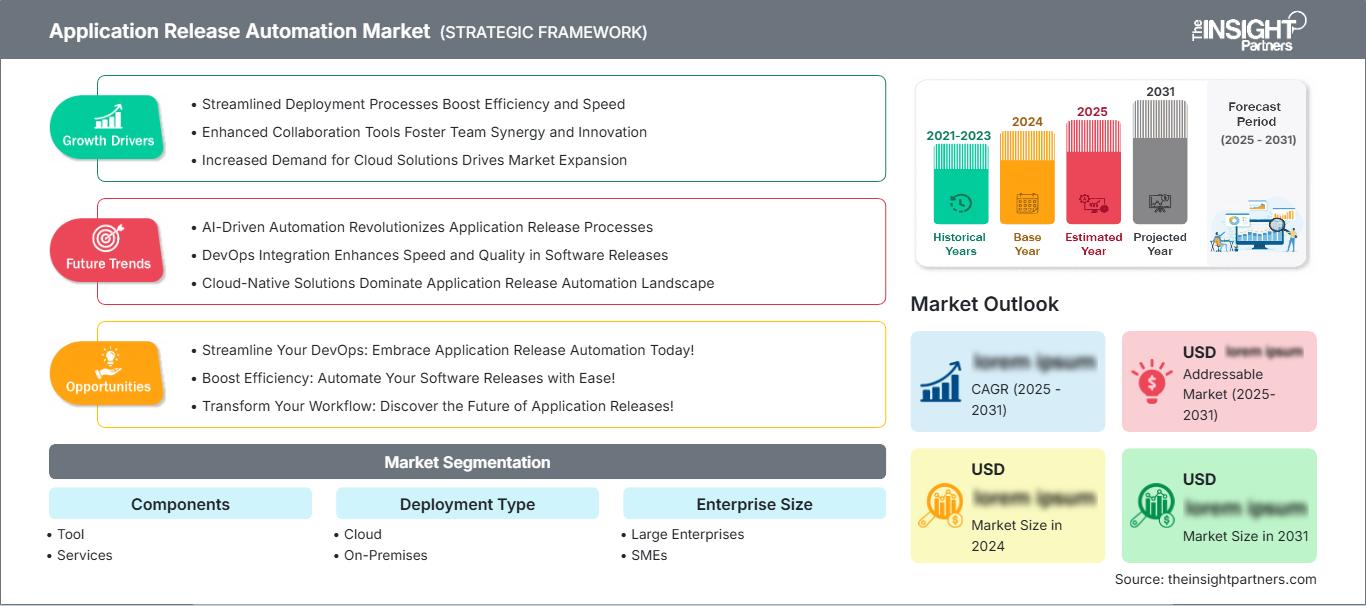
Application Release Automation Market: Strategic Insights
Regional Insights
North America application release automation market
North America held 38–40% share of the Application Release Automation Market in 2025 and is projected to expand at a CAGR range of 14–16% during 2026–2034. The region benefits from deep cloud adoption, early DevOps maturity, and complex software estates across banking, insurance, healthcare, retail, and technology. Demand is reinforced by resilience expectations and continuous delivery programs used to support customer-facing digital services.
The application release automation market share in North America is concentrated among large enterprises that need auditable release workflows across hybrid infrastructure. Platform engineering teams are replacing fragmented deployment scripts with governed pipelines that connect change approvals, testing, security checks, and production rollout. Vendors with strong integrations into Kubernetes, ITSM, and public cloud environments are gaining preference.
U.S. application release automation Market
The U.S. accounted for 78–82% of the North America Application Release Automation Market in 2025 and is expected to grow at a CAGR range of 14–15% during 2026–2034. Adoption is highest for financial organizations, cloud software vendors, telecommunications providers, healthcare providers, and government IT providers. Enterprises are giving more focus to release management as changes in software have more impact on customers, payment systems, claims, and critical infrastructure.
Market density is high, with Broadcom Inc., CloudBees, Inc., Flexagon LLC, Plutora, Inc., Red Hat, Inc., and Digital.ai Software, Inc. offering support for enterprise implementations and partner-managed implementations. Application adoption trends cover blue-green deployments, progressive delivery, database deployment automation, mainframe to cloud synchronization, and compliance reporting. The market increasingly demands solutions that combine release management with incident response and observability capabilities.
Europe application release automation Market
Europe represented 24–26% share of the Application Release Automation Market in 2025 and is projected to grow at a CAGR range of 13–15% during 2026–2034. The UK is a leading country because banks, insurers, telecom operators, and public agencies require auditable software release controls. Cloud migration and resilience planning have increased demand for standardized deployment workflows across regulated environments.
Followed by Germany, which has robust adoption in manufacturing, automotive software, finance, and IT operations. Organizations are aligning their release automation strategy with their digitization of industry, SAP modernization, and secure hybrid clouds. Buyers are typically focused on data protection, change management, and alignment with their current IT service management processes.
France, Italy, and Spain have gained traction through modernization in the public sector, digital banking, and retail transformation. France is experiencing demand for more enterprise-level governance, Italy has seen progress in cloud-based modernization among banks and utilities, while Spain is seeing the benefits of telecom and consumer digital platform modernization.
APAC application release automation Market
APAC held 22–24% of the Application Release Automation Market in 2025 and is forecast to grow at a CAGR range of 17–19% during 2026–2034. The key player in the region is China, which benefits from big digital platforms, cloud computing deployment, and localization of software applications. Japan and South Korea are also using release automation technology for telecom, manufacturing, and finance sectors.
In India, Australia, and Southeast Asia, demand is rising due to digital banking, export of IT services, and government cloud strategy. Growth in the region is highest due to enterprise adoption of centralized DevOps governance from manually coordinated releases. Government policies favoring digital public infrastructure and cloud-first modernization are expanding the customer base.
Middle East & Africa application release automation Market
The Middle East & Africa Application Release Automation Market is projected to grow at a CAGR range of 12–14% during 2026–2034. Leading countries include Saudi Arabia due to national digital transformation, financial technology development, and smart infrastructure programs, and the UAE for implementing release automation in the banking sector, the aviation industry, the retail sector, and digital public services.
The most mature submarket in Africa is South Africa, which is enabled by the modernization of financial services and telecom software solutions. Companies within the energy, utility, and infrastructure sectors are enhancing release management as their operational systems are becoming increasingly software-enabled. RoMEA demand is growing, and adoption is linked with cloud investment and managed services capabilities.
Segmentation Analysis
Components
The Components segment is expected to grow at a CAGR range of 14–16% during 2026–2034. The application release automation market scope across components includes orchestration platforms, deployment tools, advisory services, integration support, and managed operations. Tools dominate early spending because enterprises need repeatable automation, while services remain important for workflow redesign, compliance mapping, and legacy environment integration.
- Tool: Tools hold the strongest market position because enterprises need centralized deployment orchestration, environment modeling, release dashboards, approval controls, and rollback workflows across cloud, on-premises, and hybrid application estates.
- Services: Services support implementation, customization, migration, training, and managed release operations, making them strategically important where organizations lack DevOps maturity or must integrate automation with legacy governance structures.
Deployment Type
The Deployment Type segment is projected to grow at a CAGR range of 16–18% during 2026–2034. Cloud deployment is expanding faster as organizations seek scalable release automation, subscription pricing, and easier integration with cloud-native CI/CD ecosystems. On-premises deployment remains relevant in regulated sectors where data locality, mainframe dependency, and internal control requirements influence technology architecture.
- Cloud: Cloud deployment is gaining preference due to faster provisioning, lower infrastructure management, and stronger alignment with SaaS development, containerized workloads, remote teams, and multi-cloud operating models.
- On-Premises: On-premises deployment remains strategically important for banks, defense, public agencies, and large manufacturers that require local control, customized security, and integration with long-established enterprise systems.
Enterprise Size
The Enterprise Size segment is anticipated to grow at a CAGR range of 15–17% during 2026–2034. Large enterprises lead adoption because they manage complex software portfolios, multiple release trains, and strict audit requirements. SMEs are increasing uptake through cloud-based tools that reduce setup complexity and allow smaller teams to automate deployment without building extensive internal platform engineering functions.
- Large Enterprises: Large enterprises represent the strongest demand base, using release automation to coordinate multiple teams, reduce deployment risk, enforce change policies, and improve visibility across business-critical applications.
- SMEs: SMEs are adopting lightweight cloud-based automation to improve release speed, reduce manual errors, and compete through faster digital service updates without large DevOps infrastructure investments.
Industry Vertical
The Industry Vertical segment is expected to grow at a CAGR range of 14–16% during 2026–2034. BFSI and IT and telecommunications remain core adopters because release frequency, uptime, auditability, and customer-facing digital channels are business-critical. Healthcare, media, retail, and consumer goods are increasing adoption as software reliability becomes central to patient engagement, streaming, e-commerce, and omnichannel operations.
- BFSI: BFSI demand is anchored in digital banking, payments, fraud systems, and regulatory reporting, where controlled releases reduce downtime, improve audit evidence, and support fast product updates.
- IT and Telecommunications: IT and telecommunications companies use release automation to manage high release velocity, distributed infrastructure, network software updates, and customer application changes across complex operating environments.
- Healthcare: Healthcare organizations adopt release automation for patient portals, claims platforms, clinical applications, and compliance-sensitive workflows where controlled change management supports reliability and data protection.
- Media and Entertainment: Media and entertainment firms rely on deployment automation for streaming platforms, content workflows, subscription systems, and user experience improvements that require frequent, low-risk software updates.
- Retail and Consumer Goods: Retail and consumer goods companies deploy automation to support e-commerce, inventory systems, loyalty platforms, and omnichannel applications where release stability affects revenue and customer retention.
Opportunity Snapshot
| Industry Vertical | Revenue Contribution | Trend Tag | Adoption Stage |
| BFSI | High | Digital Banking | Mature |
| IT and Telecommunications | High | Network Automation | Mature |
| Healthcare | Medium | Patient Platforms | Scaling |
| Media and Entertainment | Medium | Streaming Ops | Scaling |
| Retail and Consumer Goods | Medium | Commerce Releases | Scaling |
Application Release Automation Market Growth Drivers and Impact Analysis
Rising Need for Governed Continuous Delivery
The enterprises have a need to deliver the software rapidly with continued control, thus, governed continuous delivery becomes one of the main drivers. The manual release coordination process involves time wastage, inconsistencies in the approval process, and limited audit proof. Automated release tools help to provide standardization in the deployment processes, connect the approvals to the pipeline events, and reduce reliance on individuals as operators. The most significant effect is noticed in the BFSI, Healthcare, and Telecom sectors because the downtime affects customer confidence and their exposure to regulations. As digital channels become the main source of income generation, automated release becomes an enterprise governance tool instead of an engineering tool.
Hybrid Cloud and Kubernetes Complexity
There is an increase in the complexity of releases due to the emergence of hybrid clouds, in which applications have been deployed on both public and private clouds, as well as containerized, virtualized, and legacy architectures. While Kubernetes increases the portability of the workloads, it also adds new dependencies in clusters, secrets, configurations, and service meshes. Release automation ensures that teams manage all these complexities by deploying through standard deployment and rollout patterns. The outcome for businesses from this driver is that the likelihood of failed releases decreases, and recovery time after the release of poor-performing changes is also shortened. In addition, enterprises are automating their infrastructure deployments along with their application deployments.
Software Resilience and Compliance Requirements
Resilience requirements are influencing the way applications are delivered, especially in regulated environments. This is because there is a need for proof that a software modification was tested, authorized, deployed, monitored, and roll-backable. Release automation tools facilitate the realization of this requirement in that they are able to collect data from processes, enforce role-based control, and correlate deployment with change requests. The outcome is that it becomes easier to prepare for audits and account for problems if they arise. In light of the increasing compliance requirements, there is also an increased need for segregation of duties, environmental controls, and automation of roll-back operations.
Application Release Automation Market Future Trends
AI-Assisted Release Risk Scoring
AI-assisted release risk scoring is expected to become one of the defining application release automation market trends as enterprises seek predictive controls before production deployment. Future platforms will analyze historical failures, change size, dependency patterns, test coverage, incident records, and environment health to recommend release readiness. This trend will move automation beyond execution into decision support, helping teams prioritize manual review only where risk is elevated. Adoption will be gradual because buyers need explainability, governance, and human override capabilities. Vendors that embed transparent models into existing approval workflows will be better positioned than providers offering standalone AI features without operational context.
Convergence of Release Automation and Value Stream Management
Release automation is expected to converge with value stream management as technology leaders demand visibility from planning to production. Future platforms will not only deploy applications but also measure lead time, wait states, quality gates, business impact, and change outcomes. This will help executives understand which teams, applications, and controls slow delivery without improving reliability. The trend will benefit organizations with multiple toolchains because centralized visibility can reveal fragmented ownership and duplicated approval steps. Over time, buyers will favor platforms that translate deployment data into portfolio-level decisions, especially where software delivery performance is tied to digital transformation funding.
Application Release Automation Market Opportunities
Regulated Industry Release Control Programs
Regulated industries offer a strong opportunity because release control is becoming a board-level technology risk issue. Banks, insurers, healthcare providers, utilities, and public agencies need auditable workflows, segregation of duties, emergency release controls, and evidence-ready reporting. Vendors can win by packaging automation with compliance templates, resilience reporting, and advisory services tailored to sector-specific requirements. The application release automation market Forecasts indicate stronger spending where modernization is linked to regulatory inspection and operational continuity. Investment should focus on integrations with ITSM, identity management, security testing, and observability platforms, since regulated buyers rarely replace existing governance systems in a single transformation wave.
Database and Mainframe Release Automation
Database and mainframe release automation remains underpenetrated compared with application pipeline automation, creating a practical expansion opportunity. Many failed releases originate from schema changes, data migration defects, or dependencies between modern applications and systems of record. Vendors that coordinate application, database, and mainframe changes can address a high-value pain point for banks, insurers, telecom operators, and large retailers. Investment opportunities include automated database change validation, dependency mapping, deployment simulation, and rollback support. This opportunity is commercially attractive because it targets environments with high switching costs, long modernization timelines, and a strong willingness to pay for lower operational risk.
Frequently Asked Questions

- Comprehensive Market Sizing and Forecast Analysis
- Detailed Segmentation Analysis
- In-Depth Market Dynamics Assessment
- Regional and Country-Level Insights
- Competitive Landscape and Company Benchmarking
- Strategic Business Intelligence
Recent Reports
Testimonials

The Insight Partners' SCADA System Market report is comprehensive, with valuable insights on current trends and future forecasts. The team was highly professional, responsive, and supportive throughout. We are very satisfied and highly recommend their services.
RAN KEDEM Partner, Reali Technologies LTDs
I requested a report on a very specific software market and the team produced the report in a few days. The information was very relevant and well presented. I then requested some changes and additions to the report. The team was again very responsive and I got the final report in less than a week.
JEAN-HERVE JENN Chairman, Future Analytica
We worked with The Insight Partners for an important market study and forecast. They gave us clear insights into opportunities and risks, which helped shape our plans. Their research was easy to use and based on solid data. It helped us make smart, confident decisions. We highly recommend them.
PIYUSH NAGPAL Sr. Vice President, High Beam Global
The Insight Partners delivered insightful, well-structured market research with strong domain expertise. Their team was professional and responsive throughout. The user-friendly website made accessing industry reports seamless. We highly recommend them for reliable, high-quality research services
YUKIHIKO ADACHI CEO, Deep Blue, LLC.
This is the first time I have purchased a market report from The Insight Partners.While I was unsure at first, I visited their web site and felt more comfortable to take the risk and purchase a market report.I am completely satisfied with the quality of the report and customer service. I had several questions and comments with the initial report, but after a couple of dialogs over email with their analyst I believe I have a report that I can use as input to our strategic planning process.Thank you so much for taking the extra time and making this a positive experience.I will definitely recommend your service to others and you will be my first call when we need further market data.
JOHN SUZUKI President and Chief Executive Officer, Board Director, BK Technologies
I wish to appreciate your support and the professionalism you displayed in the course of attending to my request for information regarding to infectious disease IVD market in Nigeria. I appreciate your patience, your guidance, and the fact that you were willing to offer a discount, which eventually made it possible for us to close a deal. I look forward to engaging The Insight Partners in the future, all thanks to the impression you have created in me as a result of this first encounter.
DR CHIJIOKE ONYIA MANAGING DIRECTOR, PineCrest Healthcare Ltd.Reason to Buy
- Informed Decision-Making
- Understanding Market Dynamics
- Competitive Analysis
- Identifying Emerging Markets
- Customer Insights
- Market Forecasts
- Risk Mitigation
- Boosting Operational Efficiency
- Strategic Planning
- Investment Justification
- Tracking Industry Innovations
- Aligning with Regulatory Trends





 Get Free Sample for