
Armor Materials Market Demand, Share & Growth by 2034
Coverage: by Type (Metals and Alloy, Ceramic and Composite, Para-aramid Fibers, Ultra-high-molecular-weight Polyethylene, Others); Application (Aerospace, Body Armor, Civil Armor, Marine Armor, Vehicle Armor) , and Geography (North America, Europe, Asia Pacific, and South and Central America)
- Status : Data Released
- Report Code : TIPRE00003764
- Category : Chemicals and Materials
- No. of Pages : 150
- Available Report Formats :


- Last update date : September 01, 2026


2025 Market Size
US$ 17.79 Bn
Base year value
2034 Forecast
US$ 36.02 Bn
Projected by 2034
CAGR 2026-2034
8.15 %
Growth rate
Addressable Market
US$ 241.77 Bn
(2026-2034)
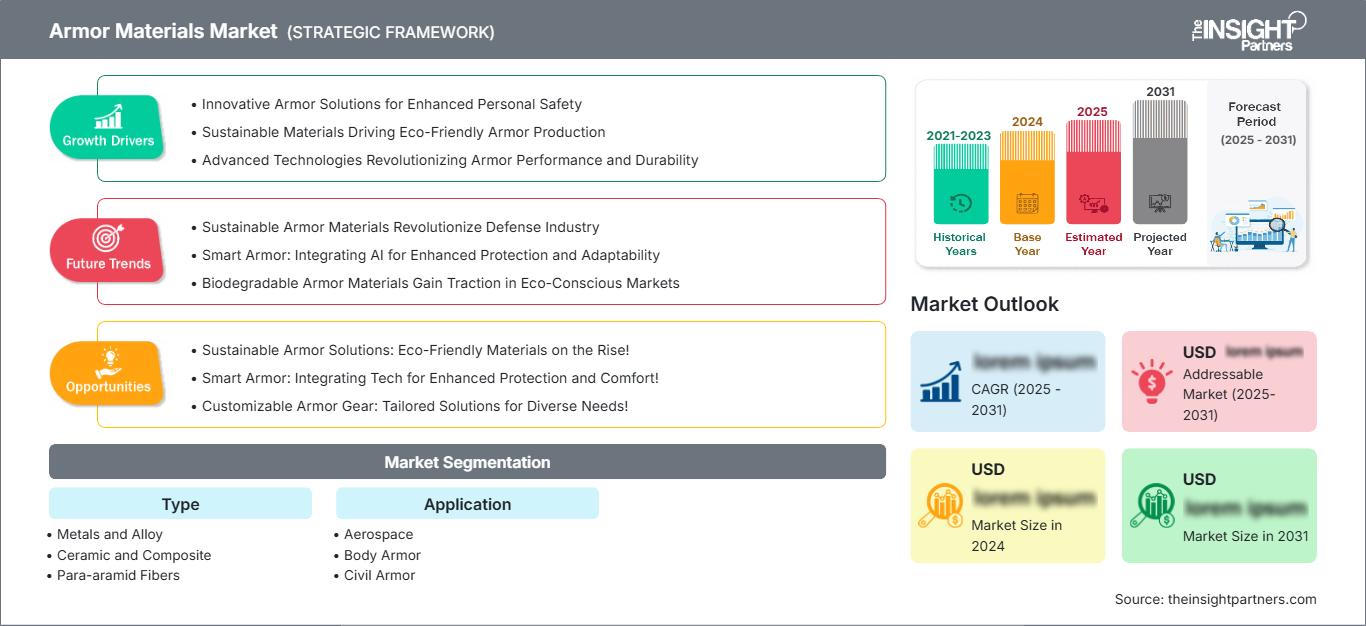
The armor materials market is positioned within the broader advanced materials and defense ecosystem, with demand shaped by requirements for ballistic resistance, structural protection, mobility, and survivability. The market is valued at US$ 17.79 Billion in 2025 and is projected to reach US$ 36.02 Billion by 2034, registering a CAGR of 8.15% during 2026–2034. Growth is supported by defense modernization, material substitution, and adoption of lightweight protection systems.
North America remains a strategically important production and consumption center, supported by defense procurement, aerospace programs, vehicle modernization, and domestic advanced-materials capabilities. The armor materials market size in the region is expected to expand at an estimated 7.6–8.2% CAGR during 2026–2034. Demand is particularly influenced by lightweight armor requirements, platform survivability programs, and increased use of advanced ceramics, para-aramids, UHMWPE, and titanium alloys.
Armor Materials Market Assessment and Insights
- North America: North America is expected to hold a 36–40% armor materials market share in 2025 and grow at a CAGR of 7.6–8.2% between 2026–2034, supported by defense modernization, aerospace production, and advanced material manufacturing.
- US: The US is estimated to represent 88–92% of North America's 2025 market and grow at a CAGR of 7.7–8.3% during 2026–2034, led by defense procurement and aerospace applications.
- Europe: Europe is estimated to account for a 22–26% share in 2025 and expand at a CAGR of 7.0–7.7% during 2026–2034, with Germany, France, the UK, Italy, and Spain supporting regional demand.
- Asia Pacific: Asia Pacific is estimated to hold a 24–28% share in 2025 and register the fastest regional CAGR of 8.7–9.4% during 2026–2034, led by China, India, Japan, South Korea, and Australia.
- Largest Segment: Metals and Alloy is estimated to command a 39–43% market share in 2025 and grow at a CAGR of 7.3–7.9% during 2026–2034, reflecting extensive platform applications.
- High Growth Segment: Para-aramid Fibers are estimated to hold a 17–21% market share in 2025 and grow at a CAGR of 8.8–9.5% during 2026–2034, driven by lightweight ballistic protection.
- Key companies analyzed in detail: Allegheny Technologies Incorporated (ATI), Armor Designs Inc., ArmorSource LLC, CeramTec GmbH, DuPont de Nemours, Inc., Honeywell International Inc., JPS Composite Materials Corporation, Morgan Advanced Materials plc, Compagnie de Saint-Gobain S.A., The 3M Company.
Source: The Insight Partners' analysis based on proprietary research, government publications, company annual reports, investor presentations, industry databases, and expert interviews.
Material technology has progressed from traditional steel to blends of metals, ceramics, aramid fibers, UHMWPE, and engineered composite materials offering the right mix of ballistics with areal density. Modern manufacturing trends are inclined towards the microstructure, automation in composite layup, ceramic fabrication, and modular armor design. In this way, suppliers have been able to provide custom armor solutions based on threat scenarios and minimizing weight.
The focus of investments is more on localized manufacturing, advanced fiber fabrication, ceramic fabrication, and hybrid armor structures. Some of the emerging market areas include India, Southeast Asia, the Middle East, and Eastern Europe where defense industry expansion will open new opportunities. Also, regulatory and procurement considerations are forcing manufacturers to ensure traceability, qualification testing, localization of sourcing, and performance across the life cycle.
Armor Materials Market Report Scope
| Report Attribute | Details |
|---|---|
| Market size in 2025 | US$ 17.79 Billion |
| Market Size by 2034 | US$ 36.02 Billion |
| Global CAGR (2026 - 2034) | 8.15% |
| Historical Data | 2021-2024 |
| Forecast period | 2026-2034 |
Armor Materials Market Analysis
The demand is driven largely by needs for defense modernization, updating of the old protection solutions, and requirements for lighter platforms. The dynamics of the armor materials market growth will be affected by the increasing need to increase survivability without increasing the weight burden for soldiers, aircrafts, vehicles, and ships. Customers are looking more for protection per unit of weight than for the price of the material itself, which creates opportunities for composite products with ceramic strike faces and fiber/composite substrates.
The supply chain covers the companies that produce specialty alloys, ceramics, fibers, resins, fabricators, armor manufacturers, platform manufacturers and end-users such as the military and law enforcement agencies. It is essential to have consistent raw materials due to the importance of precise control of the properties and manufacturing tolerances for the material in order to achieve effective ballistics.
Positioning is reliant upon material specialization, certification ability, production capacity, and integration support. Allegheny Technologies Incorporated (ATI) has participation through specialty metals relating to aerospace and defense platform applications, whereas CeramTec GmbH and Compagnie de Saint-Gobain S.A. have capability in advanced ceramics. Honeywell International Inc. has a history of supplying high-performance Spectra material, while The 3M Company has capability in composites and protective materials. DuPont de Nemours, Inc., has been involved in protection technology based on Kevlar, despite having sold their aramid operation to Arclin in 2026. JPS Composite Materials Corporation, Morgan Advanced Materials plc, ArmorSource LLC, and Armor Designs Inc. meet specialized composite, ceramic, and armor system needs. Competitive strategy now relies increasingly on lightweighting, qualification support, material customization, and cooperation with defense integrators, rather than mere provision of commoditized material.
● REPORT CUSTOMIZATION
Tailor This Report To Align With Your Specific Business Requirements
This report can be customized to align precisely with your business objectives, scope, and target markets. Customization options include tailored segmentation, geography, competitive analysis, and strategic insights to support informed decision-making.
Customize This Report →WHAT YOU CAN ADJUST
- ● Segmentations
- ● Geography
- ● Competitive Analysis
- ● Language Preferences
Armor Materials Market: Strategic Insights
Regional Insights
North America armor materials market
North America is estimated to represent 36–40% of the global armor materials market in 2025 and is expected to expand at a 7.6–8.2% CAGR through 2034. The US dominates regional demand because of extensive military procurement, aerospace manufacturing, armored vehicle programs, and law-enforcement protection requirements. Canada contributes through aerospace, defense manufacturing, and specialized materials supply. The region also benefits from established ceramic, specialty-metal, fiber, and composite production capabilities.
In US procurement programs, there is increasing focus on lighter forms of protection, modularity, and survival of platforms. Consequently, there is demand for materials not only for personal protection but also for aircrafts, ground combat vehicles, ships, and mission equipment. Requirements to source within the domestic industry and other defense-related logistics and procurement policies favor local firms who qualify, and research programs foster the development of composite ceramics, high-strength fibers, and alloys.
U.S. armor materials Market
The US accounts for approximately 88–92% of North America's armor materials market in 2025 and is expected to grow at a 7.7–8.3% CAGR during 2026–2034. Defense procurement continues to be the key demand driver, with application coverage ranging from body armor, aircraft structures, ground vehicles, marine platforms, to armor components. Local suppliers such as ATI, Honeywell, ArmorSource, 3M, and others provide support for various levels of the value chain.
The increasing trend of demand is towards lighter armor solutions which provide protection as well as higher mobility, higher payload, and improved fuel economy. As a result, ceramic strike plates, para-aramid fabrics, UHMWPE, titanium, and composite materials are becoming more popular in addition to existing steel solutions. Also, the requirements of the procurement process emphasize repeatable manufacturing and qualification which works to the benefit of suppliers with a tested technology.
Europe armor materials market
Europe is estimated to hold a 22–26% share in 2025 and is projected to grow at a 7.0–7.7% CAGR through 2034. Germany is the main consumer country, after which come France, the UK, Italy, and Spain, due to the modernization of its armed forces and greater attention being paid to defense industrial capabilities. The European companies are well equipped in ceramics, aramids, advanced composites, and manufacturing technologies.
The UK represents a market with requirements in aerospace, armoured vehicles, and personal protection products, as well as with internal defense procurements of advanced materials. Germany is characterized by vehicle manufacturing together with specialization in ceramics and composite technologies, which drives demand for lightweight armor systems. France, Italy, and Spain represent themselves with aerospace, naval, land system, and law enforcement applications. There is an increasing demand for material traceability, recyclability, energy efficiency, and localization among European consumers.
APAC armor materials market
APAC is estimated to account for 24–28% of the armor materials market in 2025 and is expected to register an 8.7–9.4% CAGR through 2034. China drives regional demand, whereas India, Japan, South Korea, and Australia add their contribution by way of military modernization, aerospace industry, and defense manufacturing in the country. There is a growing trend among countries to promote industrial activities and processes that involve the use of strategic materials.
China and India offer long-term demand for strategic materials on the back of programs related to protection of vehicles, aircraft, and personnel. In case of Japan and South Korea, there is a focus on the development of advanced materials for aerospace and defense industry, while Australia is looking at sovereign defense capability building. These producers are adding capability in ceramics, composites, fibers, and specialty alloys.
Middle East & Africa armor materials Market
Middle East and Africa demand is supported by defense procurement, armored vehicle fleets, border-security requirements, and infrastructure protection. Saudi Arabia and the UAE represent leading Gulf markets, while South Africa provides an established defense manufacturing base. The region is expected to expand at a 6.5–7.3% CAGR through 2034, with Saudi Arabia representing a leading demand center.
Investments made by the Gulf into their defense industry are leading to localized assembly and materials procurement, but harsh environmental conditions are demanding robust protection systems. The role of South Africa comes in through its vehicle and individual protection solutions, while the rest of the MEA is more procurement-driven. The need for light weight ceramics, fiber composites, and heat-resistant metals is rising.
Segmentation Analysis
Type
The Type segment is expected to grow at a 7.5–8.2% CAGR between 2026–2034. Material selection depends on threat level, weight constraints, platform architecture, and required durability. Metals and alloys remain important for structural and vehicle protection, while ceramics, composites, para-aramids, and UHMWPE increasingly support lightweighting. Hybrid architectures combine complementary materials to optimize ballistic performance, weight, and multi-hit capability.
- Metals and Alloy: Metals and alloys remain fundamental for vehicle, marine, and structural armor because of their toughness, manufacturability, established qualification pathways, and compatibility with large protective structures.
- Ceramic and Composite: Ceramic and composite systems provide high hardness and reduced weight, making them strategically important for body armor, aircraft protection, vehicle inserts, and hybrid ballistic architectures.
- Para-aramid Fibers: Para-aramid fibers offer high tensile strength, thermal stability, and flexibility, supporting soft armor, helmets, spall protection, and composite systems where mobility and comfort matter.
- Ultra-high-molecular-weight Polyethylene: UHMWPE supports lightweight ballistic designs through high strength-to-weight performance, particularly in body armor, helmets, vehicle components, and hard protective inserts.
Application
The Application segment is projected to expand at a 7.9–8.6% CAGR during 2026–2034. Procurement requirements differ substantially across aircraft, personnel, civilian security, marine platforms, and vehicles. Vehicle and aerospace systems require large-area structural protection, whereas body armor prioritizes mobility and ergonomics. Civil and marine applications broaden demand beyond military procurement and create opportunities for specialized protection systems.
- Aerospace: Aerospace applications prioritize minimum weight, structural integration, vibration resistance, and protection of crew and critical systems, supporting ceramics, composites, titanium alloys, and fiber-based architectures.
- Body Armor: Body armor requires a balance of ballistic protection, flexibility, comfort, and weight, driving demand for para-aramid fibers, UHMWPE, ceramics, and hybrid protective systems.
- Civil Armor: Civil armor serves law enforcement, security, infrastructure, and specialized protection requirements, with purchasing decisions influenced by certification, durability, ergonomics, and lifecycle cost.
- Marine Armor: Marine armor must withstand corrosion, moisture, vibration, and structural loads, creating demand for corrosion-resistant alloys, ceramics, and composite protection for naval platforms.
- Vehicle Armor: Vehicle armor represents a major material-consuming application because platforms require extensive protected areas and modular systems combining metallic, ceramic, and composite components.
Opportunity Snapshot
| Application | Revenue Contribution | Trend Tag | Adoption Stage |
|---|---|---|---|
| Aerospace | High | Lightweight Armor | Scaling |
| Body Armor | High | Soldier Mobility | Mature |
| Civil Armor | Medium | Flexible Protection | Scaling |
| Marine Armor | Medium | Naval Survivability | Scaling |
| Vehicle Armor | High | Hybrid Armor | Mature |
Armor Materials Market Growth Drivers and Impact Analysis
Defense modernization and platform survivability requirements
According to the armor materials market forecast, defense modernization is generating increased need for protection materials for personnel, aircraft, vehicles, and naval vessels. Increasingly, acquisition authorities look to obtain greater survivability while not increasing platform weight by corresponding amounts, especially where payload, range, maneuverability, and fuel efficiency influence platform effectiveness. This consideration moves the purchase of materials towards those with greater protection relative to their weight. The effect carries through the entire chain of suppliers since armor fabricators will need quality-controlled ceramics, advanced fibers, unique alloys, and complementary backing materials. Material suppliers able to provide support for qualification, prototype fabrication, and production scale-up will have an advantage in participating in defense modernization efforts. The replacement of traditional steel with advanced composite systems further increases material demand due to the use of multiple materials within a single armor system.
Lightweight protection requirements across defense applications
Weight reduction is becoming a central design parameter as military users seek greater mobility, endurance, and payload capacity. Advanced fibers, ceramics, and composites can reduce system weight while maintaining required protection levels, creating opportunities for material substitution within established armor architectures. The effect is especially significant for body armor, aircraft, helicopters, unmanned platforms, and armored vehicles where every kilogram can influence operational performance. Lightweight materials also enable designers to redistribute protection toward higher-risk areas without exceeding platform weight limits. Consequently, suppliers are increasingly investing in higher-tenacity fibers, improved ceramic processing, optimized laminates, and hybrid constructions. The commercial impact is a shift from single-material armor toward engineered systems in which different materials are selected according to specific threat, geometry, and weight requirements.
Localization of strategic defense-material supply chains
Governments are placing greater emphasis on secure access to strategic materials and domestic defense manufacturing capabilities. Armor production depends on specialized fibers, ceramic powders, high-performance alloys, resins, and composite processing, making supply continuity important for defense readiness. Localization initiatives can therefore stimulate investment in domestic manufacturing, qualified suppliers, testing infrastructure, and technology partnerships. For material producers, this environment creates opportunities to establish regional production or collaborate with defense integrators and government-backed industrial programs. The impact is particularly relevant in Asia Pacific, Europe, and the Middle East, where governments are strengthening indigenous defense capabilities. Local sourcing can also reduce exposure to transportation disruptions, export restrictions, and geopolitical uncertainty while improving responsiveness to military procurement schedules.
Armor Materials Market Future Trends
Hybrid architectures will become the preferred design approach
The armor materials market trends show that future armor systems are expected to increasingly combine metals, ceramics, para-aramids, UHMWPE, and polymer composites within engineered multi-layer architectures. Instead of selecting a single material for an entire protective component, designers can assign different functions to individual layers, such as projectile disruption, energy absorption, fragmentation control, and structural support. Digital simulation and improved ballistic testing will support optimization of layer thickness, interface bonding, and material orientation before physical qualification. This approach should expand the role of specialist material suppliers because performance will depend on compatibility between components rather than isolated material properties. Hybridization will also support modular protection concepts, allowing armor packages to be configured according to mission requirements, threat environments, platform geometry, and weight limits.
Circularity and lower-impact armor materials will gain attention
Environmental considerations are expected to influence material selection more strongly as defense organizations and industrial suppliers evaluate lifecycle impacts. Future development will focus on reducing manufacturing waste, incorporating recycled feedstocks where performance permits, improving processing efficiency, and designing components that can be refurbished or replaced selectively. Fiber producers are already investigating circular-content approaches, while composite manufacturers are evaluating improved recovery and recycling pathways. The transition will not eliminate performance requirements because ballistic qualification remains fundamental, but suppliers able to demonstrate environmental improvements without compromising protection may gain preference in sustainability-conscious procurement programs. Lifecycle assessment could therefore become an additional decision criterion alongside ballistic performance, weight, durability, cost, and manufacturability.
Armor Materials Market Opportunities
Localized advanced-material production in emerging defense economies
Investment opportunities are emerging in countries seeking greater domestic control over defense-material supply chains. India, Saudi Arabia, the UAE, South Korea, Australia, and selected European markets are expanding indigenous manufacturing capabilities, creating potential demand for ceramic processing, fiber conversion, composite fabrication, specialty alloys, and ballistic testing. Material suppliers can capture this opportunity through technology licensing, joint ventures, regional production facilities, and partnerships with local armor integrators. The most attractive projects are likely to combine manufacturing with engineering support because customers require assistance with material qualification and system integration. Establishing regional capabilities can also shorten delivery cycles and reduce exposure to trade restrictions. For investors, the opportunity lies in specialized capacity rather than broad commodity production, particularly where local qualification creates barriers to entry.
High-performance materials for next-generation air and land platforms
Advanced aerospace and vehicle programs offer opportunities for suppliers that can deliver high protection at lower areal density. New aircraft, helicopters, unmanned platforms, and armored vehicles increasingly require materials that combine ballistic resistance with structural efficiency, thermal stability, and durability. Suppliers can target these requirements through ceramic-metal hybrids, fiber-reinforced composites, titanium alloys, and multifunctional protective structures. Integration capability will be particularly valuable because platform manufacturers prefer materials that can be incorporated without extensive redesign. Companies can also pursue opportunities in modular armor kits, retrofit packages, and replacement components for existing fleets. Strategic investment in precision manufacturing, automated composite processing, ceramic shaping, and digital simulation can improve production consistency while enabling customized solutions for different platform geometries.
Recent Developments
- June 15, 2026: SSAB AB launched Armox 500 AM Powder, described by the company as the world's first armor-steel powder designed for additive manufacturing. The material is intended for 3D-printed protective components such as camera housings, antenna mounts, sights, radar components, and hydraulic couplings. SSAB plans commercial-scale production from 2028 at approximately 350 tonnes annually.
- November 3, 2025: DuPont and Hohenstein announced plans to launch new testing protocols for body armor comfort and mobility assessment, alongside the expansion of Kevlar EXO™ into hard armor applications. The development is relevant to the para-aramid fiber segment because it supports broader use of next-generation Kevlar technology in hard protective systems.
Frequently Asked Questions

- Comprehensive Market Sizing and Forecast Analysis
- Detailed Segmentation Analysis
- In-Depth Market Dynamics Assessment
- Regional and Country-Level Insights
- Competitive Landscape and Company Benchmarking
- Strategic Business Intelligence
Recent Reports
Testimonials

The Insight Partners' SCADA System Market report is comprehensive, with valuable insights on current trends and future forecasts. The team was highly professional, responsive, and supportive throughout. We are very satisfied and highly recommend their services.
RAN KEDEM Partner, Reali Technologies LTDs
I requested a report on a very specific software market and the team produced the report in a few days. The information was very relevant and well presented. I then requested some changes and additions to the report. The team was again very responsive and I got the final report in less than a week.
JEAN-HERVE JENN Chairman, Future Analytica
We worked with The Insight Partners for an important market study and forecast. They gave us clear insights into opportunities and risks, which helped shape our plans. Their research was easy to use and based on solid data. It helped us make smart, confident decisions. We highly recommend them.
PIYUSH NAGPAL Sr. Vice President, High Beam Global
The Insight Partners delivered insightful, well-structured market research with strong domain expertise. Their team was professional and responsive throughout. The user-friendly website made accessing industry reports seamless. We highly recommend them for reliable, high-quality research services
YUKIHIKO ADACHI CEO, Deep Blue, LLC.
This is the first time I have purchased a market report from The Insight Partners.While I was unsure at first, I visited their web site and felt more comfortable to take the risk and purchase a market report.I am completely satisfied with the quality of the report and customer service. I had several questions and comments with the initial report, but after a couple of dialogs over email with their analyst I believe I have a report that I can use as input to our strategic planning process.Thank you so much for taking the extra time and making this a positive experience.I will definitely recommend your service to others and you will be my first call when we need further market data.
JOHN SUZUKI President and Chief Executive Officer, Board Director, BK Technologies
I wish to appreciate your support and the professionalism you displayed in the course of attending to my request for information regarding to infectious disease IVD market in Nigeria. I appreciate your patience, your guidance, and the fact that you were willing to offer a discount, which eventually made it possible for us to close a deal. I look forward to engaging The Insight Partners in the future, all thanks to the impression you have created in me as a result of this first encounter.
DR CHIJIOKE ONYIA MANAGING DIRECTOR, PineCrest Healthcare Ltd.Reason to Buy
- Informed Decision-Making
- Understanding Market Dynamics
- Competitive Analysis
- Identifying Emerging Markets
- Customer Insights
- Market Forecasts
- Risk Mitigation
- Boosting Operational Efficiency
- Strategic Planning
- Investment Justification
- Tracking Industry Innovations
- Aligning with Regulatory Trends





 Get Free Sample for