
Articulated Bus Market Trends, Size & Growth by 2034
Coverage: By Articulation (Single Articulated, Double Articulated); Powertrain (Diesel, Electric, Hybrid) , and Geography (North America, Europe, Asia Pacific, and South and Central America)
- Status : Data Released
- Report Code : TIPRE00021950
- Category : Automotive and Transportation
- No. of Pages : 150
- Available Report Formats :


- Last update date : September 01, 2026


2025 Market Size
US$ 22.43 Bn
Base year value
2034 Forecast
US$ 43.02 Bn
Projected by 2034
CAGR 2026-2034
8.48 %
Growth rate
Addressable Market
US$ 310.00 Bn
(2026-2034)
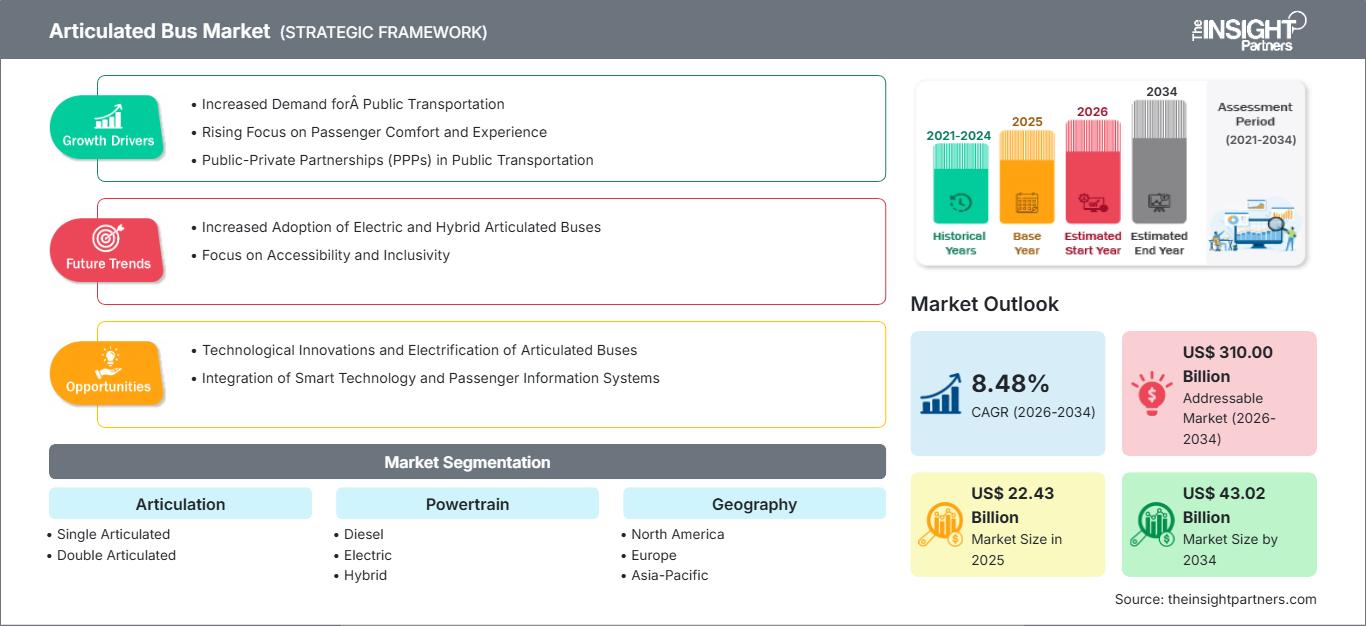
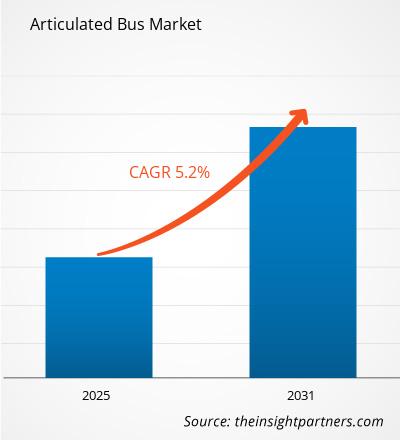
The articulated bus market is projected to grow from US$ 22.43 Billion in 2025 to US$ 43.02 Billion by 2034, registering a CAGR of 8.48% during 2026–2034. The market is being shaped by demand for high-capacity urban transit vehicles, rising corridor-based mobility planning, and fleet replacement programs that favor larger buses over multiple standard units.
North America’s articulated bus market size is expected to expand at an estimated 7.8–8.4% CAGR, supported by bus rapid transit upgrades, fleet modernization grants, and congestion mitigation programs in large metropolitan areas. Procurement is strongest where agencies require higher passenger throughput without expanding depot footprints, especially across U.S. and Canadian corridors facing peak-hour capacity constraints.
Articulated Bus Market Assessment and Insights
- North America accounted for 22–25% share in 2025 and is projected to grow at a CAGR of 7.8–8.4% between 2026–2034, supported by fleet renewal, federal transit funding, and high-capacity urban routes.
- US represented 78–82% of North America in 2025 and is projected to grow at a CAGR of 7.6–8.2% between 2026–2034, led by large transit agencies replacing aging fleets.
- Europe held 27–30% share in 2025 and is projected to grow at a CAGR of 7.2–7.8% between 2026–2034, with Germany, France, Poland, Spain, and the UK leading zero-emission procurement.
- Asia Pacific captured 35–38% share in 2025 and is projected to grow at a CAGR of 9.1–9.8% between 2026–2034, driven by China, India, Japan, South Korea, and Australia.
- Largest Segment: Single Articulated held 70–74% market share in 2025 and is projected to grow at a CAGR of 7.9–8.5% between 2026–2034 due to route flexibility.
- High Growth Segment: Electric held 24–28% market share in 2025 and is projected to grow at a CAGR of 11.5–12.8% between 2026–2034 as battery capacity improves.
- Key companies analyzed in detail: AB Volvo, Ashok Leyland Limited, Scania CV AB, Solaris Bus & Coach sp. z o.o., Proterra Operating Company Inc., Ebusco Holding N.V., Daimler Truck AG, Alexander Dennis Limited, New Flyer Industries Canada ULC, OTOKAR Otomotiv ve Savunma Sanayi A.S.
Source: The Insight Partners' analysis based on proprietary research, government publications, company annual reports, investor presentations, industry databases, and expert interviews.
Technology migration is changing the market from a diesel-centered procurement cycle into a platform-led ecosystem built around modular batteries, connected diagnostics, and depot energy management. Producers are altering their production lines to accommodate low-floor designs, light-weight construction, higher battery packs, and various door options. As transit agencies look at life cycle costs, parts availability, and charging capability, along with acquisition cost, supplier integration capabilities become more important than just vehicle capabilities.
In the next few years, purchasing priorities are likely to move towards the new BRT corridors in Asia Pacific, Latin America, and the Middle East, while Europe and North America concentrate on urban conversions. Government regulation of urban emissions, government funding for cleaner buses, and private funding for infrastructure will help accelerate the replacement process. Urban areas that are restricted by limited road space will probably choose articulated buses because this design increases capacity without increasing the number of drivers.
Articulated Bus Market Report Scope
| Report Attribute | Details |
|---|---|
| Market size in 2025 | US$ 22.43 Billion |
| Market Size by 2034 | US$ 43.02 Billion |
| Global CAGR (2026 - 2034) | 8.48% |
| Historical Data | 2021-2024 |
| Forecast period | 2026-2034 |
Articulated Bus Market Analysis
Urban operators are prioritizing the articulated bus market growth because passenger volumes are recovering while agencies face driver shortages and timetable reliability targets. One articulated bus can replace multiple standard buses on trunk routes, lowering labor intensity per passenger movement. The value chain includes chassis suppliers, body manufacturers, battery providers, charging integrators, telematics vendors, fleet financiers, and maintenance partners.
Supply dynamics remain uneven because long vehicle frames, joint assemblies, battery packs, and high-voltage components require specialized capacity. The market benefits from standardized platforms, yet customization remains high across door systems, climate packages, axle loads, and charging interfaces. Agencies are therefore balancing delivery speed against technical fit for local operating conditions.
The competitive environment is consolidating around firms with broad propulsion portfolios and credible aftersales networks. The articulated bus market analysis shows that AB Volvo, Daimler Truck AG, New Flyer Industries Canada ULC, Solaris Bus & Coach sp. z o.o., and Scania CV AB are positioning around electric and hybrid platforms, while Alexander Dennis Limited, Ashok Leyland Limited, Ebusco Holding N.V., Proterra Operating Company Inc., and OTOKAR Otomotiv ve Savunma Sanayi A.S. address regional and technology-specific demand.
Investment is moving beyond vehicles toward charging depots, battery monitoring, workforce training, and service contracts. Suppliers able to package buses with infrastructure planning and uptime guarantees are gaining strategic leverage. This favors balance-sheet strength, local assembly access, and reference fleets in high-density metropolitan operations, where downtime costs are materially higher than vehicle acquisition savings, according to the articulated bus market forecast.
● REPORT CUSTOMIZATION
Tailor This Report To Align With Your Specific Business Requirements
This report can be customized to align precisely with your business objectives, scope, and target markets. Customization options include tailored segmentation, geography, competitive analysis, and strategic insights to support informed decision-making.
Customize This Report →WHAT YOU CAN ADJUST
- ● Segmentations
- ● Geography
- ● Competitive Analysis
- ● Language Preferences
Articulated Bus Market: Strategic Insights
Regional Insights
North America articulated bus market
North America accounted for 22–25% share in 2025 and is projected to expand at a CAGR of 7.8–8.4% through 2034. Funding from federal and provincial transit programs supports fleet renewal, while cities such as New York, Toronto, Los Angeles, Seattle, and Vancouver continue to deploy high-capacity buses on corridors where rail expansion is costly or delayed.
The region’s articulated bus market share is sustained by mature procurement systems, predictable replacement cycles, and rigorous accessibility standards. Clean-diesel orders remain relevant where range, winter performance, and depot constraints slow electrification. Battery-electric adoption is growing in dense agencies with charging plans, while hybrid platforms serve as transition options for mixed duty cycles.
U.S. articulated bus Market
The U.S. represented 78–82% of North American demand in 2025 and is forecast to grow at a CAGR of 7.6–8.2% during 2026–2034. Large agencies continue to procure 60-foot buses for heavy corridors, airport links, university routes, and bus rapid transit services where passenger loads regularly exceed standard bus capacity.
Company presence is strong through New Flyer Industries Canada ULC, Daimler Truck AG, AB Volvo-related platforms, Alexander Dennis Limited, and Proterra Operating Company Inc. Application trends include clean-diesel replacement, battery-electric pilots, and route-specific scaling where depot charging is available. The U.S. market remains highly specification-driven because agencies prioritize reliability, local service support, and compliance with funding rules.
Europe articulated bus Market
Europe held 27–30% share in 2025 and is projected to grow at a CAGR of 7.2–7.8% between 2026–2034. Germany is in the lead position owing to municipal bus operators, urban air quality regulations, and the availability of buses within the country from Daimler Truck AG. There is increasing electric articulated bus procurement in France, Italy, Spain, Poland, and the UK.
The UK is moving ahead in zero-emission bus corridors through city collaborations and depot electrification, and the need is mainly in London, Manchester, Glasgow, and Birmingham. Germany continues to be at the top due to the combination of electric buses, hydrogen pilots, and maintenance ecosystems. France and Spain are more inclined towards urban low-emission zones.
APAC articulated bus Market
APAC represented 35–38% share in 2025 and is projected to grow at a CAGR of 9.1–9.8% through 2034. China leads procurement due to large electric bus manufacturing capacity and dense urban transit corridors, while India is scaling bus modernization through public procurement and state-level mobility schemes.
Japan, South Korea, and Australia are adopting articulated vehicles where airport, university, and metropolitan routes need higher throughput. The market in APAC benefits from manufacturing localization, battery supply chains, and policy interest in reducing urban congestion. India offers the strongest incremental opportunity as BRT expansion and city fleet renewal accelerate.
Middle East & Africa articulated bus Market
The Middle East & Africa is projected to grow at a CAGR of 6.4–7.1% during 2026–2034. Saudi Arabia and the UAE have been the most prominent markets for this technology due to their urban infrastructure projects, airport connectivity and public transport network development. South Africa continues to be the leading African market due to its BRT corridor network.
Energy context impacts purchase decisions throughout the region. The use of diesel technology continues to dominate where fuel economics and infrastructure facilities make it a viable proposition, but electric technology is gaining ground in richer cities that can make investments in grid infrastructure. The demand from RoMEA will continue to be project-oriented.
Segmentation Analysis
Articulation
Articulation is projected to grow at a CAGR of 8.0–8.6% during 2026–2034. The articulated bus market scope across this segment is defined by corridor density, turning geometry, depot configuration, and passenger boarding speed. Single units dominate because they fit existing routes, while double articulated buses are selected for BRT systems requiring maximum capacity with fewer vehicles.
- Single Articulated buses hold the strongest position because 18-meter platforms suit most urban depots, terminals, and turning radii while delivering meaningful passenger-capacity gains on high-frequency trunk routes.
- Double Articulated buses are strategically important for BRT corridors with dedicated lanes, platform-level boarding, and very high peak loads, but adoption is limited by infrastructure and operational complexity.
Powertrain
Powertrain is projected to grow at a CAGR of 8.3–8.9% during 2026–2034. The segment is shifting from diesel toward electric and hybrid configurations as cities link procurement to emissions targets and lifecycle efficiency. Diesel remains relevant for reliability and long routes, but electric platforms are gaining momentum where charging, grid upgrades, and battery warranties are aligned with service planning.
- Diesel buses remain widely used where agencies prioritize predictable range, established maintenance skills, lower depot conversion needs, and immediate replacement of aging high-capacity fleets.
- Electric buses are gaining strategic importance as battery density, charging interoperability, and zero-emission mandates improve, especially on dense routes with predictable schedules and depot-based charging.
- Hybrid buses serve transition needs by reducing fuel consumption without full infrastructure conversion, making them useful for mixed-route agencies balancing emissions goals and operational flexibility.
Opportunity Snapshot
| Powertrain | Revenue Contribution | Trend Tag | Adoption Stage |
| Diesel | High | Fleet Renewal | Mature |
| Electric | High | Depot Charging | Scaling |
| Hybrid | Medium | Transition Fleet | Scaling |
Articulated Bus Market Growth Drivers and Impact Analysis
Urban corridor densification and BRT expansion
The rise of dense urban corridors is creating an increased need for vehicles that can carry a greater number of passengers while not needing proportional numbers of drivers, roads, or parking. This is one of the strengths that articulated buses have, as it becomes increasingly difficult to implement metro or light rail systems due to the high cost of their development and long periods of construction. BRT development allows for the use of separate lanes and off-board fares and platform-level boarding, making larger buses possible with rail-like capacity but at a reduced infrastructure cost. This leads to increased need for durability in axles, articulation, door design, and interior space.
Zero-emission procurement mandates
Public transportation operators are aligning the buying of buses with climate change policies of cities, low-emission areas, and air quality goals. This development is especially relevant for the purchase of electric articulated buses, since large capacity routes create significant visibility and reduction of emissions. Yet, the process implies a well-planned investment in chargers, grid modifications, battery supervision, and emergency measures. Public operators are now looking at the total cost of ownership rather than just the cost of purchase, which means favoring companies that can help in designing the whole charging infrastructure and providing after-sales services.
Fleet replacement and reliability modernization
Most transit companies have old bus fleets experiencing escalating maintenance expenses, low fuel economy, and poor passenger experience. Modern high-capacity buses as replacements for aged standard and articulated buses ensure more reliability, fewer route cancellations, and compliance with the ADA standards. It is a driving force that goes beyond electrification because of the continued relevance of clean diesel and hybrid buses, where the charging facilities are not yet available. Modernized fleets can also help agencies embrace telematics, predictive maintenance, ADAS, and a standardized spare part program. Market implications include constant demand by type of propulsion system, while immediate procurement focuses on proven platforms.
Articulated Bus Market Future Trends
Software-defined fleet operations
The next phase of articulated bus market trends will be shaped by software-defined fleet operations that connect vehicles, chargers, depots, and control centers. Operators will use real-time battery health, passenger loading, driver behavior, and route energy data to adjust schedules and maintenance windows. This will make procurement less dependent on static vehicle specifications and more dependent on data interoperability, cybersecurity, and fleet-management integration. Suppliers that provide open diagnostics, predictive maintenance tools, and energy optimization platforms will gain influence in tenders. The trend will also encourage outcome-based contracts where uptime, charging availability, and operating cost performance become measurable commercial commitments.
High-capacity electric BRT platforms
It is anticipated that electric BRT platforms would go from being pilot projects to corridor-wide installations as battery technologies enable longer duty cycles and opportunity charging becomes more mainstream. This tendency is most pronounced in the case of double and long single articulated buses that serve trunk lines with heavy loadings of passengers. The manufacturers' efforts would be concentrated on lightweight designs, thermal management systems, capacity maximization of battery packs, and regenerative braking technology suited for frequent starts and stops. Cities would start planning their depots and terminals to accommodate these vehicles instead of modifying existing ones to fit the vehicle requirements.
Articulated Bus Market Opportunities
Integrated depot electrification services
There is an opportunity to offer articulated electric buses in bundles with depot infrastructure, chargers, energy management software, network integration, and maintenance skills. A lot of municipalities know the case for the buses to be electrified, but they have a risk of implementation concerning power supply, charger use, and scheduling. Vendors that minimize such difficulties will go up the value chain and retain more profits than those selling just vehicles. Cooperation with utilities, charger suppliers, and infrastructure developers can help speed up the purchasing process. Such an opportunity is mostly relevant to North America and Europe, where funds exist, but the implementation poses problems.
Localized manufacturing for emerging corridors
Emerging markets offer a practical opportunity for localized assembly of articulated buses serving BRT, airport, and metropolitan feeder routes. Local production can reduce import exposure, improve eligibility for public tenders, and create faster access to service parts. India, Southeast Asia, the Gulf, and selected African cities are especially relevant because urbanization is pushing agencies toward high-capacity vehicles while governments seek domestic industrial participation. Manufacturers can enter through chassis localization, body partnerships, or technology licensing. This opportunity requires disciplined supplier development and quality control, but it can unlock long-term fleet programs where price sensitivity and service proximity are decisive.
Frequently Asked Questions

- Comprehensive Market Sizing and Forecast Analysis
- Detailed Segmentation Analysis
- In-Depth Market Dynamics Assessment
- Regional and Country-Level Insights
- Competitive Landscape and Company Benchmarking
- Strategic Business Intelligence
Recent Reports
Testimonials

The Insight Partners' SCADA System Market report is comprehensive, with valuable insights on current trends and future forecasts. The team was highly professional, responsive, and supportive throughout. We are very satisfied and highly recommend their services.
RAN KEDEM Partner, Reali Technologies LTDs
I requested a report on a very specific software market and the team produced the report in a few days. The information was very relevant and well presented. I then requested some changes and additions to the report. The team was again very responsive and I got the final report in less than a week.
JEAN-HERVE JENN Chairman, Future Analytica
We worked with The Insight Partners for an important market study and forecast. They gave us clear insights into opportunities and risks, which helped shape our plans. Their research was easy to use and based on solid data. It helped us make smart, confident decisions. We highly recommend them.
PIYUSH NAGPAL Sr. Vice President, High Beam Global
The Insight Partners delivered insightful, well-structured market research with strong domain expertise. Their team was professional and responsive throughout. The user-friendly website made accessing industry reports seamless. We highly recommend them for reliable, high-quality research services
YUKIHIKO ADACHI CEO, Deep Blue, LLC.
This is the first time I have purchased a market report from The Insight Partners.While I was unsure at first, I visited their web site and felt more comfortable to take the risk and purchase a market report.I am completely satisfied with the quality of the report and customer service. I had several questions and comments with the initial report, but after a couple of dialogs over email with their analyst I believe I have a report that I can use as input to our strategic planning process.Thank you so much for taking the extra time and making this a positive experience.I will definitely recommend your service to others and you will be my first call when we need further market data.
JOHN SUZUKI President and Chief Executive Officer, Board Director, BK Technologies
I wish to appreciate your support and the professionalism you displayed in the course of attending to my request for information regarding to infectious disease IVD market in Nigeria. I appreciate your patience, your guidance, and the fact that you were willing to offer a discount, which eventually made it possible for us to close a deal. I look forward to engaging The Insight Partners in the future, all thanks to the impression you have created in me as a result of this first encounter.
DR CHIJIOKE ONYIA MANAGING DIRECTOR, PineCrest Healthcare Ltd.Reason to Buy
- Informed Decision-Making
- Understanding Market Dynamics
- Competitive Analysis
- Identifying Emerging Markets
- Customer Insights
- Market Forecasts
- Risk Mitigation
- Boosting Operational Efficiency
- Strategic Planning
- Investment Justification
- Tracking Industry Innovations
- Aligning with Regulatory Trends





 Get Free Sample for