
Automotive Manual Transmission Market Growth, Trends & Demand by 2034
Coverage: By Components (Dry Clutch, Gearbox and Controller); and Vehicle Class (Passenger vehicle, LCV, HCV), and Geography
- Status : Data Released
- Report Code : TIPTE100000604
- Category : Automotive and Transportation
- No. of Pages : 150
- Available Report Formats :


- Last update date : August 11, 2026


2025 Market Size
US$ 25.18 Bn
Base year value
2034 Forecast
US$ 35.34 Bn
Projected by 2034
CAGR 2026-2034
3.84 %
Growth rate
Addressable Market
US$ 274.90 Bn
(2026-2034)
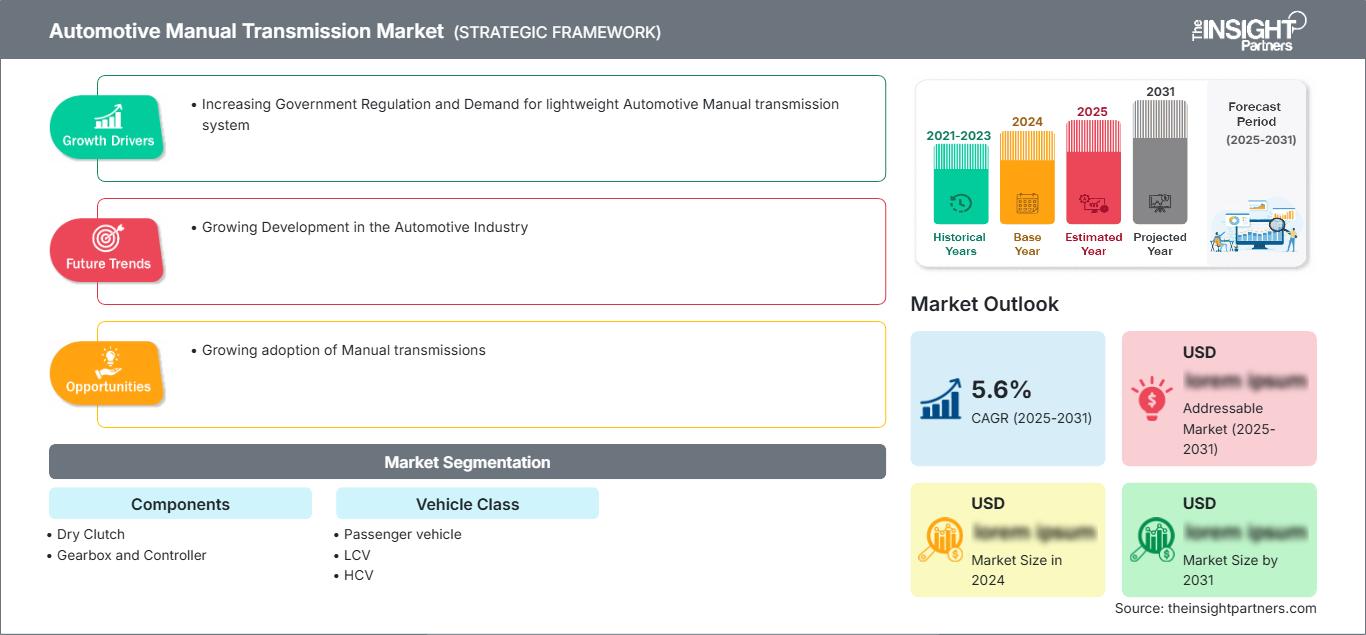
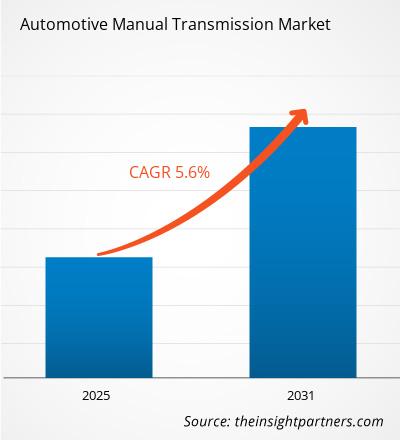
The automotive manual transmission market is projected to grow from US$ 25.18 Billion in 2025 to US$ 35.34 Billion by 2034, registering a CAGR of 3.84% during 2026–2034. Demand remains supported by cost-sensitive vehicle platforms, repairable mechanical architectures, and commercial mobility use cases where durability, driver control, and lower acquisition cost continue to influence purchasing decisions.
North America shows steady relevance for the automotive manual transmission market size as performance vehicles, light commercial applications, and vocational fleets maintain selective demand. The region is estimated to grow at a CAGR of 3.1–3.5% during 2026–2034, supported by enthusiast vehicle lines, off-road applications, and transmission upgrades that improve torque handling and efficiency.
Automotive Manual Transmission Market Assessment and Insights
- North America: Accounted for an estimated 22–25% share in 2025 and is expected to grow at a CAGR of 3.1–3.5% between 2026–2034, supported by pickup, off-road, and performance-oriented vehicle demand.
- US: Represented 78–82% of North America in 2025 and is projected to grow at a CAGR of 3.0–3.4%, led by enthusiast models and commercial utility fleets.
- Europe: Held an estimated 24–27% share in 2025 and is forecast to grow at a CAGR of 3.2–3.6%, with Germany, France, Italy, Spain, and the UK leading production-linked demand.
- Asia Pacific: Accounted for 38–42% share in 2025 and is projected to grow at a CAGR of 4.1–4.6%, driven by China, India, Japan, and Southeast Asian cost-sensitive vehicle production.
- Largest Segment: Passenger vehicle held 58–62% market share in 2025, growing at a CAGR of 3.5–3.9% due to compact car demand in emerging economies.
- High Growth Segment: LCV held 22–26% market share in 2025, growing at a CAGR of 4.2–4.7% as last-mile logistics and utility fleets prioritize repairable drivetrains.
- Key companies analyzed in detail: ZF Friedrichshafen AG, Continental AG, Magna International Inc., BorgWarner Inc., JTEKT Corporation, American Axle & Manufacturing Holdings, Inc., Eaton Corporation plc, GKN Automotive Limited, Dana Incorporated, AISIN Corporation, JATCO Ltd.
Source: The Insight Partners' analysis based on proprietary research, government publications, company annual reports, investor presentations, industry databases, and expert interviews.
The basic platform for manual transmissions has been transformed from an economically driven gearbox design to a sophisticated driveline system that includes superior synchronizers, reduced-weight casings, optimal dry clutch systems, and electronically controlled assistance. While manufacturers continue to justify manual transmissions in advanced passenger car markets, there is still significant production when affordability, terrain, fuel economy, and maintainability play important roles in the total cost of vehicle ownership.
Future requirements will rely on targeted investments as opposed to widespread adoption. New geographies, commercial trucks, and performance cars will ensure relevance, while regulation and automatic transmission usage will constrain growth in luxury cars and urban transportation. Suppliers able to combine mechanical efficiency with hybrid-compatible packaging will be better positioned across forecast years in the Automotive Manual Transmission Market report.
Automotive Manual Transmission Market Report Scope
| Report Attribute | Details |
|---|---|
| Market size in 2025 | US$ 25.18 Billion |
| Market Size by 2034 | US$ 35.34 Billion |
| Global CAGR (2026 - 2034) | 3.84% |
| Historical Data | 2021-2024 |
| Forecast period | 2026-2034 |
Automotive Manual Transmission Market Analysis
The automotive manual transmission market growth is shaped by global vehicle production recovery, localized drivetrain sourcing, and continuing preference for low-cost powertrain configurations. Manual gearboxes continue to be highly appealing wherever purchase cost, maintainability, and mechanical predictability take precedence over ease of use. They find their biggest market in basic cars, utilitarian vehicles, rural transportation needs, and fleets whose budgets are dictated by their total cost of ownership limitations.
The supply chain will benefit manufacturers who can offer the complete manual system comprising the clutch, the gearbox, the actuator and the controller. The capabilities for gear machining, synchronization, lightweight housing and heat resistance will increasingly become competitive advantages due to the reduction in platform variety at the OEMs.
The automotive manual transmission market analysis indicates a competitive base led by companies balancing conventional gearbox demand with electrified driveline investment. ZF Friedrichshafen AG, Magna International Inc., BorgWarner Inc., Eaton Corporation plc, AISIN Corporation, Dana Incorporated, and JATCO Ltd. remain focused on configuring driveline portfolios to fit regional vehicle platforms, performance applications, and commercial powertrains.
The investment focus remains prudent in the form of modular systems, low-friction products, high torque transfer ability, and the ability to work well with mild hybrid solutions. Suppliers are not investing evenly in manual transmission capacity; rather, they are safeguarding lucrative market segments while diverting funds to automated manual transmissions, electric drives, and transmission control units where demand will be greater in the future.
● REPORT CUSTOMIZATION
Tailor This Report To Align With Your Specific Business Requirements
This report can be customized to align precisely with your business objectives, scope, and target markets. Customization options include tailored segmentation, geography, competitive analysis, and strategic insights to support informed decision-making.
Customize This Report →WHAT YOU CAN ADJUST
- ● Segmentations
- ● Geography
- ● Competitive Analysis
- ● Language Preferences
Automotive Manual Transmission Market: Strategic Insights
Regional Insights
North America automotive manual transmission market
North America is estimated to hold 22–25% share in 2025, with a CAGR of 3.1–3.5% during 2026–2034. Demand is concentrated in performance vehicles, pickup variants, off-road models, and commercial applications where driver control and durability are valued. The automotive manual transmission market share is supported by aftermarket enthusiasm and specialty vehicle configurations.
OEMs in the region are limiting manual options in mainstream passenger cars, but niche retention remains commercially relevant. Commercial fleets, driving schools, and recreational vehicle owners continue to favor repairable drivetrains. Supplier opportunities are strongest in clutch kits, gearbox components, and high-torque systems that support heavier-duty operating cycles.
U.S. automotive manual transmission Market
The US represented 78–82% of North America’s 2025 market and is projected to grow at a CAGR of 3.0–3.4%. Demand is concentrated in enthusiast passenger cars, off-road utilities, and vocational vehicle applications. Manual variants are increasingly positioned as specialty trims rather than mass-market defaults.
Company presence is supported by transmission suppliers, aftermarket distributors, and commercial drivetrain specialists. Application trends include high-torque clutch upgrades, increased demand for gearbox service, and selected OEM manual offerings to preserve brand engagement. The US market remains smaller than Asia Pacific but commercially meaningful because margins in specialty applications can be stronger.
Europe automotive manual transmission Market
Europe accounted for 24–27% share in 2025 and is expected to grow at a CAGR of 3.2–3.6%. Germany leads regional demand through engineering capability, premium performance models, and supplier concentration. The UK remains relevant for specialty vehicles and aftermarket performance applications, while France and Italy support compact vehicle and light commercial demand.
Spain contributes through vehicle assembly and export-linked manufacturing, especially for compact and utility platforms. Electrification policies are gradually reducing manual transmission penetration, yet manual systems remain common in cost-sensitive ICE models. European suppliers are therefore balancing conventional gearbox programs with investment in automated, hybrid-ready, and electrified driveline systems.
APAC automotive manual transmission Market
APAC held 38–42% share in 2025 and is forecast to grow at a CAGR of 4.1–4.6%. China remains the largest production base, while India provides strong demand for affordable passenger vehicles and light commercial fleets. Japan and South Korea contribute through precision component manufacturing and exports.
Policy support for domestic manufacturing, expanding road logistics, and price-sensitive consumer segments sustains demand. The region benefits from dense supplier networks and scale-based cost advantages. However, rapid automatic transmission adoption in urban passenger cars will gradually shift manual demand toward entry-level, rural, commercial, and export-oriented vehicle categories.
Middle East & Africa automotive manual transmission Market
The Middle East & Africa is projected to grow at a CAGR of 3.4–3.8% during 2026–2034. Saudi Arabia and the UAE support demand through commercial fleets, construction-linked mobility, and imported utility vehicles. South Africa remains the leading manufacturing and aftermarket hub within the region.
Manual transmissions remain attractive where repairability, rugged terrain performance, and lower maintenance costs shape ownership decisions. Infrastructure investments and energy-sector logistics support commercial vehicle demand. Import dependence and limited local component manufacturing, however, constrain supplier depth compared with Asia Pacific and Europe.
Segmentation Analysis
Components
Components are projected to grow at a CAGR of 3.6–4.0% during 2026–2034. The automotive manual transmission market scope across components is defined by clutch durability, gearbox precision, and controller integration. Suppliers are improving friction materials, gear tooth profiles, lubrication efficiency, and control interfaces to meet OEM requirements for smoother shifts and longer service intervals.
- Dry Clutch remains central to cost-effective manual drivetrains, offering mechanical simplicity, low service cost, and suitability for passenger cars and light commercial vehicles operating under moderate torque loads.
- Gearbox represents the core value component, with demand shaped by gear ratio optimization, material strength, noise reduction, and compatibility with compact engines and higher torque diesel applications.
- Controller supports improved drivability through electronic coordination, diagnostics, and integration with engine management systems, especially where manual platforms incorporate efficiency-focused calibration and hybrid-adjacent features.
Vehicle Class
Vehicle Class is expected to grow at a CAGR of 3.8–4.2% during 2026–2034. Passenger vehicles lead volume, while LCVs deliver faster growth due to fleet replacement and last-mile logistics. HCV applications remain selective, favoring durability and driver control in demanding routes and specialized commercial operations.
- Passenger vehicle demand is anchored in entry-level cars, enthusiast variants, and emerging-market models where lower purchase price and repair familiarity continue to outweigh convenience-oriented automatic alternatives.
- LCV adoption is supported by delivery fleets, rural distribution, and small business mobility, where durability, fuel efficiency, and lower maintenance expense are decisive procurement factors.
- HCV demand is narrower but relevant in construction, mining, and long-duty cycles where experienced drivers value direct control, torque management, and robust mechanical serviceability.
Opportunity Snapshot
| Components | Revenue Contribution | Trend Tag | Adoption Stage |
| Dry Clutch | High | Friction Upgrade | Mature |
| Gearbox | High | Ratio Optimization | Mature |
| Controller | Medium | Shift Logic | Scaling |
Automotive Manual Transmission Market Growth Drivers and Impact Analysis
Cost Advantage in Entry-Level and Utility Vehicles
In terms of manufacturing cost, manual transmission systems are still less expensive than many automatic alternatives, and thus remain crucial for low-end consumer cars and utility vehicles. Where consumers are particularly sensitive about auto financing, the lower cost of acquisition can have a direct effect on product competitiveness. This rationale is relevant for OEMs to continue producing manual variants of compact cars, light trucks, and rural mobility models. It also continues to drive the need for aftermarket clutch kits and gearbox repair services.
Commercial Fleet Preference for Repairable Drivetrains
Fleet operators often prioritize uptime, predictable maintenance cost, and repair network availability over advanced comfort features. Manual gearboxes meet these needs because mechanics can diagnose and service core components without complex calibration tools. LCV and selected HCV users benefit from direct torque control, especially in delivery, construction, agricultural, and uneven-terrain use cases. This creates steady demand for durable clutches, reinforced gearsets, and service parts. As logistics networks expand outside major cities, the automotive manual transmission market retains practical value in vehicles that must operate reliably under mixed road and load conditions.
Driver Control in Performance and Off-Road Applications
Performance and off-road vehicle consumers still find manual transmissions useful owing to the engagement factor, gear shifting capability, and the mechanical feel that it provides. Though it appeals to a smaller segment compared to that of passenger vehicles, it helps in making premium prices on specialized parts and high-torque manual transmissions possible. It helps car manufacturers promote brand image through their specialized models by offering manuals and benefits to the aftermarket suppliers through upgrades in clutch, shifters, and gears. This driver is effective in ensuring that the automatic transmission market does not dominate through its effect in niche markets.
Automotive Manual Transmission Market Future Trends
Hybrid-Compatible Manual Architectures
One of the important automotive manual transmission market trends is the gradual development of manual-compatible hybrid architectures for selected vehicle categories. Electrification eliminates the need for conventional transmissions, although mild hybrids may employ manual systems when tuned for start/stop functionality, torque assistance, and fuel economy improvement. The emphasis for suppliers will be on clutch operation, electronic controls, and frictionless gear sets that enable the OEM to hit its emissions targets while avoiding discarding the cost-effective transmission system. This technology is expected to continue being a niche product aimed at new markets and specialty vehicles.
Component Lightweighting and Durability Engineering
Future programs in manual transmissions will have a greater focus on light-weight housing, better lubrication, quiet gears, and increased clutch durability. Vehicle manufacturers are working on lowering the weight of vehicles to ensure compliance with emission regulations and fuel efficiency requirements. As a result, optimization of transmission components becomes increasingly critical even for traditional mechanical designs. Use of new materials, tighter machining specifications, and thermal management enhancements will provide a competitive advantage to suppliers. This approach will be helpful to those manufacturers of gearboxes and dry clutches that can increase their performance without increasing costs.
Automotive Manual Transmission Market Opportunities
Aftermarket Service and Replacement Component Expansion
There will be opportunities for the existing installed base of manually-transmitted automobiles in relation to replacement, rebuilding of gears, synchronizers, bearings, fluids and controller diagnosis. The use of cars over longer periods of time in economically sensitive countries would mean that drivers opt for repairs rather than buying new ones. Distributors and suppliers have the chance to add more margin value through the provision of kits, correct fitment information, and quick delivery to popular models. The opportunity is particularly strong in such countries as India, Southeast Asia, Latin America, South Africa and some Eastern European countries.
Localized Production for Emerging Vehicle Platforms
Emerging market car platforms create the potential for local manufacturing of manual transmissions and their components. There is an advantage for OEMs to have local manufacturing of gearboxes, clutches, and machinery at reduced cost and with better supply chain security. Local manufacturing will help in achieving quick adaptation to road conditions and engines, as well as meeting fleet needs. Suppliers that combine global manufacturing expertise and cost efficiency will be able to win long-cycle deals. This would be most attractive where passenger cars become affordable, where small businesses have efficient logistics, and there is a manufacturing incentive from the government.
Frequently Asked Questions

- Comprehensive Market Sizing and Forecast Analysis
- Detailed Segmentation Analysis
- In-Depth Market Dynamics Assessment
- Regional and Country-Level Insights
- Competitive Landscape and Company Benchmarking
- Strategic Business Intelligence
Recent Reports
Testimonials

The Insight Partners provided valuable market intelligence that supported our global go-to-market strategy. Their team was professional, responsive, and attentive to our feedback, providing thoughtful analysis and helpful methodological clarifications throughout the project.
Junmo Kim Chief Financial Officer (CFO), Enertech Co., Ltd.
The Insight Partners' SCADA System Market report is comprehensive, with valuable insights on current trends and future forecasts. The team was highly professional, responsive, and supportive throughout. We are very satisfied and highly recommend their services.
RAN KEDEM Partner, Reali Technologies LTDs
I requested a report on a very specific software market and the team produced the report in a few days. The information was very relevant and well presented. I then requested some changes and additions to the report. The team was again very responsive and I got the final report in less than a week.
JEAN-HERVE JENN Chairman, Future Analytica
We worked with The Insight Partners for an important market study and forecast. They gave us clear insights into opportunities and risks, which helped shape our plans. Their research was easy to use and based on solid data. It helped us make smart, confident decisions. We highly recommend them.
PIYUSH NAGPAL Sr. Vice President, High Beam Global
The Insight Partners delivered insightful, well-structured market research with strong domain expertise. Their team was professional and responsive throughout. The user-friendly website made accessing industry reports seamless. We highly recommend them for reliable, high-quality research services
YUKIHIKO ADACHI CEO, Deep Blue, LLC.
This is the first time I have purchased a market report from The Insight Partners.While I was unsure at first, I visited their web site and felt more comfortable to take the risk and purchase a market report.I am completely satisfied with the quality of the report and customer service. I had several questions and comments with the initial report, but after a couple of dialogs over email with their analyst I believe I have a report that I can use as input to our strategic planning process.Thank you so much for taking the extra time and making this a positive experience.I will definitely recommend your service to others and you will be my first call when we need further market data.
JOHN SUZUKI President and Chief Executive Officer, Board Director, BK Technologies
I wish to appreciate your support and the professionalism you displayed in the course of attending to my request for information regarding to infectious disease IVD market in Nigeria. I appreciate your patience, your guidance, and the fact that you were willing to offer a discount, which eventually made it possible for us to close a deal. I look forward to engaging The Insight Partners in the future, all thanks to the impression you have created in me as a result of this first encounter.
DR CHIJIOKE ONYIA MANAGING DIRECTOR, PineCrest Healthcare Ltd.Reason to Buy
- Informed Decision-Making
- Understanding Market Dynamics
- Competitive Analysis
- Identifying Emerging Markets
- Customer Insights
- Market Forecasts
- Risk Mitigation
- Boosting Operational Efficiency
- Strategic Planning
- Investment Justification
- Tracking Industry Innovations
- Aligning with Regulatory Trends





 Get Free Sample for