
Bauxite Market Size, Growth & Demand by 2034
Coverage: by Product (Metallurgical Grade, Refractory Grade); Application (Alumina Production, Refractory, Cement, Others) , and Geography (North America, Europe, Asia Pacific, and South and Central America)
- Status : Data Released
- Report Code : TIPRE00011865
- Category : Chemicals and Materials
- No. of Pages : 150
- Available Report Formats :


- Last update date : August 19, 2026


2025 Market Size
US$ 16.70 Bn
Base year value
2034 Forecast
US$ 20.25 Bn
Projected by 2034
CAGR 2026-2034
2.17 %
Growth rate
Addressable Market
US$ 167.59 Bn
(2026-2034)
The Bauxite market size is expected to be US$ 16.70 Billion in 2025, and is projected to grow to US$ 20.25 Billion by 2034 at a CAGR of 2.17% during 2026-2034. Bauxite is an important mineral product that is integral to the international aluminum value chain. Growth will be driven by robust demand for alumina, capacity enhancement, mining, and investments in mining-to-metal supply chains.
North America features developed aluminum value chain, heavy reliance on imports, and growing concerns about resilient supply chain security. The growth outlook for the Bauxite Market is aided by rising demand for metallurgical raw material, refractories, and industrial minerals, coupled with constraints in domestic mining activities.
Bauxite Market Assessment and Insights
- North America: The region is expected to account for a 9–11% Bauxite Market share in 2025 and grow at a CAGR of 1.8–2.2% between 2026 and 2034, supported by alumina refining requirements, import diversification, and resilient industrial demand.
- U.S.: The U.S. is estimated to represent 78–82% of North America’s 2025 share and expand at a CAGR of 1.7–2.1% during 2026–2034, reflecting strong downstream consumption and limited domestic mining.
- Europe: Europe is projected to hold an 11–13% share in 2025 and register a CAGR of 1.6–2.0% during 2026–2034, with Germany, France, Italy, Spain, and the UK sustaining industrial and refractory demand.
- Asia Pacific: Asia Pacific is estimated at a 44–47% share in 2025 and is expected to grow at a CAGR of 2.3–2.7% during 2026–2034, led by China, India, Indonesia, Japan, and Australia.
- Largest Segment: Metallurgical Grade is estimated at 88–91% market share in 2025, expanding at a CAGR of 2.0–2.3% during 2026–2034, supported by alumina production.
- High Growth Segment: Refractory application is estimated at 4–7% market share in 2025 and is projected to grow at a CAGR of 3.4–3.8% during 2026–2034, supported by heat-resistant industrial materials.
- Key companies analyzed in detail: Alcoa Corporation, Aluminum Corporation of China Limited, Compagnie des Bauxites de Guinée S.A., Emirates Global Aluminum PJSC, Hindalco Industries Limited, National Aluminum Company Limited, Norsk Hydro ASA, Rio Tinto plc, Saudi Arabian Mining Company (Ma’aden), United Company RUSAL, international public joint-stock company, and Vale S.A.
Source: The Insight Partners' analysis based on proprietary research, government publications, company annual reports, investor presentations, industry databases, and expert interviews.
The production systems in the Bauxite Market are developing from traditional mine planning to resource management system, automation of material handling, digital monitoring of the mines, and better ore dressing. Quality feed is important for the economic viability of the alumina production process, as the optimization of mine sequencing, haulage, residue handling, and rehabilitation becomes increasingly important. Such a production system will be characterized by emphasis on consistency and logistics and efficient recovery in long-lived resources.
Future investments in the Bauxite Market will be made in mining districts with ready infrastructure facilities, expansion potential of the resource and integrated alumina production facilities. Guinea, Australia, Brazil, India, and Indonesia have strategic importance while importers emphasize diversity. Land rehabilitation, water usage, biodiversity, and community relations issues are becoming significant in project development and capital expenditures.
Bauxite Market Report Scope
| Report Attribute | Details |
|---|---|
| Market size in 2025 | US$ 16.70 Billion |
| Market Size by 2034 | US$ 20.25 Billion |
| Global CAGR (2026 - 2034) | 2.17% |
| Historical Data | 2021-2024 |
| Forecast period | 2026-2034 |
Bauxite Market Analysis
Demand in the Bauxite Market is mainly based on production of alumina since most of the commercially available bauxite is processed through the Bayer Process. Consequently, the market growth will depend heavily on the use of refinery capacity, demand for aluminum, and availability of competitively priced ores. The supply chain includes exploration, mine development, mining, beneficiation where applicable, stockpiling, transport by rail or road, handling at port facilities, and transport to refineries and end-users of aluminum. The key quality factors include alumina content, reactive silica content, moisture, and available alumina. The supply chain is still very geographically dependent and therefore prone to the influences of weather, infrastructure constraints, mining policies, restrictions on exports, and geopolitics.
Competitive positioning will increasingly be dependent upon quality of resources, mine life, efficiency of infrastructure, and integration with alumina and aluminum assets. According to Bauxite Market analysis, the strategies employed by the major producers differ: Alcoa Corporation focuses on mine-to-metal integration, Rio Tinto plc prolongs the mine life of Australia, Norsk Hydro ASA reinforces its upstream position in Brazil, and Emirates Global Aluminum PJSC reinforces its Guinea-connected supplies. Aluminum Corporation of China Limited and National Aluminum Company Limited have an advantage of their large domestic industrial ecosystem, while Hindalco Industries Limited, Saudi Arabian Mining Company (Ma'aden), Vale S.A., Compagnie des Bauxites de Guinée S.A., and United Company RUSAL, International Public Joint Stock Company operate via differentiated geographical assets and downstream connections.
● REPORT CUSTOMIZATION
Tailor This Report To Align With Your Specific Business Requirements
This report can be customized to align precisely with your business objectives, scope, and target markets. Customization options include tailored segmentation, geography, competitive analysis, and strategic insights to support informed decision-making.
Customize This Report →WHAT YOU CAN ADJUST
- ● Segmentations
- ● Geography
- ● Competitive Analysis
- ● Language Preferences
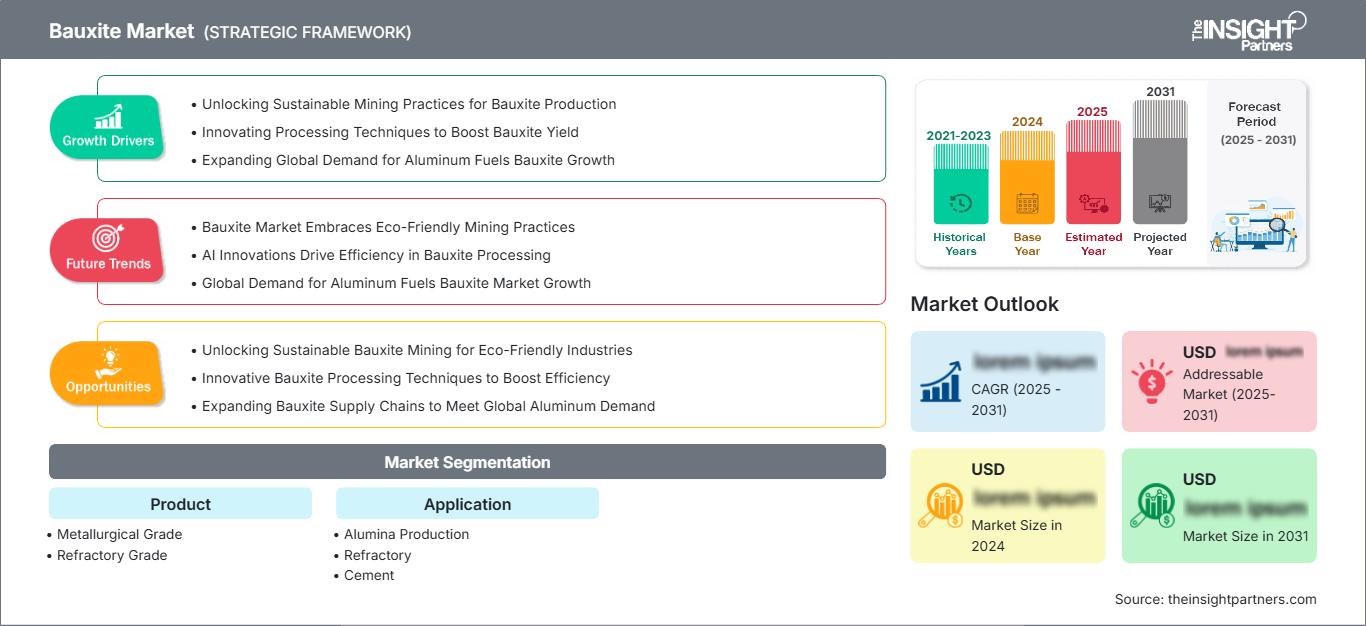
Bauxite Market: Strategic Insights
Regional Insights
North America Bauxite Market
North America is estimated to hold 9–11% of the Bauxite Market share in 2025 and expand at a CAGR of 1.8–2.2% through 2034. The regional market is structurally dependent on imports because domestic bauxite production is limited, while downstream alumina and aluminum infrastructure continue to require reliable feedstock.
The U.S. represents the dominant regional demand center, supported by aerospace, automotive, packaging, construction, and electrical applications that sustain aluminum consumption. Supply diversification remains strategically important as importers manage freight costs, source quality, geopolitical exposure, and refinery requirements. Canada contributes through downstream aluminum production and an established trade infrastructure.
U.S. Bauxite Market
The U.S. comprises about 78%-82% of North America’s 2025 Bauxite Market share and is forecasted to grow at a CAGR of 1.7%-2.1% till 2034. The industry continues to be an import-oriented one, where Jamaica, Turkey, Guyana, and Australia have already been identified as some of the well-known sources.
The demand for the commodity is focused on alumina processing, abrasives, cement, chemicals, and refractory material uses. According to USGS, in 2025, bauxite imports were at around 3.0 million metric tons and the domestic consumption was 1.7 million tons.
Europe Bauxite Market
Europe’s contribution to the share is estimated at 11-13% in 2025, increasing at CAGR of 1.6-2.0% during 2026-2034. Germany is one of the key industrial centers, while the UK, France, Italy, and Spain are sustaining the demand through refractory, cement, alumina, and engineering material uses.
The UK segment is driven by mineral consumption, infrastructural reconstruction projects, and special refractories demand. The import logistics and environmental compliance are still playing important roles in purchase decision making due to limited local resource availability.
Germany is retaining high demand from steel industry, casting, refractories, auto, and industrial manufacturing. Consistent chemistry, reliable logistics, and material efficiency become important parameters for procurement in favor of well-established international suppliers.
France, Italy, and Spain combined retain European consumption through cement, ceramics, refractory, metallurgical, and construction industries. The purchasing trends in these countries value material certification and maritime logistics reliability while environmental permits and carbon-neutral production play increasing role in decision making.
APAC Bauxite Market
It has been estimated that APAC will constitute an estimated 44-47% share and have a CAGR of 2.3-2.7% till 2034, thus making it the leading regional market. China leads the pack in this regard while India, Indonesia, Australia, Japan, and South Korea help create diverse supply and downstream demand.
China has large refining capacities along with aluminum manufacturing facilities. Australia has maintained its relevance as a mining and exporting country, while India and Indonesia have increased their domestic value chain capabilities. Japan and South Korea are more relevant as a downstream industrial consumer.
Middle East & Africa Bauxite Market
MEA will witness a CAGR growth rate of 2.4%-2.8% until 2034, with Guinea being the primary center for upstream operations. Saudi Arabia and UAE boost downstream aluminum operations, whereas South Africa helps in meeting industrial consumption needs and logistics facilities.
MEA still holds importance due to high reserves and export mining activities in the region. Saudi Arabia and UAE have the advantage of aluminum investments integrated within them, whereas South Africa and the other part of MEA offer refractory, cement, infrastructure, and industrial consumption.
Segmentation Analysis
Product
Product segmentation defines an important part of the Bauxite Market scope, reflecting differences in chemical composition, processing suitability, and end-use requirements. The metallurgical category dominates because alumina refining consumes substantially more material than non-aluminum industrial applications. The segment is expected to expand at a CAGR of 2.0–2.3% during 2026–2034, supported by refinery utilization and long-term aluminum demand.
- Metallurgical Grade: This grade remains the principal commercial product because its alumina yield and impurity profile are suited to Bayer-process refineries. Demand is closely connected to refinery capacity, ore quality requirements, and integrated mine-to-refinery supply agreements.
- Refractory Grade: Refractory-grade material serves high-temperature industrial applications where alumina content, thermal stability, and impurity control are critical. Demand is linked to steelmaking, cement kilns, foundries, and specialty furnace construction.
Application
Application segmentation captures the different value pools generated by downstream processing. The segment is expected to register a CAGR of 2.1–2.5% during 2026–2034, supported by alumina consumption and expanding industrial applications requiring heat-resistant mineral inputs.
- Alumina Production: This application represents the principal demand center because bauxite is the essential feedstock for alumina refining. Long-term refinery investments, operating-rate stability, and aluminum demand directly determine purchasing requirements.
- Refractory: Refractory applications require mineral inputs capable of maintaining structural integrity under extreme temperatures. Consumption is supported by steel, cement, glass, nonferrous metals, and foundry operations requiring durable furnace linings.
- Cement: Cement producers use suitable bauxite materials as alumina-bearing inputs and specialty mineral components. Demand follows infrastructure construction, cement production, raw-material optimization, and efforts to manage clinker chemistry.
Opportunity Snapshot
| Application | Revenue Contribution (High/Medium/Low) | Trend Tag (MAX 2 words) | Adoption Stage (Emerging/Scaling/Mature) |
| Alumina Production | High | Refinery Feedstock | Mature |
| Refractory | Medium | Furnace Linings | Scaling |
| Cement | Low | Alumina Correction | Mature |
Bauxite Market Growth Drivers and Impact Analysis
Expansion of Integrated Alumina and Aluminum Capacity
Expansion and modernization of alumina refining capacity create direct requirements for dependable bauxite feedstock. Integrated producers increasingly seek mine-to-refinery coordination to reduce exposure to freight volatility, quality inconsistency, and supply interruptions. New or upgraded refineries can also alter regional procurement patterns by increasing demand for specific ore chemistry rather than simply increasing tonnage. This favors suppliers capable of blending different ore bodies and maintaining consistent specifications. The impact is particularly visible in Asia, the Middle East, and Africa, where investments are strengthening domestic aluminum value chains. For mining companies, refinery-linked demand improves visibility for long-term production planning and can support infrastructure investment. For buyers, integrated sourcing can improve security of supply and reduce operational risks associated with spot procurement.
Infrastructure Development Strengthens Industrial Mineral Consumption
Infrastructure investment supports consumption beyond the primary aluminum chain by increasing requirements for cement, refractories, steel, and engineered construction materials. These industries use bauxite-derived or bauxite-containing products where alumina content, hardness, thermal stability, or chemical performance is advantageous. Emerging economies are particularly important because transportation networks, industrial plants, housing, and energy infrastructure require sustained construction activity. The effect on mining demand is indirect but structurally significant because industrial consumers diversify the end-use base and create incremental demand for non-metallurgical material. Refractory applications also benefit from steel and cement capacity additions, increasing the importance of consistent mineral quality. Suppliers able to serve multiple downstream applications can therefore reduce dependence on a single customer group and improve asset utilization across market cycles.
Supply Security and Geographic Diversification
Geographic concentration of high-quality deposits makes supply security an increasingly important procurement criterion. Weather disruptions, port congestion, policy changes, export restrictions, and community-related operating constraints can affect shipments even when underlying resources remain abundant. Buyers are responding by developing multiple sourcing channels, maintaining strategic inventories, and increasing contractual coverage with established producers. Mining companies with diversified geographic portfolios can capture this preference by offering continuity across different production regions. Guinea and Australia remain especially significant for seaborne supply, while Brazil, India, and Indonesia contribute additional regional alternatives. The commercial impact extends beyond physical availability because customers increasingly evaluate suppliers on logistics resilience, environmental performance, traceability, and the ability to maintain specifications across multiple mines and blending programs.
Bauxite Market Future Trends
Digitalization of Mine-to-Port Operations
Bauxite Market trends are increasingly associated with digital mine management, autonomous equipment, predictive maintenance, remote sensing, and integrated logistics platforms. Mining operators are using real-time production information to optimize haulage cycles, monitor equipment utilization, improve stockpile management, and coordinate shipments with refinery requirements. Digital systems can also improve ore blending by linking geological information with processing specifications. Over the forecast period, the strongest adoption is expected at large-scale operations where high throughput justifies technology investment. Data integration between mine planning, rail systems, ports, and downstream refineries should become more important as producers seek to reduce variability and improve asset productivity. The resulting operating model is likely to emphasize predictive decision-making rather than reactive maintenance and manual production control.
Greater Focus on Mine Rehabilitation and Resource Efficiency
Environmental performance is becoming a core component of mine planning rather than a post-production consideration. Producers are increasingly integrating progressive rehabilitation, biodiversity management, water monitoring, residue handling, and land-use planning into operating models. This shift can influence mine sequencing, capital requirements, permitting timelines, and relationships with local communities. Resource efficiency is also gaining attention through improved ore recovery, lower material movement, optimized energy consumption, and beneficial use of mining residues. Technologies that reduce waste volumes or create secondary applications can improve the environmental profile of mining operations while creating additional economic value. Over time, buyers may increasingly differentiate suppliers according to environmental performance, particularly where downstream aluminum producers are seeking lower-carbon and more responsibly sourced raw materials.
Bauxite Market Opportunities
Development of Strategic Mine-to-Metal Partnerships
Bauxite Market Forecasts indicate an opportunity for producers to strengthen long-term relationships with alumina refiners and aluminum manufacturers rather than relying exclusively on transactional sales. Strategic partnerships can combine multi-year supply agreements, quality management, infrastructure investment, shared logistics planning, and coordinated expansion schedules. Such arrangements can reduce procurement uncertainty for refiners while giving miners greater visibility into future production requirements. Opportunities are particularly relevant in regions where new refining capacity is being developed alongside mining projects. Integrated commercial structures can also support investment in railways, ports, slurry pipelines, storage facilities, and blending systems. Companies that secure these partnerships may improve asset utilization and reduce exposure to short-term commodity-price fluctuations while customers gain greater control over feedstock continuity and specification consistency.
Value Recovery from Bauxite Residues and By-products
In the Bauxite market, increasing attention to circular resource management creates opportunities to recover value from materials generated during mining and refining. Research and commercial demonstrations are exploring applications for bauxite residues in construction materials, cementitious products, mineral recovery, and other industrial uses. Successful commercialization could reduce storage requirements while generating supplementary revenue streams and improving environmental performance. Investment opportunities extend across residue characterization, separation technologies, processing equipment, and downstream product development. Producers with large existing residue inventories can become early adopters because the available material provides a substantial testing base. Partnerships with cement manufacturers, construction-material companies, universities, and technology developers can accelerate qualification and commercialization. The opportunity is particularly attractive where regulatory frameworks encourage resource recovery and reduce dependence on virgin industrial minerals.
Recent Developments
- July 2026: VBX Limited signed a strategic framework agreement with a Hong Kong-based subsidiary of a Chinese aluminum industry group covering bauxite offtake, potential project investment, and future collaboration at the Wuudagu project in Western Australia. The proposed arrangement includes annual purchases of 2–3 million tonnes of bauxite once production begins, with pricing linked to an international benchmark and adjusted for ore quality.
- January 2026: S&P Global Commodity Insights launched weekly Platts bauxite spot price assessments for CIF China and FOB Guinea, effective January 8, 2026. The assessments introduce standardized benchmarks for 45% alumina and 3% silica bauxite, with typical cargo volumes of 170,000 metric tons. The initiative reflects expanding seaborne trade and provides greater upstream pricing transparency across the bauxite value chain.
Frequently Asked Questions

- Comprehensive Market Sizing and Forecast Analysis
- Detailed Segmentation Analysis
- In-Depth Market Dynamics Assessment
- Regional and Country-Level Insights
- Competitive Landscape and Company Benchmarking
- Strategic Business Intelligence
Recent Reports
Testimonials

The Insight Partners' SCADA System Market report is comprehensive, with valuable insights on current trends and future forecasts. The team was highly professional, responsive, and supportive throughout. We are very satisfied and highly recommend their services.
RAN KEDEM Partner, Reali Technologies LTDs
I requested a report on a very specific software market and the team produced the report in a few days. The information was very relevant and well presented. I then requested some changes and additions to the report. The team was again very responsive and I got the final report in less than a week.
JEAN-HERVE JENN Chairman, Future Analytica
We worked with The Insight Partners for an important market study and forecast. They gave us clear insights into opportunities and risks, which helped shape our plans. Their research was easy to use and based on solid data. It helped us make smart, confident decisions. We highly recommend them.
PIYUSH NAGPAL Sr. Vice President, High Beam Global
The Insight Partners delivered insightful, well-structured market research with strong domain expertise. Their team was professional and responsive throughout. The user-friendly website made accessing industry reports seamless. We highly recommend them for reliable, high-quality research services
YUKIHIKO ADACHI CEO, Deep Blue, LLC.
This is the first time I have purchased a market report from The Insight Partners.While I was unsure at first, I visited their web site and felt more comfortable to take the risk and purchase a market report.I am completely satisfied with the quality of the report and customer service. I had several questions and comments with the initial report, but after a couple of dialogs over email with their analyst I believe I have a report that I can use as input to our strategic planning process.Thank you so much for taking the extra time and making this a positive experience.I will definitely recommend your service to others and you will be my first call when we need further market data.
JOHN SUZUKI President and Chief Executive Officer, Board Director, BK Technologies
I wish to appreciate your support and the professionalism you displayed in the course of attending to my request for information regarding to infectious disease IVD market in Nigeria. I appreciate your patience, your guidance, and the fact that you were willing to offer a discount, which eventually made it possible for us to close a deal. I look forward to engaging The Insight Partners in the future, all thanks to the impression you have created in me as a result of this first encounter.
DR CHIJIOKE ONYIA MANAGING DIRECTOR, PineCrest Healthcare Ltd.Reason to Buy
- Informed Decision-Making
- Understanding Market Dynamics
- Competitive Analysis
- Identifying Emerging Markets
- Customer Insights
- Market Forecasts
- Risk Mitigation
- Boosting Operational Efficiency
- Strategic Planning
- Investment Justification
- Tracking Industry Innovations
- Aligning with Regulatory Trends





 Get Free Sample for