
Beacon Market Size, Demand & Growth by 2034
Coverage: By Component (Software, Hardware, and Services); Connectivity (Bluetooth Low Energy, Hybrid, and Others); Technology (Eddystone, iBeacon, and others); and Verticals (Public Spaces, Retail, Transportation & Logistics, Travel & Tourism, Healthcare, Aviation, and Others); , and Geography (North America, Europe, Asia Pacific, and South and Central America)
- Status : Data Released
- Report Code : TIPEL100001350
- Category : Electronics and Semiconductor
- No. of Pages : 150
- Available Report Formats :


- Last update date : July 21, 2026


2025 Market Size
US$ 23.86 Bn
Base year value
2034 Forecast
US$ 1,123.47 Bn
Projected by 2034
CAGR 2026-2034
53.42 %
Growth rate
Addressable Market
US$ 3,158.38 Bn
(2026-2034)
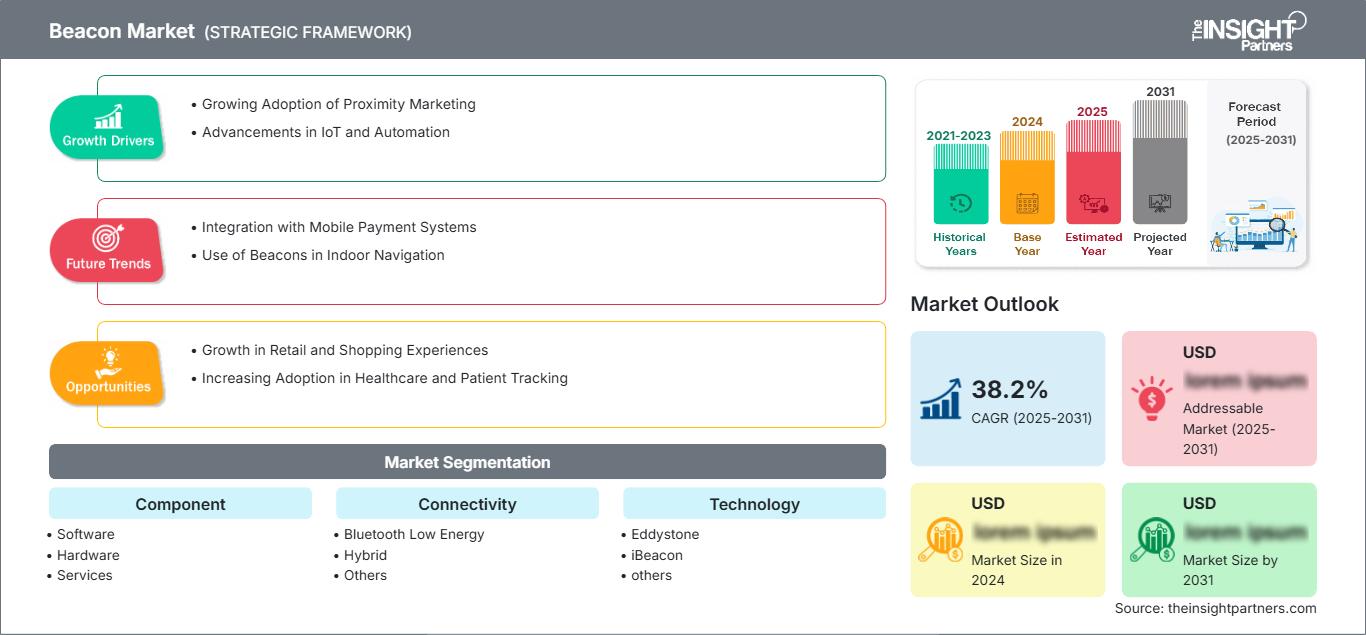
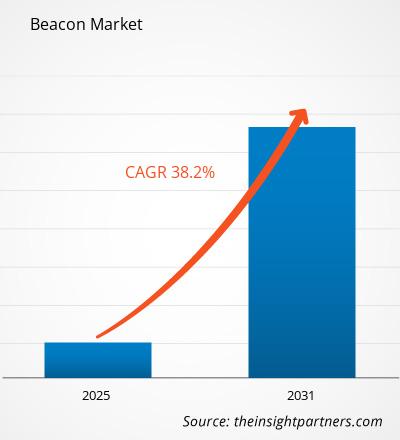
The Beacon Market size stood at US$ 23.86 Billion in 2025 and is expected to witness growth up to US$ 1,123.47 Billion in 2034 with a compound annual growth rate of 53.42% from 2026 to 2034. There has been an increase in demand due to the transition of proximity intelligence, indoor positioning, asset visibility, and contextual engagement from pilots to large-scale adoption in public places, retail, transport, healthcare, aviation, and tourism environments.
In North America, there is an increasing market size attributed to the smart venue upgrade, investment in RTLS in hospitals, and requirement of retailers for proximity engagement that adheres to the privacy of the customers. The region is predicted to exhibit a compound annual growth rate of 48%-52% during the years 2026-2034.
Beacon Market Assessment and Insights
- North America accounted for 34–37% share in 2025 and is growing at a CAGR of 48–52% between 2026–2034, led by retail analytics, healthcare RTLS, airport modernization, and connected venue deployments.
- US represented 78–82% of North America in 2025 and is growing at a CAGR of 47–51% between 2026–2034, driven by hospitals, stadiums, logistics hubs, and omnichannel retail.
- Europe held 24–27% share in 2025 and is growing at a CAGR of 46–50% between 2026–2034, with Germany, the UK, France, Italy, and Spain leading adoption in public spaces and retail.
- Asia Pacific captured 27–30% share in 2025 and is growing at a CAGR of 56–60% between 2026–2034, supported by China, Japan, South Korea, India, and Australia across smart infrastructure and mobility.
- Largest Segment Software held 41–45% market share in 2025 and is growing at a CAGR of 52–56% between 2026–2034 because analytics and campaign management drive recurring enterprise value.
- High Growth Segment Healthcare held 11–14% market share in 2025 and is growing at a CAGR of 60–64% between 2026–2034 as hospitals scale RTLS, safety, and asset-tracking use cases.
- Key companies analyzed in detail: Cisco Systems, Inc.; Aruba, a Hewlett Packard Enterprise company; Kontakt.io, Inc.; Accent Advanced Systems, SLU; Swirl Networks, Inc.; Gimbal, Inc.; Bluvision, Inc.; Estimote, Inc.; Onyx Beacon Ltd.; Beaconinside GmbH.
Source: The Insight Partners' analysis based on proprietary research, government publications, company annual reports, investor presentations, industry databases, and expert interviews.
The enterprise usage has evolved from standalone beacons to proximity networks comprising beacon hardware, edge gateways, analytics dashboards, and application programming interfaces. Production processes are becoming more sophisticated in terms of improving the battery life, multi-protocol communication, provisioning, and cybersecurity measures of beacons. These trends result in the transition of value from hardware-based acquisition costs to software-enabled orchestration, management, location analytics, and integration of beacons with Wi-Fi, IoT, mobile applications, and digital signage solutions.
In the coming years, the adoption of beacons in emerging geographies will occur through smart airports, urban transportation, public safety, and hospitals, in addition to shopping centers. The government-initiated digital infrastructure projects, consumers' mobile-first nature, and the need for real-time indoor analytics encourage such investments. Moreover, the market can benefit from the privacy-by-design architectural approaches allowing enterprises to utilize anonymous proximity signals.
Beacon Market Report Scope
| Report Attribute | Details |
|---|---|
| Market size in 2025 | US$ 23.86 Billion |
| Market Size by 2034 | US$ 1,123.47 Billion |
| Global CAGR (2026 - 2034) | 53.42% |
| Historical Data | 2021-2024 |
| Forecast period | 2026-2034 |
Beacon Market Analysis
The market expansion will be driven by three core operations: indoor asset deployment, contextual engagement of mobile users, and motion analytics in locations where GPS is not applicable. Beacon-enabled retail solutions connect shelves, apps, and loyalty programs; beacon-enabled hospitals track medical equipment, healthcare professionals' processes, and patient traffic. Beacon-enabled airports and logistic facilities optimize resources by analyzing proximity data and removing any inefficiencies.
The value chain consists of chipsets, hardware vendors, platform developers, integration specialists, applications partners and managed services. Increasingly differentiation is provided by provisioning capabilities, location precision, firmware security, and cloud analysis, not just by transmitter price. It is beneficial for the market when solution providers offer hardware bundles along with software subscription, monitoring SLA, and APIs.
Positioning is disparate yet highly technical. Cisco Systems, Inc. and Aruba, which is a subsidiary of Hewlett Packard Enterprise, are pertinent by virtue of their wireless infrastructure, while Kontakt.io, Inc., Estimote, Inc., Gimbal, Inc. and Accent Advanced Systems, SLU are competitors due to their specific beacon technology and vertical products. Based on the Beacon Market analysis, healthcare, transportation, and large venues are the markets that reward vendors with implementation services and analytical capabilities.
Investments will be made in AI-powered management tools, RTLS dashboards, and mixed-location stacks that combine Bluetooth low energy (BLE) with Wi-Fi, sensors, and mobile software development kits (SDKs). Strategic partnerships with application developers, hospitals, retail, and airport authorities will be key since the network of beacons is only useful once integrated into workflow processes.
● REPORT CUSTOMIZATION
Tailor This Report To Align With Your Specific Business Requirements
This report can be customized to align precisely with your business objectives, scope, and target markets. Customization options include tailored segmentation, geography, competitive analysis, and strategic insights to support informed decision-making.
Customize This Report →WHAT YOU CAN ADJUST
- ● Segmentations
- ● Geography
- ● Competitive Analysis
- ● Language Preferences
Beacon Market: Strategic Insights
Regional Insights
North America Beacon Market
The North American market had a 34% to 37% share in 2025 and is estimated to grow at a CAGR of 48% to 52% through 2034. The Beacon Market share is high due to high density of deployments in the US, where retailers, hospitals, universities, sports arenas, and airports all have robust mobile apps.
North American regional expansion is further enabled by WiFi refresh initiatives, digital sign adoption, and hospital safety investments. Network vendors with enterprise relationships will be able to leverage BLE technology in larger connectivity upgrade initiatives. Privacy and cybersecurity regulations are influencing purchasing decisions, making consent-based mobile engagements, encryption, and central device management capabilities essential for large-scale deployments in North America.
U.S. Beacon Market
The US comprised 78–82% share of the North American region in 2025 and is anticipated to show a CAGR of 47–51% during 2026–2034. The adoption occurs in healthcare RTLS, stadium engagement, airport navigation, retail loyalty, and warehouse tracking use cases. Pre-existing volumes of smartphone devices, enterprise Wi-Fi networks, and cloud-based analytics make it easy to incorporate beacon-based solutions in operations.
The company reach is wide, with Cisco Systems, Inc., Aruba, a Hewlett Packard Enterprise company, Kontakt.io, Inc., Gimbal, Inc., and Estimote, Inc. catering to infrastructure, healthcare, and engagement use cases. US customers have become more outcome-driven by looking for improvements in metrics such as equipment searching, routing of visitors, and application engagement.
Europe Beacon Market
Share for Europe stood at 24-27%, and CAGR during 2026-2034 is estimated at 46-50%. UK is dominating the retail media, visitor analytics and transport hub segments owing to urban venues and mobile loyalty schemes. Germany is next with industrial, logistics, healthcare and smart building deployments which require reliability and interoperability, as well as data governance.
France, Italy, and Spain are deploying beacons via tourism, museums, airports and public space enhancement in multilingual navigation and visitor experience solutions. GDPR compliance ensures that consent management and anonymous analytics are core features of the solutions. Thus, the Beacon Market in Europe is more operational than promotional in nature, with emphasis made on data transparency, long battery and integration services.
APAC Beacon Market
The APAC region held a 27–30% market share in 2025 and is expected to register 56–60% CAGR from 2026 to 2034 due to being the fastest-growing region. In APAC, China leads with its smart retail, transit, and manufacturing places; Japan and South Korea focus on smart venues, tourism, and indoor navigation.
Australia and India contribute through airports, healthcare, malls, and logistics sectors. Policies supporting smart cities, digital payments, and digitization of infrastructures have boosted adoption. The APAC Beacon Market is cost-sensitive and grows fast due to the integration of Bluetooth Low Energy technology with mobile, QR, Wi-Fi, and IoT technologies.
Middle East & Africa Beacon Market
The Middle East & Africa region is anticipated to expand at a CAGR of 49-53% between 2026 and 2034 with the largest deployments seen in Saudi Arabia and the UAE. The presence of large-scale airport, tourism, shopping, healthcare, and smart cities drives demand for indoor location solutions including tracking and visitor analytics.
Selective adoption of beacons in South Africa and the Rest of MEA is taking place in malls, hospitals, educational institutions, and logistics corridors. Location technology is employed in energy sector installations to enhance safety of the workforce and asset management. Hardware robustness, multi-language capability, and managed services are preferred by regional buyers.
Segmentation Analysis
Component
Component is expected to grow at a 51–55% CAGR during 2026–2034. The Beacon Market scope across components is widening as buyers procure software, hardware, and services together to reduce installation risk. Software captures the largest value because enterprises need campaign management, analytics, API integration, security monitoring, and fleet maintenance once beacon networks move beyond pilots.
- Software leads demand as dashboards, SDKs, analytics, and orchestration tools convert proximity signals into workflow automation, customer engagement, and operational intelligence for enterprise users.
- Hardware remains essential because beacon durability, battery life, signal stability, and environmental suitability determine deployment reliability across stores, hospitals, airports, and industrial facilities.
- Services are strategically important as enterprises require site surveys, installation, calibration, integration, staff training, and managed support to sustain performance at scale.
Connectivity
Connectivity is projected to expand at a 52–56% CAGR during 2026–2034. Bluetooth Low Energy remains the foundation because it offers low power consumption, broad smartphone compatibility, and cost-effective indoor coverage. Hybrid connectivity is gaining relevance where enterprises need stronger accuracy, cloud supervision, and integration with Wi-Fi, sensors, or gateway-based asset tracking.
- Bluetooth Low Energy dominates deployments because it balances battery efficiency, device affordability, and compatibility with mobile operating systems used in retail, healthcare, travel, and public venues.
- Hybrid solutions are gaining traction where BLE must work with Wi-Fi, cellular, NFC, or sensor networks to support analytics, asset tracking, and enterprise-grade monitoring.
Technology
Technology is forecast to grow at a 50–54% CAGR during 2026–2034. iBeacon remains widely used in app-based engagement because it is familiar to developers and supports stable proximity triggers. Eddystone retains relevance for open environments and URL-style interactions, although platform support and privacy rules influence deployment design choices.
- Eddystone supports open beacon interactions and is useful where organizations want flexible identifiers, web-linked experiences, and multi-platform proximity engagement in public locations.
- iBeacon maintains strong market position because retailers, venues, and app developers recognize its protocol maturity, mobile compatibility, and suitability for precise location-triggered experiences.
Verticals
Verticals are expected to grow at a 54–58% CAGR during 2026–2034. Adoption is shifting from promotional use cases to operational applications across public spaces, transportation, healthcare, aviation, tourism, and logistics. Retail remains important, but healthcare shows the fastest growth because hospitals require staff safety, equipment tracking, temperature monitoring, and patient-flow visibility.
- Public Spaces use beacons for visitor routing, crowd insights, accessibility support, and contextual information delivery in campuses, museums, stadiums, civic buildings, and event venues.
- Retail applies beacons to connect loyalty apps, in-store analytics, shelf engagement, and personalized offers while improving understanding of shopper movement and dwell patterns.
- Transportation & Logistics relies on beacons for asset visibility, yard management, parcel movement, workforce coordination, and indoor navigation across depots, warehouses, ports, and transit terminals.
- Travel & Tourism benefits from multilingual guides, location-based offers, route assistance, and attraction engagement that help operators personalize visitor experiences without complex infrastructure.
- Healthcare is a high-growth vertical because hospitals use beacons for equipment tracking, staff duress alerts, patient flow, hand hygiene, and temperature-sensitive inventory visibility.
- Aviation deploys beacons for airport navigation, baggage journey updates, queue visibility, passenger assistance, and proximity-triggered service information across terminals and lounges.
Opportunity Snapshot
| Industry Vertical | Revenue Contribution | Trend Tag | Adoption Stage |
| Public Spaces | Medium | Visitor Flow | Scaling |
| Retail | High | Loyalty Apps | Mature |
| Transportation & Logistics | High | Asset Visibility | Scaling |
| Travel & Tourism | Medium | Smart Guides | Scaling |
| Healthcare | High | RTLS Safety | Scaling |
| Aviation | Medium | Passenger Flow | Scaling |
| Others | Low | Site Automation | Emerging |
Beacon Market Growth Drivers and Impact Analysis
Indoor Positioning Moves Into Mission-Critical Operations
The demand for location information indoors, where satellite-based positioning is not viable or reliable, is increasing for organizations. Hospital staff productivity is wasted due to delays in locating pumps, wheelchairs, and portable medical devices, while logistics facilities need improved visibility within docks, yards, and warehouses. Beacon positioning offers an affordable layer that can be rolled out room by room and incorporated into dashboards. Market implications entail a shift from experiments in customer engagement to ongoing, measurable productivity initiatives. Buyers assess vendors based on availability, calibration assistance, API capabilities, and integration with current work order management, inventory tracking, and security systems.
Mobile-First Consumer Behavior Expands Proximity Engagement
Smartphones are now serving as the go-to interface for travel, shopping, events, and healthcare visits, creating an opportunity for beacon-triggered solutions. According to IATA, more than 78% of travelers have requested that there should be a single application that would integrate digital wallet, passport and also loyalty cards to be able to develop applications related to airports and traveling through improved navigations and service timings. App-based engagements by the retailers are also used to correlate visits to loyalty data.
Enterprise IoT Integration Improves Return on Deployment
Beacons have become more common within larger IoT, wireless, and analytics solutions rather than being used just as individual devices. By combining proximity data with Wi-Fi, camera, mobile, access, and enterprise resource information, these tools yield better operational insights. This helps to increase return on investment by offering many applications from one solution like asset tracking, visitor navigation, emergency alerts, and utilization analysis. The result is more valuable contracts for the providers because of cloud management, provisioning, and integration capabilities, while the buyers receive comprehensive solutions rather than disparate point solutions.
Beacon Market Future Trends
AI-Led Proximity Intelligence Platforms
Beacon Market trends increasingly favor AI-powered platforms that process proximity messages as actions rather than locations directly. Future solutions will help with congestion prediction, staff allocation recommendations, anomaly detection in equipment usage, and personalization of mobile user interactions on the basis of consensual behavior patterns. Such capabilities will be especially important in environments such as hospitals, airports, campuses, and logistics centers, where many mobile devices are involved in workflows. Providers of solutions that combine beacons with predictive analytics, digital twins, and workflow management can move from selling devices to a subscription business model based on customer outcomes.
Hybrid BLE, Wi-Fi, and Sensor Location Stacks
Future deployments will increasingly combine Bluetooth Low Energy with Wi-Fi sensing, mobile SDKs, gateways, and environmental sensors to improve reliability and coverage. Enterprises rarely want a single-purpose infrastructure when indoor spaces must support safety, navigation, asset management, and engagement simultaneously. Hybrid stacks will allow different accuracy levels for different zones, balancing cost with performance. This trend favors vendors that provide interoperable hardware, open APIs, and unified management consoles. It also supports longer asset lifecycles because organizations can add new use cases without replacing every beacon or rewriting every application.
Beacon Market Opportunities
Healthcare RTLS Modernization Programs
Hospitals offer one of the strongest Beacon Market Forecasts opportunities because location systems can address equipment utilization, staff safety, infection control, and patient throughput within the same estate. Vendors can target health systems with phased deployments beginning in emergency departments, operating rooms, and high-value equipment pools. Investment cases should quantify time saved in equipment searches, reduced rental leakage, faster room turnover, and improved compliance documentation. Partnerships with electronic health record vendors, facilities management providers, and nurse call platforms can accelerate adoption by embedding beacon events directly into clinical and operational workflows.
Smart Airports and Connected Transport Hubs
Airports, rail terminals, ports, and bus interchanges create attractive opportunities because they combine large passenger volumes, complex indoor layouts, time-sensitive movement, and commercial zones. Beacon networks can support wayfinding, accessibility assistance, baggage-status cues, queue management, and retail engagement from one location layer. Transport operators can start with high-friction touchpoints such as security, transfer corridors, lounges, and baggage areas. The investment logic strengthens when beacons are linked to mobile apps, digital signage, and operational dashboards, helping operators improve passenger experience while generating data for capacity planning.
Recent Developments
- July 2026: Avalon GloboCare announced plans to launch Beacon, an AI-powered Generative Engine Optimization (GEO) platform designed to help small businesses improve visibility across AI search engines such as ChatGPT, Gemini, Claude, Perplexity, and Grok. Scheduled for commercial launch in late Q3 2026, Beacon will be offered as a subscription-based SaaS solution, expanding the company's growing portfolio of agentic AI products.
- June 2026: Beacon raised US$225 million in a Series C funding round led by General Catalyst and HarbourVest to accelerate development of its AI-native business operating system. The funding will also support the acquisition and modernization of mission-critical businesses using AI, bringing Beacon's total capital raised to over US$500 million in the past year.
- July 2026: LightPath Technologies announced the acquisition of G5 Infrared, expanding its portfolio of infrared imaging and sensing technologies. The acquisition strengthens LightPath’s capabilities in advanced optical and thermal imaging solutions for defense, industrial, and commercial applications, while enhancing its manufacturing capacity and product offerings.
Frequently Asked Questions

- Comprehensive Market Sizing and Forecast Analysis
- Detailed Segmentation Analysis
- In-Depth Market Dynamics Assessment
- Regional and Country-Level Insights
- Competitive Landscape and Company Benchmarking
- Strategic Business Intelligence
Recent Reports
Testimonials

The Insight Partners' SCADA System Market report is comprehensive, with valuable insights on current trends and future forecasts. The team was highly professional, responsive, and supportive throughout. We are very satisfied and highly recommend their services.
RAN KEDEM Partner, Reali Technologies LTDs
I requested a report on a very specific software market and the team produced the report in a few days. The information was very relevant and well presented. I then requested some changes and additions to the report. The team was again very responsive and I got the final report in less than a week.
JEAN-HERVE JENN Chairman, Future Analytica
We worked with The Insight Partners for an important market study and forecast. They gave us clear insights into opportunities and risks, which helped shape our plans. Their research was easy to use and based on solid data. It helped us make smart, confident decisions. We highly recommend them.
PIYUSH NAGPAL Sr. Vice President, High Beam Global
The Insight Partners delivered insightful, well-structured market research with strong domain expertise. Their team was professional and responsive throughout. The user-friendly website made accessing industry reports seamless. We highly recommend them for reliable, high-quality research services
YUKIHIKO ADACHI CEO, Deep Blue, LLC.
This is the first time I have purchased a market report from The Insight Partners.While I was unsure at first, I visited their web site and felt more comfortable to take the risk and purchase a market report.I am completely satisfied with the quality of the report and customer service. I had several questions and comments with the initial report, but after a couple of dialogs over email with their analyst I believe I have a report that I can use as input to our strategic planning process.Thank you so much for taking the extra time and making this a positive experience.I will definitely recommend your service to others and you will be my first call when we need further market data.
JOHN SUZUKI President and Chief Executive Officer, Board Director, BK Technologies
I wish to appreciate your support and the professionalism you displayed in the course of attending to my request for information regarding to infectious disease IVD market in Nigeria. I appreciate your patience, your guidance, and the fact that you were willing to offer a discount, which eventually made it possible for us to close a deal. I look forward to engaging The Insight Partners in the future, all thanks to the impression you have created in me as a result of this first encounter.
DR CHIJIOKE ONYIA MANAGING DIRECTOR, PineCrest Healthcare Ltd.Reason to Buy
- Informed Decision-Making
- Understanding Market Dynamics
- Competitive Analysis
- Identifying Emerging Markets
- Customer Insights
- Market Forecasts
- Risk Mitigation
- Boosting Operational Efficiency
- Strategic Planning
- Investment Justification
- Tracking Industry Innovations
- Aligning with Regulatory Trends





 Get Free Sample for