
Blood Clotting Accelerant Market Size, Trends & Demand by 2034
Coverage: By Product Form (Powder, Solution, Others); Route of Administration (Topical, Parental); End User (Specialty Clinics, Hospitals, Research Institutes, Diagnostic Laboratories); and Geography , and Geography (North America, Europe, Asia Pacific, and South and Central America)
- Status : Data Released
- Report Code : TIPRE00018937
- Category : Life Sciences
- No. of Pages : 150
- Available Report Formats :


- Last update date : August 17, 2026


2025 Market Size
US$ 3.94 Bn
Base year value
2034 Forecast
US$ 6.07 Bn
Projected by 2034
CAGR 2026-2034
4.92 %
Growth rate
Addressable Market
US$ 45.43 Bn
(2026-2034)
The global Blood Clotting Accelerant market was valued at US$ 3.94 billion in 2025 and is expected to reach US$ 6.07 billion by 2034; it is estimated to record a CAGR of 4.92% during 2026-2034.
Blood Clotting Accelerant Market Assessment and Insights
- North America: North America is expected to maintain the leading position, with a 2025 share of 34–38% and a CAGR of 5.70–6.10% between 2026–2034, supported by advanced surgical capacity, specialist hematology services, and established reimbursement structures.
- US: The US accounts for 71–75% of North American revenue in 2025 and is projected to grow at a CAGR of 5.80–6.20% between 2026–2034, led by hospitals and specialty coagulation centers.
- Europe: Europe is estimated at 27–31% share in 2025 and a CAGR of 5.10–5.50% between 2026–2034, with Germany, the UK, France, Italy, and Spain providing the principal demand base through mature hospital networks and blood-management programs.
- Asia Pacific: Asia Pacific represents 21–25% share in 2025 and is modeled to grow at 6.10–6.60% between 2026–2034, with China, Japan, India, South Korea, and Australia driving adoption through healthcare expansion and improving access to specialist therapies.
- Largest Segment: Product Form is the largest segment, holding a 55–59% market share in 2025 and advancing at a 5.20–5.60% CAGR between 2026–2034, reflecting broad use of powder and solution formats.
- High Growth Segment: Route of Administration is the high-growth segment, representing a 24–28% market share in 2025 and expanding at a 6.10–6.50% CAGR between 2026–2034, supported by preference for convenient, rapid delivery.
- Key companies analyzed in detail: Baxter International Inc., Merck KGaA, Grifols International, S.A., CSL Limited, Novo Nordisk A/S, Kedrion S.p.A., PeproTech, Inc., Octapharma AG, ACROBiosystems, and Takeda Pharmaceutical Company Limited.
Source: The Insight Partners' analysis based on proprietary research, government publications, company annual reports, investor presentations, industry databases, and expert interviews.
Technological evolution is shifting hemostatic products toward faster preparation, predictable coagulation activity, and improved handling in time-sensitive settings. Powder formulations may have the edge when refrigeration and/or complex preparations are not feasible, whereas solution formulation will continue to be important where rapid delivery and clinical routines are key. Moreover, improvements in the form of recombinant and plasma-derived starting materials, quality controls, purification procedures, and packaging formats are being made by manufacturers.
The future growth potential will probably be greatest in those healthcare systems that, at the same time, have increasing numbers of operations and growing awareness of bleeding disorders. The most pertinent new markets in this regard are emerging Asian nations, along with some Middle Eastern countries. Regulatory emphasis on product safety, traceability, validated manufacturing, and evidence-based blood management should favor suppliers able to demonstrate reliable clinical performance and resilient production networks, supporting growth in the Blood Clotting Accelerant Market share.
Blood Clotting Accelerant Market Report Scope
| Report Attribute | Details |
|---|---|
| Market size in 2025 | US$ 3.94 Billion |
| Market Size by 2034 | US$ 6.07 Billion |
| Global CAGR (2026 - 2034) | 4.92% |
| Historical Data | 2021-2024 |
| Forecast period | 2026-2034 |
Blood Clotting Accelerant Market Analysis
Demand for the market growth is anchored in surgical hemostasis, management of coagulation-factor deficiencies, trauma care, and specialized bleeding-disorder treatment. Hospitals represent a critical purchasing node because product selection depends on clinical protocols, procedure volume, blood-bank capabilities, and availability of trained personnel. The ecosystem links plasma collection, recombinant protein manufacturing, formulation, sterile processing, quality testing, distribution, hospital procurement, and specialist clinical use, as highlighted in the Blood Clotting Accelerant Market report.
Supply characteristics vary with the technological nature of the product. Plasma-derived products have their supply determined by the availability of donors, the process of fractionation, the process of pathogen control, and refrigeration needs. On the other hand, the production of recombinant products depends greatly on bioprocessing and manufacturing processes. The form of powder may offer the benefit of transportation and storage ease, while solutions offer well-recognized modes of administration.
The Blood Clotting Accelerant analysis indicates a competitive environment combining established hemostasis suppliers with specialist plasma and recombinant-protein manufacturers. Baxter International Inc. maintains a strong surgical hemostasis position, while CSL Limited, Grifols International, S.A., Kedrion S.p.A., and Octapharma AG emphasize plasma-derived coagulation and bleeding-management capabilities. Novo Nordisk A/S adds a major rare-disease and hemophilia platform, while Merck KGaA and PeproTech, Inc. contribute broader biological-development capabilities.
The focus of strategic investments is becoming centered around formulation ease, data generation, production stability, and administration differentiation. ACROBiosystems would be involved by providing biological components through recombinant technology, while Takeda Pharmaceutical Company Limited offers knowledge in hematology and sales networks globally. Competitive positioning thus is not based on just one attribute but rather on clinical data, regulatory capability, manufacturing size, specialization, and integration of the product into the hospital’s blood management processes.
● REPORT CUSTOMIZATION
Tailor This Report To Align With Your Specific Business Requirements
This report can be customized to align precisely with your business objectives, scope, and target markets. Customization options include tailored segmentation, geography, competitive analysis, and strategic insights to support informed decision-making.
Customize This Report →WHAT YOU CAN ADJUST
- ● Segmentations
- ● Geography
- ● Competitive Analysis
- ● Language Preferences
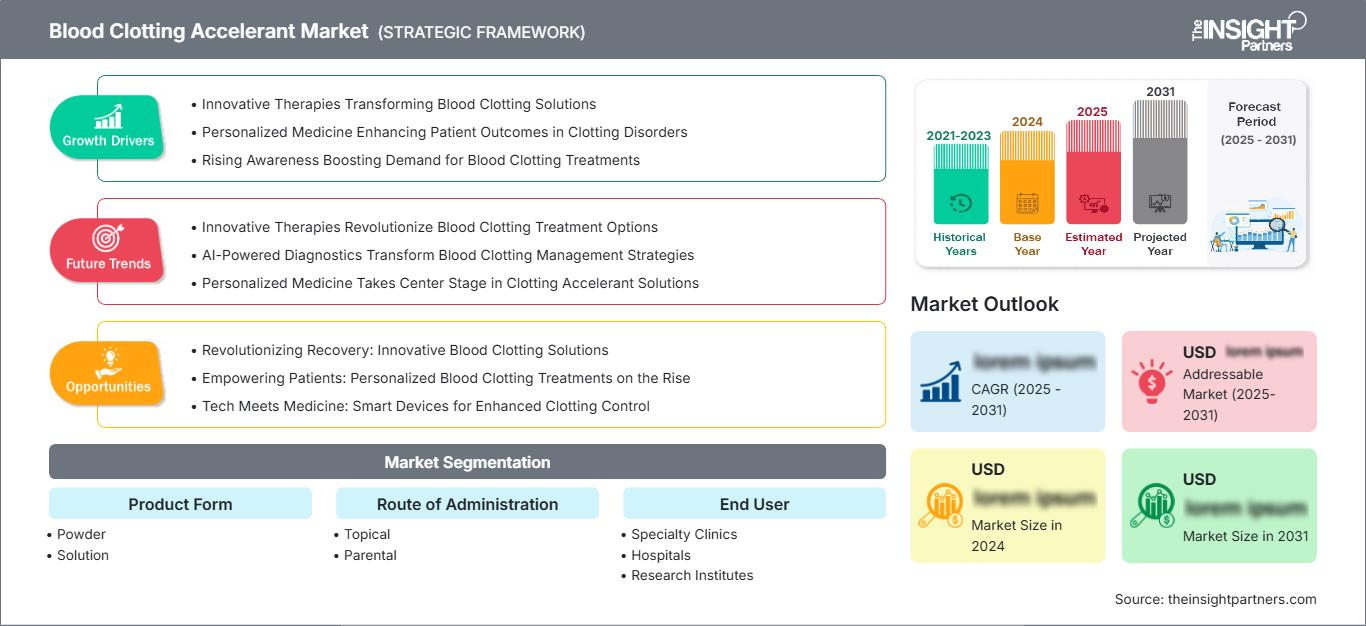
Blood Clotting Accelerant Market: Strategic Insights
Regional Insights
North America Blood Clotting Accelerant Market
North America is estimated to hold 34–38% of the global market in 2025 and is modeled to expand at a 5.70–6.10% CAGR through 2034, supporting a positive Blood Clotting Accelerant Market forecast. The U.S. represents the principal demand center, supported by high procedure volumes, specialist coagulation laboratories, sophisticated trauma systems, and established use of topical and systemic hemostatic interventions. Canada contributes through centralized healthcare procurement and the growing adoption of evidence-based blood-management practices.
The regional ecosystem is also supported by the presence of existing manufacturers, specialty distributors, and strong clinical research networks. The demand is driven by the growing focus on patient blood management, bleeding cessation, and minimizing unnecessary exposure to transfusions. Hospitals continue to be the major buyer, whereas specialty clinics help in treating the inherited bleeding disorders. The regulatory environment related to biologicals, plasma-derived products, and recombinant coagulation factors necessitates a stringent manufacturing process.
U.S. Blood Clotting Accelerant Market Market
The U.S. accounts for 71–75% of North American revenue in 2025 and is expected to register a 5.80–6.20% CAGR through 2034, reflecting key Blood Clotting Accelerant Market trends. This placement is due to the presence of well-established surgery infrastructure, specialist hematology services, high-quality trauma care, and access to the coagulation test facilities. Hospitals continue to be the major field of application, whereas the specialty clinics are becoming more involved in managing hemophilia and other bleeding disorders on a long-term basis.
Other factors that affect product adoption include formulary considerations, evidence, reimbursement, and operating room workflow needs. Baxter International Inc., CSL Limited, Grifols International, S.A., Novo Nordisk A/S, Octapharma AG, and other companies have appropriate competencies in surgical hemostasis and coagulation management. The trend towards products requiring minimal preparation, easy storage, and reliable administration is gaining momentum.
Europe Blood Clotting Accelerant Market Market
Europe is projected to account for 27–31% of global revenue in 2025 and expand at a 5.10–5.50% CAGR through 2034, reinforcing its position in the Blood Clotting Accelerant Market. In addition, Germany is a key national market, backed by well-established centers of hematology, proper blood management practices and strict regulations. The United Kingdom, Germany, France, Italy and Spain altogether make up the primary market demand.
The United Kingdom takes advantage of centralized purchasing and budget management practices, Germany combines its extensive hospital and specialist network, France boasts excellent tertiary care facilities, Italy keeps developing specialized treatment approaches and Spain gets an advantage from increasing hematology facilities in hospitals. In Europe, the demand shifts towards clinically proven products, facilitating quick response, efficient resource allocation and good coagulation behavior.
APAC Blood Clotting Accelerant Market Market
The Blood Clotting Accelerant Market in APAC represents 21–25% share in 2025 and is modeled to grow at 6.10–6.60% through 2034, with China as the leading market. Japan and South Korea have mature specialists in their health care systems, whereas India has great long-term potential due to growth in tertiary hospitals and diagnoses. Australia continues to be an example of the developed market due to its developed healthcare infrastructure and existing bleeding disorder treatment programs.
The development of the pharmaceutical industry, hospital infrastructure, and increased access to specialized care are factors that facilitate market adoption in the region. China is of particular importance because of the local capacity for biopharmaceuticals, whereas Japan and South Korea focus on the quality of clinical practice. India’s opportunity comes from cost-efficiency, production, and increased diagnostics of bleeding disorders.
Middle East & Africa Blood Clotting Accelerant Market Market
The Blood Clotting Accelerant Market in the Middle East & Africa is projected to grow at a 5.00–5.50% CAGR through 2034, with Saudi Arabia serving as a leading market. Tertiary care capacities in the UAE are improving, while South Africa continues to be a prominent center for specialist health care. Markets in the Rest of MEA are growing slowly because of unequal access to coagulation products. Development of healthcare infrastructure, increased surgical procedures, and better diagnostics of bleeding conditions can drive the market’s growth.
Growing healthcare infrastructure development, the number of specialty hospitals, and improvements in emergency services create opportunities for advanced hemostatics. The energy sector incomes in the Gulf countries help develop healthcare, which includes specialized laboratories and operating rooms. In other parts of the region, the development of these products relies more on their distribution and availability.
Segmentation Analysis
Product Form
The Product Form segment of the Blood Clotting Accelerant Market is the largest main segment and is projected to grow at a 5.20–5.60% CAGR between 2026 and 2034. Product selection reflects the balance between preparation speed, storage conditions, dosing flexibility, and clinical familiarity. Powder formats can improve logistics, transportation efficiency, and shelf-life management, whereas solution-based products remain integral to established hospital protocols and emergency care settings. Manufacturing investment is increasingly directed toward stable formulations, convenient reconstitution processes, and packaging designs that support rapid deployment in urgent clinical environments.
- Powder: Powder products hold strategic importance where storage flexibility, transport efficiency, and rapid reconstitution are valued. Demand is supported by emergency, surgical, and institutional settings requiring products that can be maintained within controlled inventories.
- Solution: Solutions remain important because many hospitals have established infusion and administration protocols around ready-to-use or readily prepared coagulation products. Their predictable workflow integration supports recurring institutional purchasing.
Route of Administration
The Route of Administration segment of the Blood Clotting Accelerant Market is projected to expand at a 6.10–6.50% CAGR between 2026–2034. Adoption reflects clinical requirements for rapid hemostasis, precise placement, and compatibility with established treatment protocols. Topical approaches are particularly relevant during surgical procedures and localized bleeding management, while parenteral administration remains important for systemic coagulation-factor replacement and emergency interventions. Product developers are increasingly focused on simplifying administration, improving treatment efficiency, and enabling faster clinical response during bleeding events.
- Topical: Topical products are strategically relevant in surgical settings because they can be applied directly to bleeding surfaces. Their value proposition centers on rapid localization, ease of use, and compatibility with conventional operative techniques.
- Parental: Parental administration supports systemic coagulation management when local hemostasis is insufficient. Hospitals and specialty clinics depend on controlled dosing, validated potency, and trained personnel for appropriate administration.
End User
The End User segment of the Blood Clotting Accelerant Market is expected to register a 5.40–5.80% CAGR between 2026–2034. Hospitals remain the core purchasing environment because they manage surgery, trauma, critical care, and complex bleeding disorders. Specialty clinics support chronic coagulation management, while research institutes and diagnostic laboratories influence product development, testing, and biomarker-driven treatment decisions. Increasing specialization and expanding treatment capabilities are expected to broaden demand across multiple institutional channels within the market.
- Specialty Clinics: Specialty clinics are strategically important for inherited and chronic bleeding disorders, providing concentrated expertise in coagulation assessment, treatment planning, monitoring, and long-term therapy management.
- Hospitals: Hospitals provide the broadest application environment because surgical, emergency, trauma, and intensive-care departments require rapid access to hemostatic interventions across diverse patient populations.
- Research Institutes: Research institutes support translational development, coagulation science, biomarker validation, and preclinical evaluation, making them important for future product differentiation and technology development.
- Diagnostic Laboratories: Diagnostic laboratories underpin treatment selection through coagulation testing and factor assessment. Their strategic role increases as clinical decision-making becomes more dependent on precise characterization of bleeding mechanisms.
Opportunity Snapshot
| Segment Name | Revenue Contribution | Trend Tag | Adoption Stage |
|---|---|---|---|
| Specialty Clinics | Medium | Factor Testing | Scaling |
| Hospitals | High | Surgical Hemostasis | Mature |
| Research Institutes | Low | Coagulation Research | Emerging |
| Diagnostic Laboratories | Medium | Coagulation Testing | Scaling |
Blood Clotting Accelerant Market Growth Drivers and Impact Analysis
Expansion of Surgical and Trauma Hemostasis Applications
The growing need for an efficient means of controlling bleeding in surgery and trauma care is expanding the target population for hemostatics. Complicated cardiovascular, orthopedic, gastrointestinal, and minimally invasive surgeries may create conditions that would require advanced means beyond conventional options in order to deal with them. This highlights the importance of providing products that are capable of providing either localized or systemic support for coagulation. In addition, hospitals need to increase efficiency in the operating rooms and minimize the need for transfusions. In such circumstances, purchasing departments become more interested in such criteria as preparation time, storage stability, scientific evidence, and integration into the standard procedure. The greatest market success will be achieved by products that are capable of providing efficient hemostasis and integrating easily into the standard practice.
Greater Recognition of Inherited and Acquired Bleeding Disorders
The diagnosis of hemophilia, von Willebrand disease, deficiencies in fibrinogen, and acquired disorders of blood clotting is making the population being treated larger than ever before. More awareness in the clinical community, better access to diagnostic centers, and more referrals are facilitating early access to hematological services for patients. The World Federation of Hemophilia and the International Society on Thrombosis and Hemostasis have continued highlighting the diagnosis, therapy and multidisciplinary approach, thus re-emphasizing the need for specialized coagulation management. The consequence of such trends is increased demand for systemic and supportive treatments. From a business perspective, the effects of this development go beyond the quantity of sales since patients need follow-up, repeated doses, and expert care.
Shift Toward Patient Blood Management and Concentrate-Based Care
Patient blood management is now playing a significant role in the development of hospital approaches for managing hemorrhage, blood-component utilization, and perioperative care. Specialized coagulation factors can prove to be an interesting choice when the need is to target replacement rather than exposure to any plasma or blood component. The implication holds significance more for cardiac surgery, trauma, transplantation, and abdominal surgery when the correction of coagulation deficiency influences the course of the procedure. Protocols within the hospitals make use of laboratory tests, clinical evaluation, and specialized interventions rather than relying only on the traditional transfusion protocol. This increases the requirement for products that can offer standardized doses, quick preparation, and availability. Manufacturers can benefit from this clinical evidence that their product complements the blood management approach of the institution.
Blood Clotting Accelerant Market Future Trends
Personalized Coagulation Management Through Rapid Diagnostics
Going forward, future treatment strategies are expected to involve the use of fast coagulation testing combined with selective hemostatic treatment, enabling differentiation of fibrinogen deficiency, depletion of factors, dysfunctional platelets, or any other cause of bleeding. The use of point-of-care testing, together with advanced laboratory technology, will reduce the time from testing to decision-making about appropriate treatment. Such an approach might push vendors to offer their product line based on the particular coagulation deficit. With the help of electronic decision support systems, dosing and monitoring can be standardized even more. Eventually, hospitals might base the choice of hemostatic products on such criteria as effectiveness in patients, transfusion avoidance, time to hemostasis, and resource consumption.
Next-Generation Recombinant and Stabilized Hemostatic Products
Advances in biotechnology should enable greater use of recombinant proteins and stable formulations in bleeding treatment. The manufacturing platform should make it possible to achieve controlled production, known composition, and decreased dependence on donor-derived materials for certain products. Meanwhile, formulation technology should make it possible to increase the stability of the drug, its rapid reconstitution, and ease of administration. These advances should be especially helpful in the setting of emergency rooms, operating theatres, remote hospitals, and countries lacking cold chain infrastructure. Regulatory agencies will probably require comprehensive evidence regarding safety, efficacy, immunogenicity, and manufacturing consistency. The company offering advanced expression platforms along with reliable quality control procedures should be in a favorable position in such application areas. The long-term prospect is associated with products offering consistent coagulation activity, yet lower complexity of handling.
Blood Clotting Accelerant Market Opportunities
Localized Manufacturing and Regional Supply Resilience
Investment opportunities are emerging in regional manufacturing, fill-finish capacity, plasma-processing infrastructure, and specialized distribution networks. Dependence on concentrated manufacturing hubs can expose healthcare systems to shortages caused by production interruptions, regulatory delays, or transportation constraints. Establishing additional qualified capacity in Asia Pacific and selected Middle Eastern markets could improve availability while supporting local healthcare strategies. Investors should prioritize facilities capable of meeting stringent biologics and plasma-product standards rather than pursuing capacity alone. Partnerships with established manufacturers, local governments, hospitals, and specialist distributors can reduce market-entry barriers. Blood Clotting Accelerant Forecasts should therefore be evaluated alongside regulatory timelines, raw-material availability, cold-chain requirements, and reimbursement conditions. Companies that build flexible regional supply models can improve resilience while creating platforms for broader hematology and critical-care portfolios.
Integrated Hospital Solutions for Emergency Hemostasis
A second opportunity lies in integrating hemostatic products with diagnostic testing, blood-management protocols, inventory systems, and clinician education. Hospitals increasingly require solutions that support rapid decisions during surgery and critical bleeding rather than isolated products without workflow integration. Suppliers can create value through bundled clinical support, point-of-care compatibility, digital dosing tools, and inventory optimization. Such approaches may be especially relevant in large tertiary hospitals and trauma centers where treatment decisions must be made within minutes. Strategic partnerships with diagnostic companies and hospital networks could strengthen adoption by demonstrating measurable improvements in treatment speed and resource utilization. Successful models should remain clinically evidence-based and adaptable to local protocols. The strongest opportunities are likely to emerge where product manufacturers can solve operational bottlenecks as well as coagulation-management needs.
Recent Developments
- June 2026: Grifols International, S.A. announced the US launch of FESILTY, a fibrinogen concentrate approved for acute bleeding episodes in pediatric and adult patients with congenital fibrinogen deficiency. The launch expands Grifols’ bleeding-management portfolio and follows US regulatory approval in December 2025.
- July 2026: Octapharma AG announced that the US FDA had expanded approval of wilate for routine prophylaxis to reduce bleeding episodes in children younger than six years with von Willebrand disease. The decision broadened the product’s prophylaxis indication across pediatric age groups and was supported by Phase 3 WIL-33 data.
- April 2025: Baxter International Inc. introduced a room-temperature version of its Hemopatch Sealing Hemostat in Europe. The product evolution removes refrigeration requirements and was designed to improve operating-room accessibility while supporting tissue sealing and control of mild or moderate bleeding during open and minimally invasive surgery.
Frequently Asked Questions

- Comprehensive Market Sizing and Forecast Analysis
- Detailed Segmentation Analysis
- In-Depth Market Dynamics Assessment
- Regional and Country-Level Insights
- Competitive Landscape and Company Benchmarking
- Strategic Business Intelligence
Recent Reports
Testimonials

The Insight Partners provided valuable market intelligence that supported our global go-to-market strategy. Their team was professional, responsive, and attentive to our feedback, providing thoughtful analysis and helpful methodological clarifications throughout the project.
Junmo Kim Chief Financial Officer (CFO), Enertech Co., Ltd.
The Insight Partners' SCADA System Market report is comprehensive, with valuable insights on current trends and future forecasts. The team was highly professional, responsive, and supportive throughout. We are very satisfied and highly recommend their services.
RAN KEDEM Partner, Reali Technologies LTDs
I requested a report on a very specific software market and the team produced the report in a few days. The information was very relevant and well presented. I then requested some changes and additions to the report. The team was again very responsive and I got the final report in less than a week.
JEAN-HERVE JENN Chairman, Future Analytica
We worked with The Insight Partners for an important market study and forecast. They gave us clear insights into opportunities and risks, which helped shape our plans. Their research was easy to use and based on solid data. It helped us make smart, confident decisions. We highly recommend them.
PIYUSH NAGPAL Sr. Vice President, High Beam Global
The Insight Partners delivered insightful, well-structured market research with strong domain expertise. Their team was professional and responsive throughout. The user-friendly website made accessing industry reports seamless. We highly recommend them for reliable, high-quality research services
YUKIHIKO ADACHI CEO, Deep Blue, LLC.
This is the first time I have purchased a market report from The Insight Partners.While I was unsure at first, I visited their web site and felt more comfortable to take the risk and purchase a market report.I am completely satisfied with the quality of the report and customer service. I had several questions and comments with the initial report, but after a couple of dialogs over email with their analyst I believe I have a report that I can use as input to our strategic planning process.Thank you so much for taking the extra time and making this a positive experience.I will definitely recommend your service to others and you will be my first call when we need further market data.
JOHN SUZUKI President and Chief Executive Officer, Board Director, BK Technologies
I wish to appreciate your support and the professionalism you displayed in the course of attending to my request for information regarding to infectious disease IVD market in Nigeria. I appreciate your patience, your guidance, and the fact that you were willing to offer a discount, which eventually made it possible for us to close a deal. I look forward to engaging The Insight Partners in the future, all thanks to the impression you have created in me as a result of this first encounter.
DR CHIJIOKE ONYIA MANAGING DIRECTOR, PineCrest Healthcare Ltd.Reason to Buy
- Informed Decision-Making
- Understanding Market Dynamics
- Competitive Analysis
- Identifying Emerging Markets
- Customer Insights
- Market Forecasts
- Risk Mitigation
- Boosting Operational Efficiency
- Strategic Planning
- Investment Justification
- Tracking Industry Innovations
- Aligning with Regulatory Trends





 Get Free Sample for