
Cable Television Networks Market Demand, Size & Forecast by 2034
Coverage: By Type (Closed Circuit Television Circuits, Satellite Master Antenna System, Multipoint Distribution System, Others); Applications (Home Use, Commercial Use) , and Geography (North America, Europe, Asia Pacific, and South and Central America)
- Status : Data Released
- Report Code : TIPRE00025288
- Category : Electronics and Semiconductor
- No. of Pages : 150
- Available Report Formats :


- Last update date : July 28, 2026


2025 Market Size
US$ 557.33 Bn
Base year value
2034 Forecast
US$ 2,001.66 Bn
Projected by 2034
CAGR 2026-2034
15.26 %
Growth rate
Addressable Market
US$ 10,903.21 Bn
(2026-2034)
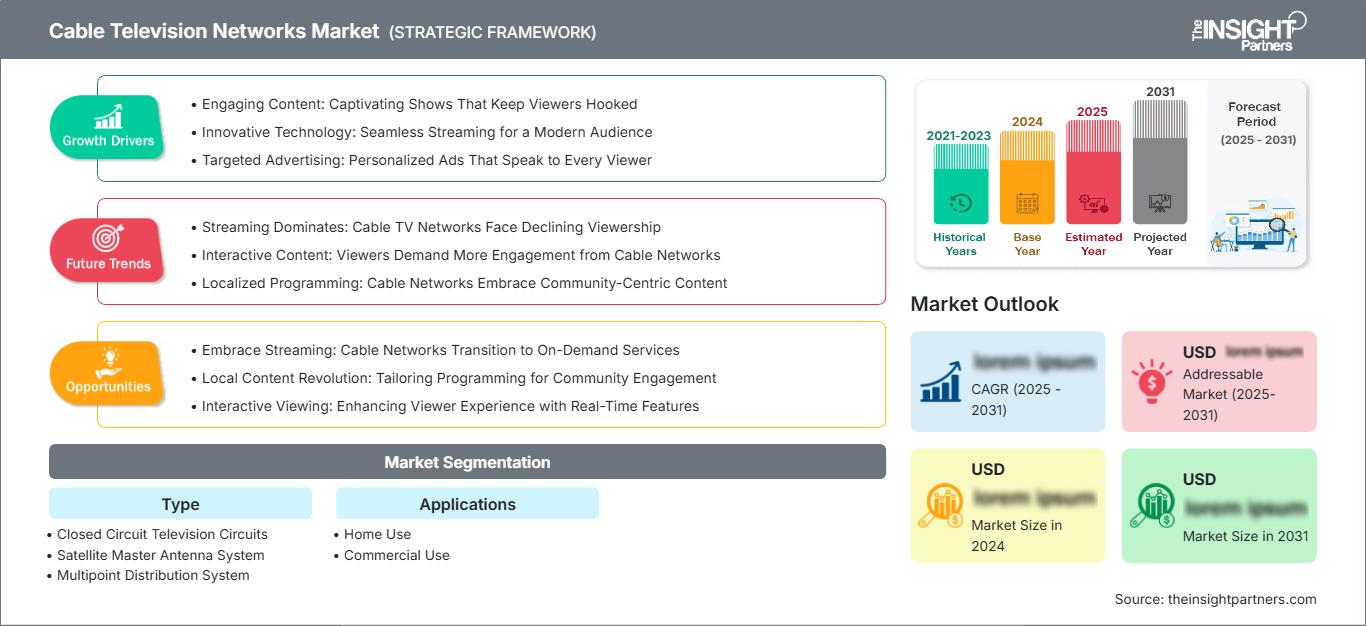
The Cable Television Networks Market size has been estimated to be worth US$ 557.33 Billion in 2025 and is anticipated to reach US$ 2,001.66 Billion by 2034, witnessing growth at a CAGR of 15.26% through 2026–2034. The growth is attributed to a move away from traditional carriage of channels and toward hybrid networks that involve use of closed circuit television circuits, satellite master antenna system and multipoint distribution system with access to digital content.
Within North America, the market has been driven by factors such as bundled broadband, sports and commercial venue, with the market in North America predicted to grow at a rate of 13.8–14.6% CAGR through 2026–2034. Adoption of hybrid fiber-coaxial network technology, enterprise video networks, and hospitality distribution networks continues to aid in the uptake.
Cable Television Networks Market Assessment and Insights
- North America accounted for 32–35% share in 2025 and is growing at a CAGR of 13.8–14.6% during 2026–2034, supported by broadband-video bundling, sports distribution, and enterprise-grade network upgrades.
- US represented 79–83% of North America in 2025 and is growing at a CAGR of 13.6–14.4% during 2026–2034, led by bundled services and cable network restructuring.
- Europe held 24–27% share in 2025 and is growing at a CAGR of 12.9–13.7% during 2026–2034, with the UK, Germany, France, Italy, and Spain leading digital cable modernization.
- Asia Pacific captured 28–31% share in 2025 and is growing at a CAGR of 16.4–17.2% during 2026–2034, led by China, India, Japan, South Korea, and Australia.
- Largest Segment Home Use held 58–62% market share in 2025 and is growing at a CAGR of 14.7–15.5% during 2026–2034, driven by bundled entertainment access.
- High Growth Segment Commercial Use held 38–42% market share in 2025 and is growing at a CAGR of 16.6–17.4% during 2026–2034, supported by hotels, offices, campuses, and venues.
- Key companies analyzed in detail: Cable News Network, Inc.; Comcast Corporation; Cox Enterprises, Inc.; Warner Bros. Discovery, Inc.; ESPN, Inc.; Liberty Media Corporation; Charter Communications, Inc.; TNT Sports; Paramount Global; Vivendi SE.
Source: The Insight Partners' analysis based on proprietary research, government publications, company annual reports, investor presentations, industry databases, and expert interviews.
Evolving technological shifts have changed the economics of networking as operators move from analog-based networking technologies to addressable, Internet Protocol, and hybrid fiber-coaxial networks. The production side has undergone changes in light of content owners’ preference for live news, sports, and entertainment programming, which continue to thrive in packaged form in TV offerings. Market growth thus depends on modern infrastructure, rights issues, ad management, and capability to keep relevance among households and businesses.
For the future, growth is projected to stem from additional demand in emerging economies due to deployment of managed video distribution services at housing, hospitality, educational, and healthcare establishments. Digitization policies, efficient spectrum utilization, and broadband connectivity further enhance viability of cable network infrastructures. Investments will likely be made in those platforms that can provide robust linear feeds alongside digital interfaces and thereby guard subscription revenues amid fractured viewing habits.
Cable Television Networks Market Report Scope
| Report Attribute | Details |
|---|---|
| Market size in 2025 | US$ 557.33 Billion |
| Market Size by 2034 | US$ 2,001.66 Billion |
| Global CAGR (2026 - 2034) | 15.26% |
| Historical Data | 2021-2024 |
| Forecast period | 2026-2034 |
Cable Television Networks Market Analysis
Demand is further strengthened by families who continue to prefer stable packages of news, sports, documentaries, and family content. There is also an additional demand for quantity in the commercial category, where hospitality establishments, health-care facilities, offices, and educational institutions need centrally-controlled distribution with lower latency. Companies that link traditional TV networks with broadband gateways help improve service longevity and lower churn.
The value chain includes content licensing, channel packaging, transmission infrastructure, customer premises equipment, advertising, and billing systems. The supply chain is becoming tighter regarding premium content, primarily sports and live entertainment, and network equipment manufacturers are concerned about modulation efficiencies and fiber node upgrades. This Cable Television Networks Market report reveals how profitable operators increasingly take advantage of broadband adjacency versus just their subscription revenues.
Positioning strategy is shifting from scale-based distribution to portfolio orientation. The companies Comcast Corporation and Warner Bros. Discovery, Inc. are indicating structural division of their cable network operations, whereas Charter Communications, Inc. and Cox Enterprises, Inc. focus on connectivity-driven customer retention strategies. Cable News Network, Inc., ESPN, Inc., TNT Sports, and Paramount Global are still critical due to the importance of live news, sports, and entertainment channels in bundles.
Strategic investments are made into digital advertising insertion, addressable audience measurement, cloud playout services, and application-based set top box integrations. Liberty Media Corporation, Vivendi SE, and worldwide content holders are exploring partnerships to retain linear audiences while expanding direct digital monetization capabilities. The market is strategically important in situations when distribution control, local advertising, and premium programs generate sustainable cash flows amid streaming competition.
● REPORT CUSTOMIZATION
Tailor This Report To Align With Your Specific Business Requirements
This report can be customized to align precisely with your business objectives, scope, and target markets. Customization options include tailored segmentation, geography, competitive analysis, and strategic insights to support informed decision-making.
Customize This Report →WHAT YOU CAN ADJUST
- ● Segmentations
- ● Geography
- ● Competitive Analysis
- ● Language Preferences
Cable Television Networks Market: Strategic Insights
Regional Insights
North America Cable Television Networks Market
The Cable Television Networks Market Share of North America accounted for 32-35% in 2025, while the growth rate would be between 13.8% and 14.6% for 2026-2034. The dense hybrid fiber coaxial network, well-established MCPP distributors, and valuable sports and news programming are responsible for sustaining the household subscriptions. The broadband bundles and commercial distribution services in hospitality, healthcare, and education sectors are helping to maintain resilience.
A new trend is also observable due to the structural changes that the media organizations are undergoing and are separating cable networks from their streaming and studio properties. The operators are focusing on providing addressable advertising capabilities, cloud video delivery, and streamer-friendly interface. Therefore, the market in North America is very mature but commercially active nonetheless.
U.S. Cable Television Networks Market
In 2025, the U.S. was responsible for 79-83% of share in North America and is estimated to grow at a CAGR of 13.6-14.4% in 2026-2034. Comcast Corporation, Charter Communications, Inc., Cox Enterprises, Inc., Cable News Network, Inc., ESPN, Inc., TNT Sports, and Paramount Global are some of the companies with good operating presence in distribution, programming, advertising, and sports rights.
The trend analysis in applications reveals a shift among households towards bundling broadband and video services, whereas commercial venues are using the channel management system for guest rooms, waiting rooms, sports bars, offices, and campuses. The U.S. is growing due to political ad cycles, regional sports channels, and TV everywhere authenticated access. Therefore, the U.S. becomes an operating hub for Cable Television Networks Market in North America.
Europe Cable Television Networks Market
The Europe region had a market share of 24-27% in 2025 and is expected to grow at 12.9-13.7% CAGR during 2026-2034. The leading monetizers in the region are the UK through premium sports, news content, and premium broadband bundles. Other leading players in Europe are Germany, through cable broadband networks and apartment-block distribution, and France, through converged products offered by telecommunications companies that include video services.
Italy and Spain participate in the market through hospitality, residential multi-dwelling networks, and local entertainment packages. Regulations in terms of digital connectivity and consumer freedom drive network upgradation. However, price sensitivity will prevent any quick rise in premium offerings. Thus, the market in Europe is impacted by the country-wise broadband regulation, pay TV right cost, and integration of cable TV channels in flexible home packages.
APAC Cable Television Networks Market
APAC is estimated to hold 28–31% market share in 2025 and will grow at 16.4–17.2% CAGR from 2026 to 2034. China is the biggest due to size, urban infrastructure, and controlled distribution systems. India contributes volume by virtue of digitized cable connections, while Japan, South Korea, and Australia contribute by way of value-added commercial and residential upgrades.
The market drivers include smart-city connectivity, hotel construction, educational networks, and digital broadcasting laws. The cable television companies are upgrading their multipoint and satellite master antenna systems for terrains where wired distribution systems prove difficult. Thus, key growth drivers are growing expenditure on entertainment from the growing middle class.
Middle East & Africa Cable Television Networks Market
Middle East & Africa is forecast to grow at 14.8%–15.6% CAGR between 2026 and 2034, driven by investments made in Saudi Arabia. The UAE adds value with its hospitality sector, skyscrapers, and premium real estate, while South Africa brings along an already established subscription TV audience base from urban homes and offices.
Infrastructure investments fueled by energy, tourism development projects, and smart building installations facilitate video distribution networks throughout the region. The need for Rest of MEA is rather unpredictable due to varying affordability and penetration rates. In order to deploy video distribution systems easily, the market can capitalize on satellite master antenna systems and multipoint distribution systems.
Segmentation Analysis
Type
The Type segment is projected to grow at a 15.0–15.8% CAGR during 2026–2034. Cable Television Networks Market scope across transmission formats is expanding as operators balance wired reliability, satellite-fed distribution, and multipoint delivery. Selection depends on building density, terrain, service continuity needs, and the economics of upgrading legacy infrastructure without disrupting existing subscribers.
- Closed Circuit Television Circuits remain strategically important for controlled campuses, residential complexes, hotels, and institutions that require secure internal video routing, predictable signal quality, and centralized content management.
- Satellite Master Antenna System supports multi-dwelling buildings and hospitality properties by receiving satellite signals centrally, reducing antenna duplication, simplifying maintenance, and improving service consistency across distributed viewing points.
- Multipoint Distribution System is useful where cable laying is expensive or impractical, enabling wireless or hybrid delivery to clustered users across semi-urban, commercial, and geographically constrained environments.
Applications
The Applications segment is projected to grow at a 15.2–16.0% CAGR during 2026–2034. Home Use remains the largest revenue contributor, while Commercial Use is expanding faster as enterprises need managed video systems for customer experience, information display, entertainment, and operational communication. Bundled service economics continue to influence both household and institutional adoption.
- Home Use benefits from bundled broadband, family entertainment, live sports, and news access, making it the largest application area despite gradual migration toward streaming-led consumption models.
- Commercial Use is gaining strategic importance across hotels, hospitals, restaurants, offices, campuses, and public venues where centralized channel distribution improves service consistency and operational control.
Opportunity Snapshot
| Applications | Revenue Contribution | Trend Tag | Adoption Stage |
| Home Use | High | Bundled Access | Mature |
| Commercial Use | Medium | Managed Video | Scaling |
Cable Television Networks Market Growth Drivers and Impact Analysis
Bundled Broadband and Video Retention Models
Bundled broadband and video packages remain a central driver because they reduce customer acquisition costs and increase household service stickiness. Operators can price video more flexibly when it is packaged with high-speed internet, Wi-Fi equipment, voice, mobile plans, or streaming add-ons. This model is particularly important in mature regions where standalone pay-TV subscribers are declining but broadband demand remains resilient. The practical market impact is a shift from channel-count competition to lifetime customer value management, allowing providers to preserve revenue while modernizing legacy cable systems and improving digital interfaces.
Commercial Venue Demand for Managed Distribution
Commercial facilities are increasing demand for managed television distribution because they require consistent content delivery across many screens without the complexity of individual subscriptions. Hotels use centralized systems for guest entertainment, hospitals deploy them for patient rooms and waiting areas, and sports bars depend on reliable live-event feeds. Offices, education campuses, airports, and residential towers also need controlled channel access for information and engagement. This driver supports equipment upgrades, maintenance contracts, and recurring service revenue, making commercial adoption a higher-margin complement to household cable subscriptions.
Premium Live Content and Advertising Value
Premium live content strengthens cable network relevance because sports, breaking news, and major entertainment events retain appointment-viewing behavior. Advertisers value these audiences because live programming reduces ad skipping and supports time-sensitive campaigns. Networks with rights to sports leagues, election coverage, financial news, and regional events can command stronger carriage and advertising terms. The impact is a more selective content economy where operators prioritize channels with measurable engagement, while weaker networks face packaging pressure. This reinforces strategic investment in rights, analytics, and addressable advertising technology.
Cable Television Networks Market Future Trends
IP-Enabled Cable Interfaces
IP-enabled interfaces will become one of the defining Cable Television Networks Market trends as operators move beyond fixed channel grids toward searchable, app-like viewing environments. Set-top boxes and smart gateways are expected to combine linear channels, catch-up viewing, streaming apps, and personalized recommendations. This approach allows cable providers to remain the household video aggregator rather than only a transmission utility. Over time, operators that control authentication, billing, and recommendation layers can improve customer retention while collecting viewing data needed for addressable advertising and more efficient content negotiations.
Network Portfolio Separation
Large media groups are expected to continue separating cable networks from studios, streaming platforms, or connectivity businesses to improve strategic clarity. Independent network portfolios may pursue tighter cost control, sharper content investment, and partnerships with distributors that were previously constrained by broader corporate priorities. This trend could increase consolidation among mid-sized channel groups and create new acquisition opportunities for financial investors. For operators, clearer network ownership may simplify carriage negotiations, although pricing tension could rise around channels with strong live content or differentiated audience reach.
Cable Television Networks Market Opportunities
Commercial Managed Video Platforms
Commercial managed video platforms offer attractive Cable Television Networks Market Forecasts because hotels, hospitals, campuses, and mixed-use developments need scalable systems that combine television, information channels, emergency messaging, and branded content. Providers can package installation, maintenance, content licensing, and analytics into recurring contracts. The opportunity is strongest where new construction and renovation cycles allow network design to be embedded early. Vendors that offer flexible channel management, remote diagnostics, and integration with property management systems can differentiate beyond price and capture higher-value institutional accounts.
Addressable Advertising and Audience Measurement
Addressable advertising creates an investment opportunity by allowing cable networks and distributors to sell impressions based on audience attributes, geography, and viewing context rather than only broad channel ratings. This can improve advertising yield, especially for local businesses, political campaigns, retail media partnerships, and regional sports sponsors. Operators with authenticated subscribers and return-path data are well positioned to build measurement products that compete with connected television platforms. The opportunity requires privacy-compliant data governance, transparent reporting, and technical integration across ad servers, set-top boxes, and streaming interfaces.
Recent Developments
- March 2025: Hathway Digital and DEN Networks, both owned by Reliance Industries, have introduced dedicated television channels featuring short-form video content. The initiative brings the fast-growing short-video viewing experience from digital platforms to traditional cable television. The new channels are designed to cater to changing viewer preferences, as short-form content continues to gain widespread popularity across digital media.
- May 2026: Dish TV India Ltd. has unveiled VZY, a connected entertainment ecosystem designed to provide users with seamless access to streaming services, live television, and premium content through a unified platform. The new solution addresses the growing demand for simplified entertainment experiences as consumers increasingly use multiple streaming platforms, smart devices, and subscription services. By bringing diverse content sources together in one ecosystem, VZY aims to make content discovery and viewing more convenient while enhancing the overall connected TV experience for Indian audiences.
- June 2026: UCN Cable Network launched its IPTV service on Sunday, June 28, at a grand event held at Suresh Bhat auditorium in Nagpur. The service was inaugurated by Union Minister UCN group directors and other dignitaries. The launch marks a new chapter for UCN, which has consistently introduced new technology for its customers over the years. From bringing Dolby services in the 1990s to introducing set top boxes in the 2010s and later expanding into HD television and broadband services, the company has focused on providing modern and quality entertainment solutions.
Frequently Asked Questions

- Comprehensive Market Sizing and Forecast Analysis
- Detailed Segmentation Analysis
- In-Depth Market Dynamics Assessment
- Regional and Country-Level Insights
- Competitive Landscape and Company Benchmarking
- Strategic Business Intelligence
Recent Reports
Testimonials

The Insight Partners' SCADA System Market report is comprehensive, with valuable insights on current trends and future forecasts. The team was highly professional, responsive, and supportive throughout. We are very satisfied and highly recommend their services.
RAN KEDEM Partner, Reali Technologies LTDs
I requested a report on a very specific software market and the team produced the report in a few days. The information was very relevant and well presented. I then requested some changes and additions to the report. The team was again very responsive and I got the final report in less than a week.
JEAN-HERVE JENN Chairman, Future Analytica
We worked with The Insight Partners for an important market study and forecast. They gave us clear insights into opportunities and risks, which helped shape our plans. Their research was easy to use and based on solid data. It helped us make smart, confident decisions. We highly recommend them.
PIYUSH NAGPAL Sr. Vice President, High Beam Global
The Insight Partners delivered insightful, well-structured market research with strong domain expertise. Their team was professional and responsive throughout. The user-friendly website made accessing industry reports seamless. We highly recommend them for reliable, high-quality research services
YUKIHIKO ADACHI CEO, Deep Blue, LLC.
This is the first time I have purchased a market report from The Insight Partners.While I was unsure at first, I visited their web site and felt more comfortable to take the risk and purchase a market report.I am completely satisfied with the quality of the report and customer service. I had several questions and comments with the initial report, but after a couple of dialogs over email with their analyst I believe I have a report that I can use as input to our strategic planning process.Thank you so much for taking the extra time and making this a positive experience.I will definitely recommend your service to others and you will be my first call when we need further market data.
JOHN SUZUKI President and Chief Executive Officer, Board Director, BK Technologies
I wish to appreciate your support and the professionalism you displayed in the course of attending to my request for information regarding to infectious disease IVD market in Nigeria. I appreciate your patience, your guidance, and the fact that you were willing to offer a discount, which eventually made it possible for us to close a deal. I look forward to engaging The Insight Partners in the future, all thanks to the impression you have created in me as a result of this first encounter.
DR CHIJIOKE ONYIA MANAGING DIRECTOR, PineCrest Healthcare Ltd.Reason to Buy
- Informed Decision-Making
- Understanding Market Dynamics
- Competitive Analysis
- Identifying Emerging Markets
- Customer Insights
- Market Forecasts
- Risk Mitigation
- Boosting Operational Efficiency
- Strategic Planning
- Investment Justification
- Tracking Industry Innovations
- Aligning with Regulatory Trends





 Get Free Sample for