
Cantilever Probe Cards Market Growth, Size & Forecast by 2034
Coverage: By Type (Advanced Probe Cards, Standard Probe Cards); Application (Microelectronics and Semiconductor Production, Medical and Bio Medical Assemblies, Photovoltaic Device, RF Electronics, Others) , and Geography (North America, Europe, Asia Pacific, and South and Central America)
- Status : Data Released
- Report Code : TIPRE00021262
- Category : Electronics and Semiconductor
- No. of Pages : 150
- Available Report Formats :


- Last update date : July 27, 2026


2025 Market Size
US$ 228.96 Mn
Base year value
2034 Forecast
US$ 269.69 Mn
Projected by 2034
CAGR 2026-2034
1.84 %
Growth rate
Addressable Market
US$ 2,259.83 Mn
(2026-2034)
The Cantilever Probe Cards Market Size reached US$ 228.96 million in 2025 and is expected to reach US$ 269.69 million by 2034, growing at a CAGR of 1.84% during 2026-2034, driven by the requirement for wafer level testing where cantilever types still find relevance in mature node tests, display driver ICs, RF applications and select microelectronics packaging applications with robust pad contact and economical testing requirements.
North America region is anticipated to report a modest 1.6-2.0% CAGR over the period of analysis, driven by regional semiconductor capacity initiatives, rising demand for RF electronic testing and defense associated microelectronics testing requirements. North American market is favored by presence of local wafer test capacity, but the growth is limited by high adoption rate of MEMS and Vertical Probes in cutting edge logic testing applications.
Cantilever Probe Cards Market Assessment and Insights
- North America held 7–9% share in 2025 and is growing at a CAGR of 1.6–2.0% during 2026–2034, driven by RF, aerospace electronics, and localized test capacity.
- US represented 78–82% of North America in 2025 and is growing at a CAGR of 1.7–2.1% during 2026–2034.
- Europe accounted for 4–6% share in 2025 and is growing at a CAGR of 1.3–1.7% during 2026–2034, led by Germany, France, Italy, and the UK.
- Asia Pacific captured 84–87% share in 2025 and is growing at a CAGR of 1.8–2.2% during 2026–2034, with Japan, China, South Korea, and Taiwan leading demand.
- Largest Segment Standard Probe Cards held 58–62% market share in 2025, growing at a CAGR of 1.2–1.6% during 2026–2034.
- High Growth Segment Advanced Probe Cards held 38–42% market share in 2025, growing at a CAGR of 2.1–2.5% during 2026–2034.
- Key companies analyzed in detail: FEINMETALL GmbH, FormFactor, Inc., Japan Electronic Materials Corporation, Micronics Japan Co., Ltd., MPI Corporation, STAr Technologies, Inc., Synergie Cad Probe S.r.l., T.I.P.S. Messtechnik GmbH, Technoprobe S.p.A., Wentworth Laboratories, Inc.
Source: The Insight Partners' analysis based on proprietary research, government publications, company annual reports, investor presentations, industry databases, and expert interviews.
Device testing specifications have evolved from basic connectivity tests to repeatable parametric validation through progressively smaller pads, increased die counts, and multi-function architectures. The progression of Cantilever Probe Cards is a result of this trend: existing cantilever probe cards remain viable for display drivers, analog, RF, and specialty logic circuits, as manufacturers refine tips, planarity, cleaning frequencies, and PCB integration in order to increase life span and decrease the cost of touches.
Going forward, demand will focus on Asia’s mature clusters for wafer testing and certain reshoring initiatives in North America and Europe. Semiconductor organizations keep close tabs on pipeline investments and semiconductor shipments, and government incentives favor domestic electronics production capabilities. Traceability, reliability, and mission-critical electronics make regulatory tailwinds an important factor for this industry.
Cantilever Probe Cards Market Report Scope
| Report Attribute | Details |
|---|---|
| Market size in 2025 | US$ 228.96 Million |
| Market Size by 2034 | US$ 269.69 Million |
| Global CAGR (2026 - 2034) | 1.84% |
| Historical Data | 2021-2024 |
| Forecast period | 2026-2034 |
Cantilever Probe Cards Market Analysis
Cantilever Probe Cards Industry growth will come from wafer testing applications in semiconductor manufacturing lines that produce mature-geometry products, display drivers, power management ICs, sensors, and RF parts. The need increases in fabs that are looking for cheaper test solutions for stable pad configurations with medium number of pins without excessive complexity in yield testing requirements.
The supply chain consists of probe needles manufacturers, ceramic and PCB manufacturers, precision assembly companies, wafer probers, automatic test equipment manufacturers, and OSAT facilities. Supply issues are related to tungsten rhenium tips availability, probe alignment capabilities, fast customization process and ability to recondition cards, so the geographical location of services providers plays an important role for recurring business.
In the Cantilever Probe Cards Market, competition is based on the reliability of contact, engineering support, and integration into wafer-test platforms among FormFactor, Inc., Japan Electronic Materials Corporation, Micronics Japan Co., Ltd., Technoprobe S.p.A., MPI Corporation, and FEINMETALL GmbH. Customized cards will help specialists remain relevant with speedy customization for their specialized purposes.
There are efforts to invest more in material enhancements rather than in capacity increases, improved probe geometry, minimization of cleaning procedures, and the hybridization of RF and biomedical microassemblies. The strategic advantage lies in suppliers’ ability to offer profitable solutions for mature fabs and migration routes to advanced probe cards for those that move towards higher levels of parallelism or testing frequency.
● REPORT CUSTOMIZATION
Tailor This Report To Align With Your Specific Business Requirements
This report can be customized to align precisely with your business objectives, scope, and target markets. Customization options include tailored segmentation, geography, competitive analysis, and strategic insights to support informed decision-making.
Customize This Report →WHAT YOU CAN ADJUST
- ● Segmentations
- ● Geography
- ● Competitive Analysis
- ● Language Preferences
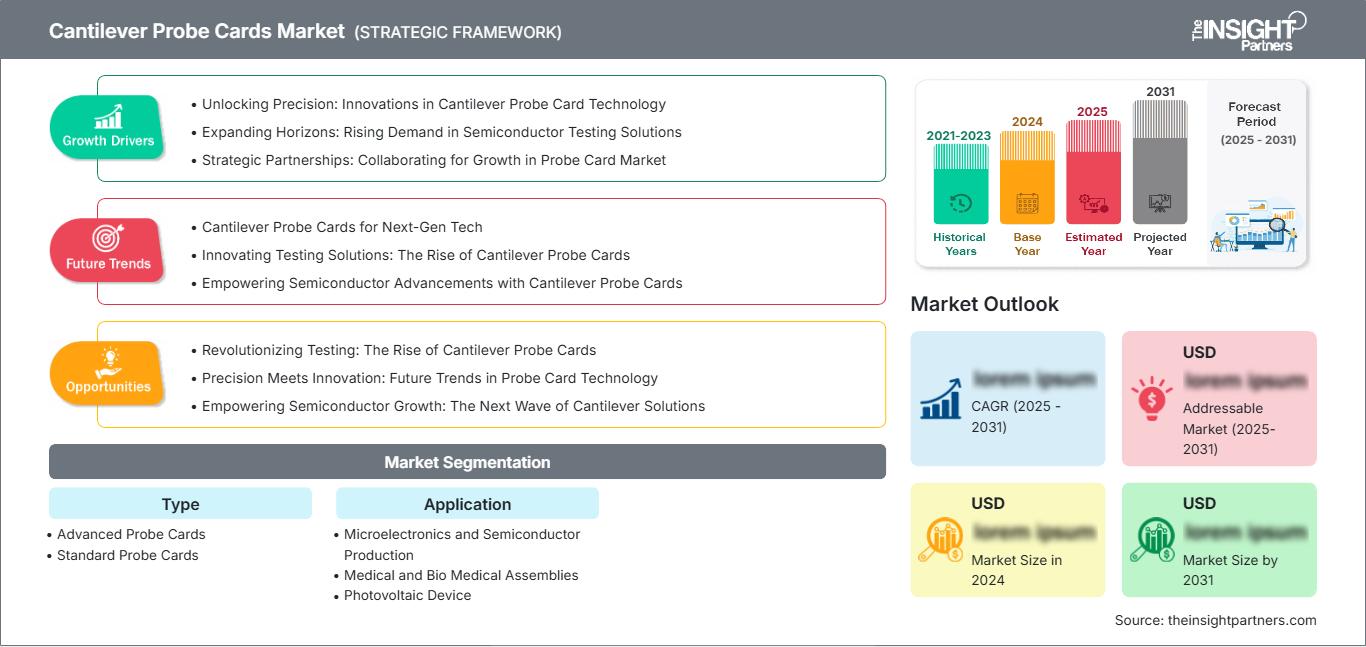
Cantilever Probe Cards Market: Strategic Insights
Regional Insights
North America Cantilever Probe Cards Market
North America held 7–9% share in 2025 and is projected to grow at a 1.6–2.0% CAGR during 2026–2034. The region’s Cantilever Probe Cards Market share is anchored by U.S. wafer-test demand for RF front-end devices, aerospace electronics, analog ICs, and biomedical microelectronic assemblies where mature-node production remains commercially important.
Domestic incentives for semiconductors, electronics for defense assurance, and increased compound semiconductor adoption enable steady demand for replacement cards. Nonetheless, advanced logic developments are becoming inclined towards vertical and MEMS probes, thus impeding regional advancement. Locality of services, rapid repairs, and documentation still play a critical role among customers purchasing cantilever probe cards.
U.S. Cantilever Probe Cards Market
The US comprised 78-82% of North America in 2025, and is projected to grow at a CAGR of 1.7-2.1% until 2034. The market has demand for engineering in the wafer-test engineering, RF electronics, automobile testing, and specialty microelectronic applications that need repeatability in the pad probing process, but not ultra-high density probes.
Domestic customers are catered to by FormFactor, Inc., Wentworth Laboratories, Inc. and other engineering services firms with customized solutions, maintenance, and testing interface consulting. Current application developments include RF electronics and medical devices due to long product life cycles compared to consumer logic products.
Europe Cantilever Probe Cards Market
Europe held a share of 4-6% in 2025 and is projected to have a CAGR of 1.3-1.7%. Germany is leading in regional demand with its involvement in automotive electronics, industrial sensors, and power management IC applications. The UK is contributing with the help of compound semiconductor testing. France is involved in aerospace, defense, and mixed signal applications.
Italy and Spain are adding demand through electronics manufacturing, photovoltaic device testing, and microelectronics applications due to research. European customers generally value documentation, durability, and customer support more than price war. This will benefit companies like FEINMETALL GmbH, Synergie Cad Probe S.r.l., and Technoprobe S.p.A.
APAC Cantilever Probe Cards Market
In 2025, APAC had a market share of 84–87%, which is expected to increase at a CAGR of 1.8–2.2%, thus becoming the major center for demand for the Cantilever Probe Cards Market. Japan continues to be the market leader in terms of suppliers and engineering capability, and China, South Korea, Taiwan, and India contribute towards volume consumption.
The industrial factors include fabrication of display driver ICs, analog testing, packaging environment, and high OSAT usage. The policy push towards semiconductor independence in China, India, Japan, and South Korea ensures domestic qualification efforts continue despite competition from more advanced probe systems for new device qualifications.
Middle East & Africa Cantilever Probe Cards Market
The Middle East and Africa have low demand but will experience growth in the range of 1.0%-1.4% compound annual growth rate (CAGR) until 2034. These countries rely on localized electronics, defense systems, renewable energy, and nascent semiconductor ecosystems in Saudi Arabia and the UAE, while South Africa caters to industry and academic microelectronics applications.
Purchases in the region tend to be project oriented than driven by volume. Photovoltaic device testing, power electronics qualification, and infrastructure digitization drive niche demand for stable wafer probing. Vendors generally market their products through distributors, European engineering centers, or Asian service operations, not local manufacturing facilities.
Segmentation Analysis
Type
Type is expected to grow at a 1.6–2.0% CAGR during 2026–2034. The Cantilever Probe Cards Market scope by type is shaped by the trade-off between cost-efficient standard cards and advanced variants designed for tighter pitch, improved planarity, RF compatibility, and longer cleaning intervals in specialized wafer-test environments.
- Advanced Probe Cards serve customers requiring refined probe geometry, tighter alignment, and improved electrical performance. They are strategically important where RF, biomedical, and mixed-signal devices need stable contact under customized test conditions.
- Standard Probe Cards remain the volume backbone for mature wafer testing. Their position is supported by predictable pad layouts, lower ownership cost, easier refurbishment, and broad use in display driver and analog IC production.
Application
Application is projected to expand at a 1.7–2.1% CAGR during 2026–2034. Demand is led by semiconductor production, but adjacent use cases in medical assemblies, photovoltaic devices, and RF electronics create diversified replacement cycles. Buyers evaluate probe cards by contact repeatability, cleaning frequency, and compatibility with existing wafer probers.
- Microelectronics and Semiconductor Production dominates demand because wafer-level screening is essential before packaging. Stable cantilever contact helps manufacturers manage yield loss, especially across mature logic, display driver, analog, and sensor devices.
- Medical and Bio Medical Assemblies create specialized demand where small production volumes, traceability, and reliability validation matter. Probe card customization supports implantable electronics, biosensor interfaces, and diagnostic microdevice qualification.
- Photovoltaic Device applications use probing for electrical characterization of cells and related semiconductor structures. Demand is selective but relevant where energy device manufacturers require repeatable testing across production and research lines.
- RF Electronics requires controlled contact resistance and signal integrity during wafer test. Cantilever solutions remain useful for selected RF front-end, communication, aerospace, and defense electronics where device layouts are stable.
Opportunity Snapshot
| Application | Revenue Contribution | Trend Tag | Adoption Stage |
| Microelectronics and Semiconductor Production | High | Wafer Test | Mature |
| Medical and Bio Medical Assemblies | Medium | Biosensor Test | Scaling |
| Photovoltaic Device | Low | Cell Characterization | Emerging |
| RF Electronics | Medium | RF Validation | Scaling |
Cantilever Probe Cards Market Growth Drivers and Impact Analysis
Sustained Mature-Node Wafer Test Demand
Mature-node devices remain relevant in applications such as automotive control systems, industrial automation, displays, power management, medical electronics, and communications modules. Some of these devices can have pads and test configurations that can benefit from cantilever probe cards, making the demand resistant to changes even when nodes continue moving to MEMS and vertical nodes. This leads to a reliable flow of orders from fabs and OSATs that care about cost per touchdowns, reparability, and proven process windows. In the Cantilever Probe Cards Market, this factor will create stability in revenues and make market vulnerable to only volatile semiconductors.
Rising RF and Specialty Electronics Qualification
RF electronic, aerospace, defense, and biomedical products will need robust wafer-level testing prior to assembly due to high costs associated with failure at the end stage of manufacture. Cantilever probing can be used in these applications where the layout is fixed and signals are under design specifications. Apart from providing electrical connections, these probes are also useful for consistency during engineering runs, qualification builds, and ramping up production lines. This has resulted in higher orders for custom probes, improved cooperation with suppliers, and better refurbishing service.
Cost Discipline Across Semiconductor Test Operations
There is pressure on wafer test equipment to minimize downtime, achieve high yields, and not over-specify test interfaces. The use of cantilever probe cards still makes sense when they meet technical requirements and have an overall cost lower than that of higher-density solutions. The customer assesses cost based on cleaning interval, touchdowns, repairs, and compatibility with current probers. This trend works to the advantage of suppliers who can prove the performance record of their cantilevers and offer fast engineering service. It also drives gradual innovation and not technology substitution until 2034.
Cantilever Probe Cards Market Future Trends
Hybrid Probe Architectures for Specialty Devices
Cantilever Probe Cards Market trends point toward hybrid engineering, where suppliers adapt traditional cantilever mechanics with improved PCB routing, enhanced tip metallurgy, tighter planarity control, and RF-aware layouts. This direction will not replace MEMS or vertical cards, but it will allow cantilever platforms to serve specialty devices longer. Future buyers will favor solutions that combine familiar operating procedures with better signal consistency, fewer cleaning interruptions, and stronger documentation. The trend is especially relevant for biomedical assemblies, RF electronics, and mixed-signal wafers that value custom engineering over extreme probe density.
Localized Service Models Around Wafer-Test Clusters
As semiconductor supply chains regionalize, probe card suppliers are expected to strengthen refurbishment, cleaning, and engineering support close to fabs and OSAT plants. Local service can reduce downtime, improve root-cause analysis, and support faster design iterations when device pads or test programs change. This trend is likely to benefit firms with Asia-based scale, U.S. engineering depth, or European specialty support. For customers, service proximity may become as important as initial card price, particularly in regulated or high-reliability production environments.
Cantilever Probe Cards Market Opportunities
Application-Specific Cards for Biomedical Microdevices
Biomedical microelectronics presents a focused opportunity because production lots are smaller, qualification requirements are strict, and device designs often need customized electrical contact strategies. Suppliers can differentiate through traceable materials, validated cleaning procedures, and engineering support for biosensors, implantable electronics, and lab-on-chip assemblies. Cantilever Probe Cards Market Forecasts indicate that volume may remain modest, but margins can be attractive where customers pay for documentation, design collaboration, and repeatability. Partnerships with medical device manufacturers and research fabs can convert early-stage programs into recurring replacement demand.
Refurbishment and Lifecycle Services
Lifecycle services offer an actionable opportunity as customers try to extend card utilization without compromising test integrity. Providers can build revenue through probe replacement, planarity restoration, cleaning optimization, inspection reporting, and failure analysis. This model is attractive because installed cantilever cards across mature fabs create repeat service needs even when new card sales grow slowly. Suppliers with regional repair centers and standardized documentation can capture recurring revenue while strengthening customer retention. The approach also supports sustainability goals by reducing premature disposal of precision test hardware.
Recent Developments
- March 2025STAr Technologies, a leading manufacturer of probe card solutions, is celebrating 25 years of expertise in probe card technology with the introduction of its latest innovation, the STAr Virgo Prima series. Designed for semiconductor parametric and reliability testing, the Virgo Prima probe card series represents a significant advancement in 3D and 2.5D MEMS probe card technology for Wafer Acceptance Test (WAT) applications. The solution is engineered to deliver improved testing efficiency, enhanced measurement accuracy, and reliable test results for semiconductor manufacturers.
- January 2025: UIGreen Automotive-Grade 2D MEMS Probe Card: Completion of Three-Temperature CP Testing and Acceptance. With the significant increase in demand for automotive wafers, an increasing number of analog devices are being upgraded from consumer-grade to automotive-grade. Due to the strict quality management requirements in the automotive industry, the enhanced reliability requirements have led to a growing demand for three-temperature testing of wafers (ranging from -40°C to 125°C).
- January 2025: Advantest Corporation, FormFactor, Inc., and Technoprobe S.p.A. — announced strategic partnerships and minority investments intended to advance technology development and printed circuit board manufacturing collaboration for future wafer-level test solutions, highlighting the importance of probe-card makers in high-performance semiconductor test supply chains.
Frequently Asked Questions

- Comprehensive Market Sizing and Forecast Analysis
- Detailed Segmentation Analysis
- In-Depth Market Dynamics Assessment
- Regional and Country-Level Insights
- Competitive Landscape and Company Benchmarking
- Strategic Business Intelligence
Recent Reports
Testimonials

The Insight Partners provided valuable market intelligence that supported our global go-to-market strategy. Their team was professional, responsive, and attentive to our feedback, providing thoughtful analysis and helpful methodological clarifications throughout the project.
Junmo Kim Chief Financial Officer (CFO), Enertech Co., Ltd.
The Insight Partners' SCADA System Market report is comprehensive, with valuable insights on current trends and future forecasts. The team was highly professional, responsive, and supportive throughout. We are very satisfied and highly recommend their services.
RAN KEDEM Partner, Reali Technologies LTDs
I requested a report on a very specific software market and the team produced the report in a few days. The information was very relevant and well presented. I then requested some changes and additions to the report. The team was again very responsive and I got the final report in less than a week.
JEAN-HERVE JENN Chairman, Future Analytica
We worked with The Insight Partners for an important market study and forecast. They gave us clear insights into opportunities and risks, which helped shape our plans. Their research was easy to use and based on solid data. It helped us make smart, confident decisions. We highly recommend them.
PIYUSH NAGPAL Sr. Vice President, High Beam Global
The Insight Partners delivered insightful, well-structured market research with strong domain expertise. Their team was professional and responsive throughout. The user-friendly website made accessing industry reports seamless. We highly recommend them for reliable, high-quality research services
YUKIHIKO ADACHI CEO, Deep Blue, LLC.
This is the first time I have purchased a market report from The Insight Partners.While I was unsure at first, I visited their web site and felt more comfortable to take the risk and purchase a market report.I am completely satisfied with the quality of the report and customer service. I had several questions and comments with the initial report, but after a couple of dialogs over email with their analyst I believe I have a report that I can use as input to our strategic planning process.Thank you so much for taking the extra time and making this a positive experience.I will definitely recommend your service to others and you will be my first call when we need further market data.
JOHN SUZUKI President and Chief Executive Officer, Board Director, BK Technologies
I wish to appreciate your support and the professionalism you displayed in the course of attending to my request for information regarding to infectious disease IVD market in Nigeria. I appreciate your patience, your guidance, and the fact that you were willing to offer a discount, which eventually made it possible for us to close a deal. I look forward to engaging The Insight Partners in the future, all thanks to the impression you have created in me as a result of this first encounter.
DR CHIJIOKE ONYIA MANAGING DIRECTOR, PineCrest Healthcare Ltd.Reason to Buy
- Informed Decision-Making
- Understanding Market Dynamics
- Competitive Analysis
- Identifying Emerging Markets
- Customer Insights
- Market Forecasts
- Risk Mitigation
- Boosting Operational Efficiency
- Strategic Planning
- Investment Justification
- Tracking Industry Innovations
- Aligning with Regulatory Trends





 Get Free Sample for