
Cogeneration Equipment Market Demand, Share & Growth by 2034
Coverage: by Type (Steam Turbine, Gas Turbine, Combined Cycle Gas Turbine, Reciprocating Engine); Capacity (Upto 30 MW, 31- 60 MW, 61- 100 MW); Fuel (Biomass, Coal, Natural Gas); Application (Industrial, Residential, Commercial) , and Geography (North America, Europe, Asia Pacific, and South and Central America)
- Status : Data Released
- Report Code : TIPRE00008809
- Category : Electronics and Semiconductor
- No. of Pages : 150
- Available Report Formats :


- Last update date : July 28, 2026


2025 Market Size
US$ 29.09 Bn
Base year value
2034 Forecast
US$ 48.98 Bn
Projected by 2034
CAGR 2026-2034
5.96 %
Growth rate
Addressable Market
US$ 353.62 Bn
(2026-2034)
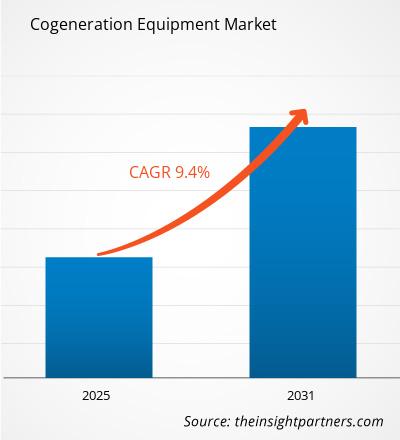
The Cogeneration Equipment Market size had reached US$ 29.09 billion in valuation in 2025 and would touch the market value of US$ 48.98 billion in 2034, marking a CAGR of 5.96% from 2026 to 2034. This is driven by the growing demand for technologies for the conversion of fuels to electricity and thermal outputs which help users achieve efficiency in energy management.
In North America, the market would be driven by initiatives like industrial energy resilience programs, rising electricity prices, and policies aimed at efficient on-site electricity production. In North America, the region's market would grow with a CAGR of 6.1% to 6.6% to 2034 owing to natural gas infrastructure, energy security in hospitals, energy systems at universities, and manufacturing projects.
Cogeneration Equipment Market Assessment and Insights
- North America held 31–33% share in 2025 and is expected to grow at a 6.1–6.6% CAGR between 2026–2034, led by industrial CHP retrofits and commercial resilience needs.
- US accounted for 78–82% of North America in 2025 and is projected to expand at a 6.0–6.5% CAGR between 2026–2034.
- Europe represented 26–28% share in 2025, growing at a 5.2–5.7% CAGR between 2026–2034, with Germany, the UK, France, Italy, and Spain leading deployment.
- Asia Pacific captured 29–31% share in 2025 and is forecast to grow at a 6.6–7.2% CAGR between 2026–2034, driven by China, Japan, South Korea, India, and Australia.
- Largest Segment Industrial applications held 58–62% market share in 2025, advancing at a 5.8–6.3% CAGR between 2026–2034 due to steam-intensive manufacturing demand.
- High Growth Segment Gas turbine systems held 24–28% market share in 2025, rising at a 6.7–7.3% CAGR between 2026–2034 as users seek flexible, lower-emission CHP assets.
- Key companies analyzed in detail: Allied Equipments Inc., Alstom Power, American DG Energy Inc., Baxi Group, Caterpillar Inc., GE Vernova, Mitsubishi Heavy Industries Ltd., Rolls-Royce plc, Siemens Energy AG, Turner Crane, Wärtsilä Corporation, Cummins Inc.
Source: The Insight Partners' analysis based on proprietary research, government publications, company annual reports, investor presentations, industry databases, and expert interviews.
The technology trend in the Cogeneration Equipment Market is evolving from traditional boiler turbine setups to modular digitally controlled equipment that manages electricity, steam, and emission needs efficiently. The manufacturing trends are geared towards the production of package gas turbines, reciprocating engines, heat recovery steam generators, and controls that can be set up within shorter periods of time in brownfield locations. The manufacturers are making design changes in order to increase flexibility in terms of fuel and maintenance capabilities, and integration with energy management solutions.
According to the Cogeneration Equipment Market forecast, demand is set to expand beyond the industrial regions where mature markets are located, driven by the development of reliable distributed generation systems in emerging economies. There will be increased political backing of the Cogeneration Equipment Market in regions where there is an intersection of grid reliability, fuel cost, and decarbonization policies.
Cogeneration Equipment Market Report Scope
| Report Attribute | Details |
|---|---|
| Market size in 2025 | US$ 29.09 Billion |
| Market Size by 2034 | US$ 48.98 Billion |
| Global CAGR (2026 - 2034) | 5.96% |
| Historical Data | 2021-2024 |
| Forecast period | 2026-2034 |
Cogeneration Equipment Market Analysis
The Cogeneration Equipment market growth is driven by demand for the production of electricity and thermal energy simultaneously in plants with constant loads. Industrial customers are interested in savings on the cost of fuel, hospitals need reliable heating and electricity, and business parks employ cogeneration equipment to cope with the peaks in tariffs. The highest demand is observed in those places where electricity costs, boiler renewal cycle period, and environmental regulations meet.
Value chain consists of turbine and engine manufacturers, heat recovery systems suppliers, controls companies, engineering contractors, fuel suppliers, and after-sales support providers. Although supply characteristics are influenced by specialty parts, qualified installations, and engineering, buyers pay more attention to life-cycle performance, service access, and natural gas, biomass, and future low-carbon fuels.
The Cogeneration Equipment Market indicates moderate consolidation within an industry dominated by diversified groups providing power equipment and dedicated distributed energy solutions. GE Vernova, Siemens Energy AG, Mitsubishi Heavy Industries Ltd., Caterpillar Inc., Rolls-Royce plc, Wärtsilä Corporation, and Cummins Inc. offer products and services that differ in terms of their efficiency, reliability, controllability, flexibility regarding fuels used, and service level.
Investment trends are currently directed at developing hydrogen-fired turbine technology, modular reciprocating engines, cogeneration packages suitable for biomass, and digital monitoring solutions. Among the niche players are Alstom Power, Baxi Group, American DG Energy Inc., Allied Equipments Inc., and Turner Crane. Positioning is now more about demonstrating uptime capabilities, financial backing, and emissions reduction.
● REPORT CUSTOMIZATION
Tailor This Report To Align With Your Specific Business Requirements
This report can be customized to align precisely with your business objectives, scope, and target markets. Customization options include tailored segmentation, geography, competitive analysis, and strategic insights to support informed decision-making.
Customize This Report →WHAT YOU CAN ADJUST
- ● Segmentations
- ● Geography
- ● Competitive Analysis
- ● Language Preferences
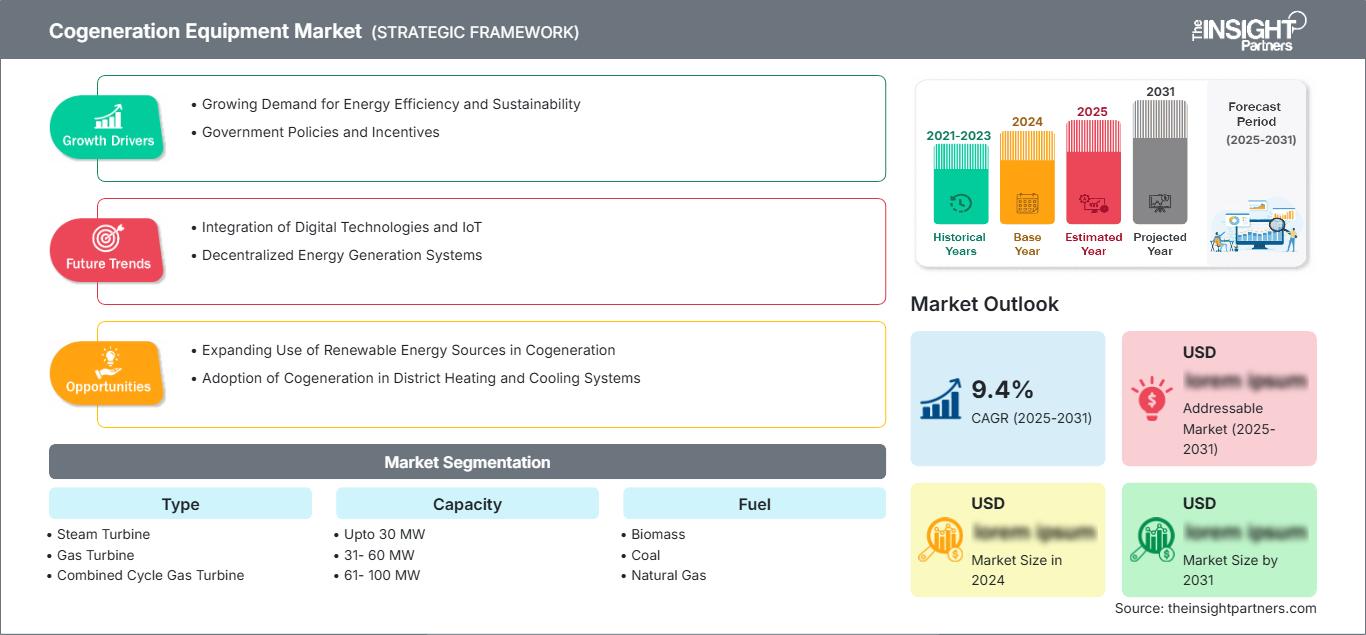
Cogeneration Equipment Market: Strategic Insights
Regional Insights
North America Cogeneration Equipment Market
The North American market share was 31-33% in 2025 and expected to witness a growth at CAGR of 6.1-6.6%. In the case of Cogeneration Equipment Market share, the demand is supported by large industrial facilities, hospitals, universities, food processing plants, and district energy installations that require constant thermal loads. The availability of natural gas, aging utility infrastructure, and resilience planning contribute to new investments.
The procurement trend in recent years relies more on avoided costs due to outages and efficiency targets rather than simply on reduced electric bill payments. Packaged cogeneration systems with sophisticated controls to enable load following are selected by end-users. State-level policies, environmental regulation, and interconnection processes continue playing a vital role in project scheduling.
U.S. Cogeneration Equipment Market
The US accounted for 78% – 82% of the North America region in 2025 and is projected to grow at a CAGR of 6.0% - 6.5%. The key demand drivers include applications for chemicals, refineries, food & beverages, healthcare, university, and data-oriented commercial premises. Caterpillar Inc., GE Vernova, Siemens Energy AG, Cummins Inc., and American DG Energy Inc. aid deployment of domestic solutions with their equipment services and distributed energy knowledge.
Applications trends include growing preference for systems that can supply steam, hot water, stand-by power, and grid parallel capability. The Cogeneration Equipment Market gains from customers looking for lesser risk from peak rate charges and better continuity during weather disturbances. The retrofits are also significant where outdated boilers and back-up generators can be substituted by CHP solutions.
Europe Cogeneration Equipment Market
The European share in 2025 was 26–28%, and the forecast is a 5.2–5.7% CAGR due to district heating depth, industrial heat demand, and efficiency regulations in Germany. The UK market is driven by hospitals, universities, and industrial estates which evaluate CHP as a means of energy security and cost saving.
Germany is still the leader, as combined heat and power technology is integrated in municipal utilities and manufacturing sites. In France, Italy, and Spain there is a selective uptake in food processing, chemicals, hospitality, and district heating facilities. The Cogeneration Equipment Market is driven by carbon price, gas market, and transition to renewable heat usage.
APAC Cogeneration Equipment Market
The APAC region has acquired 29-31% market share in 2025 and has a forecast growth of 6.6-7.2% CAGR. The Chinese economy takes the lead in the region by deploying cogen systems in industrial parks, chemical and paper industries, and district energy applications, whereas Japan and South Korea focus on high-efficiency systems in urban and industrial areas.
India and Australia contribute to the market demand through reliability projects for industry, energy cost reduction, and efficient on-site power generation policies. The Cogeneration Equipment Market is growing as equipment manufacturers strike a balance between grid limitations and decarbonization goals.
Middle East & Africa Cogeneration Equipment Market
The Middle East & Africa region will expand by a CAGR of 5.4–5.9%, driven by growth in industrial, petrochemical, and utilities-related projects in Saudi Arabia. In UAE, demand will be driven by district cooling, airports, hospitality, and power supply reliability, whereas in South Africa, the priority will be the power security of industries.
Adoption in the rest of MEA will be project-driven, typically involving mining, refineries, food processing plants, and large business buildings. Availability of natural gas enables turbine technology adoption; biomass and waste-heat generation is selective in nature.
Segmentation Analysis
Type
The Type segment is projected to expand at a 5.9–6.4% CAGR during 2026–2034. The Cogeneration Equipment Market scope across technologies reflects varied thermal loads, fuel choices, installation scales, and emissions profiles. Steam turbines remain relevant for large process heat users, while gas turbines and reciprocating engines gain traction in flexible, modular, and faster-payback projects.
- Steam Turbine systems serve large industrial sites with high-pressure steam requirements, offering durable operation and strong suitability for process industries where waste heat recovery and boiler integration are established.
- Gas Turbine systems are strategically important for medium and large users needing high power density, lower emissions than coal-based systems, and compatibility with combined cycle arrangements.
- Combined Cycle Gas Turbine configurations improve fuel utilization by recovering exhaust heat for additional generation, making them attractive for large campuses, utilities, and industrial clusters.
- Reciprocating Engine packages support distributed applications requiring quick start-up, part-load flexibility, and modular expansion, especially in commercial buildings, hospitals, and smaller industrial facilities.
Capacity
The Capacity segment is expected to grow at a 5.6–6.1% CAGR during 2026–2034. Selection depends on facility load stability, steam intensity, grid interconnection limits, and capital availability. Smaller installations support distributed energy adoption, while larger units serve industrial parks and production facilities where continuous operation improves payback visibility.
- Upto 30 MW systems address commercial buildings, hospitals, hotels, and small manufacturing sites where compact footprints, faster installation, and local heat demand support distributed energy economics.
- 31- 60 MW systems fit mid-sized industrial and institutional users requiring meaningful power output, steam recovery, and resilience without the complexity of utility-scale project development.
- 61- 100 MW systems serve larger industrial plants and district energy networks where high operating hours and predictable thermal demand improve utilization and lifecycle returns.
Fuel
The Fuel segment is forecast to advance at a 5.8–6.3% CAGR during 2026–2034. Natural gas remains the principal choice where pipeline access, emissions rules, and operating flexibility are favorable. Biomass adoption is rising in regions with agricultural residues, while coal-based systems face tighter environmental scrutiny and modernization pressure.
- Biomass supports users with local residues, waste streams, or renewable heat mandates, making it relevant for food processing, paper, agriculture-linked industries, and municipal energy systems.
- Coal remains present in select industrial regions with legacy assets, but investment is increasingly limited to efficiency upgrades, emissions controls, and sites with constrained fuel alternatives.
- Natural Gas is the preferred fuel for many new installations due to availability, controllability, lower local pollutants, and compatibility with gas turbines and reciprocating engines.
Application
The Application segment is projected to grow at a 5.9–6.4% CAGR during 2026–2034. Industrial users dominate because continuous steam and electricity needs create strong utilization. Commercial adoption is expanding through hospitals, hotels, universities, and data-intensive buildings, while residential systems remain niche and depend on policy incentives and compact technology economics.
- Industrial applications lead demand because chemicals, refining, paper, food processing, and manufacturing facilities need continuous heat and electricity, improving utilization rates and project payback.
- Residential adoption remains selective, centered on micro-cogeneration, district heating connections, and multifamily assets where policy incentives and high retail energy prices support economics.
- Commercial demand is increasing across healthcare, education, hospitality, and office campuses that require resilience, hot water, cooling support, and reduced exposure to peak electricity costs.
Opportunity Snapshot
| Application | Revenue Contribution | Trend Tag | Adoption Stage |
| Industrial | High | Process Heat | Mature |
| Residential | Low | Micro CHP | Emerging |
| Commercial | Medium | Campus Energy | Scaling |
Cogeneration Equipment Market Growth Drivers and Impact Analysis
Industrial Energy Efficiency Mandates
Industrial facilities are under pressure to reduce fuel waste while maintaining heat-intensive operations. Cogeneration converts one fuel input into electricity and useful steam or hot water, allowing users to improve total energy utilization. The impact is strongest in chemicals, refining, paper, food processing, and manufacturing plants with predictable baseload requirements. Procurement decisions increasingly compare CHP lifecycle savings against separate boiler replacement, grid electricity purchases, and emissions compliance costs. As companies set energy productivity targets, the Cogeneration Equipment Market benefits from projects that can deliver measurable efficiency gains without disrupting production processes.
Grid Resilience and Distributed Power Needs
Weather disruptions, grid congestion, and peak pricing are making on-site generation a strategic infrastructure decision. Hospitals, universities, data-oriented buildings, and industrial parks require electricity and thermal continuity that conventional standby generators cannot always optimize economically. Cogeneration systems operate as productive assets during normal conditions and provide resilience during utility interruptions when configured with appropriate controls. This dual value improves project justification, especially where outage losses are high. The Cogeneration Equipment Market therefore gains from capital budgets tied to business continuity, not only sustainability or fuel savings.
Fuel Flexibility and Lower-Emission Operation
Buyers are increasingly evaluating systems that can operate on natural gas today while allowing future blends, biomass, biogas, or waste-heat integration where feasible. This flexibility helps facilities avoid locking into assets that may become non-compliant under tighter emissions rules. Equipment suppliers are responding with improved combustion systems, digital controls, and service models that support efficiency tuning over the asset life. The market impact is a shift from single-criterion capital purchasing toward technology roadmaps that consider emissions, fuel availability, and long-term operating resilience together.
Cogeneration Equipment Market Future Trends
Hybrid CHP with Renewable Heat and Storage
Cogeneration Equipment Market trends are moving toward hybrid configurations that combine CHP with renewable heat, battery storage, thermal storage, and smart energy management. Future projects will increasingly optimize when to generate power, store heat, export electricity, or reduce load based on tariffs and carbon intensity. This trend is particularly relevant for campuses and industrial parks that need flexible energy assets. Suppliers able to integrate controls, analytics, and multi-asset dispatch will gain an advantage as customers move from equipment procurement to energy-system optimization.
Hydrogen-Ready and Low-Carbon Fuel Pathways
Future equipment design will place more emphasis on compatibility with hydrogen blends, renewable natural gas, biogas, and sustainable biomass streams. Adoption will vary by region because fuel availability and infrastructure readiness differ widely, but specification decisions are already moving toward optionality. Industrial buyers want assets that can meet current performance requirements while supporting later decarbonization steps. This creates opportunities for turbine, engine, burner, and controls suppliers that can validate performance across multiple fuels without sacrificing reliability.
Cogeneration Equipment Market Opportunities
Industrial Park Energy-as-a-Service Models
Developers and equipment suppliers can capture opportunity by bundling CHP assets with financing, operation, maintenance, and performance guarantees for industrial parks. Many users want lower energy costs and higher reliability but hesitate because of upfront capital, permitting complexity, and technical risk. Energy-as-a-service structures convert equipment purchases into long-term service contracts tied to uptime, efficiency, and heat delivery. This model is especially attractive in emerging manufacturing corridors where grid reliability is uneven and tenants require predictable utility costs before expanding production.
Retrofit Programs for Boilers and Backup Generators
A large installed base of aging boilers and standby generators creates a retrofit pathway for packaged CHP systems. Facilities can replace fragmented heat and power assets with integrated solutions that improve fuel efficiency, reduce maintenance duplication, and provide operational continuity. The opportunity is strongest in hospitals, universities, hotels, food plants, and municipal facilities with stable thermal loads. Vendors that simplify audits, interconnection studies, emissions permitting, and lifecycle cost modeling can accelerate customer decisions and shorten sales cycles in mature markets.
Recent Developments
- July 2025: Mitsubishi Heavy Industries Engine & Turbocharger, Ltd. (MHIET), a member of the Mitsubishi Heavy Industries (MHI) Group, has announced a new addition to its SGP M450 gas cogeneration system lineup. Jointly developed with Toho Gas Co., Ltd., the system delivers a power output of 450kW and supports hydrogen co-firing at a maximum of 15 vol%. It is currently being launched in the Japanese market.
- January 2026: At POWERGEN International in San Antonio, announced the launch of the DR aura 412. The new system is designed to provide fast-response, dispatchable power for demand response, grid support, and island operation as US power systems continue to experience increasing variability and reliability challenges.
- January 2025: Catalyst Power Holdings LLC ("Catalyst" or the "Company"), an independent integrated provider of retail energy and cleaner energy solutions for the commercial and industrial sector, has expanded the availability and service of its cogeneration systems, also known as combined heat and power ("CHP") systems, to Connecticut and Massachusetts. Cogeneration systems generate heat and electricity simultaneously from the same energy source and can achieve more than 90% thermal efficiency by recovering otherwise wasted thermal energy to provide on-site heating or cooling.
Frequently Asked Questions

- Comprehensive Market Sizing and Forecast Analysis
- Detailed Segmentation Analysis
- In-Depth Market Dynamics Assessment
- Regional and Country-Level Insights
- Competitive Landscape and Company Benchmarking
- Strategic Business Intelligence
Recent Reports
Testimonials

The Insight Partners' SCADA System Market report is comprehensive, with valuable insights on current trends and future forecasts. The team was highly professional, responsive, and supportive throughout. We are very satisfied and highly recommend their services.
RAN KEDEM Partner, Reali Technologies LTDs
I requested a report on a very specific software market and the team produced the report in a few days. The information was very relevant and well presented. I then requested some changes and additions to the report. The team was again very responsive and I got the final report in less than a week.
JEAN-HERVE JENN Chairman, Future Analytica
We worked with The Insight Partners for an important market study and forecast. They gave us clear insights into opportunities and risks, which helped shape our plans. Their research was easy to use and based on solid data. It helped us make smart, confident decisions. We highly recommend them.
PIYUSH NAGPAL Sr. Vice President, High Beam Global
The Insight Partners delivered insightful, well-structured market research with strong domain expertise. Their team was professional and responsive throughout. The user-friendly website made accessing industry reports seamless. We highly recommend them for reliable, high-quality research services
YUKIHIKO ADACHI CEO, Deep Blue, LLC.
This is the first time I have purchased a market report from The Insight Partners.While I was unsure at first, I visited their web site and felt more comfortable to take the risk and purchase a market report.I am completely satisfied with the quality of the report and customer service. I had several questions and comments with the initial report, but after a couple of dialogs over email with their analyst I believe I have a report that I can use as input to our strategic planning process.Thank you so much for taking the extra time and making this a positive experience.I will definitely recommend your service to others and you will be my first call when we need further market data.
JOHN SUZUKI President and Chief Executive Officer, Board Director, BK Technologies
I wish to appreciate your support and the professionalism you displayed in the course of attending to my request for information regarding to infectious disease IVD market in Nigeria. I appreciate your patience, your guidance, and the fact that you were willing to offer a discount, which eventually made it possible for us to close a deal. I look forward to engaging The Insight Partners in the future, all thanks to the impression you have created in me as a result of this first encounter.
DR CHIJIOKE ONYIA MANAGING DIRECTOR, PineCrest Healthcare Ltd.Reason to Buy
- Informed Decision-Making
- Understanding Market Dynamics
- Competitive Analysis
- Identifying Emerging Markets
- Customer Insights
- Market Forecasts
- Risk Mitigation
- Boosting Operational Efficiency
- Strategic Planning
- Investment Justification
- Tracking Industry Innovations
- Aligning with Regulatory Trends





 Get Free Sample for