
Compound Semiconductor Market Growth, Size & Forecast by 2034
Compound Semiconductor Market Size and Forecasts (2021 - 2034), Global and Regional Share, Trends, and Growth Opportunity Analysis Report Coverage : By Deposition Technologies (Chemical Vapor Deposition (CVD), Molecular Beam Epitaxy, Hydride Vapor Phase Epitaxy (HVPE), Ammonothermal, Atomic Layer Deposition (ALD), Others); Type (GaN, GaAs, SiC, InP, Others); Product (LED, Optoelectronics, RF Devices, Power Electronics); Application (Telecommunication, General Lighting, Automotive, Consumer Devices, Power Supply, Others)
- Status : Data Released
- Report Code : TIPRE00039795
- Category : Electronics and Semiconductor
- No. of Pages : 150
- Available Report Formats :


- Last update date : August 05, 2026


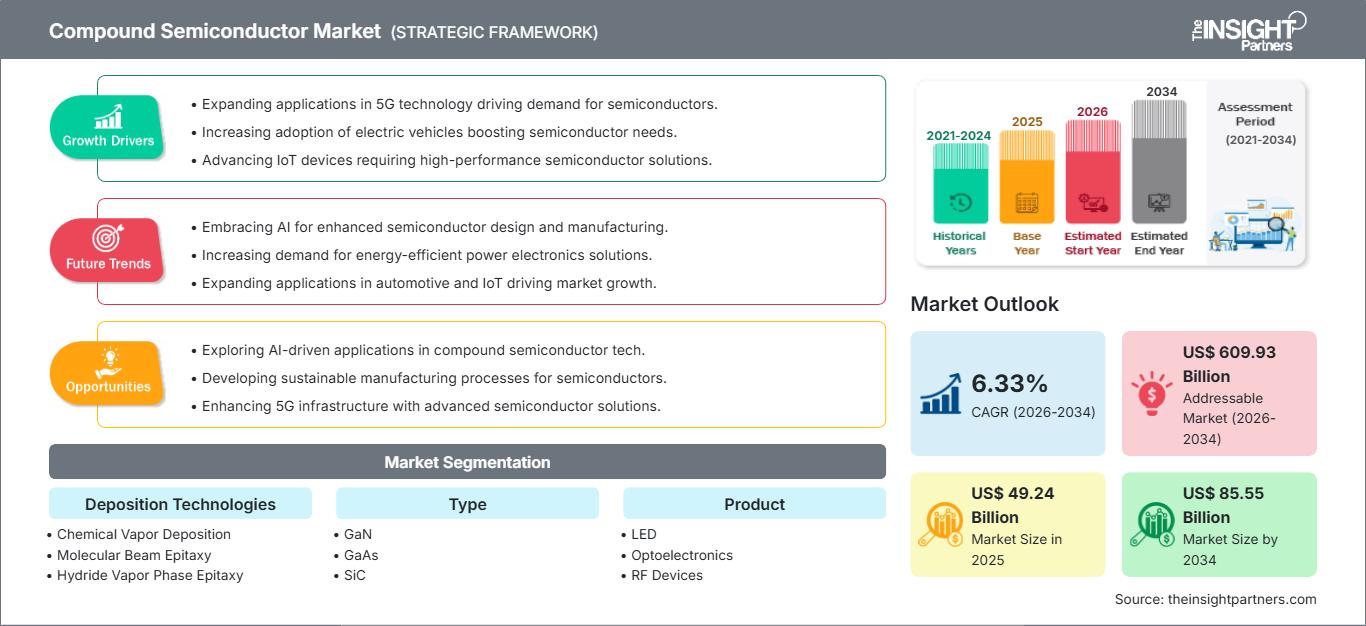
2025 Market Size
US$ 49.24 Bn
Base year value
2034 Forecast
US$ 85.55 Bn
Projected by 2034
CAGR 2026-2034
6.33 %
Growth rate
Addressable Market
US$ 609.93 Bn
(2026-2034)
The Global Compound Semiconductors Market has reached a value of US$ 49.24 Billion in 2025 and is expected to touch a value of US$ 85.55 Billion by 2034, growing at a CAGR of 6.33% from 2026 to 2034. The market demand is based on materials like GaN, GaAs, SiC, and InP used in high frequency communication, power conversion, optoelectronics, LEDs, and automotive and consumer electronics applications.
In North America, the Compound Semiconductor Market size is driven by a forecasted CAGR of 5.7–6.4%, as there are factors like semiconductors policy, investments in electric vehicles, 5G densification, and defense electronics that boost demand. Growth factors for the market are wafer capacity at home, SiC device qualification, RF front-end enhancements, and deployment of GaN power transistors in data centers, fast chargers, and telecommunications.
Compound Semiconductor Market Assessment and Insights
- North America: North America held a 23–26% share in 2025 and is growing at a 5.7–6.4% CAGR between 2026–2034, supported by CHIPS Act incentives, EV platforms, defense RF systems, and power electronics localization.
- US: The US represented 78–82% of North America in 2025 and is growing at a 5.9–6.6% CAGR between 2026–2034, led by SiC fabs, GaN RF adoption, and telecom infrastructure.
- Europe: Europe accounted for an 18–21% share in 2025 and is growing at a 5.4–6.1% CAGR between 2026–2034, with Germany, France, the UK, Italy, and Spain leading automotive and industrial demand.
- Asia Pacific: Asia Pacific held a 42–45% share in 2025 and is growing at a 6.8–7.6% CAGR between 2026–2034, driven by China, Japan, South Korea, India, and Taiwan electronics ecosystems.
- Largest Segment: Power electronics led with a 31–35% market share in 2025 and a 7.1–8.0% CAGR between 2026–2034, reflecting SiC inverter and GaN power adoption.
- High Growth Segment: SiC held a 24–28% market share in 2025 and is growing at an 8.2–9.4% CAGR between 2026–2034 due to EV traction, charging, and renewable inverter use.
- Key companies analyzed in detail: Nichia Corporation, Samsung Electronics Co., Ltd., ams-OSRAM AG, Qorvo, Inc., Skyworks Solutions, Inc., Wolfspeed, Inc., GaN Systems Inc., Canon Inc., Infineon Technologies AG, Coherent Corp., STMicroelectronics N.V., and ROHM Co., Ltd.
Source: The Insight Partners' analysis based on proprietary research, government publications, company annual reports, investor presentations, industry databases, and expert interviews.
The technological evolution trend moves away from specialization to optoelectronics and RFs and into scaled power, photonic, and high frequency devices systems. The Compound Semiconductor Market is driven by the transition from 150 mm to 200 mm SiC wafers, GaN on Si technology development, MBE precision for RF and photonics, and the tighter integration of epitaxial process, device fabrication, packaging and modules qualification. Production trends are becoming increasingly focused on yield, substrates availability, thermal issues and supply chain sustainability.
Future demand drivers will be region-specific semiconductor sovereignty, EV efficiency needs, AI data center power densities and spectrum-hungry networks. Emerging regions are building domestic capabilities in assembly, packaging and devices qualification to decrease imports. Energy efficiency, grid upgrade, and electronics supply chains regulations will expand the addressable base of the market into automotive, telecoms, lighting, consumer electronics and power supply segments.
Compound Semiconductor Market Report Scope
| Report Attribute | Details |
|---|---|
| Market size in 2025 | US$ 49.24 Billion |
| Market Size by 2034 | US$ 85.55 Billion |
| Global CAGR (2026 - 2034) | 6.33% |
| Historical Data | 2021-2024 |
| Forecast period | 2026-2034 |
Compound Semiconductor Market Analysis
The Compound Semiconductor Market growth is because of the requirement for high switching speeds, low loss, high thermal stability, and high-frequency performance which silicon does not have. The applications include electric vehicle traction inverters, 5G massive MIMO radios, fast charging stations, LEDs, LiDAR, and optical communications modules. The value chain includes substrates, epitaxial wafers, deposition equipment, device manufacturers, packaging facilities, system integrators, automotive OEMs, telecommunication OEMs, and power supply OEMs.
The supply situation continues to be influenced by the yields from crystal growth, availability of gallium and indium, wafer diameter transitions, and automotive level qualification testing. Purchasers tend to favor integrated suppliers who can source substrates, epitaxy, devices, and modules. Industry reports state that wide bandgap materials are growing quickly in the power electronics segment, whereas photonics and RF are strong in telecom and aerospace industries.
A Competitive Analysis of the Compound Semiconductor Market reveals competition based on material specialization, economies of scale, customer qualification time frames, and end market applications. Competitors in the area of power semiconductors include Infineon Technologies AG, Wolfspeed, Inc., STMicroelectronics N.V., ROHM Co., Ltd., and GaN Systems Inc. Meanwhile, Qorvo, Inc. and Skyworks Solutions, Inc. continue to be players in the radio frequency device segment. Nichia Corporation, Samsung Electronics Co., Ltd., and ams-OSRAM AG build capabilities in LEDs and optoelectronic semiconductors.
Investment opportunities include the development of 200 mm silicon carbide, gallium nitride on silicon, microLED, automotive modules, and advanced deposition technologies. Canon Inc. and Coherent Corp. offer solutions for enabling tools, optics, and materials infrastructure. Strategic positioning will be driven by long-term supply contracts, local production, intellectual property, and proven performance at high voltage, high frequency, and high temperature applications where reliability is more important than component cost.
● REPORT CUSTOMIZATION
Tailor This Report To Align With Your Specific Business Requirements
This report can be customized to align precisely with your business objectives, scope, and target markets. Customization options include tailored segmentation, geography, competitive analysis, and strategic insights to support informed decision-making.
Customize This Report →WHAT YOU CAN ADJUST
- ● Segmentations
- ● Geography
- ● Competitive Analysis
- ● Language Preferences
Compound Semiconductor Market: Strategic Insights
Regional Insights
North America Compound Semiconductor Market
North America had a market share of 23–26% in 2025 and is anticipated to exhibit 5.7–6.4% CAGR growth from 2026 to 2034. Compound semiconductor market share is driven by the presence of U.S. semiconductor incentives, defense electronics, localization of the EV supply chain, and adoption of GaN RF components in telecom networks. The investments being made in the capacity include SiC wafers, power modules, and processing of compound materials.
The applications that value efficiency, reliability, and security above commodity prices exhibit the highest potential for growth. Applications such as automotive electrification, aerospace radar, satellite communications, AI data centers, and industrial drives have requirements of handling heat, voltage, and frequencies. Companies like Wolfspeed, Inc., Qorvo, Inc., Skyworks Solutions, Inc., Coherent Corp., and GaN Systems Inc. provide technological expertise to North America.
U.S. Compound Semiconductor Market
In 2025, the United States accounted for 78-82% of North America and has a growth rate of 5.9-6.6% CAGR from 2026 to 2034. The drivers include SiC wafer substrate production, GaN RF module production, communication devices in military equipment, EV inverter projects, and power supply enhancement in cloud computing and industrial infrastructures. Local sourcing has been a procurement strategy among auto, aerospace, and telecommunication buyers.
Companies active in this market are Wolfspeed, Inc., Qorvo, Inc., Skyworks Solutions, Inc., Coherent Corp., and GaN Systems Inc., along with university studies and government-funded semiconductor program initiatives. The application preference goes toward SiC in traction inverters and fast chargers, GaN in RF front-end and data center power converters, and InP photonics in optical network applications.
Europe Compound Semiconductor Market
Europe had a market share of 18–21% in 2025 and is expected to register a CAGR of 5.4–6.1% during 2026–2034. Germany stands out for automotive power electronics applications, industrial drives, and renewable inverter technologies. Compound semiconductor technology development and RF photonics are seen in the UK, and French contributions include applications in aerospace and defense electronics and power conversion.
Italy and Spain make their contributions via electric vehicle charging equipment, grid equipment, lighting, and industrial automation. European policies highlight the importance of semiconductor resiliency, energy efficiency, and electrification mobility. These policies help in SiC and GaN qualification. Devices, automotive, and power semiconductor offerings are seen from companies such as Infineon Technologies AG, STMicroelectronics N.V., ams-OSRAM AG, and ROHM Co., Ltd.
APAC Compound Semiconductor Market
The APAC region held 42-45% share in 2025 and is estimated to grow at 6.8-7.6% CAGR from 2026 to 2034. China dominates with LED, RF, electric vehicle (EV), and domestic silicon carbide investments, whereas Japan and South Korea are contributing with materials, displays, optoelectronics, and automotive electronics. Taiwan contributes to packaging and foundries ecosystem.
India and Australia are building their electronics manufacturing capability, telecommunication infrastructure, renewable energy integration, and power conversion applications. Drivers are semiconductor independence, electric vehicle incentives, 5G networks, and digitalization of industries. Nichia Corporation, Samsung Electronics Co., Ltd., Canon Inc., ROHM Co., Ltd., and other regional suppliers augment APAC's production and applications expertise.
Middle East & Africa Compound Semiconductor Market
Middle East & Africa is anticipated to grow between 5.1-5.9% CAGR from 2026-2034. In this region, Saudi Arabia is leading by adopting smart infrastructure, renewable energy solutions, telecom infrastructure, and diversifying its industrial base. For the UAE, the growth will be facilitated by data centers, advanced logistics, and reliable power systems, whereas South Africa will contribute due to telecom and energy infrastructure requirements.
Adoption of compound semiconductors for the rest of MEA will be driven by investments in grid infrastructure, solar power, mobile broadband infrastructure, and industrial automation. These semiconductor materials have a good fit for these applications owing to the energy-efficient nature, high-temperature capability, and reliable connectivity.
Segmentation Analysis
Deposition Technologies
The Deposition Technologies segment is forecast to grow at a 5.8–6.7% CAGR during 2026–2034. Compound Semiconductor Market scope by deposition technology reflects the need for defect control, uniform epitaxial layers, high throughput, and application-specific material stacks. Device makers select deposition routes based on wafer size, material system, crystal quality, thermal budget, and compatibility with RF, LED, power, or photonic device architectures.
- Chemical Vapor Deposition: CVD remains central for scalable epitaxy and device layer formation, supporting high-volume production where uniformity, reproducibility, and integration with existing semiconductor fabs are strategic requirements.
- Molecular Beam Epitaxy: MBE is valued for precision layer control in RF, photonics, and research-intensive devices where interface quality and atomic-scale composition accuracy influence performance.
- Hydride Vapor Phase Epitaxy: HVPE supports thick, high-quality layers and bulk-like growth, making it important for GaN substrates, LEDs, and applications needing improved crystal quality.
- Ammonothermal: Ammonothermal growth is strategically important for native GaN substrates because it can improve defect density, device reliability, and long-term performance in demanding optoelectronic applications.
- Atomic Layer Deposition: ALD is used where conformal thin films, gate dielectrics, and passivation layers are needed to improve device reliability, leakage control, and miniaturized structure performance.
Type
The Type segment is projected to grow at a 6.2–7.1% CAGR during 2026–2034. Material selection determines switching speed, breakdown voltage, optical emission, frequency response, and manufacturing economics. GaN and SiC are accelerating in power and RF systems, while GaAs remains relevant in mobile RF and LEDs. InP is gaining strategic importance in photonics, high-speed optical communication, and sensing.
- GaN: GaN demand is expanding in RF amplifiers, fast chargers, power supplies, and LEDs due to high electron mobility, compact form factors, and efficient high-frequency operation.
- GaAs: GaAs remains important in RF front-end modules, laser diodes, LEDs, and satellite communication where signal performance and mature fabrication ecosystems support continued adoption.
- SiC: SiC is central to high-voltage EV inverters, onboard chargers, renewable energy systems, and industrial drives because it improves efficiency, thermal performance, and system power density.
- InP: InP supports high-speed photonic devices, optical transceivers, lasers, and sensing systems where electron velocity and direct bandgap properties enable advanced communication performance.
Product
The Product segment is expected to grow at a 6.0–6.9% CAGR during 2026–2034. Product demand is diversified across LEDs, optoelectronics, RF devices, and power electronics. Power electronics leads due to EVs, grid equipment, renewable inverters, and industrial power supplies. RF devices benefit from 5G and defense systems, while LEDs and optoelectronics continue to serve lighting, sensing, display, and optical communication needs.
- LED: LED products remain a high-volume outlet for compound semiconductors, supported by general lighting, displays, automotive lighting, and specialty illumination requiring efficiency and brightness stability.
- Optoelectronics: Optoelectronics demand is tied to lasers, photodiodes, sensors, LiDAR, and optical communication modules where direct bandgap materials deliver strong emission and detection performance.
- RF Devices: RF devices use GaN and GaAs to improve power density, linearity, and high-frequency performance in 5G base stations, satellite links, radar, and mobile front ends.
- Power Electronics: Power electronics is the leading product area as SiC and GaN devices reduce switching losses, support compact designs, and improve efficiency across mobility and energy systems.
Application
The Application segment is forecast to grow at a 6.1–7.0% CAGR during 2026–2034. Telecommunications, lighting, automotive, consumer devices, and power supply applications each create distinct qualification requirements. Automotive and power supply use emphasize reliability and thermal performance, while telecommunication prioritizes high-frequency efficiency. Consumer devices reward compactness, sensing capability, and power density.
- Telecommunication: Telecommunication applications use GaN, GaAs, and InP for RF amplifiers, optical networks, and high-speed modules supporting 5G, fiber backhaul, satellite connectivity, and data transmission.
- General Lighting: General lighting depends on LED efficiency, color stability, and lifetime performance, making compound materials important for commercial, residential, industrial, and outdoor illumination systems.
- Automotive: Automotive adoption is rising through SiC inverters, onboard chargers, LiDAR, LEDs, and power conversion systems that improve range, charging speed, and electronics reliability.
- Consumer Devices: Consumer devices use compound semiconductors in RF front ends, displays, chargers, sensors, cameras, and wearables where performance per watt and miniaturization matter.
- Power Supply: Power supply applications use GaN and SiC to raise conversion efficiency, reduce heat, shrink system size, and support fast chargers, servers, telecom equipment, and industrial systems.
Opportunity Snapshot
| Application | Revenue Contribution | Trend Tag | Adoption Stage |
| Telecommunication | High | 5G RF | Mature |
| General Lighting | Medium | LED Efficiency | Mature |
| Automotive | High | SiC Inverters | Scaling |
| Consumer Devices | Medium | Fast Charging | Scaling |
| Power Supply | High | GaN Servers | Emerging |
Compound Semiconductor Market Growth Drivers and Impact Analysis
EV Powertrain Efficiency Accelerates SiC Qualification
EVs have moved from silicon to SiC MOSFETs and modules since higher switching efficiency will lead to better performance of the inverter and faster charging and cooling. This application drives the following industries due to the qualification process in automotive that involves a lot of time and commitments: car makers, Tier 1, wafers and module manufacturers. This technology affects the Compound Semiconductor Market in the applications of traction inverter, onboard charger, DC-DC converter and fast charging stations. Suppliers who have roadmap for 200mm SiC, substrate management and automotive packaging will take advantage of longer product lifecycles, while customers will gain system efficiency and smaller power electronics.
5G and Defense RF Systems Expand GaN Device Demand
GaN RF devices are gaining adoption in 5G base stations, satellite communication, radar, and electronic warfare because they deliver high power density, high-frequency operation, and better thermal robustness than many legacy technologies. This driver creates demand for GaN-on-SiC and GaN-on-Si platforms, depending on performance and cost targets. Telecom operators require efficient radios for dense networks, while defense users prioritize reliability under demanding conditions. Market impact appears across epitaxy, RF device fabrication, packaging, and test ecosystems. Companies with strong RF design capabilities, thermal management, and system-level customer support are positioned to benefit from multi-year network and defense procurement cycles.
Energy-Efficient Power Supplies Create New Volume Pathways
Data centers, consumer fast chargers, telecom power systems, and industrial equipment are adopting GaN and SiC devices to reduce conversion losses and shrink power supply footprints. Rising AI workloads increase rack power density, making efficient conversion and heat reduction commercially important. This driver widens demand beyond automotive into high-volume electronics and infrastructure markets. Device makers can address power adapters, server power supply units, battery backup systems, and industrial converters with differentiated designs. The real-world impact is lower cooling burden, smaller magnetics, higher switching frequency, and improved total cost of ownership for operators managing electricity consumption at scale.
Compound Semiconductor Market Future Trends
200 mm SiC Manufacturing Becomes a Strategic Cost Lever
Compound Semiconductor Market trends point to 200 mm SiC manufacturing becoming a decisive cost and capacity lever as suppliers transition from 150 mm wafers. Larger wafers can improve die output, support automotive-scale contracts, and reduce cost per ampere when yield matures. Future competitiveness will depend on crystal quality, defect management, epitaxy uniformity, and equipment readiness. The transition will not be uniform because qualification risk remains high, but successful producers can improve margins and supply reliability. Automotive, renewable energy, and industrial customers will increasingly evaluate suppliers by their ability to scale 200 mm SiC without compromising reliability.
GaN-on-Si Moves Toward Broader Power Conversion Use
GaN-on-Si is expected to broaden from chargers and adapters into higher-power supplies, telecom power, and selected data center applications as device reliability, packaging, and controller ecosystems improve. The trend is important because silicon substrates offer a potential cost pathway while retaining GaN’s fast switching advantages. Wider adoption will depend on design familiarity, failure-mode understanding, and power-stage integration. Suppliers that combine devices with reference designs, drivers, and application support can accelerate customer conversion. Over time, GaN-on-Si could reshape compact power conversion where efficiency, size, and thermal constraints determine product differentiation.
Compound Semiconductor Market Opportunities
Automotive SiC Module Partnerships for Platform Programs
Compound Semiconductor Market Forecasts indicate strong opportunity in automotive SiC module partnerships because automakers need qualified devices, packaging, cooling concepts, and long-term supply assurance for multi-year EV platforms. Suppliers can invest in co-development with tier-one inverter manufacturers, offering modules, die, gate drivers, and application engineering. The opportunity is action-oriented because early design wins can lock in volume across vehicle generations. Companies should prioritize reliability data, dual-source risk planning, and localized support near automotive engineering centers. Strong partnerships can reduce qualification delays and position suppliers for 800 V and higher-efficiency architectures.
Integrated GaN Power Solutions for AI Infrastructure
AI infrastructure creates an opportunity for integrated GaN power solutions that combine devices, drivers, controllers, and thermal reference designs for high-density server and networking equipment. Operators need efficient conversion from facility power to board-level loads while managing heat and space constraints. Suppliers can target power supply units, rack-level conversion, battery backup, and telecom equipment with repeatable design kits. The investment case is strongest where energy savings, reduced cooling load, and compact power stages translate into measurable operating benefits. Partnerships with power supply manufacturers and cloud hardware integrators can accelerate adoption.
Recent Developments
- July 2026: The Government of India approved the Semicon 2.0 program with an outlay of ₹1.28 trillion (approximately US$13.2–13.3 billion) to strengthen the country's semiconductor ecosystem. The initiative expands support beyond chip fabrication to include semiconductor equipment, materials, design IP, research, workforce development, and supply chain capabilities, with the goal of accelerating domestic manufacturing, reducing import dependence, and positioning India as a global semiconductor hub.
- May 2026: Cyient Semiconductors launched India’s first family of 650 V GaN power ICs, developed using Navitas Semiconductor’s GaN technology. The portfolio includes seven integrated power devices targeting AI data centers, telecommunications, industrial power supplies, fast chargers, and e-mobility applications, delivering higher power density, improved energy efficiency, reduced thermal losses, and compact system designs.
- March 2025: TSMC announced an additional US$100 billion investment to expand its semiconductor manufacturing capacity in the United States, bringing its total planned U.S. investment to US$165 billion. The expansion includes three new fabrication plants, two advanced packaging facilities, and a major R&D center in Arizona, aiming to strengthen domestic production of advanced chips for AI, high-performance computing, smartphones, and other next-generation technologies while enhancing U.S. semiconductor supply chain resilience.
Frequently Asked Questions

- Comprehensive Market Sizing and Forecast Analysis
- Detailed Segmentation Analysis
- In-Depth Market Dynamics Assessment
- Regional and Country-Level Insights
- Competitive Landscape and Company Benchmarking
- Strategic Business Intelligence
Recent Reports
Testimonials

The Insight Partners' SCADA System Market report is comprehensive, with valuable insights on current trends and future forecasts. The team was highly professional, responsive, and supportive throughout. We are very satisfied and highly recommend their services.
RAN KEDEM Partner, Reali Technologies LTDs
I requested a report on a very specific software market and the team produced the report in a few days. The information was very relevant and well presented. I then requested some changes and additions to the report. The team was again very responsive and I got the final report in less than a week.
JEAN-HERVE JENN Chairman, Future Analytica
We worked with The Insight Partners for an important market study and forecast. They gave us clear insights into opportunities and risks, which helped shape our plans. Their research was easy to use and based on solid data. It helped us make smart, confident decisions. We highly recommend them.
PIYUSH NAGPAL Sr. Vice President, High Beam Global
The Insight Partners delivered insightful, well-structured market research with strong domain expertise. Their team was professional and responsive throughout. The user-friendly website made accessing industry reports seamless. We highly recommend them for reliable, high-quality research services
YUKIHIKO ADACHI CEO, Deep Blue, LLC.
This is the first time I have purchased a market report from The Insight Partners.While I was unsure at first, I visited their web site and felt more comfortable to take the risk and purchase a market report.I am completely satisfied with the quality of the report and customer service. I had several questions and comments with the initial report, but after a couple of dialogs over email with their analyst I believe I have a report that I can use as input to our strategic planning process.Thank you so much for taking the extra time and making this a positive experience.I will definitely recommend your service to others and you will be my first call when we need further market data.
JOHN SUZUKI President and Chief Executive Officer, Board Director, BK Technologies
I wish to appreciate your support and the professionalism you displayed in the course of attending to my request for information regarding to infectious disease IVD market in Nigeria. I appreciate your patience, your guidance, and the fact that you were willing to offer a discount, which eventually made it possible for us to close a deal. I look forward to engaging The Insight Partners in the future, all thanks to the impression you have created in me as a result of this first encounter.
DR CHIJIOKE ONYIA MANAGING DIRECTOR, PineCrest Healthcare Ltd.Reason to Buy
- Informed Decision-Making
- Understanding Market Dynamics
- Competitive Analysis
- Identifying Emerging Markets
- Customer Insights
- Market Forecasts
- Risk Mitigation
- Boosting Operational Efficiency
- Strategic Planning
- Investment Justification
- Tracking Industry Innovations
- Aligning with Regulatory Trends





 Get Free Sample for