
Computer Vision Market Size, Share & Forecast by 2034
Coverage: by Component (Hardware, Software); Product (PC-based computer vision systems, Smart cameras-based computer vision systems); Application (Quality Assurance and Inspection, Positioning and Guidance, Measurement, Identification, Predictive Maintenance); Vertical (Industrial Vertical, Non-Industrial Vertical) , and Geography (North America, Europe, Asia Pacific, and South and Central America)
- Status : Data Released
- Report Code : TIPRE00007875
- Category : Electronics and Semiconductor
- No. of Pages : 150
- Available Report Formats :


- Last update date : September 22, 2026


2025 Market Size
US$ 23.27 Bn
Base year value
2034 Forecast
US$ 122.47 Bn
Projected by 2034
CAGR 2026-2034
20.26 %
Growth rate
Addressable Market
US$ 588.60 Bn
(2026-2034)
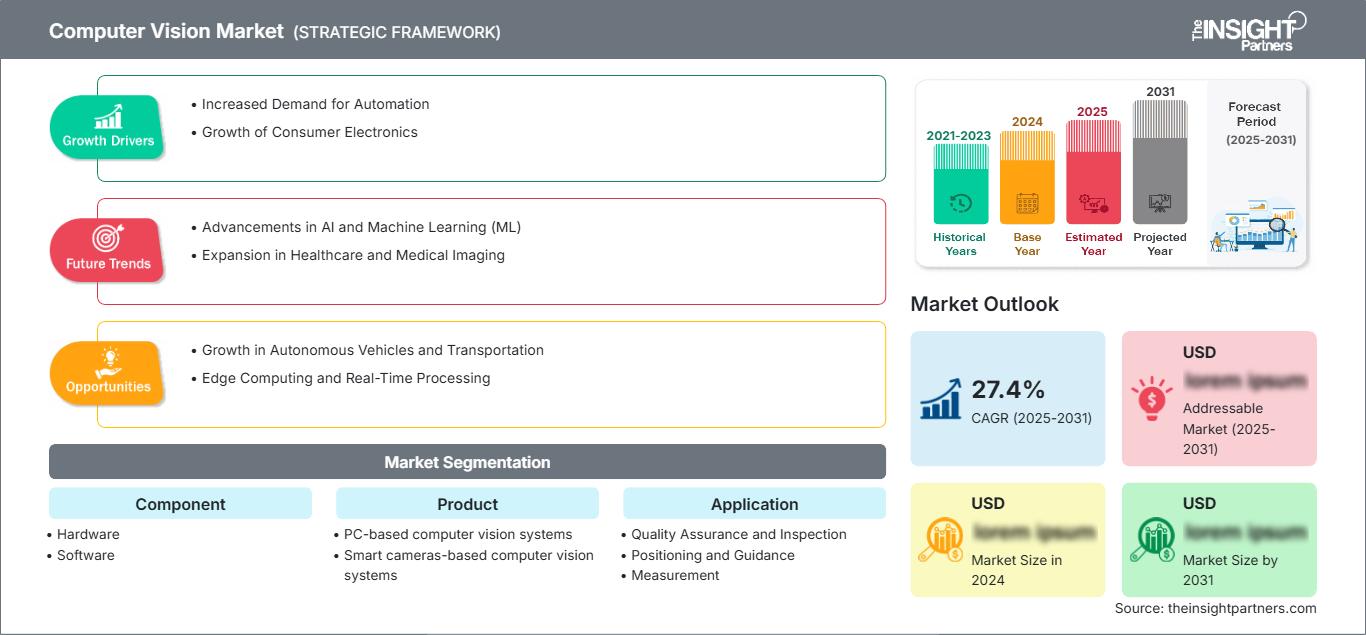
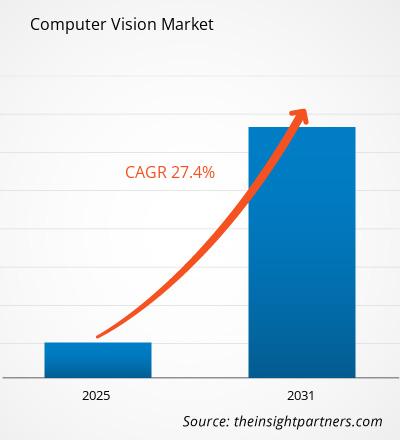
The Computer Vision Market is forecasted to increase from US$ 23.27 Billion in 2025 to US$ 122.47 Billion by 2034 at a CAGR of 20.26% during 2026-2034. The growth of the market will be driven by factors like automation, artificial intelligence, edge computing, intelligent cameras, and real-time defect detections in manufacturing, healthcare, logistics, automotive, and security industries.
North America exhibits moderate adoption at a high-value scale with the Computer Vision Market size driven by advanced manufacturing, semiconductor inspection, retail automation, and defense-grade vision analytics. North America is likely to register a CAGR of 18.8-19.6% during 2026-2034 due to factors such as reshoring of electronics manufacturing, edge AI deployments, and investments in automated quality control in enterprises.
Computer Vision Market Assessment and Insights
- North America accounted for 28–32% Computer Vision Market share in 2025 and is projected to grow at a 18.8–19.6% CAGR between 2026–2034, led by smart factories, warehouse automation, and AI inspection programs.
- US represented 77–82% of North America in 2025 and is expected to grow at a 18.9–19.7% CAGR between 2026–2034, driven by semiconductor, automotive, and defense applications.
- Europe held 20–24% share in 2025 and is forecast to grow at a 17.4–18.2% CAGR between 2026–2034, with Germany, the UK, and France leading industrial deployment.
- Asia Pacific captured 38–42% share in 2025 and is projected to grow at a 21.3–22.1% CAGR between 2026–2034, supported by China, Japan, South Korea, and India.
- Largest Segment Hardware held 66–70% market share in 2025 and is expected to grow at a 18.7–19.5% CAGR between 2026–2034, supported by cameras, sensors, optics, and processors.
- High Growth Segment Software held 30–34% market share in 2025 and is forecast to grow at a 22.5–23.4% CAGR between 2026–2034, aided by deep learning and analytics.
- Key companies analyzed in detail: Cognex Corporation, Basler AG, OMRON Corporation, KEYENCE CORPORATION, National Instruments Corporation, Sony Group Corporation, Teledyne Technologies Incorporated, Allied Vision Technologies GmbH, Texas Instruments Incorporated, Intel Corporation.
Source: The Insight Partners' analysis based on proprietary research, government publications, company annual reports, investor presentations, industry databases, and expert interviews.
Manufacturing vision systems evolved from rule-based image comparison to AI-powered perception for defect detection, geometrical measurement, robotic guidance, and traceability in milliseconds. Image resolution, lighting controls, embedded processors, and neural network accelerators now determine the capability of manufacturing lines. The Computer Vision Market will be influenced by tight tolerance requirements of electronics, shorter product cycles, and an increasing need for automated inspection in areas where manual sampling does not allow reaching zero-defect manufacturing objectives.
Over the forecast period, implementation of computer vision will progress further into medium-scale facilities, logistics centers, hospitals, and public infrastructure projects. Growth opportunities for emerging markets will come from localization of electronics, funding for smart cities and digital manufacturing solutions. Pressure for traceability, product safety, and documentation will provide impetus for deployments with validation.
Computer Vision Market Report Scope
| Report Attribute | Details |
|---|---|
| Market size in 2025 | US$ 23.27 Billion |
| Market Size by 2034 | US$ 122.47 Billion |
| Global CAGR (2026 - 2034) | 20.26% |
| Historical Data | 2021-2024 |
| Forecast period | 2026-2034 |
Computer Vision Market Analysis
The Market is propelled by the change from factory inspections done at set intervals to constant inspections enabled by cameras. The demand for computer vision is highest where there is high throughput and tiny defects leading to waste generation, warranty, and safety issues. Manufacturers in industries such as electronics, automotive, food processing, pharmaceutical, and logistics need visual inspection systems that integrate cameras, lighting, optics, processing units, software, and automation controllers.
Supply factors include the availability of imaging sensors, GPU, and edge processor development schedules, and integration capabilities. In terms of hardware, suppliers compete on robust cameras, frames per second, illumination, and reliability while software innovation revolves around training of models, defect databases, and low code implementation. Integrators continue to play an important role as each application necessitates configuration based on product geometry, lighting, and production speeds.
Analysis of Computer Vision Market reveals a competitive market where Cognex Corporation, KEYENCE CORPORATION, OMRON Corporation, Basler AG, Teledyne Technologies Incorporated, Sony Group Corporation, and Intel Corporation establish themselves through precision inspection, embedded AI, and industrial connectivity. Competitiveness now becomes more about the development of vertical specific libraries, simple implementation, and the ability to integrate into robots, PLCs, and manufacturing execution systems.
Capital is being invested in edge AI cameras, synthetic image training, hyperspectral imaging, and 3D metrology solutions. Test and embedded processing technologies provided by National Instruments Corporation and signal chain solutions provided by Texas Instruments Incorporated are the key contributors to the ecosystem, with Allied Vision Technologies GmbH providing specialized imaging solutions. The key strategic advantage lies in reducing time to implementation and achieving tangible yields improvement.
● REPORT CUSTOMIZATION
Tailor This Report To Align With Your Specific Business Requirements
This report can be customized to align precisely with your business objectives, scope, and target markets. Customization options include tailored segmentation, geography, competitive analysis, and strategic insights to support informed decision-making.
Customize This Report →WHAT YOU CAN ADJUST
- ● Segmentations
- ● Geography
- ● Competitive Analysis
- ● Language Preferences
Computer Vision Market: Strategic Insights
Regional Insights
North America Computer Vision Market
North America holds the 28–32% share of the worldwide market in 2025 and is anticipated to register a growth rate of 18.8–19.6% CAGR between 2026 and 2034. This region enjoys high technological advancements in manufacturing, semiconductor inspection, aerospace quality control, warehouse automation, and adoption of AI cameras in its production facilities.
Market share in North America is bolstered by its integrators, cloud computing infrastructure, and substantial investment in automation. Computer vision technology adoption in the region is evolving from automotive assembly lines to applications in food safety, medical device inspection, and retail security.
U.S. Computer Vision Market
In 2025, the U.S. comprised 77-82% of North America and is expected to have a CAGR growth of 18.9-19.7% during 2026-2034. The application areas include semiconductors manufacturing, automotive manufacturing, medical technologies, aerospace, defense equipment, and logistics automation, wherein high-quality inspection results in reduced rework and warranty claims.
Some of the key players with a wide range of technologies available domestically include Cognex Corporation, Teledyne Technologies Incorporated, National Instruments Corporation, Texas Instruments Incorporated, and Intel Corporation. Some of the major applications include edge inference in manufacturing facilities, AI-based defect classification, 3D bin picking, automatic identification, and visual change detection for predictive maintenance.
Europe Computer Vision Market
Share held by Europe was 20–24% in 2025 and is anticipated to witness growth at 17.4–18.2% CAGR from 2026 to 2034. Germany is the dominating nation, due to the usage of vision systems for dimensional measurement, welding validation, surface measurement, and robotic control in automobile, machinery, and electronics manufacturing industries that are largely automated.
Demand in the UK is being created in life sciences, logistics, and AI security applications, whereas the key focus of France is on aerospace, luxury manufacturing, and smart infrastructure sectors. There is a stable application of vision systems in Italy and Spain in sectors like packaging, food processing, automobile components, and machinery.
APAC Computer Vision Market
APAC held market share of 38-42% in 2025 and is expected to grow at a 21.3-22.1% CAGR between 2026-2034. China dominates the regional uptake by means of electronics, EV battery, solar manufacturing, surveillance technology, and industrial robotics applications, whereas Japan and South Korea maintain their high precision requirements for semiconductors and automation.
India and Australia fuel the uptake by logistics automation, healthcare imaging, smart retail, and mining safety applications. Domestic policy push for electronics, digitized factory setup, and AI uptake enables the region to scale up. Consequently, the Computer Vision Market becomes more dependent on the production ecosystem and export quality standards in APAC.
Middle East & Africa Computer Vision Market
Middle East & Africa is expected to grow at a 19.2–20.1% CAGR during 2026–2034, with Saudi Arabia leading regional deployment. Energy, utilities, smart city surveillance, infrastructure monitoring, and industrial safety programs are creating demand for visual analytics across large-scale assets and public facilities.
The UAE emphasizes smart mobility, airports, logistics, and security analytics, while South Africa uses vision systems in mining, manufacturing, and retail operations. Rest of MEA adoption remains selective but rising as cloud connectivity, edge devices, and infrastructure modernization reduce barriers to deployment.
Segmentation Analysis
Component
The Component segment is projected to grow at a 20.1–20.9% CAGR during 2026–2034. Computer Vision Market scope within components is defined by the balance between physical imaging infrastructure and software intelligence. Hardware remains essential for image capture accuracy, while software increasingly determines classification, measurement, anomaly detection, and workflow integration.
- Hardware retains the largest position because cameras, sensors, lenses, lighting, frame grabbers, and processors form the inspection foundation for industrial, logistics, healthcare, and infrastructure deployments.
- Software is gaining strategic importance as deep learning, model management, defect libraries, and analytics dashboards help users convert image data into repeatable operational decisions.
Product
The Product segment is forecast to expand at a 19.8–20.6% CAGR during 2026–2034. PC-based systems remain preferred where complex processing, multi-camera setups, and high-resolution analytics are required. Smart camera-based systems are scaling quickly because integrated processing reduces footprint, latency, cabling, and deployment complexity for distributed inspection points.
- PC-based computer vision systems serve complex inspection tasks that require multi-camera synchronization, high processing power, advanced analytics, and integration with factory control systems.
- Smart cameras-based computer vision systems support compact, decentralized inspection where embedded processing, easy installation, and lower integration burden are more important than centralized computing capacity.
Application
The Application segment is expected to grow at a 20.3–21.1% CAGR during 2026–2034. Quality assurance and inspection remain central, but positioning, guidance, measurement, identification, and predictive maintenance are expanding as firms connect vision data with robotics, asset monitoring, and production analytics for closed-loop automation.
- Quality Assurance and Inspection leads adoption because automated defect detection, surface review, label verification, and assembly checks protect yield, brand quality, and compliance in high-volume environments.
- Positioning and Guidance supports robotic picking, placement, welding, and assembly by giving machines visual coordinates that improve accuracy in dynamic production settings.
- Measurement enables dimensional verification, gap analysis, alignment checks, and metrology tasks where visual systems reduce manual gauging time and improve repeatability.
- Identification supports barcode reading, optical character recognition, part tracking, and traceability programs needed for regulated manufacturing, logistics, and inventory accuracy.
- Predictive Maintenance uses visual anomaly detection to identify wear, leakage, corrosion, vibration effects, or product drift before failures disrupt operations.
Vertical
The Vertical segment is projected to grow at a 20.0–20.8% CAGR during 2026–2034. Industrial verticals remain foundational because production environments require precision and traceability. Non-industrial verticals are expanding through healthcare imaging support, retail analytics, traffic monitoring, security, agriculture, and logistics applications that use visual data for decisions.
- Industrial Vertical includes manufacturing-heavy use cases in automotive, electronics, semiconductors, food, pharmaceuticals, metals, and packaging where inspection accuracy and throughput matter most.
- Non-Industrial Vertical covers healthcare, retail, transportation, security, agriculture, and smart infrastructure, where visual intelligence improves monitoring, automation, safety, and operational visibility.
Opportunity Snapshot
| Application | Revenue Contribution | Trend Tag | Adoption Stage |
| Quality Assurance and Inspection | High | Defect AI | Mature |
| Positioning and Guidance | Medium | Robot Vision | Scaling |
| Measurement | Medium | 3D Metrology | Scaling |
| Identification | Medium | Traceability | Mature |
| Predictive Maintenance | Low | Asset Vision | Emerging |
Computer Vision Market Growth Drivers and Impact Analysis
Factory Automation Raises Inspection Intensity
The rise in inspection is due to the intricacy of the products being manufactured, labor shortages, and the stringent quality standards set, which makes manual inspections difficult to achieve. Visual systems ensure that each unit is inspected for any defects, measurements, positioning, labeling, and assembly errors without affecting the high-speed flow of production. This increases productivity, decreases wastage, and enhances the traceability process for the customers and regulatory agencies. The effects of the visual inspection system are best seen in the electronics, automobile, food processing, and pharmaceutical industries where even a slight mistake could be catastrophic.
Edge AI Makes Real-Time Decisions Practical
Inference is now being made more economical through Edge AI. The processing is no longer done centrally at a server but at the edge near cameras and manufacturing equipment. All the images do not have to be sent to a server for processing as intelligent machines can now classify defects, reject products, control robots or detect anomalies on the spot. It helps in reducing latency, bandwidth and data management complexities. In addition, it enables privacy-compliant use-cases in industries like healthcare, retail and security. Computer Vision Market is boosted due to embedded processing capabilities.
Traceability Requirements Increase Vision Adoption
Traceability requirements are increasing the value of visual identification and verification across regulated and export-focused sectors. Vision systems read codes, inspect labels, confirm package integrity, and link image evidence with batch records or manufacturing execution systems. This creates auditable proof of quality and helps companies respond faster to customer claims or recalls. In pharmaceuticals, food, electronics, and automotive components, traceability reduces compliance risk and improves supply-chain transparency. As buyers demand stronger documentation, visual data becomes a practical evidence layer for product history, process control, and supplier accountability.
Computer Vision Market Future Trends
Multimodal Vision Models Move into Operations
Computer Vision Market trends point toward multimodal models that combine images, video, text, sensor signals, and process data. These models will help operators understand why a defect occurred, not only whether it appeared. Future systems may compare visual anomalies with machine temperature, vibration, recipe changes, or supplier batches to recommend corrective action. This shift will elevate vision from inspection automation to decision support. Suppliers that package domain-trained models with explainable outputs, audit trails, and integration connectors will be better positioned for regulated and high-throughput industries.
3D and Hyperspectral Imaging Expand Use Cases
3D and hyperspectral imaging will broaden future adoption by capturing depth, shape, material properties, and chemical signatures that standard 2D cameras cannot detect. In electronics, 3D systems improve solder, connector, and micro-component inspection. In food and pharmaceuticals, hyperspectral imaging can identify contamination, composition changes, or packaging issues. As sensor costs fall and AI models handle richer datasets, these technologies will move from specialized laboratories into production environments. The result will be more precise inspection and new opportunities for premium, safety-critical applications.
Computer Vision Market Opportunities
Vision-as-a-Service for Mid-Market Manufacturers
Mid-market manufacturers often delay adoption because custom integration, model training, and maintenance require scarce expertise. Vision-as-a-service can address this barrier through packaged cameras, pre-trained defect libraries, remote monitoring, and subscription pricing. Vendors can target packaging, food processing, fabricated metals, and medical components with repeatable templates that shorten payback periods. Computer Vision Market Forecasts indicate strong opportunity where suppliers combine hardware leasing, cloud model updates, and local integrator support. The model can convert automation from a capital project into an operational productivity tool for smaller plants.
Visual Intelligence for Logistics and Retail Networks
Logistics and retail networks create opportunity because visual data can improve speed, accuracy, and asset utilization across distributed sites. Cameras can identify parcels, monitor shelf availability, verify loading, detect damage, and support autonomous checkout or loss prevention. The opportunity is strongest when vision data connects with inventory, warehouse management, and transport systems. Vendors should prioritize scalable software, privacy controls, and low-maintenance hardware for multi-site deployment. As e-commerce and omnichannel operations expand, visual intelligence can become a measurable lever for service quality and cost control.
Recent Developments
- July 2026: Ultralytics announced that YOLO26 computer vision models are optimized for Intel OpenVINO, enabling real-time AI inference on Intel CPUs, GPUs and NPUs. The collaboration delivers sub-5 ms latency and up to 10× faster inference in supported scenarios, simplifying deployment of edge AI applications across manufacturing, robotics, logistics, retail and smart cities.
- June 2025: WiMi Hologram Cloud Inc. announced technical research on quantum visual tracking algorithms, integrating quantum computing concepts with computer vision to improve target tracking accuracy, robustness and computational efficiency for intelligent visual systems.
- May 2025: UL Solutions introduced Computer Vision Benchmark (CV) 2.0, an upgraded AI benchmarking suite designed to evaluate computer vision performance across image classification, object detection and segmentation workloads, providing more comprehensive and standardized AI performance assessments for edge and embedded systems.
Frequently Asked Questions

- Comprehensive Market Sizing and Forecast Analysis
- Detailed Segmentation Analysis
- In-Depth Market Dynamics Assessment
- Regional and Country-Level Insights
- Competitive Landscape and Company Benchmarking
- Strategic Business Intelligence
Recent Reports
Testimonials

The Insight Partners provided valuable market intelligence that supported our global go-to-market strategy. Their team was professional, responsive, and attentive to our feedback, providing thoughtful analysis and helpful methodological clarifications throughout the project.
Junmo Kim Chief Financial Officer (CFO), Enertech Co., Ltd.
The Insight Partners' SCADA System Market report is comprehensive, with valuable insights on current trends and future forecasts. The team was highly professional, responsive, and supportive throughout. We are very satisfied and highly recommend their services.
RAN KEDEM Partner, Reali Technologies LTDs
I requested a report on a very specific software market and the team produced the report in a few days. The information was very relevant and well presented. I then requested some changes and additions to the report. The team was again very responsive and I got the final report in less than a week.
JEAN-HERVE JENN Chairman, Future Analytica
We worked with The Insight Partners for an important market study and forecast. They gave us clear insights into opportunities and risks, which helped shape our plans. Their research was easy to use and based on solid data. It helped us make smart, confident decisions. We highly recommend them.
PIYUSH NAGPAL Sr. Vice President, High Beam Global
The Insight Partners delivered insightful, well-structured market research with strong domain expertise. Their team was professional and responsive throughout. The user-friendly website made accessing industry reports seamless. We highly recommend them for reliable, high-quality research services
YUKIHIKO ADACHI CEO, Deep Blue, LLC.
This is the first time I have purchased a market report from The Insight Partners.While I was unsure at first, I visited their web site and felt more comfortable to take the risk and purchase a market report.I am completely satisfied with the quality of the report and customer service. I had several questions and comments with the initial report, but after a couple of dialogs over email with their analyst I believe I have a report that I can use as input to our strategic planning process.Thank you so much for taking the extra time and making this a positive experience.I will definitely recommend your service to others and you will be my first call when we need further market data.
JOHN SUZUKI President and Chief Executive Officer, Board Director, BK Technologies
I wish to appreciate your support and the professionalism you displayed in the course of attending to my request for information regarding to infectious disease IVD market in Nigeria. I appreciate your patience, your guidance, and the fact that you were willing to offer a discount, which eventually made it possible for us to close a deal. I look forward to engaging The Insight Partners in the future, all thanks to the impression you have created in me as a result of this first encounter.
DR CHIJIOKE ONYIA MANAGING DIRECTOR, PineCrest Healthcare Ltd.Reason to Buy
- Informed Decision-Making
- Understanding Market Dynamics
- Competitive Analysis
- Identifying Emerging Markets
- Customer Insights
- Market Forecasts
- Risk Mitigation
- Boosting Operational Efficiency
- Strategic Planning
- Investment Justification
- Tracking Industry Innovations
- Aligning with Regulatory Trends





 Get Free Sample for