
Conductive Plastic Market Share, Growth & Forecast by 2034
Coverage: by Type (Polyphenylene Sulfide (PPS), Polyamide, Polycarbonate, PEI, Polysulfones, Others); End-Use Industry (Aerospace and Defense, Electronics and Electrical, Industrial, Healthcare, Others) , and Geography (North America, Europe, Asia Pacific, and South and Central America)
- Status : Data Released
- Report Code : TIPRE00008572
- Category : Chemicals and Materials
- No. of Pages : 150
- Available Report Formats :


- Last update date : August 27, 2026


2025 Market Size
US$ 7.86 Bn
Base year value
2034 Forecast
US$ 11.34 Bn
Projected by 2034
CAGR 2026-2034
4.16 %
Growth rate
Addressable Market
US$ 87.21 Bn
(2026-2034)
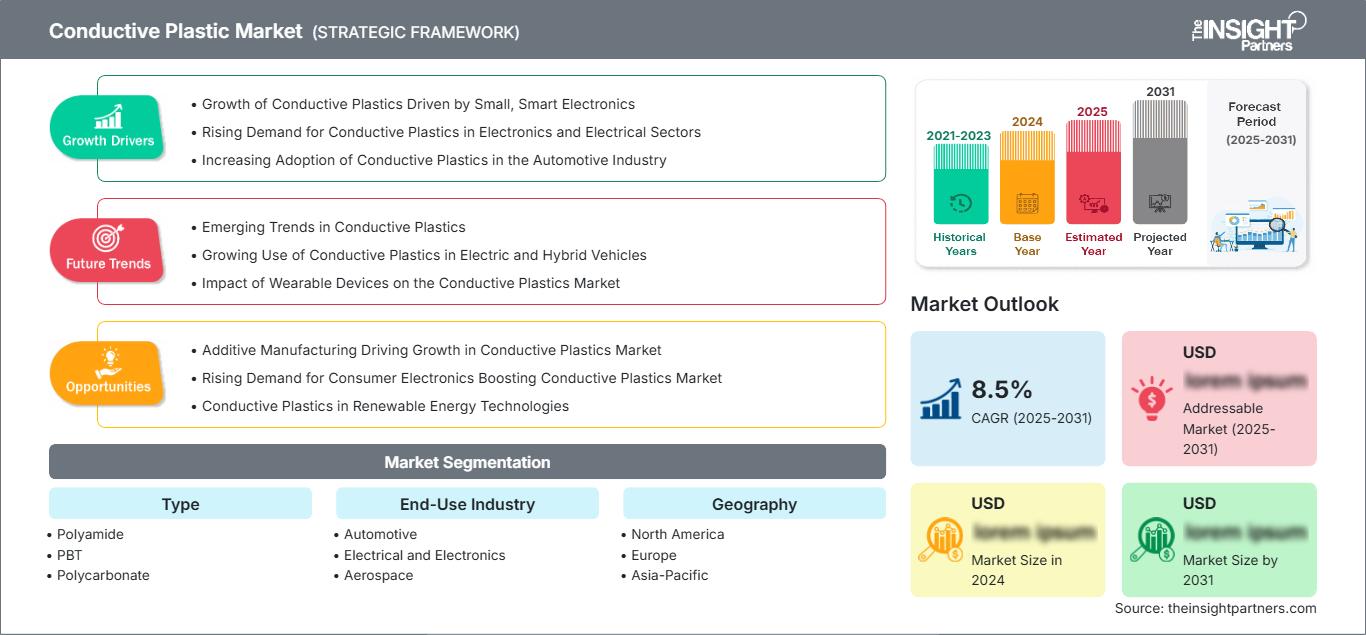
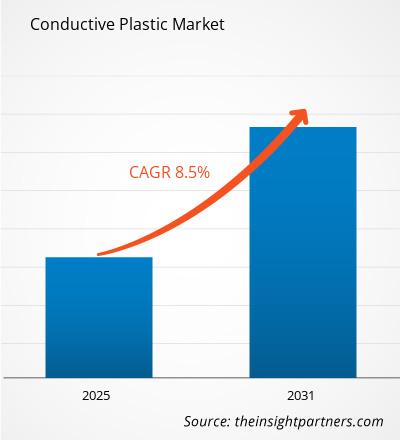
The Conductive Plastic Market is valued at US$ 7.86 Billion in 2025 and is projected to reach US$ 11.34 Billion by 2034, registering a CAGR of 4.16% during 2026–2034. The market encompasses engineered polymer systems designed to provide controlled electrical conductivity while retaining thermoplastic processing, mechanical performance, and lightweight characteristics. Demand is increasingly linked to electrification, electronic miniaturization, electromagnetic interference management, and replacement of selected metallic components.
North America remains an important technology and manufacturing base, supported by advanced automotive electronics, aerospace programs, semiconductor equipment, and medical-device production. The regional Conductive Plastic Market size is estimated to expand at a 3.8–4.6% CAGR between 2026 and 2034, as manufacturers seek lightweight materials for connectors, sensor housings, shielding components, and high-voltage systems. Localized engineering, established compounders, and stringent performance requirements support continued adoption.
Conductive Plastic Market Assessment and Insights
- North America: North America represented an estimated 24–28% share in 2025 and is expected to grow at a 3.8–4.6% CAGR between 2026–2034, supported by automotive electrification, aerospace electronics, medical devices, and advanced manufacturing.
- US: The US accounted for approximately 20–23% of the global market in 2025, with a 3.7–4.5% CAGR between 2026–2034, led by automotive electronics, aerospace, healthcare, and industrial applications.
- Europe: Europe held an estimated 22–26% share in 2025 and is projected to grow at a 4.0–4.8% CAGR between 2026–2034, with Germany, France, Italy, and the UK benefiting from automotive engineering and electronics manufacturing.
- Asia Pacific: Asia Pacific represented approximately 34–38% share in 2025 and is expected to register a 4.5–5.3% CAGR between 2026–2034, led by China, Japan, South Korea, and India across electronics and automotive manufacturing.
- Largest Segment: Polyamide represented an estimated 30–34% market share in 2025, with a 4.2–5.0% CAGR between 2026–2034, reflecting its mechanical strength, thermal resistance, and established automotive use.
- High Growth Segment: Electrical and Electronics accounted for approximately 29–33% share in 2025, expanding at a 4.8–5.6% CAGR between 2026–2034 as electronic density and EMI-management requirements increase.
- Key companies analyzed in detail: Celanese Corporation, DSM, SABIC, BASF SE, DuPont, LANXESS, Mitsubishi Engineering-Plastics Corporation, Ensinger, Toray Industries, Inc., and Kaneka Corporation.
Source: The Insight Partners' analysis based on proprietary research, government publications, company annual reports, investor presentations, industry databases, and expert interviews.
There has been movement from the use of fundamental antistatic formulations to engineered resins that incorporate dimensional stability, flame retardancy, impact performance, conductivity, and heat resistance. Resins based on polyamides, PBT, polycarbonate, and PPS are gaining more relevance in the formulation of connectors, housing, sensors, battery parts, and other electronic assemblies. Carbon-based filler materials and conductive additives ensure that compounders can tailor the conductivity of the resins without compromising their molding characteristics.
Future growth is projected to occur where there is convergence of electrification and electronics technology adoption. Platforms for electric vehicles, charging systems, aircraft electronics, medical devices, and semiconductors will require more conductive polymer components. The trend toward material safety and efficient designs in vehicle design will increase the need for lightweight engineering plastics in which performance will not be compromised. Asia Pacific will continue to dominate production of the materials while North America and Europe will maintain high demand for high-performance materials.
Conductive Plastic Market Report Scope
| Report Attribute | Details |
|---|---|
| Market size in 2025 | US$ 7.86 Billion |
| Market Size by 2034 | US$ 11.34 Billion |
| Global CAGR (2026 - 2034) | 4.16% |
| Historical Data | 2021-2024 |
| Forecast period | 2026-2034 |
Conductive Plastic Market Analysis
The Conductive Plastic Market growth is supported by increasing electronic content in vehicles, industrial equipment, and consumer systems. The conductive materials offer the manufacturers possibilities to incorporate electrical features in the molded parts by lightening the weight and lowering the assembly complications. The value chain involves polymer producers, conductive additives, compounders, molders, component manufacturers, and OEMs. Supply depends on engineering resins supply, additive prices, compounding capacity, and qualification cycles.
The controlled conductivity, EMI shielding, electrostatic dissipation, and dimensional stability have become key demands of automobile and electronics makers recently. The trend works well for those material providers who are able to customize the content and chemistry of the polymer for their specific application. Polyamides and PBT have the advantages because of the existing processing technology, while polycarbonate and PPS serve applications that need impact, transparency, high temperature, and chemical resistance.
Competition is shaped by material portfolios, formulation expertise, regional production, and technical support. BASF SE, Celanese Corporation, SABIC, DuPont, and LANXESS participate across engineering polymer systems, while Mitsubishi Engineering-Plastics Corporation, Ensinger, Toray Industries, Inc., Kaneka Corporation, and DSM strengthen specialized material offerings. The Conductive Plastic Market analysis therefore extends beyond resin sales to application engineering, customized compounding, certification, and long-term OEM relationships.
Strategic investments are moving away from conductivity to electrification and electronics. Grades are being offered on the basis of high-voltage parts, connections, sensing elements, battery systems, and shielding applications with reduced weight. Distinguishing features in these grades rely on conductivity after molding, surface resistance control, thermal management, and mechanical property retention. BASF offers engineering plastics for automotive electronics systems, while SABIC’s LNP STAT-KON range consists of conductive polycarbonate materials reinforced with carbon powder, carbon fibers, and nanotubes.
● REPORT CUSTOMIZATION
Tailor This Report To Align With Your Specific Business Requirements
This report can be customized to align precisely with your business objectives, scope, and target markets. Customization options include tailored segmentation, geography, competitive analysis, and strategic insights to support informed decision-making.
Customize This Report →WHAT YOU CAN ADJUST
- ● Segmentations
- ● Geography
- ● Competitive Analysis
- ● Language Preferences
Conductive Plastic Market: Strategic Insights
Regional Insights
North America Conductive Plastic Market
North America held an estimated 24–28% of the regional Conductive Plastic Market share in 2025, with regional growth projected at 3.8–4.6% CAGR through 2034. US dominance in the demand side in the region arises from the significant automotive, aerospace, electronics, healthcare and industrial manufacturing capabilities. Electrification is raising the demand for lightweight conductive housings, connectors, sensors and shielding applications. Medical devices and semiconductor manufacturing also contribute to the need for engineered materials with controlled electrical characteristics.
The presence of Canada and Mexico in the regional supply chain through automotive assembly, electronics manufacturing and industrial manufacturing plays a supporting role in the market. There is support from the regional ecosystem through the presence of resin suppliers, compounders and injection molders, as well as OEM qualifying networks. The demands are increasingly application-specific and have requirements based on conductivity, flame resistance, dimensional stability, chemical resistance and heat resistance. Aerospace and defense are other application areas that present possibilities for specialized materials.
U.S. Conductive Plastic Market
The US represented approximately 82–86% of North America's 2025 regional Conductive Plastic Market demand, while its market is projected to grow at a 3.7–4.5% CAGR during 2026–2034. Electrical vehicles, aerospace electronics, medical appliances, and industrial automation continue to be key applications of interest. Leading polymer companies have technical expertise along with commercial capabilities within the country to help develop application-specific materials at a fast pace.
Automotive uses involve connectors, sensors, electronic control units, battery elements, and electromagnetic shielding. DuPont focuses on developing materials for connectors, motors, switches, sensors, and electric control units, whereas BASF provides engineering polymers for automotive electrical/electronic applications. Medical and industrial buyers need materials that meet repeatability requirements in addition to regulatory compliance standards, and hence, compound quality is an important purchase consideration.
Europe Conductive Plastic Market
Europe accounted for an estimated 22–26% of the regional Conductive Plastic Market share in 2025, with growth expected at a 4.0–4.8% CAGR. Germany is the leading country because of its automotive manufacturing and engineering base. The UK, France, Italy, and Spain participate via automotive parts, aerospace, heavy industry, electronics, and healthcare. Sustainability issues and vehicle efficiency goals lead to an emphasis on lightweight polymers.
The UK sustains demand via aerospace, healthcare, and advanced manufacturing. Germany is supported by automotive electronics and industrial engineering. France integrates aerospace, automotive, and electrical manufacturing applications. Italy and Spain make contributions in the area of automotive components and heavy industry. In all countries, material choice is becoming increasingly influenced by conductivity, along with sustainability properties such as flammability, heat deflection, and lightweight design. This trend leads to the use of technically differentiating resins and not commodity plastics.
APAC Conductive Plastic Market
APAC represented approximately 34–38% share of the regional Conductive Plastic Market in 2025 and is projected to expand at a 4.5–5.3% CAGR. China is the leading market, followed by Japan, South Korea, India, and Australia. Electronics manufacturing, automotive production, semiconductor investment, and EV supply chains provide a broad demand base for engineered conductive materials.
The integrated ecosystem of electronics in China makes it well-positioned within its region, while the focus of Japan and South Korea on automobiles and electronics lies in the production of high-performance components. The rapid growth of India takes place through its electronics manufacturing and automobile localization. Industrial modernization and policies on EVs create a high demand for engineering plastics.
Middle East & Africa Conductive Plastic Market
The Middle East and Africa represent a smaller share of global regional Conductive Plastic Market consumption, with regional growth estimated at 3.2–4.0% CAGR. Saudi Arabia and the United Arab Emirates are the key Middle East markets due to reasons such as industrial diversification, investments in infrastructure, and manufacturing development. South Africa continues to be the key market in Africa, driven by automotive assembly and industrial uses.
The demand in the region depends on such products as electrical equipment, automotive parts, industrial machines, and infrastructure modernization. The energy-consuming industries require materials that operate in high-temperature conditions. Local initiatives in Saudi Arabia and the United Arab Emirates can potentially develop downstream polymer processing, but at this moment, engineering plastics and compounds continue to be important imports.
Segmentation Analysis
Type
Type segment of the regional Conductive Plastic Market is a central basis for material selection because resin chemistry determines mechanical performance, thermal stability, processability, chemical resistance, and compatibility with conductive additives. The segment is expected to grow at a 4.0–4.8% CAGR from 2026–2034. Polyamide remains prominent because of its automotive and electrical applications, while PBT, polycarbonate, and PPS address progressively demanding environments.
- Polyamide: Widely selected for automotive and electrical components because its strength, heat resistance, and dimensional performance can be combined with controlled conductivity through appropriate compounding.
- PBT: Demand is concentrated in connectors, electrical components, and automotive systems requiring dimensional stability, low moisture sensitivity, and reliable injection-molding performance.
- Polycarbonate: Its impact resistance and design flexibility support conductive applications involving electronic housings, automotive components, and specialized equipment requiring robust molded structures.
- PPS: High-temperature stability and chemical resistance make PPS strategically important for demanding automotive electrical systems and applications exposed to heat, aggressive fluids, or prolonged operating stress.
End-Use Industry
The end-use industry segment of the regional Conductive Plastic Market determines performance specifications and qualification requirements. The segment is projected to expand at a 4.4–5.2% CAGR during 2026–2034, supported by rising electronic content in vehicles and equipment. Electrical and Electronics represents the largest demand pool, while automotive applications increasingly require conductive materials for electrified platforms.
- Automotive: Electrification, sensor proliferation, electronic control systems, and lightweighting create requirements for conductive polymers in connectors, housings, shielding, and selected battery-related components.
- Electrical and Electronics: Miniaturized devices require materials that manage electrostatic discharge, electromagnetic interference, and electrical performance while retaining dimensional accuracy and processing efficiency.
- Aerospace: Aerospace manufacturers prioritize lightweight, durable, and precisely engineered materials, creating selective demand for conductive compounds in electronic housings and specialized components.
- Healthcare: Medical equipment manufacturers require controlled electrical properties, chemical resistance, dimensional stability, and consistent processing for selected diagnostic, monitoring, and equipment applications.
Opportunity Snapshot
| End-Use Industry | Revenue Contribution | Trend Tag | Adoption Stage |
| Automotive | High | EV Electronics | Scaling |
| Electrical and Electronics | High | EMI Shielding | Mature |
| Aerospace | Medium | Lightweight Systems | Scaling |
| Healthcare | Medium | Device Safety | Scaling |
Conductive Plastic Market Growth Drivers and Impact Analysis
Rising electronic content in vehicles
Vehicle architectures are becoming increasingly dependent on sensors, cameras, electronic control units, power electronics, connectors, and high-voltage systems. This increases the number of components requiring controlled electrical behavior alongside mechanical durability. Conductive plastics can combine these requirements within molded geometries that are difficult or costly to achieve using conventional metals. The impact is strongest in electric and connected vehicles, where weight reduction and electromagnetic compatibility influence material decisions. Suppliers that can demonstrate stable electrical performance after molding, environmental resistance, and long-term reliability are positioned to gain specification approvals. This driver also increases collaboration between resin suppliers, compounders, tier suppliers, and OEM engineering teams because conductivity targets must be matched with processing and application requirements.
Growth of electronics miniaturization and EMI management
Electronic systems are becoming smaller while operating at higher frequencies and carrying greater data volumes. These changes increase sensitivity to electromagnetic interference and electrostatic discharge, creating opportunities for polymer compounds that provide controlled conductivity or shielding while preserving complex molded designs. The market impact extends across consumer electronics, industrial controls, telecommunications equipment, and automotive electronics. Conductive compounds can simplify component architecture by integrating functional electrical properties into housings and structural parts. Demand consequently favors formulations with predictable surface resistance, low variability, dimensional stability, and compatibility with automated molding. Suppliers able to combine electrical performance with flame resistance and thermal stability can address applications where conventional commodity plastics are insufficient.
Expansion of lightweight engineering material substitution
Manufacturers across transportation and industrial equipment are evaluating polymer alternatives to metals where weight, corrosion, design flexibility, and production efficiency can improve total system economics. Conductive grades extend this substitution opportunity to applications where electrical functionality previously required metallic structures or additional conductive components. Automotive platforms provide a major pathway, particularly for connectors, electronic housings, sensors, and selected shielding applications. Aerospace and medical equipment provide smaller but technically valuable opportunities because performance requirements support premium material pricing. The resulting impact is a shift from material selection based solely on resin cost toward lifecycle performance, part consolidation, molding productivity, and functional integration. Compound suppliers, therefore, increasingly compete through application engineering rather than resin availability alone.
Conductive Plastic Market Future Trends
Multifunctional compounds for electrified platforms
The Conductive Plastic Market trends are moving toward multifunctional compounds that deliver conductivity alongside flame retardancy, thermal stability, impact resistance, chemical resistance, and dimensional control. Future formulations are likely to target specific EV and electronics architectures rather than broad conductivity classifications. This will encourage greater use of engineered filler networks, optimized additive dispersion, and application-specific resin selection. Compounders may increasingly develop grades that address high-voltage environments, thermal cycling, sensor integration, and electromagnetic compatibility simultaneously. Another emerging direction is the optimization of conductive performance at lower filler loading, helping preserve mechanical properties and processing efficiency. As qualification requirements become more demanding, material suppliers with simulation, testing, and application-development capabilities should gain greater influence over component design decisions and long-term platform specifications.
Localized high-performance material ecosystems
Regionalization is expected to become increasingly important as automotive and electronics manufacturers seek shorter supply chains, faster technical support, and greater resilience for specialized engineering materials. Producers may establish localized compounding, technical centers, or application-development capabilities near major manufacturing clusters. This trend should be particularly visible in India, Southeast Asia, Mexico, and selected Central and Eastern European markets. Localized supply can reduce lead times and facilitate quicker formulation adjustments during product development. At the same time, global customers will continue demanding consistent material specifications across manufacturing sites. Suppliers therefore face a dual requirement: local responsiveness combined with global quality control. Companies that establish regional technical capabilities while maintaining standardized qualification procedures can strengthen customer retention and expand into new platforms.
Conductive Plastic Market Opportunities
High-voltage EV component development
The Conductive Plastic Market Forecasts indicate attractive opportunities in high-voltage EV components where manufacturers need lightweight materials capable of meeting electrical, thermal, and mechanical requirements simultaneously. Suppliers can target terminal systems, connector housings, sensor components, power-electronics enclosures, and selected battery-system applications. The opportunity is strongest for grades that reduce part weight while maintaining flame resistance, dimensional stability, and controlled electrical behavior. Strategic investment should focus on application-specific testing, including thermal cycling, moisture exposure, electrical tracking, and electromagnetic compatibility. Partnerships with automotive tier suppliers can accelerate qualification because material performance must be validated within complete component architectures. Companies that establish early design-in positions may secure longer product lifecycles and recurring demand as vehicle platforms transition toward higher voltage electrical systems.
Regional compounding and technical service expansion
The opportunity lies in setting up compounding and application-support facilities near the fast-developing clusters for the automotive and electronic industries. In India, Southeast Asia, Mexico, and specific manufacturing sites in Europe, there are possibilities where local manufacturing would help reduce chain length and customer proximity. This is also an opportunity not just from the facility point of view but from the customer point of view as well, since today's customers are asking more for assistance in formulating and mold flow, electrical testing, and problem solving in their component development process. Any strategic move should involve both production and labs and engineering capability that will be able to support the qualification programs.
Recent Developments
- August 2026: Principal Mineral, a leader in rebuilding the industrial "missing midstream" of the global strategic materials supply chain, announced the acquisition of Conductive Group, an advanced materials manufacturer specializing in electrically conductive composite technologies and electromagnetic interference (EMI) shielding solutions. The acquisition expands Principal Mineral's portfolio across the advanced materials stack that underpins America's electronics industrial base, from electrodeposited copper foil and copper-clad laminates to the structural composites and shielding systems that protect mission-critical platforms.
- June 2026: Coperion K-Tron — Coperion supported Premix in establishing a new automated compounding plant in Dallas, Texas, for conductive polyolefin compounds used in pipettes and other demanding applications. The facility incorporates two Coperion ZSK twin-screw extruders, automated feeding, blending, conveying, and material-handling systems, with real-time process monitoring designed to improve production consistency, traceability, and quality for healthcare and electronics applications.
Frequently Asked Questions

- Comprehensive Market Sizing and Forecast Analysis
- Detailed Segmentation Analysis
- In-Depth Market Dynamics Assessment
- Regional and Country-Level Insights
- Competitive Landscape and Company Benchmarking
- Strategic Business Intelligence
Recent Reports
Testimonials

The Insight Partners' SCADA System Market report is comprehensive, with valuable insights on current trends and future forecasts. The team was highly professional, responsive, and supportive throughout. We are very satisfied and highly recommend their services.
RAN KEDEM Partner, Reali Technologies LTDs
I requested a report on a very specific software market and the team produced the report in a few days. The information was very relevant and well presented. I then requested some changes and additions to the report. The team was again very responsive and I got the final report in less than a week.
JEAN-HERVE JENN Chairman, Future Analytica
We worked with The Insight Partners for an important market study and forecast. They gave us clear insights into opportunities and risks, which helped shape our plans. Their research was easy to use and based on solid data. It helped us make smart, confident decisions. We highly recommend them.
PIYUSH NAGPAL Sr. Vice President, High Beam Global
The Insight Partners delivered insightful, well-structured market research with strong domain expertise. Their team was professional and responsive throughout. The user-friendly website made accessing industry reports seamless. We highly recommend them for reliable, high-quality research services
YUKIHIKO ADACHI CEO, Deep Blue, LLC.
This is the first time I have purchased a market report from The Insight Partners.While I was unsure at first, I visited their web site and felt more comfortable to take the risk and purchase a market report.I am completely satisfied with the quality of the report and customer service. I had several questions and comments with the initial report, but after a couple of dialogs over email with their analyst I believe I have a report that I can use as input to our strategic planning process.Thank you so much for taking the extra time and making this a positive experience.I will definitely recommend your service to others and you will be my first call when we need further market data.
JOHN SUZUKI President and Chief Executive Officer, Board Director, BK Technologies
I wish to appreciate your support and the professionalism you displayed in the course of attending to my request for information regarding to infectious disease IVD market in Nigeria. I appreciate your patience, your guidance, and the fact that you were willing to offer a discount, which eventually made it possible for us to close a deal. I look forward to engaging The Insight Partners in the future, all thanks to the impression you have created in me as a result of this first encounter.
DR CHIJIOKE ONYIA MANAGING DIRECTOR, PineCrest Healthcare Ltd.Reason to Buy
- Informed Decision-Making
- Understanding Market Dynamics
- Competitive Analysis
- Identifying Emerging Markets
- Customer Insights
- Market Forecasts
- Risk Mitigation
- Boosting Operational Efficiency
- Strategic Planning
- Investment Justification
- Tracking Industry Innovations
- Aligning with Regulatory Trends





 Get Free Sample for